Introduction
While conventional weekend breaks often direct urbanites toward packed coastal promenades or noisy resort strips, the hinterlands surrounding Kolkata shelter an entirely different world. Just beyond the urban perimeter, the roads untangle into centuries-old territories where terracotta facades, colonial riverfront enclaves, and royal Islamic ruins narrate forgotten chapters of Bengal. Traveling here is not about checking off generic tourist bucket lists; it is about immersing yourself in the raw authenticity of hand-chiseled brick friezes, cobblestone alleys, and slow-moving river bends.
For the mindful traveler craving cultural depth over manufactured attractions, these historical circuits offer an evocative encounter with Bengal’s multifaceted legacy.
Why Kolkata is a must-visit city
Kolkata acts as the supreme cultural gateway to Eastern India, carrying immense geographical, literary, and political weight. Set along the Hooghly River, it is not merely an imperial relic of the British Raj, but the strategic launchpad to ancient trade outposts, Malla dynasty fortresses, and princely courts. The region’s connectivity is world-class: high-frequency suburban and express rail corridors stem from Howrah and Sealdah, smooth national expressways (NH 19, NH 12) branch westward and northward, and seasoned regional hospitality welcomes everyone from budget backpackers to discerning luxury travelers.
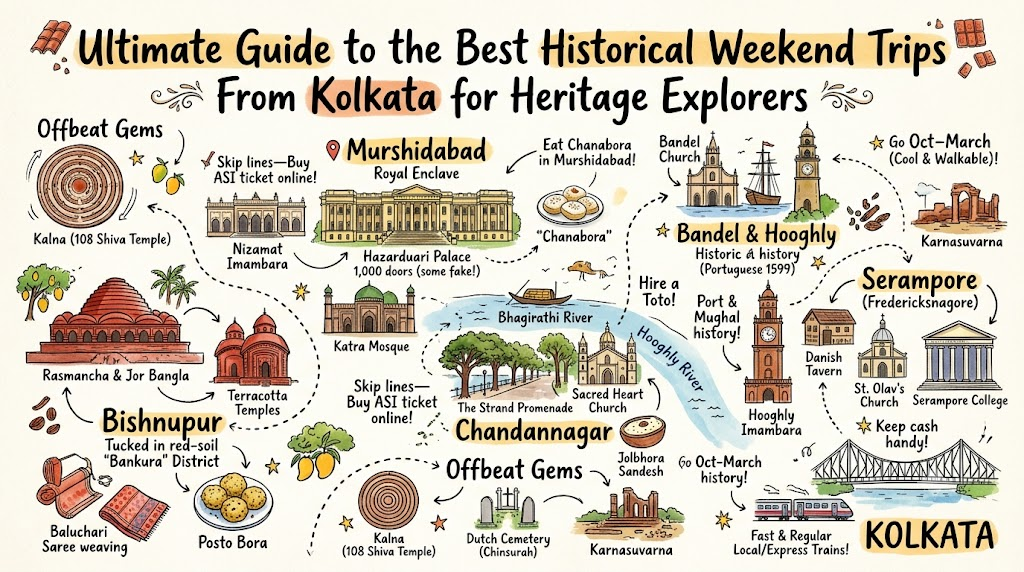
The historical circuit fans outward in distinct radial arcs. Moving north along the river takes you through the multi-colonial riverfront of Hooghly, while heading west into Bankura unveils crimson clay artistry, and venturing north-northwest into Murshidabad leads straight to the grand seat of the erstwhile Nawabs.
| Travel Circuit Metric | Essential Details |
| Hub City | Kolkata, West Bengal |
| Circuit Coverage | Hooghly, Bankura, Murshidabad, and Nadia |
| Peak Season | October to March (Crisp, dry, and walkable) |
| Key Transport Terminals | Howrah Junction, Sealdah Station, Shalimar |
| Trip Duration Format | 2 Days / 1 Night or 3 Days / 2 Nights |
| Primary Heritage Themes | Terracotta Craft, European River Enclaves, Nawabi Palaces |
Best Places or Experiences
Bishnupur Terracotta Temple Circuit
Tucked away in the red-soil terrain of Bankura, Bishnupur flourished under the devout Malla kings who turned fired clay into divine poetry between the 16th and 18th centuries. Deprived of local stone, royal architects engineered a distinct Bengali architectural idiom characterized by curving chala roofs, ornate barrel vaults, and intricate burnt-clay reliefs depicting epic scenes from the Mahabharata and Ramayana. Monuments like the massive, stepped Rasmancha, the intricately sculpted Shyamrai, and the pyramidal Jor Bangla temple represent an extraordinary confluence of indigenous Bengal folk design and imperial Islamic arch engineering.
Walking through this quiet settlement feels like traversing an open-air sculpture museum sheltered by ancient water tanks known locally as bandhs. The earthy crimson hues of the baked bricks change dramatically with the shifting sun, casting deep, expressive shadows across detailed terracotta friezes that have withstood monsoons and wars for hundreds of years.
- Location: Bankura District, approximately 140 km northwest of Kolkata.
- Why it is worth visiting: The highest concentration of preserved terracotta temples and classical Malla dynasty structural engineering in India.
- Best things to do: Study the detailed clay panels at Shyamrai Temple, visit the historic Dalmadal Cannon, and listen to authentic Bishnupur Gharana classical vocals in local artist quarters.
- Best time to visit: November through February; early morning (7:00 AM – 9:30 AM) offers pristine angled sunlight for photography.
- Ideal for whom: History buffs, architectural scholars, textile lovers, and cultural explorers.
- Travel tip: Purchase a combined single Archaeological Survey of India (ASI) ticket online at the start of your day to skip repeated ticketing queues at individual temple gates.
Hazarduari Palace and Murshidabad Royal Enclave
Murshidabad stands as the poignant, dramatic final capital of sovereign Bengal, where the fateful shift toward British East India Company rule unfolded. Dominating the eastern bank of the Bhagirathi River is the Hazarduari Palace—a monumental Greek-Doric edifice designed by Duncan MacLeod in the 1830s. Bearing 1,000 doors (900 of which are deliberately deceptive architectural illusions engineered to baffle assassins), the palace houses an extraordinary museum displaying imperial royal armory, Venetian crystal chandeliers, ivory palanquins, and historic peace treaties.
Directly facing the palace across an open esplanade sits the Nizamat Imambara, the largest Shia prayer complex in Bengal, while nearby ruins like the Katra Mosque and the crumbling tomb of Siraj-ud-Daulah at Khushbagh echo with tales of betrayal and courtly intrigue. Standing along the riverbank at sunset reveals an evocative panorama where the ghosts of Nawabi grandeur linger over tranquil waters.
- Location: Murshidabad District, approximately 220 km north of Kolkata.
- Why it is worth visiting: The epicentre of late-Mughal Bengal sovereignty, tragic colonial geopolitics, and classical European neoclassical architecture.
- Best things to do: Tour the royal weapon armory inside Hazarduari, take a country boat across the river to the tranquil tombs of Khushbagh, and admire the massive multi-domed ruin of Katra Mosque.
- Best time to visit: December to February; late afternoon for river views around the palace grounds.
- Ideal for whom: Heritage researchers, vintage artifact collectors, and multi-generational families.
- Travel tip: Mobile phones, backpacks, and professional cameras are strictly prohibited inside the main palace museum; deposit them at the secure cloakroom by the outer gate before entering.
Chandannagar French Promenade and Heritage Hub
Once known as Chandernagore, this serene town along the Hooghly River was administered by the French East India Company until 1950, developing an urban identity distinctly separate from neighboring British territories. The centerpiece of the town is the Chandannagar Strand—a paved river promenade shaded by century-old mahogany trees, dotted with ornamental wrought-iron railings, and framed by colonial administrative quarters.
Prominent historic gems include the Sacred Heart Church with its stunning French-Gothic stained glass and soaring twin bell towers, along with the Institut de Chandernagore, which houses French colonial artifacts, military relics, and Joseph François Dupleix’s personal memorabilia. The town moves to an unhurried cadence, retaining a distinct European riverbank elegance found nowhere else in Bengal.
- Location: Hooghly District, approximately 45 km north of Kolkata.
- Why it is worth visiting: India’s finest remaining French colonial riverfront, featuring remarkably preserved riverside architecture and a tranquil atmosphere.
- Best things to do: Stroll along the Strand promenade at twilight, explore the stained-glass arches of Sacred Heart Church, and sample legendary local sweets like Jolbhora Sandesh.
- Best time to visit: Late afternoon (3:30 PM – 7:30 PM) when the river breeze picks up and heritage streetlights illuminate the promenade.
- Ideal for whom: Couples, slow travelers, photographers, and literature lovers.
- Travel tip: Motorized four-wheelers are restricted along the primary Strand walkway during evening hours; hire an electric rickshaw (toto) for seamless travel between heritage sites.
Bandel and Hooghly Multi-Colonial Waterfront
The Bandel-Hooghly enclave represents the oldest European footprint in Bengal, starting with Portuguese maritime settlers in the late 16th century. The Basilica of the Holy Rosary, widely known as Bandel Church, was originally founded in 1599 by Augustinian friars and rebuilt after being razed by Mughal armies. The complex stands as a living sanctuary of faith, complete with a historic ship’s mast erected as a thanksgiving offering by a storm-tossed Portuguese captain.
Just down the road sits the majestic Hooghly Imambara, designed by Khan Bahadur Haji Muhammad Mohsin and completed in 1861. This grand Shia complex features a colossal central clock tower, twin 85-foot minarets offering sweeping river panoramas, and a vast sunlit courtyard centered on an ornamental stone water fountain. The peaceful juxtaposition of Portuguese Christian foundations and grand Islamic structural design illustrates the river’s cosmopolitan past.
- Location: Hooghly District, approximately 50 km north of Kolkata.
- Why it is worth visiting: A rare historical crossroads where 16th-century Portuguese maritime history stands beside one of Bengal’s most magnificent 19th-century Islamic architectural gems.
- Best things to do: Climb the winding spiral staircase of the Hooghly Imambara clock tower for river views, observe the mechanical clockwork mechanisms, and visit the historic mast relic inside Bandel Church.
- Best time to visit: October to February; visit before noon to catch the clock tower ascent before afternoon prayer closures.
- Ideal for whom: History lovers, structural enthusiasts, and families.
- Travel tip: Climbing the Imambara minarets involves narrow, winding stone stairs without intermediate lighting; use your phone’s flashlight and wear non-slip footwear.
Serampore Danish Trading Enclave
Once known as Frederiksnagore, Serampore served as a Danish Crown colony from 1755 to 1845 and played an outsized role in the intellectual awakening of modern Bengal. This river settlement became a renowned sanctuary for free press and education when pioneering English missionaries William Carey, Joshua Marshman, and William Ward established the historic Serampore College and the Serampore Mission Press, which cast the first movable Bengali typefaces.
Meticulous heritage restoration projects in recent years have revitalized the town’s key landmarks, including the Danish Tavern on the riverbank, St. Olav’s Church with its classic Royal Danish monogram, and the Government House compound. Resting along the riverfront while sampling freshly prepared heritage meals allows travelers to connect with a uniquely Scandinavian chapter of Bengal’s trade history.
- Location: Hooghly District, approximately 30 km north of Kolkata.
- Why it is worth visiting: The only preserved Danish heritage river circuit in Eastern India, featuring award-winning historical conservation projects.
- Best things to do: Inspect the classical ionic columns of Serampore College, walk through St. Olav’s Church courtyard, and dine at the restored Danish Tavern facing the river.
- Best time to visit: Year-round; mid-mornings for academic and architectural tours, followed by lunch along the waterfront.
- Ideal for whom: Literary historians, scholars, design purists, and heritage diners.
- Travel tip: Pair a morning walking tour of Serampore with an afternoon crossing by local ferry to Barrackpore on the opposite bank to explore early British cantonment monuments.
Offbeat Exploration: Hidden Gems Tourists Miss
Ambika Kalna’s Nava Kailash 108 Shiva Temple Complex
Located in the historic town of Kalna, this architectural marvel consists of two concentric stone circles containing exactly 108 shrines dedicated to Lord Shiva. Built in 1809 by the Maharaja of Bardhaman, the outer ring features 74 temples alternating black and white Shiva lingams, while the inner ring contains 34 temples. Walking through these concentric geometric pathways creates a mesmerizing visual rhythm found nowhere else in the country.
The Octagonal Dutch Cemetery of Chinsurah
While casual tourists rush past Chinsurah, hidden behind a quiet residential lane lies an authentic 17th-century Dutch East India Company burial ground. The cemetery features massive pyramidal and octagonal mausoleums, weathered heraldic crests, and old burial slabs marking the resting places of Dutch governors and maritime merchants who once traded along the river.
Korno Suborno (Karnasuvarna) Ruins
Just outside Berhampore lies the archaeological site of Rajbaridanga, the ancient capital of King Shashanka’s 7th-century Gauda Kingdom. Mentioned by Chinese traveler Xuanzang in his classical travelogues, this tranquil mound reveals exposed brick foundations of ancient Buddhist monastic seals, stupas, and royal courts tucked deep within lush rural farmland.
Detailed Practical Guidance for Travelers
| Destination | Standard Entry Fee | General Timings | Best Local Food Options Nearby | Recommended Nearby Attractions |
| Bishnupur | ₹25 (ASI combined ticket) | 6:00 AM – 6:00 PM | Posto Bora, Mecha sweets, Bengali thali | Pancha Ratna, Madan Mohan Temple, Dalmadal Cannon |
| Murshidabad | ₹50 (Hazarduari Museum) | 9:00 AM – 5:00 PM (Closed Fridays) | Murshidabadi Biryani, Chanabora, Sheer Khurma | Nizamat Imambara, Katra Mosque, Khushbagh |
| Chandannagar | Free (Church & Strand) | Strand open 24/7; Church 8:00 AM – 5:30 PM | Jolbhora Sandesh, French toast at Strand cafes | Institut de Chandernagore, Sacred Heart Church |
| Bandel & Hooghly | Free (Bandel Church); ₹20 (Imambara) | 6:00 AM – 6:00 PM | Bandel Cheese snacks, Kachori-Sabzi, Mughlai parathas | Hangseshwari Temple (Bansberia), Dutch Cemetery |
| Serampore | Free | 9:00 AM – 5:00 PM | Anglo-Indian dishes at Danish Tavern, Mishti Doi | St. Olav’s Church, Serampore College, Goswami Rajbari |
Logistics & On-Ground Navigation
Local Transport Options
- Suburban Railway: Fast and remarkably economical, regular local EMU trains depart Howrah and Sealdah every 15–20 minutes toward Bandel, Chandannagar, and Serampore. Express trains (such as the Hazarduari Express) connect Kolkata directly to Murshidabad in roughly 4 hours.
- Electric Rickshaws (Totos): The primary lifeline across heritage towns; they can be hired on a shared basis or reserved for entire days at negotiable rates for easy monument hopping.
- Country River Ferries: Crossing the Hooghly via local wooden passenger ferries costs merely ₹5–₹10, offering picturesque views and a shortcut between opposite bank circuits.
- Car Rentals: Self-drive or chauffeured rentals are ideal for the western circuit toward Bishnupur via the Durgapur Expressway (NH 19), avoiding local train transfers with luggage.
Budget Planning
- Budget/Backpacker Tier (₹1,500 – ₹2,500 per day): Travel via suburban rail and express trains, lodge in clean heritage dharamsalas or budget guest houses, use shared totos, and eat authentic homestyle Bengali thalis at local pise hotels.
- Mid-Range/Comfort Tier (₹5,500 – ₹9,500 per day): Hire an air-conditioned sedan from Kolkata, stay in government tourist lodges or boutique riverfront hotels, hire specialized local guides, and enjoy curated meals at heritage venues.
Safety and Inclusivity Tips
- For Families: Ensure pre-booked lodging when traveling with seniors or young children, as historic core towns have limited luxury hotels; carry essential medications since pharmacies close early in rural areas.
- For Couples: Riverside promenades like Chandannagar Strand are exceptionally safe and welcoming; maintain respectful conduct near religious shrines and orthodox temple courtyards.
- General Safety: Violent crime across these historic circuits is exceptionally rare; maintain standard caution against opportunistic overcharging by rickshaw operators and watch your step on ancient, unpaved brick ruins.
Strategic Travel Planning Guardrails
Travel Planning Tips for Historical Circuits
- Book weekend lodging well in advance if visiting between November and January, as local state-run tourist lodges fill quickly during peak winter.
- Carry ample paper cash in small denominations; rural vendors and toto drivers frequently face digital network dead zones.
- Respect active worship rules: remove footwear before stepping onto temple plinths, and dress modestly covering shoulders and knees when visiting mosques and basilicas.
- Download offline navigation maps before heading into rural interior roads where mobile signal coverage can be spotty.
- Engage registered local guides at major monuments like Hazarduari and Bishnupur to gain valuable context on architectural details that lack formal signage.
Common Mistakes to Avoid
- Overpacking schedules by attempting to visit Murshidabad and Bishnupur on the same weekend without considering transit distances.
- Assuming monuments remain open daily; Hazarduari Museum remains strictly closed on Fridays, while several temple complexes close during midday hours.
- Relying exclusively on mobile wallets or credit cards for rural fuel stations and highway eateries.
- Skipping local sweet traditions; each heritage town possesses distinct, century-old culinary specialties like Chanabora in Murshidabad or Jolbhora in Chandannagar.
- Overpaying auto drivers by failing to verify official shared route prices before boarding.
Suggested Itinerary Blueprints
1. Day Quick Dash (Little Europe Along the River)
- Target Audience: Day-trippers, photography enthusiasts, and weekend explorers wanting an easy single-day escape from Kolkata.
- Morning: Board an early local train from Howrah to Serampore. Tour St. Olav’s Church and the historic Serampore College before stopping for brunch at the Danish Tavern.
- Afternoon: Take a toto or train north to Chandannagar. Walk through the Institut de Chandernagore and explore Sacred Heart Church.
- Evening: Conclude with an evening tea walk along the Chandannagar Strand, sample fresh Jolbhora Sandesh, and return to Kolkata via evening suburban rail.
2. Day Deep-Dive (Royal Murshidabad Heritage Weekend)
- Target Audience: Heritage seekers and families interested in regal court history and architectural grandeur.
- Day 1: Depart Kolkata on the morning Hazarduari Express arriving in Murshidabad by mid-day. Check in, enjoy an authentic local lunch, and spend the afternoon exploring the Hazarduari Palace Museum and Nizamat Imambara. Take a sunset country boat ride on the Bhagirathi River.
- Day 2: Start early with a toto tour visiting Katra Mosque, Jahan Kosha Cannon, and the historic house of Jagat Seth. Cross the river to explore the peaceful shaded grounds of Khushbagh before catching the late-afternoon return train to Kolkata.
3. Complete Weekend Travel Plan (Malla Terracotta and Weaving Loop)
- Target Audience: Slow travelers, art purists, craft collectors, and photographers.
- Friday Evening: Drive or take the Rupashi Bangla Express from Kolkata to Bishnupur. Check into your lodge and enjoy a traditional dinner featuring authentic Posto Bora.
- Saturday: Spend the entire morning exploring core ASI terracotta sites: Rasmancha, Jor Bangla, and Shyamrai Temple. Spend the afternoon in the weavers’ colonies of Shankharipara observing Baluchari silk weaving on traditional looms.
- Sunday: Drive north to Ambika Kalna to explore the magnificent 108 Shiva Temple complex and the terracotta carvings of Pratapeswar Temple. Enjoy a traditional lunch and head back to Kolkata by Sunday evening via the Durgapur Expressway.
Common Tourist Mistakes to Avoid
Geographic Blunders
Attempting to connect Bishnupur in Bankura with Murshidabad in a single short weekend leads to spending most of your trip sitting in traffic. These two destinations sit on entirely different highway and railway corridors radiating out of Kolkata. Dedicate a separate weekend to each unique geographical zone.
Commercial Traps
Spending time in modern highway malls or generic restaurants strips your trip of its soul. Bypass modern roadside plazas in favor of authentic highway dhabas, local heritage dining rooms, and small town sweet makers who have perfected their craft across generations.
Neglecting Modern/Alternative Zones
Many visitors focus entirely on central monuments while completely ignoring nearby living craft villages. In Bishnupur, skipping the weavers’ lanes where authentic Baluchari and Swarnachari sarees are hand-woven deprives you of experiencing the living culture of the region.
Transport Overpayment
Accepting flat rates from unverified transport brokers outside major train stations frequently results in paying two to three times the actual rate. Always take a moment to cross-reference prices with official station counters, check state transport schedules, or ask locals about standard toto fares.
Luxury Dining Bias
Confining your meals to air-conditioned hotel dining rooms means missing the incredible regional food heritage of Bengal. Street-side kachori stalls, fresh local fish curry served in small town eateries, and roadside clay-cup tea represent the true culinary heartbeat of these historic towns.
Frequently Asked Questions
1. Which historical destination near Kolkata is easiest to visit without a personal car?
The multi-colonial riverfront towns of Hooghly—including Serampore, Chandannagar, and Bandel—are the most accessible. High-frequency suburban local trains run from Howrah Station every 15 to 20 minutes throughout the day, reaching these destinations within an hour. Once you arrive at the local stations, inexpensive electric rickshaws (totos) are readily available to take you directly between all primary heritage sites.
2. Are professional camera equipment and photography permitted inside Hazarduari Palace?
Professional cameras, camcorders, mobile phones, and large bags are strictly prohibited inside the main Hazarduari Palace Museum to safeguard delicate royal artifacts and ensure security. Visitors must store their electronic devices in the designated cloakrooms located near the entrance gate before entering the premises. However, outdoor photography of the exterior architecture, facade, and surrounding gardens is permitted.
3. What is the historic significance behind the Baluchari sarees of Bishnupur?
Baluchari sarees are world-renowned handloom textiles celebrated for their elaborate silk pallus that depict scenes from Indian epics like the Ramayana and Mahabharata. Originating in Murshidabad and later nurtured under the Malla kings in Bishnupur, these intricate designs are woven using refined silk threads. They serve as wearable works of art that reflect the identical mythological scenes found on local terracotta temple panels.
4. Can all the major European riverfront colonies be seen in a single weekend?
Yes, you can easily combine Serampore (Danish), Barrackpore (British), Chandannagar (French), Chinsurah (Dutch), and Bandel (Portuguese) into a comfortable two-day loop. Because these settlements sit consecutively along both banks of the Hooghly River, travelers can easily hop between them using brief suburban train rides, electric rickshaws, and short scenic ferry crossings that link the opposing riverbanks.
5. What is the best month to plan a historical road trip from Kolkata?
The ideal window runs from November through February when Bengal experiences dry, cool, and pleasant winter weather. Daytime temperatures consistently hover between 18°C and 25°C, making extensive outdoor walking, monument photography, and open-air riverfront exploration comfortable. In contrast, the summer months bring intense heat and high humidity that can make midday sightseeing exhausting.
6. Do I need special permits to visit ancient monuments maintained by the ASI?
No special advance permits are required for Indian or foreign tourists visiting standard Archaeological Survey of India (ASI) sites like Bishnupur’s temples or Hazarduari Palace. However, you will need to purchase an entry ticket at the site or online via the official ASI portal. Buying tickets online via mobile QR codes at monument entrances is convenient and helps you bypass lines.
7. How authentic is the local sweet Jolbhora Sandesh found in Chandannagar?
Jolbhora Sandesh was invented in Chandannagar during the early 19th century by master confectioner Surya Kumar Modak at the request of local nobility. This delicacy features an outer casing of soft, premium chhena (cottage cheese) encasing a core of liquid date-palm jaggery (nolen gur) or rose syrup. Visiting original heritage sweetshops along Chandannagar’s main bazaars lets you taste this regional classic prepared with traditional techniques.
8. Is it safe for solo female travelers to take night trains to Murshidabad?
Express trains connecting Kolkata to Murshidabad, such as the Hazarduari Express and Bhagirathi Express, are well-traveled and generally safe for solo female explorers. To ensure a comfortable and secure journey, reserve seats in advance in the air-conditioned chair car or sleeper classes. As with any journey, plan to reach your hotel before late evening and arrange station pickups in advance.
9. What unique architectural features define Bengal’s terracotta temples?
Bengal’s terracotta architecture is distinguished by curved cornices inspired by traditional rural bamboo-thatched huts (chala style), vaulted ceilings, and decorative brick facades. Faced with a shortage of stone in the alluvial delta, artisans used readily available river clay, baking it into durable tiles adorned with bas-relief carvings. These panels depict divine stories, royal court processions, floral motifs, and snapshots of daily medieval life.
10. What makes the 108 Shiva Temple complex in Kalna unique in India?
The Nava Kailash complex in Kalna stands out for its geometric design, arranged in two concentric circles representing heaven and earth. The outer circle contains 74 temples with alternating black and white Shiva lingams, while the inner circle houses 34 shrines with white stone lingams. This symmetrical layout creates an exceptional visual and spiritual perspective found nowhere else in Indian sacred architecture.
11. Are credit cards and UPI payments widely accepted in rural historic towns?
While mid-range hotels, fuel stations, and established restaurants readily accept UPI digital payments and major credit cards, network connectivity in rural pockets can be unreliable. Smaller handicraft artisans, toto rickshaw drivers, roadside tea stalls, and village eateries rely almost exclusively on paper cash. Always carry sufficient cash in small denominations (₹10, ₹20, ₹50, and ₹100) to ensure smooth transactions.
12. What traditional food should one not miss when taking a trip to Murshidabad?
When visiting Murshidabad, you must try the authentic Murshidabadi Biryani, which is distinct from its Kolkata counterpart due to its subtle spicing, saffron aromatics, and tender meat. For dessert, look for Chanabora—a fried cottage-cheese sweet soaked in cardamom syrup that features a crisp, dark exterior and a soft, melt-in-the-mouth center, famously created for the Nawabs of Bengal.
Conclusion
Stepping away from the hurried tempo of modern city life to walk along Bengal’s historic riverways and red-soil roads offers more than a simple weekend getaway; it is a grounding journey into the living soul of Eastern India. Standing beneath the terracotta arches of Bishnupur, walking along the breeze-swept French quays of Chandannagar, or gazing up at the grand facade of Hazarduari Palace connects you with centuries of human artistry and perseverance. Choosing these storied landscapes over manufactured tourist circuits leaves you with lasting memories, a deep appreciation for regional crafts, and a genuine connection to history.