Introduction
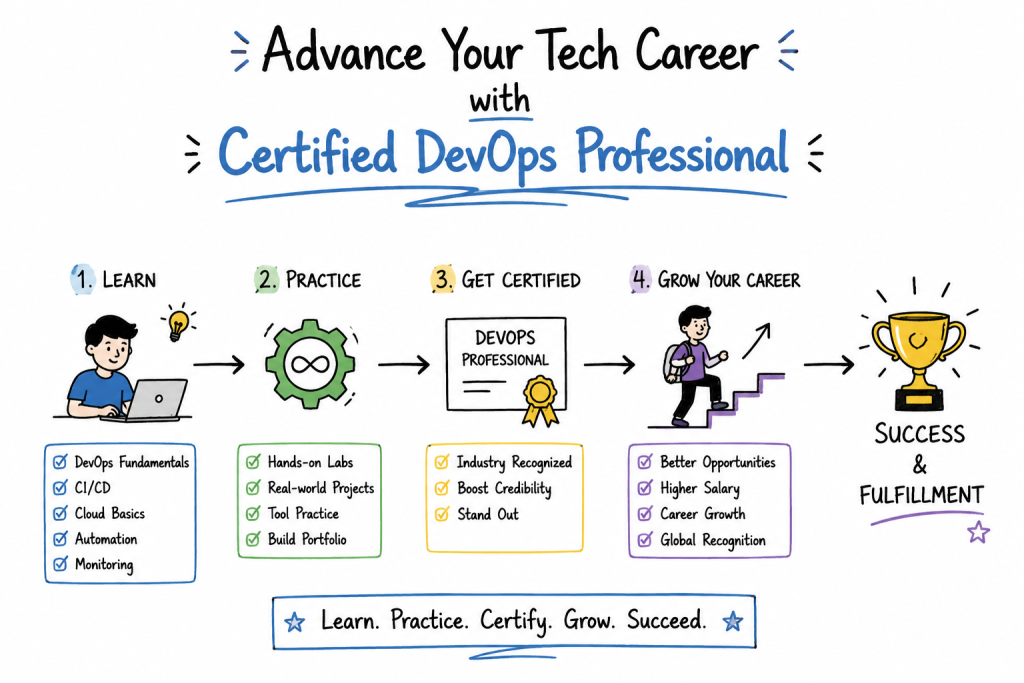
Certified DevOps Professional (CDP) is designed for engineers who want to move beyond basic tooling and truly understand how modern software delivery works in production. This guide is for working professionals—developers, SREs, cloud engineers, and tech leads—who want practical clarity before investing time and effort into certification. In today’s cloud-native world, DevOps is no longer optional. Organizations expect engineers to understand automation, CI/CD, observability, and reliability as core skills. Certified DevOps Professional (CDP) helps bridge the gap between theoretical knowledge and real-world implementation. This guide breaks down what the certification offers, who should pursue it, and how it impacts your career. The goal is simple: help you make a clear, informed decision aligned with your role and long-term growth.
What is the Certified DevOps Professional (CDP)?
Certified DevOps Professional (CDP) is a practitioner-level certification focused on real-world DevOps implementation. It validates your ability to design, build, and operate scalable, automated systems using modern tools and practices. Unlike theory-heavy programs, this certification emphasizes production-grade workflows—CI/CD pipelines, infrastructure automation, monitoring, and incident handling. It reflects how teams actually work in high-performing engineering environments. The certification exists to standardize practical DevOps knowledge across roles. It aligns closely with enterprise needs, where speed, reliability, and automation directly impact business outcomes. In essence, Certified DevOps Professional (CDP) is about doing DevOps—not just understanding it.
Who Should Pursue Certified DevOps Professional (CDP)?
This certification is ideal for software engineers transitioning into DevOps roles. If you already write code but want to understand deployment pipelines, infrastructure, and system reliability, this fits well.
SREs and platform engineers benefit by strengthening their automation and CI/CD practices. It helps formalize knowledge that is often learned informally on the job.
Cloud engineers looking to integrate DevOps workflows into AWS, Azure, or GCP environments will find it highly relevant. It connects cloud services with delivery pipelines and operational practices.
Engineering managers and team leads can also benefit. It helps them understand how to structure teams, tools, and workflows for efficient delivery, especially in fast-scaling organizations.
Why Certified DevOps Professional (CDP)
DevOps is no longer a niche skill—it is a baseline expectation. Companies are hiring engineers who can manage the full lifecycle, from code to production.
Certified DevOps Professional (CDP) remains valuable because it focuses on principles, not just tools. Tools change frequently, but concepts like automation, feedback loops, and observability remain constant.
The certification improves your ability to work across teams—development, operations, and security. This cross-functional capability is highly valued in modern engineering organizations.
From a career perspective, it offers strong ROI. It can accelerate your transition into higher-paying roles such as DevOps Engineer, SRE, or Platform Engineer.
Certified DevOps Professional (CDP) Certification Overview
The program is delivered via and hosted on devopsschool. It focuses on hands-on, instructor-led, and project-driven learning.
The certification typically includes practical assessments rather than purely theoretical exams. Candidates are evaluated on their ability to implement pipelines, automate infrastructure, and troubleshoot systems.
It is structured to simulate real-world environments. You are expected to work with tools like Jenkins, Docker, Kubernetes, Git, and monitoring systems in integrated scenarios.
Ownership of the certification lies with industry practitioners, which ensures it stays aligned with current DevOps practices rather than outdated academic models.
Certified DevOps Professional (CDP) Certification Tracks & Levels
The certification framework generally follows three levels: foundation, professional, and advanced. Each level builds on practical experience and depth of understanding.
Foundation level focuses on basics like version control, CI/CD concepts, and containerization. It is suitable for beginners entering the DevOps space.
Professional level, where Certified DevOps Professional (CDP) sits, emphasizes real-world implementation. It includes pipeline design, automation, and system integration.
Advanced levels extend into specialization tracks such as SRE, DevSecOps, FinOps, and platform engineering. These align with specific career paths and domain expertise.
Complete Certified DevOps Professional (CDP) Certification Table
| Track | Level | Who it’s for | Prerequisites | Skills Covered | Recommended Order |
|---|---|---|---|---|---|
| DevOps | Professional | Working engineers | Basic Linux, Git | CI/CD, Docker, Kubernetes, automation | After foundation |
| SRE | Advanced | SREs, platform engineers | DevOps experience | Monitoring, SLIs/SLOs, incident response | After CDP |
| DevSecOps | Advanced | Security-focused engineers | DevOps + security basics | Secure pipelines, compliance automation | After CDP |
| FinOps | Advanced | Cloud cost engineers | Cloud fundamentals | Cost optimization, budgeting, reporting | After CDP |
Detailed Guide for Each Certified DevOps Professional (CDP) Certification
Certified DevOps Professional (CDP) – Professional Level
What it is
This certification validates your ability to implement end-to-end DevOps workflows in real environments. It focuses on automation, CI/CD pipelines, and container orchestration.
It ensures you can integrate development and operations processes efficiently and reliably.
Who should take it
Software engineers moving into DevOps roles will benefit the most. It is also suitable for cloud engineers and system administrators aiming to modernize their skill set.
Professionals with 1–5 years of experience typically gain the most value from this certification.
Skills you’ll gain
- Building CI/CD pipelines using Jenkins or similar tools
- Containerization with Docker and orchestration using Kubernetes
- Infrastructure automation using scripts and tools
- Monitoring and logging setup for production systems
Real-world projects you should be able to do
- Deploy a microservices application using Kubernetes
- Build a fully automated CI/CD pipeline from code commit to production
- Implement monitoring dashboards with alerting
- Automate infrastructure provisioning using scripts or IaC tools
Preparation plan
- 7–14 days: Focus on core concepts, basic tools like Git, Docker, and CI/CD fundamentals. Practice small pipeline setups.
- 30 days: Build real projects, integrate multiple tools, and simulate production workflows. Focus on troubleshooting.
- 60 days: Deep dive into Kubernetes, monitoring, and scaling systems. Work on complex multi-service deployments.
Common mistakes
- Over-focusing on theory instead of hands-on practice
- Learning tools without understanding workflows
- Ignoring monitoring and observability
- Not practicing troubleshooting scenarios
Best next certification after this
- Same-track option: Advanced DevOps or Kubernetes specialization
- Cross-track option: DevSecOps certification
- Leadership option: Engineering management or platform architecture certification
Choose Your Learning Path
DevOps Path
Start with foundational concepts like Git and Linux. Move into CI/CD pipelines and containerization. Certified DevOps Professional (CDP) acts as the core milestone in this journey.
After completing it, focus on Kubernetes and advanced automation. This path leads to roles like DevOps Engineer and Platform Engineer.
Consistency in hands-on practice is key. Build and deploy projects regularly to reinforce learning.
DevSecOps Path
Begin with DevOps fundamentals, then introduce security practices into pipelines. Certified DevOps Professional (CDP) provides the base needed for secure automation.
Learn about vulnerability scanning, compliance, and policy enforcement. Security becomes part of the development lifecycle.
This path is ideal for engineers working in regulated industries or security-focused teams.
SRE Path
Focus on reliability, monitoring, and incident response. Certified DevOps Professional (CDP) gives you the automation and deployment foundation.
Move into SLIs, SLOs, and error budgets. Learn how to design resilient systems and manage production incidents.
This path suits engineers who enjoy system stability and performance optimization.
AIOps / MLOps Path
Combine DevOps practices with AI/ML workflows. Certified DevOps Professional (CDP) helps you automate pipelines and deployments.
Extend into model training pipelines, data versioning, and monitoring ML systems. This is a growing and specialized field.
It is ideal for engineers working with data science teams.
DataOps Path
Focus on data pipeline automation and reliability. Certified DevOps Professional (CDP) provides the operational foundation.
Learn orchestration tools, data quality checks, and monitoring. This path aligns with modern data engineering roles.
It is useful for teams handling large-scale data systems.
FinOps Path
Start with cloud fundamentals and cost management. Certified DevOps Professional (CDP) helps automate and optimize deployments.
Learn cost tracking, budgeting, and optimization strategies. This path is critical for organizations managing large cloud bills.
It is ideal for engineers working closely with finance and operations teams.
Role → Recommended Certified DevOps Professional (CDP) Certifications
| Role | Recommended Certifications |
|---|---|
| DevOps Engineer | Certified DevOps Professional (CDP), Kubernetes |
| SRE | CDP + SRE specialization |
| Platform Engineer | CDP + Advanced DevOps |
| Cloud Engineer | CDP + Cloud certifications |
| Security Engineer | CDP + DevSecOps |
| Data Engineer | CDP + DataOps |
| FinOps Practitioner | CDP + FinOps |
| Engineering Manager | CDP + Leadership certifications |
Next Certifications to Take After Certified DevOps Professional (CDP)
Same Track Progression
After completing Certified DevOps Professional (CDP), you can deepen your expertise in Kubernetes, advanced CI/CD, and infrastructure automation. This helps you become a subject matter expert.
You will handle complex deployments, scaling challenges, and multi-cloud environments. This path leads to senior engineering roles.
Cross-Track Expansion
You can expand into DevSecOps, SRE, or FinOps. This broadens your skill set and makes you more versatile.
Cross-domain knowledge is increasingly valuable in modern engineering teams. It enables better collaboration and decision-making.
Leadership & Management Track
Move into roles like engineering manager or platform lead. Certified DevOps Professional (CDP) provides the technical foundation needed.
Focus on team structure, delivery processes, and system design at scale. Leadership roles require both technical and strategic thinking.
Training & Certification Support Providers for Certified DevOps Professional (CDP)
DevOpsSchool provides structured, hands-on training aligned with real industry practices. Their programs focus on practical implementation rather than theoretical learning. Learners work on real-world scenarios, which improves job readiness. The training includes mentorship from experienced professionals and project-based assessments. This approach helps candidates build confidence in handling production systems.
Cotocus offers enterprise-focused training with an emphasis on scalability and real-world challenges. Their programs are designed for professionals working in complex environments. They focus on integrating DevOps practices into existing systems. This makes their training useful for experienced engineers. It also helps organizations upskill teams effectively.
Scmgalaxy specializes in automation and CI/CD training. Their courses are practical and tool-focused, making them suitable for beginners and intermediate learners. They emphasize hands-on labs and real-time problem solving. This helps learners understand how tools work together in real workflows.
BestDevOps provides comprehensive DevOps training with a focus on certification readiness. Their programs include detailed modules, labs, and assessments. They aim to bridge the gap between learning and implementation. This makes them suitable for professionals preparing for certifications.
devsecopsschool focuses on integrating security into DevOps pipelines. Their training covers compliance, vulnerability management, and secure coding practices. It is ideal for professionals moving into DevSecOps roles. Their approach ensures security is treated as a continuous process.
sreschool provides training focused on reliability engineering. Their programs include monitoring, incident management, and system performance. They are suitable for engineers aiming to become SREs. The training emphasizes real-world scenarios and production systems.
aiopsschool specializes in AI-driven operations. Their training covers automation, anomaly detection, and predictive analytics. It is ideal for engineers working with AI and operations. The programs focus on integrating AI into DevOps workflows.
dataopsschool focuses on data pipeline automation and management. Their training includes orchestration, data quality, and monitoring. It is suitable for data engineers and analysts. The programs emphasize real-world data challenges.
finopsschool provides training on cloud cost optimization and financial operations. Their programs focus on budgeting, cost tracking, and optimization strategies. It is ideal for professionals managing cloud expenses. The training aligns with modern FinOps practices.
Frequently Asked Questions
Is Certified DevOps Professional (CDP) difficult?
It is moderately challenging because it focuses on practical skills rather than theory.
How long does it take to prepare?
Most professionals prepare within 30–60 days depending on experience.
Do I need coding experience?
Basic scripting knowledge is helpful but not mandatory.
Is it suitable for beginners?
Beginners should start with foundational concepts before attempting it.
What tools are covered?
Common tools include Git, Docker, Kubernetes, and CI/CD systems.
Is it recognized globally?
Yes, it is relevant across global engineering roles.
Does it require prior DevOps experience?
Some exposure helps, but structured learning can bridge gaps.
What is the ROI of this certification?
It can significantly improve job opportunities and salary potential.
Can managers benefit from it?
Yes, it helps them understand workflows and team structures.
Is it more practical or theoretical?
It is heavily practical and project-based.
What roles can I target after this?
DevOps Engineer, SRE, Platform Engineer, and Cloud Engineer.
Do I need cloud knowledge?
Basic cloud understanding is beneficial but not mandatory.
FAQs on Certified DevOps Professional (CDP)
What makes Certified DevOps Professional (CDP) different from other certifications?
It focuses on real-world implementation rather than theoretical exams, making it more practical for engineers.
Can I switch careers using this certification?
Yes, it helps transition from development or system administration to DevOps roles.
Is Kubernetes mandatory for this certification?
Kubernetes is an important part, but foundational understanding is sufficient initially.
How hands-on is the certification?
It is highly hands-on, requiring real project work and pipeline implementation.
What industries value this certification most?
Tech, finance, e-commerce, and cloud service companies value it highly.
Can I prepare without training?
Yes, but structured training accelerates learning and reduces confusion.
Does it cover cloud platforms?
It integrates well with cloud platforms but is not limited to one provider.
What salary impact can I expect?
It can lead to higher-paying roles, especially in DevOps and SRE domains.
Final Thoughts: Is Certified DevOps Professional (CDP) Worth It?
If you are serious about working in modern engineering environments, Certified DevOps Professional (CDP) is a solid investment. It does not just teach tools—it teaches how systems actually work in production. The real value comes from hands-on learning. If you actively build projects and apply concepts, the certification can significantly accelerate your career. However, it is not a shortcut. You still need consistent practice and real-world exposure. Think of it as a structured path—not a guarantee. For most engineers aiming to grow into DevOps, SRE, or platform roles, this certification is worth the effort.