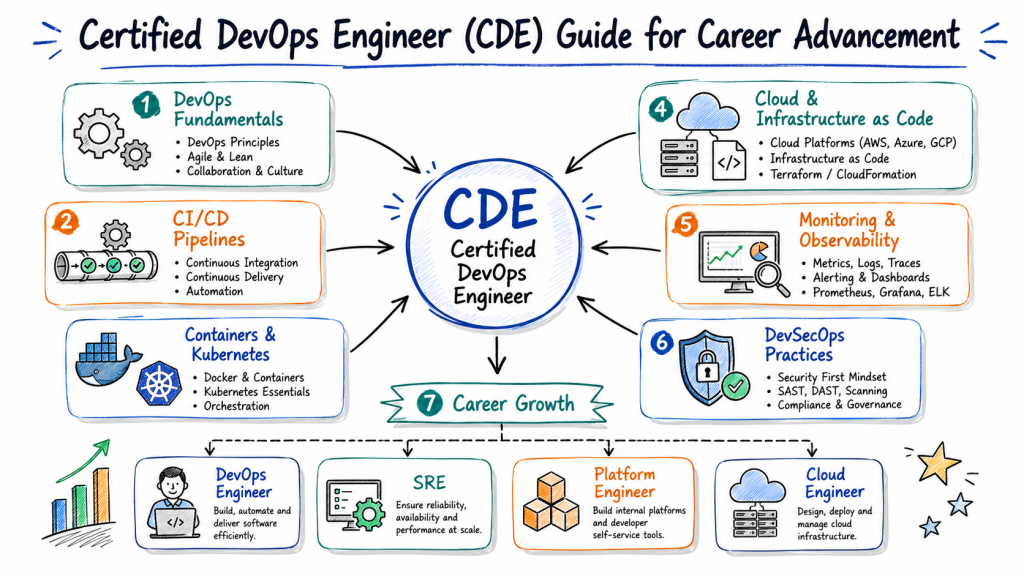
Introduction
The Certified DevOps Engineer (CDE) is a highly respected credential for professionals seeking to master DevOps practices, cloud-native workflows, and platform engineering. This guide is designed for software engineers, SREs, platform specialists, and cloud professionals aiming to validate their skills in modern production environments. With the rapid adoption of DevOps and CI/CD pipelines, organizations are increasingly seeking certified talent capable of bridging development and operations. This blog explains the value of CDE, outlines preparation strategies, and provides insights for career planning in both global and India-specific contexts.
What is the Certified DevOps Engineer (CDE)?
The Certified DevOps Engineer represents a practical, hands-on certification focused on real-world DevOps and cloud-native practices. It goes beyond theory, emphasizing production-grade automation, monitoring, and continuous integration/deployment workflows. The certification aligns with enterprise expectations, ensuring professionals can operate efficiently in agile, scalable environments. CDE equips candidates with skills to implement CI/CD pipelines, infrastructure as code, automated testing, and observability frameworks in real-world projects.
Who Should Pursue Certified DevOps Engineer (CDE)?
This certification benefits software engineers, SREs, cloud and platform specialists, security engineers, and data professionals. Beginners seeking structured DevOps knowledge, experienced engineers aiming to formalize expertise, and managers looking to understand operational pipelines can all gain value. It is relevant globally and in India, where DevOps adoption in IT, fintech, and enterprise cloud operations is growing rapidly. Professionals in hybrid or multi-cloud environments will find CDE especially valuable.
Why Certified DevOps Engineer
The demand for DevOps professionals continues to rise as organizations migrate workloads to cloud platforms and adopt agile practices. CDE certification demonstrates both foundational and advanced capabilities, ensuring career longevity despite evolving tools. By validating skills in CI/CD, cloud automation, and observability, professionals maximize ROI on their learning investment. Enterprises increasingly prefer certified engineers to streamline operations, reduce deployment errors, and enhance system reliability, making this credential a high-impact career move.
Certified DevOps Engineer (CDE) Certification Overview
The CDE program is delivered via Certified DevOps Engineer (CDE) – Official URL and hosted on devopsschool. The certification includes multiple levels, combining theoretical assessments with practical labs and projects. Ownership is professional-centric, requiring candidates to demonstrate real-world problem-solving in DevOps workflows. Structure covers automated pipelines, infrastructure as code, observability, cloud operations, and collaborative development practices.
Certified DevOps Engineer (CDE) Certification Tracks & Levels
CDE offers foundation, professional, and advanced levels. Foundation introduces DevOps principles, toolchains, and basic CI/CD automation. Professional level focuses on pipeline optimization, cloud-native deployments, and observability. Advanced level emphasizes large-scale enterprise operations, cross-team orchestration, security integration, and leadership skills. Specialization tracks include DevOps, SRE, DevSecOps, FinOps, and Cloud Operations, allowing candidates to tailor the certification to their career goals.
Complete Certified DevOps Engineer (CDE) Certification Table
| Track | Level | Who it’s for | Prerequisites | Skills Covered | Recommended Order |
|---|---|---|---|---|---|
| DevOps | Foundation | Beginners, engineers | Basic Linux/Cloud knowledge | DevOps principles, CI/CD basics | Foundation → Professional → Advanced |
| DevOps | Professional | Practicing engineers | Foundation | CI/CD pipelines, container orchestration | Foundation → Professional → Advanced |
| DevOps | Advanced | Senior engineers, leads | Professional | Multi-cloud deployment, observability, IaC | Professional → Advanced |
| SRE | Professional | Site Reliability Engineers | Foundation | SLO/SLI design, monitoring, incident management | Foundation → Professional |
| DevSecOps | Professional | Security engineers | Foundation | Security pipelines, vulnerability scanning, compliance | Foundation → Professional |
| FinOps | Professional | Finance/cloud ops | Foundation | Cost optimization, cloud billing automation | Foundation → Professional |
Detailed Guide for Each Certified DevOps Engineer (CDE) Certification
CDE – Foundation Level
What it is
Validates fundamental DevOps knowledge, including CI/CD, version control, and cloud basics.
Who should take it
Beginners, junior engineers, and professionals entering DevOps or cloud operations.
Skills you’ll gain
- DevOps lifecycle understanding
- Basic CI/CD pipeline setup
- Version control with Git
- Intro to containerization and cloud services
Real-world projects you should be able to do
- Simple automated deployment pipeline
- Basic monitoring setup using open-source tools
- Dockerizing a small application
Preparation plan
- 7–14 days: Read fundamentals and complete tutorials
- 30 days: Hands-on labs, CI/CD exercises
- 60 days: Small cloud deployment projects, mock assessments
Common mistakes
- Skipping hands-on labs
- Overlooking pipeline error handling
- Ignoring cloud provider nuances
Best next certification after this
- Same-track: CDE Professional
- Cross-track: SRE Professional
- Leadership: DevOps Lead/Manager program
CDE – Professional Level
What it is
Focuses on production-grade pipelines, cloud automation, and observability.
Who should take it
Practicing engineers, cloud specialists, SREs aiming to formalize expertise.
Skills you’ll gain
- CI/CD optimization
- Kubernetes orchestration
- Automated testing pipelines
- Monitoring and alerting frameworks
Real-world projects you should be able to do
- End-to-end CI/CD workflow with containers
- Multi-service deployment with Kubernetes
- Integration of monitoring dashboards
Preparation plan
- 7–14 days: Review foundation concepts, practice pipelines
- 30 days: Build complex pipelines, implement monitoring
- 60 days: Deploy multi-cloud applications, integrate security checks
Common mistakes
- Neglecting cloud security
- Ignoring error propagation
- Insufficient testing coverage
Best next certification after this
- Same-track: CDE Advanced
- Cross-track: DevSecOps Professional
- Leadership: DevOps Lead
CDE – Advanced Level
What it is
Validates mastery of enterprise DevOps, observability, and large-scale deployment management.
Who should take it
Senior engineers, platform leads, cloud architects.
Skills you’ll gain
- Multi-cloud deployment strategies
- Observability and alerting at scale
- Security and compliance integration
- Leadership in DevOps teams
Real-world projects you should be able to do
- Design enterprise CI/CD pipelines
- Implement large-scale monitoring frameworks
- Lead cross-functional DevOps projects
Preparation plan
- 7–14 days: Study advanced DevOps architecture
- 30 days: Hands-on enterprise projects
- 60 days: Lead mock production deployments
Common mistakes
- Ignoring cross-team dependencies
- Overlooking scalability concerns
- Underestimating security and compliance requirements
Best next certification after this
- Same-track: Cloud Architect
- Cross-track: DevSecOps Advanced
- Leadership: Engineering Manager Track
Choose Your Learning Path
DevOps Path
Focus on CI/CD pipelines, automation, cloud-native deployments, and collaboration between development and operations teams. Learn end-to-end lifecycle management and pipeline optimization.
DevSecOps Path
Integrate security into DevOps workflows. Focus on vulnerability scanning, compliance, secure deployments, and security automation in pipelines.
SRE Path
Focus on reliability, uptime, monitoring, alerting, incident response, and SLO/SLI design. Emphasize large-scale infrastructure observability.
AIOps / MLOps Path
Apply AI/ML for operational efficiency. Focus on predictive monitoring, anomaly detection, and automation of repetitive operational tasks.
DataOps Path
Manage data pipelines, quality, and governance. Learn to integrate data workflows into CI/CD pipelines and automate ETL processes.
FinOps Path
Optimize cloud costs and budgets. Focus on automation for billing, reporting, and financial monitoring in cloud environments.
Role → Recommended Certified DevOps Engineer (CDE) Certifications
| Role | Recommended Certifications |
|---|---|
| DevOps Engineer | CDE Foundation, Professional |
| SRE | CDE Foundation, Professional, SRE Professional |
| Platform Engineer | CDE Professional, Advanced |
| Cloud Engineer | CDE Professional, Advanced |
| Security Engineer | CDE Professional, DevSecOps Professional |
| Data Engineer | CDE Foundation, DataOps Professional |
| FinOps Practitioner | CDE Professional, FinOps Professional |
| Engineering Manager | CDE Advanced, Leadership Track |
Next Certifications to Take After Certified DevOps Engineer (CDE)
Same Track Progression
Deepen DevOps expertise with advanced CI/CD, observability, and cloud automation certifications.
Cross-Track Expansion
Explore DevSecOps, FinOps, SRE, or DataOps to broaden skillsets and enhance career flexibility.
Leadership & Management Track
Transition into team leadership or platform management roles, applying DevOps practices at scale across organizations.
Training & Certification Support Providers for Certified DevOps Engineer (CDE)
DevOpsSchool
Offers structured learning with hands-on labs, real-world projects, and mentorship. Focused on DevOps, SRE, and cloud-native workflows, providing a clear path from foundation to advanced levels.
Cotocus
Provides practical labs, scenario-based exercises, and expert guidance. Focuses on CI/CD, automation, and platform reliability for mid-level engineers.
Scmgalaxy
Emphasizes cloud deployments, containerization, and pipeline optimization. Offers targeted workshops for DevOps engineers and SREs.
BestDevOps
Covers foundational and professional levels with guided labs and assessment preparation. Offers practice projects replicating production environments.
DevSecOpsSchool
Focuses on integrating security into DevOps workflows. Covers automated security scans, compliance pipelines, and vulnerability management.
SRESchool
Dedicated to site reliability engineering. Covers monitoring, incident response, alerting frameworks, and reliability best practices.
AIOpsSchool
Specialized in AI/ML-driven operations. Offers courses in predictive monitoring, automated remediation, and operational analytics.
DataOpsSchool
Focuses on data pipeline automation, CI/CD integration for data workflows, and data quality management.
FinOpsSchool
Teaches cost optimization strategies, cloud billing automation, and financial monitoring in cloud environments.
Frequently Asked Questions (General)
What is the difficulty level of the CDE certification?
The CDE is moderately challenging, focusing on practical, hands-on exercises rather than pure theory. Candidates with some DevOps exposure will find it manageable.
How long does it take to prepare for CDE?
Preparation depends on experience; foundation level can take 2–4 weeks, professional 4–6 weeks, and advanced 6–8 weeks with structured practice.
What prerequisites are needed?
Basic Linux, cloud fundamentals, and version control knowledge are recommended. No strict prior certification is required for foundation level.
Is CDE recognized globally?
Yes, enterprises worldwide value CDE certification for validating practical DevOps skills and cloud operations capabilities.
Does CDE focus more on theory or practice?
It emphasizes hands-on, production-focused learning with real-world projects and CI/CD implementation tasks.
Can managers benefit from CDE?
Absolutely. Managers gain insight into DevOps workflows, enabling better project planning, team guidance, and operational decision-making.
How is the assessment structured?
The certification combines online exams, practical labs, and project submissions to validate real-world proficiency.
What career growth can I expect post-CDE?
CDE opens opportunities in DevOps, SRE, cloud engineering, platform roles, and leadership positions with measurable ROI on skills.
Are there specialization tracks?
Yes, tracks include DevOps, SRE, DevSecOps, DataOps, FinOps, and cloud-native operations.
Is CDE suitable for beginners?
Foundation level is ideal for beginners, gradually scaling to professional and advanced levels.
Can I combine CDE with other certifications?
Yes, cross-track expansion into DevSecOps, FinOps, or SRE enhances skills and career flexibility.
How do I choose the right track?
Select based on career goals: operational excellence, security integration, data workflow optimization, or financial cloud management.
FAQs on Certified DevOps Engineer (CDE)
What practical skills will I gain?
You will learn CI/CD pipeline design, container orchestration, automated testing, monitoring, cloud deployment, and production-grade workflow management.
How is CDE different from other DevOps certifications?
CDE emphasizes real-world projects, enterprise-grade scenarios, and hands-on labs rather than theoretical exams alone.
Which level should I start with?
Begin with the foundation level, progressing to professional and advanced levels based on prior experience and career goals.
How does CDE help with enterprise adoption?
It prepares engineers to implement scalable, reliable, and automated DevOps pipelines aligning with organizational practices.
Can I apply CDE skills in cloud-native environments?
Yes, CDE covers AWS, Azure, GCP fundamentals, and containerized deployments for cloud-native workflows.
Is mentorship available during preparation?
Many providers, including DevOpsSchool, offer mentorship, labs, and guided exercises for hands-on learning.
What mistakes should I avoid?
Neglecting hands-on labs, skipping pipeline debugging, and overlooking observability practices are common pitfalls.
How do I measure ROI from certification?
ROI is evident through improved deployment efficiency, faster delivery cycles, enhanced system reliability, and career advancement.
Final Thoughts: Is Certified DevOps Engineer (CDE) Worth It?
Certified DevOps Engineer (CDE) is a highly practical, career-boosting certification for engineers, SREs, and cloud professionals. It emphasizes hands-on expertise, production-ready workflows, and cross-functional collaboration. By progressing through foundation, professional, and advanced levels, candidates gain a comprehensive skill set that remains relevant despite evolving tools. CDE enhances employability, positions professionals for leadership roles, and bridges knowledge gaps across development, operations, and cloud platforms. Investing in CDE ensures measurable career growth, practical competence, and confidence to handle real-world enterprise challenges. For those serious about mastering DevOps and related disciplines, CDE is a strategic and worthwhile credential.