Introductio
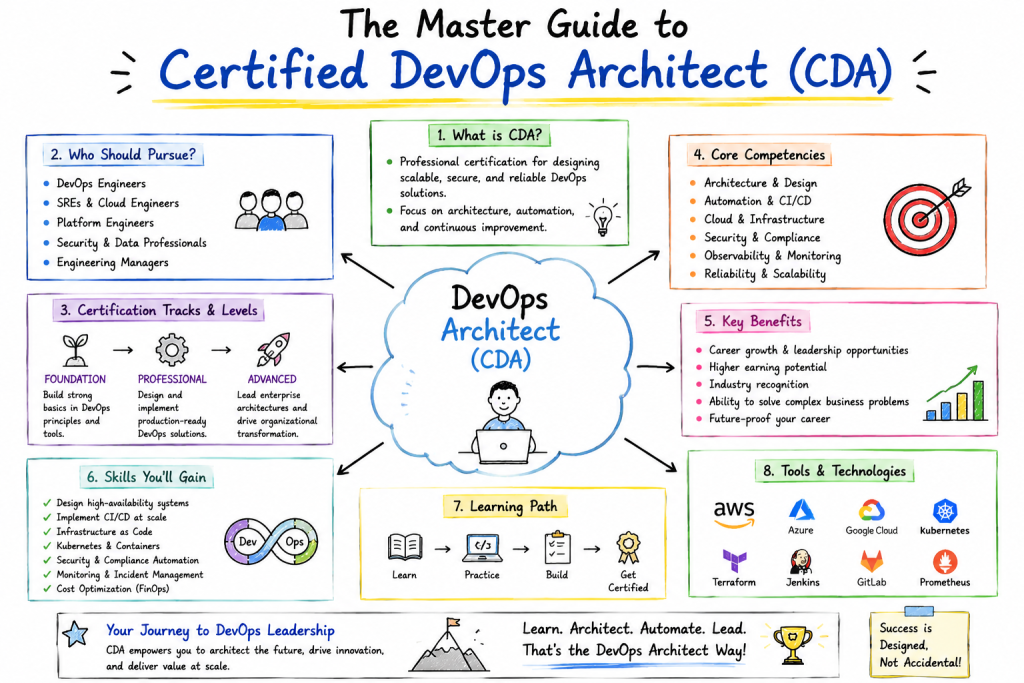
The Certified DevOps Architect (CDA) is a professional program designed for those who want to move beyond basic automation and start designing enterprise-grade systems. This guide is written for engineers, team leads, and managers who are ready to take on the responsibility of technical leadership. In today’s world of cloud-native applications and platform engineering, simply knowing how to use a tool is no longer enough.
You need to understand how different components like security, networking, and data flow work together in a complex environment. This guide helps you navigate the various levels of the certification, making it easier to decide if this is the right move for your career. Whether you are in India or working globally, understanding the architecture behind DevOps is the key to staying competitive.
What is the Certified DevOps Architect (CDA)?
The Certified DevOps Architect (CDA) represents a shift from “doing” to “designing.” While most certifications focus on how to run a specific command or configure a single tool, this program emphasizes production-focused learning and high-level strategy. It exists to bridge the gap between technical execution and business goals, ensuring that infrastructure is scalable and resilient.
It aligns perfectly with modern engineering workflows by teaching you how to build a framework that supports continuous delivery at scale. Instead of just focusing on theory, it looks at enterprise practices like multi-cloud setups, high availability, and disaster recovery. This makes it a practical choice for anyone who wants to be recognized as a leader in the engineering space.
Who Should Pursue Certified DevOps Architect (CDA)?
This certification is highly beneficial for Senior Software Engineers, Site Reliability Engineers (SREs), and Cloud Architects who are already familiar with the basics of automation. It is also a great fit for Security Engineers and Data Professionals who want to understand how their work integrates into a larger DevOps ecosystem. Even for Engineering Managers, this path provides the technical depth needed to lead high-performing teams.
In the Indian market and across the globe, companies are looking for professionals who can handle the complexity of modern software delivery. Beginners can use the foundation levels to build a strong base, while experienced engineers can use the advanced tracks to validate their expertise. It is a versatile certification that serves anyone aiming for a technical leadership role.
Why Certified DevOps Architect (CDA)
The demand for architects who can navigate complex technical landscapes is growing every day as more companies move to the cloud. The Certified DevOps Architect (CDA) offers longevity because it focuses on architectural principles rather than just a single tool that might become obsolete next year. This focus on fundamentals ensures that your skills remain relevant even as technology shifts.
Enterprise adoption of DevOps practices is now a standard, and companies need people who can design the “big picture.” This program provides a high return on investment for your time because it prepares you for high-level roles like Principal Engineer or Chief Architect. It allows you to move into a position where you are making strategic decisions rather than just putting out fires.
Certified DevOps Architect (CDA) Certification Overview
The program is delivered through and is hosted on the devopsschool platform. The certification is structured to be practical, focusing on how you apply knowledge in a real-world setting rather than just passing a multiple-choice test. It is owned by an organization that understands the pulse of the current IT industry.
The assessment approach is designed to validate your ability to solve complex infrastructure problems. It covers a wide range of domains including CI/CD, Infrastructure as Code, and monitoring. By completing this program, you demonstrate that you have the skills to manage the entire lifecycle of a software product from an architectural perspective.
Certified DevOps Architect (CDA) Certification Tracks & Levels
The certification is divided into three main levels: Foundation, Professional, and Advanced. The Foundation level is for those who are starting their journey into architecture and need to understand the core concepts. The Professional level dives deeper into specific tools and integration strategies that are used in daily production environments.
The Advanced or Master level is where you focus on specialization tracks like SRE, FinOps, or DevSecOps. These levels are designed to align with your career progression, allowing you to grow from a senior engineer into a specialist architect. Each track ensures that you are not just a generalist but someone with deep expertise in a specific area of modern operations.
Complete Certified DevOps Architect (CDA) Certification Table
| Track | Level | Who it’s for | Prerequisites | Skills Covered | Recommended Order |
| Core Architecture | Foundation | Aspiring Architects | Basic DevOps Knowledge | Core Principles, IaC Basics | First |
| System Design | Professional | Senior Engineers | 3+ years experience | Scalability, High Availability | Second |
| Leadership | Master | Team Leads/Managers | Professional Cert | Strategic Planning, Budgeting | Third |
| Specialized | Expert | Specialization Seekers | Professional Cert | SRE, Security, AI/ML | Optional |
Detailed Guide for Each Certified DevOps Architect (CDA) Certification
Certified DevOps Architect (CDA) – Foundation
What it is
This certification validates your understanding of the foundational principles of DevOps architecture. It ensures you know the basic building blocks required to design a stable and automated delivery pipeline.
Who should take it
It is suitable for Junior to Mid-level engineers who want to start thinking like an architect. It is also great for managers who need a technical overview of how modern systems are built.
Skills you’ll gain
- Understanding the DevOps lifecycle from an architectural view.
- Knowledge of core Infrastructure as Code (IaC) concepts.
- Basics of containerization and orchestration.
- Fundamental principles of continuous integration and delivery.
Real-world projects you should be able to do
- Designing a simple, automated CI/CD pipeline for a small application.
- Creating basic infrastructure templates using tools like Terraform or CloudFormation.
- Setting up a standard monitoring and logging stack for a microservice.
Preparation plan
- 7-14 Days: Focus on the official curriculum and understand the core definitions of architectural patterns.
- 30 Days: Start building small projects and lab environments to see how tools interact with each other.
- 60 Days: Deep dive into case studies and practice designing systems for specific business scenarios.
Common mistakes
- Focusing too much on specific tool syntax instead of the underlying principles.
- Skipping the networking and security basics which are crucial for any architect.
Best next certification after this
- Same-track option: CDA Professional Level.
- Cross-track option: Certified Kubernetes Administrator (CKA).
- Leadership option: Project Management Professional (PMP).
Certified DevOps Architect (CDA) – Professional
What it is
This level validates your ability to implement complex, multi-tool architectures. It confirms that you can handle the challenges of a production environment, including scaling and reliability.
Who should take it
Senior engineers and SREs who are responsible for the daily uptime and performance of enterprise applications. You should have a few years of hands-on experience before attempting this.
Skills you’ll gain
- Advanced container orchestration and service mesh management.
- Implementing security at every layer of the architecture.
- Designing for high availability and zero-downtime deployments.
- Performance tuning and cost optimization in the cloud.
Real-world projects you should be able to do
- Designing a multi-region deployment strategy for a global application.
- Building a self-healing infrastructure that can recover from node failures.
- Implementing a comprehensive DevSecOps pipeline with automated security scanning.
Preparation plan
- 7-14 Days: Review advanced networking and security protocols used in cloud environments.
- 30 Days: Work through complex labs involving multiple tools and cloud services.
- 60 Days: Conduct a mock architectural review of an existing system to identify weaknesses and improvements.
Common mistakes
- Ignoring the “soft” side of architecture, such as documentation and team collaboration.
- Building over-complicated systems that are hard to maintain in the long run.
Best next certification after this
- Same-track option: CDA Master/Advanced Architect.
- Cross-track option: AWS or Azure Solutions Architect Professional.
- Leadership option: Certified Scrum Master (CSM).
Certified DevOps Architect (CDA) – Master Architect
What it is
This is the highest level of validation, proving you can lead the entire technical strategy of an organization. It focuses on large-scale transformation and long-term technical vision.
Who should take it
Principal Engineers, Technical Directors, and aspiring CTOs. This is for those who are making decisions that affect the entire engineering department.
Skills you’ll gain
- Developing a long-term technical roadmap for an enterprise.
- Managing large-scale cloud migrations and digital transformations.
- Implementing FinOps to control and optimize multi-million dollar cloud budgets.
- Leading organizational change and fostering a strong DevOps culture.
Real-world projects you should be able to do
- Creating a migration plan to move a legacy monolithic application to a microservices architecture.
- Setting up a centralized platform engineering team to serve multiple development groups.
- Developing a governance framework for security and compliance across the organization.
Preparation plan
- 7-14 Days: Study enterprise architecture frameworks and leadership principles.
- 30 Days: Research industry trends and how they impact business strategy.
- 60 Days: Present and defend an architectural design to a mock board of technical leaders.
Common mistakes
- Losing touch with the technical details while focusing only on the strategy.
- Failing to align technical goals with the actual business needs of the company.
Best next certification after this
- Same-track option: Specialized expert tracks (AIOps/DataOps).
- Cross-track option: Certified Information Systems Security Professional (CISSP).
- Leadership option: MBA or specialized executive leadership programs.
Choose Your Learning Path
DevOps Path
This path focuses on the core principles of continuous delivery and automation. It is ideal for those who want to master the standard lifecycle of software development. You will learn how to integrate various tools to create a seamless flow from code to production. This is the most popular route for general systems and software engineers.
DevSecOps Path
The security-focused path is becoming more critical as cyber threats evolve. You will learn how to shift security to the left, meaning you integrate it early in the development process. This path teaches you how to automate security checks without slowing down the delivery speed. It is perfect for professionals who want to specialize in building safe and compliant systems.
SRE Path
Site Reliability Engineering focuses on the intersection of software engineering and operations. This path teaches you how to use software to manage systems, solve problems, and automate operations tasks. You will focus on metrics like Service Level Objectives (SLOs) and Error Budgets. It is the best choice for those who care about the stability and performance of high-scale systems.
AIOps / MLOps Path
As artificial intelligence becomes a standard part of business, the need for specialized operations grows. This path covers how to deploy and manage machine learning models in a production environment. You will learn how to build pipelines specifically for data science workflows. This is a forward-looking path for those interested in the future of automated operations.
DataOps Path
Data is the lifeblood of modern companies, and managing it requires a specific set of skills. The DataOps path focuses on the automated, policy-based management of data throughout its lifecycle. You will learn how to ensure data quality, security, and availability for analytics and applications. This is ideal for database administrators and data engineers looking to modernize.
FinOps Path
FinOps is about bringing financial accountability to the variable spend model of the cloud. This path teaches you how to balance cost, speed, and quality in your infrastructure. You will learn how to read cloud bills, identify waste, and optimize resources for maximum value. It is a crucial skill for senior architects and managers who handle large cloud budgets.
Role → Recommended Certified DevOps Architect (CDA) Certifications
| Role | Recommended Certifications |
| DevOps Engineer | CDA Foundation, CDA Professional |
| SRE | CDA Professional, SRE Specialized Track |
| Platform Engineer | CDA Professional, Master Architect |
| Cloud Engineer | CDA Foundation, Professional Cloud Tracks |
| Security Engineer | CDA Foundation, DevSecOps Specialized Track |
| Data Engineer | CDA Foundation, DataOps Specialized Track |
| FinOps Practitioner | CDA Foundation, FinOps Specialized Track |
| Engineering Manager | CDA Foundation, Master Architect |
Next Certifications to Take After Certified DevOps Architect (CDA)
Same Track Progression
Once you have completed the core levels, you should look into deep specialization. This might mean taking an expert-level course in a specific area like Advanced Kubernetes or Serverless Architecture. The goal here is to become the “go-to” person in your organization for a specific domain. Continuous learning is essential to maintain your status as a senior architect.
Cross-Track Expansion
Broadening your skills is just as important as deepening them. If you are a DevOps expert, consider taking a certification in Security or Data Management. Understanding how other teams operate makes you a much better architect because you can design systems that work for everyone. This cross-pollination of skills is what separates a good architect from a great one.
Leadership & Management Track
For those who want to move away from day-to-day coding, the leadership track is the next step. This involves certifications in project management, agile methodologies, or even business administration. These skills help you bridge the gap between the technical team and the executive board. It prepares you for roles where you are leading people as much as you are leading technology.
Training & Certification Support Providers for Certified DevOps Architect (CDA)
DevOpsSchool is a leading provider of technical training that focuses heavily on the practical side of engineering. They offer a wide range of courses that are designed to help professionals gain hands-on experience with the latest tools. Their community-driven approach means you get access to a wealth of knowledge and support from industry experts. It is a great starting point for anyone looking to earn their CDA and advance their career in the DevOps space.
Cotocus provides specialized consulting and training services that are tailored to the needs of modern enterprises. They focus on real-world scenarios and project-based learning, ensuring that students can apply what they learn immediately in their jobs. Their trainers are experienced professionals who bring years of industry knowledge to the classroom. This makes Cotocus an excellent choice for those who want a more personalized and practical learning experience.
Scmgalaxy is a massive repository of knowledge for anyone interested in software configuration management and DevOps. They provide a wealth of free resources, including blogs, tutorials, and community forums. Their training programs are well-regarded for their depth and technical accuracy. For a professional who likes to dive deep into the technical details, Scmgalaxy offers the resources and community support needed to master complex topics.
BestDevOps focuses on providing high-quality, streamlined training for the most in-demand DevOps skills. They aim to make complex topics easy to understand through clear explanations and structured learning paths. Their courses are designed to get you up to speed quickly, making them ideal for busy professionals. If you are looking for a straightforward and efficient way to prepare for your certification, BestDevOps is a solid option to consider.
devsecopsschool is dedicated to the growing field of security within the DevOps lifecycle. They provide specialized training that teaches engineers how to integrate security tools and practices into their automated pipelines. Their curriculum covers everything from threat modeling to automated compliance. As security becomes a top priority for organizations, the training provided by devsecopsschool is becoming increasingly valuable for any aspiring architect.
sreschool focuses entirely on the principles and practices of Site Reliability Engineering. They offer training that covers the essential skills needed to build and maintain highly reliable systems at scale. Their courses dive into topics like error budgets, incident response, and performance monitoring. For those who want to specialize in the operational side of architecture, sreschool provides the targeted knowledge required to excel in an SRE role.
aiopsschool is at the forefront of the intersection between artificial intelligence and IT operations. They provide training on how to use machine learning and big data to automate and improve IT processes. Their courses cover the deployment and management of AI models in production environments. As companies look to use AI to manage their complex infrastructures, the skills taught at aiopsschool are becoming highly sought after in the job market.
dataopsschool addresses the unique challenges of managing data in a fast-paced DevOps environment. They provide training on how to automate data pipelines and ensure data quality and security. Their curriculum is designed for data engineers and architects who want to apply DevOps principles to data management. By focusing on the flow of data, dataopsschool helps professionals build systems that are both agile and reliable.
finopsschool provides the essential training needed to manage the financial aspects of cloud computing. They teach professionals how to track, analyze, and optimize cloud spend to ensure maximum business value. Their courses are ideal for architects and managers who need to balance technical performance with budget constraints. In a world where cloud costs can easily spiral out of control, the training from finopsschool is a vital asset for any technical leader.
Frequently Asked Questions (General)
How hard is the Certified DevOps Architect (CDA) exam?
The difficulty depends on your experience, but it is generally considered a professional-level exam that requires a solid understanding of both tools and strategy.
How much time does it take to prepare for the certification?
Most professionals spend between 30 to 60 days preparing, depending on their existing hands-on experience with the tools.
What are the prerequisites for the CDA program?
There are no strict legal prerequisites, but having a basic understanding of Linux, networking, and at least one cloud provider is highly recommended.
Is the ROI worth the cost of the certification?
Yes, because it positions you for senior-level roles that often come with significant salary increases and better career stability.
Can I take the exam online?
Yes, most providers offer a remote proctored option so you can take the exam from the comfort of your home or office.
How long is the certification valid for?
Typically, the certification is valid for two to three years, after which you may need to renew it or move to a higher level.
What kind of jobs can I get after becoming a CDA?
You can qualify for roles like DevOps Architect, Principal Engineer, SRE Manager, and Technical Lead.
Does the certification cover specific cloud providers like AWS or Azure?
While the principles are cloud-agnostic, the labs often use major providers to demonstrate how concepts are applied in the real world.
Are there any hands-on labs included in the training?
Yes, high-quality training providers include extensive hands-on labs to ensure you can actually implement the designs you learn about.
How does this differ from a standard DevOps Engineer certification?
The CDA focuses more on design, strategy, and the big-picture architecture rather than just the day-to-day operation of tools.
Is this certification recognized globally?
Yes, the skills and principles covered in the CDA are standard across the global IT industry, making it valuable anywhere in the world.
Can a manager with a non-technical background take this?
While a manager can take the foundation level, the professional and master levels require a deeper technical background to be fully understood.
FAQs on Certified DevOps Architect (CDA)
What specific architectural patterns are covered in the CDA?
The program covers patterns like microservices, sidecar containers, event-driven architecture, and blue-green deployments to ensure you can design for any scenario.
How does the CDA address multi-cloud strategy?
It teaches you how to build portable architectures that can run across different cloud providers without being locked into a single vendor’s ecosystem.
Is there a focus on cost optimization in this architect program?
Yes, the CDA includes principles of FinOps to help you design systems that are not only performant but also cost-effective for the business.
Does the program include legacy to cloud migration strategies?
The advanced levels specifically look at how to architect the transition of older systems into modern, cloud-native environments without disrupting the business.
How are security and compliance handled in the CDA curriculum?
Security is treated as a core architectural component, teaching you how to build “secure by design” systems that automate compliance checks.
What role does automation play in the architect’s workflow?
Automation is the foundation; the CDA teaches you how to architect the automation itself so it is scalable and maintainable by a large team.
Are there case studies included in the Certified DevOps Architect training?
Yes, real-world case studies are used to show how large enterprises have successfully implemented DevOps architecture to solve massive scale challenges.
How does the CDA help in career transition from a SysAdmin role?
It provides the high-level perspective needed to move from managing individual servers to designing entire automated ecosystems, making it a perfect bridge.
Final Thoughts: Is Certified DevOps Architect (CDA) Worth It?
If you are looking to take the next big step in your career, the Certified DevOps Architect (CDA) is a very solid investment. It moves you away from the repetitive tasks of daily operations and puts you in a position where you are designing the future of your company’s technology. The real value is not just the certificate itself, but the change in mindset it brings.
You will start seeing systems as a whole rather than a collection of disconnected tools. This perspective is what companies are looking for in their technical leaders. It is a challenging path, but for those who are passionate about building great software and reliable infrastructure, it is a rewarding journey that pays off in the long run.