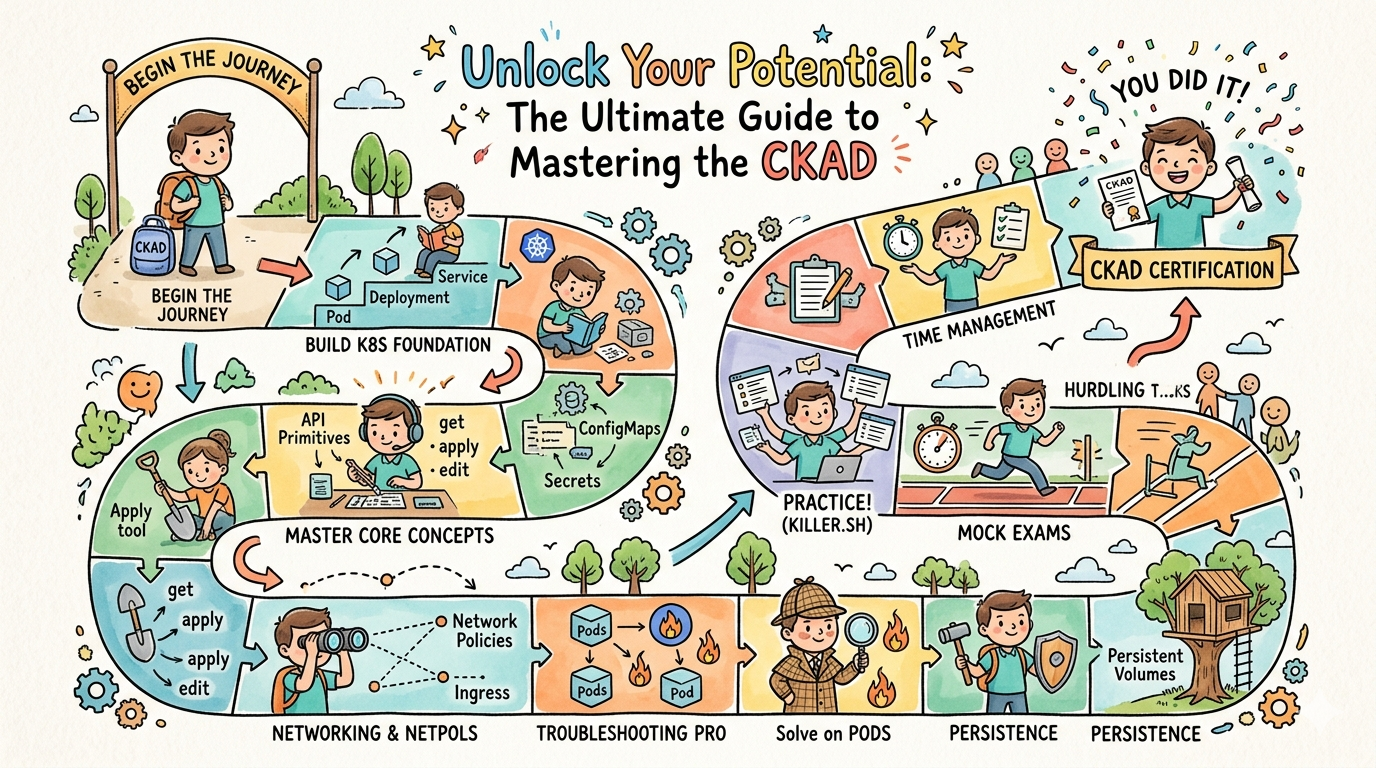
Introduction
The modern cloud-native landscape requires engineering professionals to demonstrate hands-on competence in deploying and managing containerized applications. Certified Kubernetes Application Developer (CKAD) has emerged as a definitive industry benchmark that validates an engineer’s ability to design, build, configure, and expose applications on Kubernetes clusters. This guide is written specifically for software developers, platform engineers, and technical managers who want to understand the true career impact of this credential. Navigating the ecosystem of container orchestration can feel overwhelming given the rapid pace of open-source tooling updates. This comprehensive resource helps technical professionals evaluate the depth of the exam, plan their learning roadmap, and make informed decisions that align with long-term career goals across engineering disciplines. Working with ecosystem platforms such as aiopsschool or utilizing comprehensive curriculums provided through the official Certified Kubernetes Application Developer (CKAD) program enables professionals to stay ahead of architectural shifts.
What is the Certified Kubernetes Application Developer (CKAD)?
The Certified Kubernetes Application Developer (CKAD) is a performance-based certification program designed to validate an engineer’s ability to construct, configure, and troubleshoot cloud-native applications within Kubernetes. Unlike traditional multiple-choice examinations that test theoretical recall, this assessment requires candidates to solve real-world problems directly in a live command-line environment. The exam framework is built by the Cloud Native Computing Foundation in collaboration with The Linux Foundation to ensure standard practices across global enterprises. It forces candidates to master core primitives such as Pods, Deployments, Services, ConfigMaps, and NetworkPolicies under strict time constraints. Holding this credential demonstrates to engineering organizations that you possess the practical competency required to push code safely into a production-grade Kubernetes cluster.
Who Should Pursue Certified Kubernetes Application Developer (CKAD)?
This certification is highly beneficial for core software engineers, application developers, and backend engineers who construct services meant to run inside containers. Systems architects, Site Reliability Engineers (SREs), and cloud infrastructure professionals will find immense value in learning the developer-centric primitives of the orchestration plane. It is equally important for security professionals and data engineers who must package, run, and protect specialized application workloads in multi-tenant environments. Beginners with a foundational knowledge of Linux and Docker can use this program to bridge the gap into production engineering, while senior managers gain the technical vocabulary needed to oversee cloud-native transformations. Across both Indian and international tech hubs, enterprises actively prioritize professionals who can minimize application deployment errors through verified cloud-native skills.
Why Certified Kubernetes Application Developer (CKAD)
The global shifts toward microservices architectures and distributed infrastructure have made Kubernetes the operating system of the modern cloud layer. Organizations across financial services, healthcare, e-commerce, and telecommunications are migrating legacy frameworks to cloud-native platforms to achieve higher availability and scalability. Mastering the Certified Kubernetes Application Developer (CKAD) objectives ensures that your skillset remains agnostic of specific cloud vendors, protecting your career against shifting corporate preferences between AWS, Azure, or Google Cloud. The investment in this certification delivers immediate returns by reducing the time required to debug deployment failures, optimize application resource allocation, and implement secure networking standards. As automation, continuous integration, and declarative infrastructure become mandatory engineering standards, verified Kubernetes application proficiency remains highly defensible against market volatility.
Certified Kubernetes Application Developer (CKAD) Certification Overview
The formal evaluation process is structured around a rigorous hands-on laboratory environment where candidates are presented with performance tasks. The program is delivered via the official channel devopsschool and hosted on devopsschool to provide candidates with standard preparation resources and structural insights. The evaluation tests a candidate’s efficiency in utilizing the command-line interface, editing configuration files rapidly, and parsing application logs under tight schedules. Rather than focusing on cluster administration or bootstrap procedures, the exam concentrates on the runtime, lifecycle, configuration, and security aspects of application workloads. Passing the assessment requires a clear understanding of imperative commands, declarative manifests, and fast troubleshooting mechanisms within a terminal environment.
Certified Kubernetes Application Developer (CKAD) Certification Tracks & Levels
The cloud-native development learning path transitions smoothly from basic foundation concepts to advanced multi-cluster operations. Software engineers begin by mastering single-container configurations, environment variables, and simple volumes before moving to enterprise application design patterns. The professional track deepens into complex deployment strategies like canary rollouts, blue-green architectures, and custom resources. Advanced specializations require developers to integrate their application knowledge with distinct operational frameworks such as GitOps pipelines, Service Meshes, and continuous automated security verification. This comprehensive leveling ensures that as an engineer climbs from junior developer to principal platform architect, their knowledge matches the structural needs of large organizations.
Complete Certified Kubernetes Application Developer (CKAD) Certification Table
| Track | Level | Who it’s for | Prerequisites | Skills Covered | Recommended Order |
| Application Development | Foundation | Cloud Beginners, QA Engineers, Product Managers | Basic Linux command line, Docker containers | Core primitives, Pod creation, Basic configuration | 1 |
| Core Engineering | Professional | Software Developers, DevOps Engineers, SREs | Foundational container knowledge, YAML editing | Deployment strategies, Storage, Security, Networking | 2 |
| Platform Architecture | Advanced | Lead Engineers, Platform Architects, DevSecOps | Core CKAD knowledge, Multi-cluster concepts | Helm charts, CRDs, Service Mesh, CI/CD Integration | 3 |
Detailed Guide for Each Certified Kubernetes Application Developer (CKAD) Certification
Certified Kubernetes Application Developer (CKAD) – Application Developer Professional
What it is
This assessment validates an engineer’s practical competency in designing, building, configuring, and troubleshooting production-grade applications running natively inside a Kubernetes ecosystem.
Who should take it
Backend developers, system engineers, cloud-native professionals, and SREs who are responsible for maintaining, deploying, and managing live software services in containerized clusters.
Skills you’ll gain
- Proficient use of imperative commands to build and scale application resources instantly.
- Implementation of application configuration frameworks using ConfigMaps, Secrets, and SecurityContexts.
- Execution of advanced deployment strategies including rolling updates, rollbacks, and canary releases.
- Configuration of network communication guidelines through multi-tiered NetworkPolicies.
- Diagnostic log parsing and live container troubleshooting within malfunctioning clusters.
Real-world projects you should be able to do
- Construct a secure, multi-tier application environment containing decoupled front-end and back-end architectures with restricted network access.
- Configure resilient background processing workloads utilizing CronJobs and Jobs with defined failure thresholds.
- Implement automated application health monitoring by setting up custom Liveness, Readiness, and Startup probes for microservices.
Preparation plan
- 7–14 days strategy: Focus intensely on mastering imperative commands using the command-line tool. Memorize core shortcuts, practice generating YAML files rapidly, and understand how to navigate the official documentation under constraint.
- 30 days strategy: Deep dive into individual core concepts such as persistent volume claims, multi-container design patterns like sidecars, and network policy design. Set up a local cluster using Minikube or Kind to run through multiple mock laboratories.
- 60 days strategy: Conduct full-length simulated examinations to build structural speed and endurance. Analyze common error patterns, master rapid text editing techniques in Vim, and practice debugging broken application configurations systematically.
Common mistakes
- Spending excessive time manually writing complex YAML structures instead of generating them using imperative flags.
- Misunderstanding the precise context or namespace requirements specified for a given configuration task.
- Neglecting to back up existing configuration files before making structural modifications during troubleshooting exercises.
Best next certification after this
- Same-track option: Certified Kubernetes Administrator (CKA) to master cluster management and troubleshooting.
- Cross-track option: Certified Kubernetes Security Specialist (CKS) to focus deeply on securing cloud-native workloads.
- Leadership option: Cloud Native Certified Architect to lead enterprise systems engineering teams.
Choose Your Learning Path
DevOps Path
Engineers following this path focus on building automated delivery pipelines that seamlessly bridge the gap between application source code and runtime environments. Mastery of application delivery primitives allows DevOps specialists to configure automated rolling updates, configure structural rollbacks, and manage environmental variables securely across stages. They treat infrastructure as a declarative blueprint, embedding application definitions directly into version control software. This minimizes human intervention during service deployment, accelerates delivery frequency, and establishes highly predictable application rollouts across enterprise multi-region clusters.
DevSecOps Path
This methodology prioritizes shifting security practices left by embedding strict compliance, authorization, and isolation parameters directly into the deployment configurations. Engineers running this path learn to implement non-root container execution models, set up secure file system access, and restrict network paths using micro-segmentation rules. By verifying container image origins and configuring secret data injections securely, they eliminate configuration vulnerabilities long before code reaches live systems. Their ultimate goal is to build automated, highly secure execution environments that protect corporate data without slowing down production delivery speeds.
SRE Path
Site Reliability Engineers focus on system stability, latency management, application performance monitoring, and efficient infrastructure resource utilization. This path teaches engineering professionals how to set up accurate application health parameters, define storage volume lifecycles, and configure resource limits to prevent noisy-neighbor constraints. SREs learn to analyze runtime logs, handle container crashes systematically, and build self-healing software structures that recover automatically from underlying cluster faults. Their core objective is to ensure that distributed cloud applications maintain maximum uptime and deliver optimal performance to global end-users.
AIOps Path
Professionals on this track concentrate on deploying, scaling, and managing artificial intelligence models and machine learning pipelines inside distributed environments. They learn to configure compute workloads that can request access to dedicated hardware drivers, handle large-scale transient data processing batches, and serve inference endpoints efficiently. By understanding the lifecycle of containerized compute workloads, these specialists can orchestrate automated resource scaling to handle sudden surges in data processing workloads. This guarantees that complex computational model training and live deployment processes remain cost-effective and highly responsive.
MLOps Path
This path merges machine learning workflow automation with standard cloud-native engineering patterns to manage operational model lifecycles reliably. Engineers focus on building stable pipelines for data ingestion, continuous model evaluation, and automated versioning of containerized model artifacts. They configure specialized volume mounts for large-scale training datasets and establish strict parallel execution rules using orchestrated container sets. This disciplined approach enables development teams to move machine learning models from theoretical research phases to active enterprise deployment pipelines safely and repeatedly.
DataOps Path
DataOps engineering specialists focus on building, maintaining, and scaling data processing pipelines and stateful storage clusters within cloud environments. This framework demands an advanced understanding of persistent volume mechanisms, database state management, and continuous data ingestion orchestration patterns. Specialists design highly resilient data pipelines that can recover gracefully from node terminations without corrupting active transaction logs. By aligning data infrastructure requirements with declarative scheduling principles, they provide enterprise organizations with highly reliable, automated, and real-time data streaming layers.
FinOps Path
FinOps practitioners analyze infrastructure usage patterns to optimize cloud-native spend and eliminate waste across distributed enterprise application environments. This track emphasizes setting accurate CPU and memory utilization boundaries to match actual workload performance profiles rather than over-provisioning infrastructure. Practitioners learn to implement structural autoscaling models, analyze cluster utilization metrics, and assign clear cost attribution tags across multiple engineering environments. This ensures that application infrastructure scales dynamically with business demand, delivering exceptional performance while maintaining strict budget limits.
Role → Recommended Certified Kubernetes Application Developer (CKAD) Certifications
| Role | Recommended Certifications |
| DevOps Engineer | CKAD, CKA, GitOps Fundamentals |
| SRE | CKAD, CKA, Prometheus Certified Associate |
| Platform Engineer | CKAD, CKA, CKS, Service Mesh Specialist |
| Cloud Engineer | CKAD, Cloud Provider Certifications |
| Security Engineer | CKAD, CKS, Cloud Security Professional |
| Data Engineer | CKAD, Apache Spark Developer |
| FinOps Practitioner | CKAD, FinOps Certified Practitioner |
| Engineering Manager | CKAD, Cloud Digital Leader |
Next Certifications to Take After Certified Kubernetes Application Developer (CKAD)
Same Track Progression
After establishing a strong foundation in application deployment, engineers should progress toward comprehensive cluster architecture and day-two administration operations. Moving directly into the Certified Kubernetes Administrator certification allows professionals to master control plane troubleshooting, node maintenance, and cluster networking frameworks. This deepens your understanding of how application requests flow through the infrastructure plane, turning you into a holistic cloud-native engineer capable of resolving both software and infrastructural failures.
Cross-Track Expansion
Broadening your technical domain requires moving into specialized areas such as automated security compliance or cloud-native monitoring infrastructure. Pursuing the Certified Kubernetes Security Specialist credential equips developers with the knowledge required to defend runtime environments against kernel exploits and supply-chain attacks. Alternatively, expanding into specialized service meshes or GitOps deployment frameworks ensures that your application architecture skills remain compatible with modern automated enterprise release platforms.
Leadership & Management Track
Transitioning into engineering management requires a shift from pure code execution to high-level system strategy and technology portfolio optimization. Technical leaders should evaluate advanced architectural credentials that focus on multi-cloud compliance frameworks, vendor risk management, and ROI analysis. Gaining foundational cloud architecture and platform management certifications allows you to guide organizational cloud transformations, mentor engineering squads, and choose technologies that balance fiscal responsibility with technical agility.
Training & Certification Support Providers for Certified Kubernetes Application Developer (CKAD)
DevOpsSchool delivers comprehensive, experience-driven training programs focused heavily on real-world engineering simulation laboratories. Their curriculum is structured by industry veterans to help professionals master terminal speed, imperative workflows, and complex cloud-native architectures.
Cotocus provides targeted, hands-on certification training designed to bridge practical knowledge gaps for enterprise engineering teams. Their structured laboratories focus on production-grade problem-solving, ensuring candidates are fully equipped for live examinations.
Scmgalaxy offers an extensive repository of community-driven resources, technical guides, and mock examination environments. It serves as an excellent reference point for engineering professionals looking to refine their command-line troubleshooting skills.
BestDevOps focuses on delivering high-quality, practical training roadmaps designed specifically for modern platform and cloud engineers. Their modules emphasize continuous delivery patterns and advanced application orchestration techniques.
devsecopsschool specializes in integrating deep security compliance guidelines directly into standard application development workflows. Their courses focus heavily on access control, secret management, and network policy implementation.
sreschool provides targeted training programs that emphasize system reliability, logging diagnostics, application performance tuning, and self-healing cluster designs. It is ideal for engineers focused on operational stability.
aiopsschool offers cutting-edge training programs designed to bridge the gap between artificial intelligence automation and modern containerized infrastructure systems. Their courses focus on running automated operations at scale.
dataopsschool focuses exclusively on the unique architecture challenges associated with stateful storage, persistent data volumes, and distributed data processing systems. Their tracks help optimize complex data delivery setups.
finopsschool delivers highly specialized training focused on cloud financial management, workload resource optimization, and cost allocation methodologies. They help engineering professionals build cost-effective architectures.
Frequently Asked Questions (General)
- What is the primary difference between CKA and CKAD?The Certified Kubernetes Application Developer assessment concentrates entirely on application workloads, design patterns, and developer-centric configurations. The Certified Kubernetes Administrator exam focuses on cluster administration, architecture maintenance, and underlying node troubleshooting.
- How long is the certification valid after passing the examination?The credential remains active for a specific period defined by the Cloud Native Computing Foundation, typically requiring a renewal exam to remain current with open-source updates.
- Can I use the official documentation during the performance-based test?Yes, candidates are permitted to open specific documentation tabs provided within the exam platform interface to look up resource syntax and configurations.
- Is a background in programming mandatory to pass this certification successfully?While deep software coding skills are not tested, a solid understanding of application architecture, environment configuration, and YAML serialization is critical.
- What happens if my internet connection drops during the online examination?The exam monitoring platform includes mechanisms to pause the session, allowing candidates to reconnect and resume from where they left off.
- How quickly are the official examination results delivered to the candidate?Results are systematically processed and emailed to the candidate within a few business days after completing the live performance assessment.
- Is there a free retake option included with the examination purchase?Most standard certification registrations provided by the hosting foundation include one complimentary retake attempt if the first attempt falls short.
- Which terminal text editor should I practice with for the examination?Vim or Nano are standard options available within the terminal environment, with Vim being highly recommended due to its efficient text manipulation features.
- Can I take the exam using a standard web browser on my laptop?The examination requires a secure browser extension or a specific proctoring application that ensures environmental compliance during the test session.
- Are multiple-choice questions included in the evaluation process?No, the evaluation is entirely performance-based, consisting of practical problems that must be solved in a live command-line environment.
- What is the passing score required to achieve the credential?Candidates must score above a specific percentage threshold, usually set around sixty-six percent of the total weighted laboratory tasks.
- Can I choose my preferred Kubernetes version for the testing environment?The exam platform runs on a specific stable version of Kubernetes that is updated periodically to reflect recent upstream open-source releases.
FAQs on Certified Kubernetes Application Developer (CKAD)
- How hard is the Certified Kubernetes Application Developer (CKAD) exam compared to other cloud-native certifications available today?The examination is considered moderately difficult due to its strictly hands-on, performance-based structure. It evaluates speed and accuracy under an intense time limit rather than theoretical knowledge. Candidates must know how to build resources instantly using command-line shortcuts, edit configuration files accurately, and troubleshoot broken deployments systematically without losing momentum during the session.
- What are the absolute core prerequisites that an engineer must master before attempting this application developer exam?Candidates must possess an excellent grasp of basic Linux navigation, command-line file manipulation, and containerization fundamentals using tools like Docker. Familiarity with editing nested text files using terminal tools like Vim is critical. You should understand microservices architectures, container lifecycles, and environment variable configuration to comprehend the exam objectives.
- How many hours of dedicated study time should a working technical professional allocate to clear this certification?A typical engineer spending two hours daily can feel prepared within four to six weeks. This timeline includes running practical lab simulations, memorizing imperative flags, and completing multiple full-length mock examinations to ensure your operational speed matches the constraints of the official testing environment.
- What is the true career return on investment for an engineer who holds this verified container orchestration credential?Holding this certification instantly validates your practical, real-world engineering capability to global tech enterprises, eliminating doubts regarding theoretical bluffing. It leads to improved visibility within engineering teams, opens up paths to cloud-native roles, and provides leverage during compensation and technical promotion reviews.
- Which specific development topics carry the most weight during the live performance-based evaluation process?Core application deployment configuration, pod design, runtime security parameters, and application troubleshooting represent significant chunks of the grading matrix. Understanding how to set up multi-container pods, configure network policies, inject secrets, and fix faulty deployments are critical skills that determine your success.
- Can I use custom shell aliases or bash shortcuts during the live command-line examination session to save time?Yes, candidates are highly encouraged to configure basic shell shortcuts, such as defining single-letter commands for the main orchestration tool and enabling shell auto-completion. This minimizes typing overhead, prevents syntax typos, and saves crucial minutes that can be used for solving complex tasks.
- How does this certification help an engineering manager who no longer writes code on a daily basis?It provides technical managers with the exact operational vocabulary, structural understanding, and architectural patterns used by their engineering teams. This leads to more accurate project scoping, better technical hiring decisions, and an improved ability to guide infrastructure modernization roadmaps without relying solely on external consultants.
- What strategy should I follow if I get completely stuck on a complex, high-weighted configuration question during the exam?You should immediately record the task number, skip the question, and move directly to the next task to secure easier points. Time management is critical, and getting stuck on a single difficult networking or storage issue can prevent you from answering several straightforward deployment questions at the end.
Final Thoughts: Is Certified Kubernetes Application Developer (CKAD) Worth It?
Investing your valuable personal time and professional energy into achieving the Certified Kubernetes Application Developer (CKAD) credential is a highly pragmatic career move. The tech industry has completely moved away from valuing superficial, multiple-choice certificates that fail to prove actual on-the-job competency. Because this program forces you to demonstrate real-world skills within a live, ticking terminal environment, it commands immediate respect from senior engineers, principal architects, and engineering directors alike. It systematically turns your theoretical knowledge of container systems into functional, production-ready operational engineering skills. If your long-term technical path involves building, scaling, or protecting modern distributed microservices, this credential provides an undeniable architectural foundation that pays dividends for years to come.