Introduction
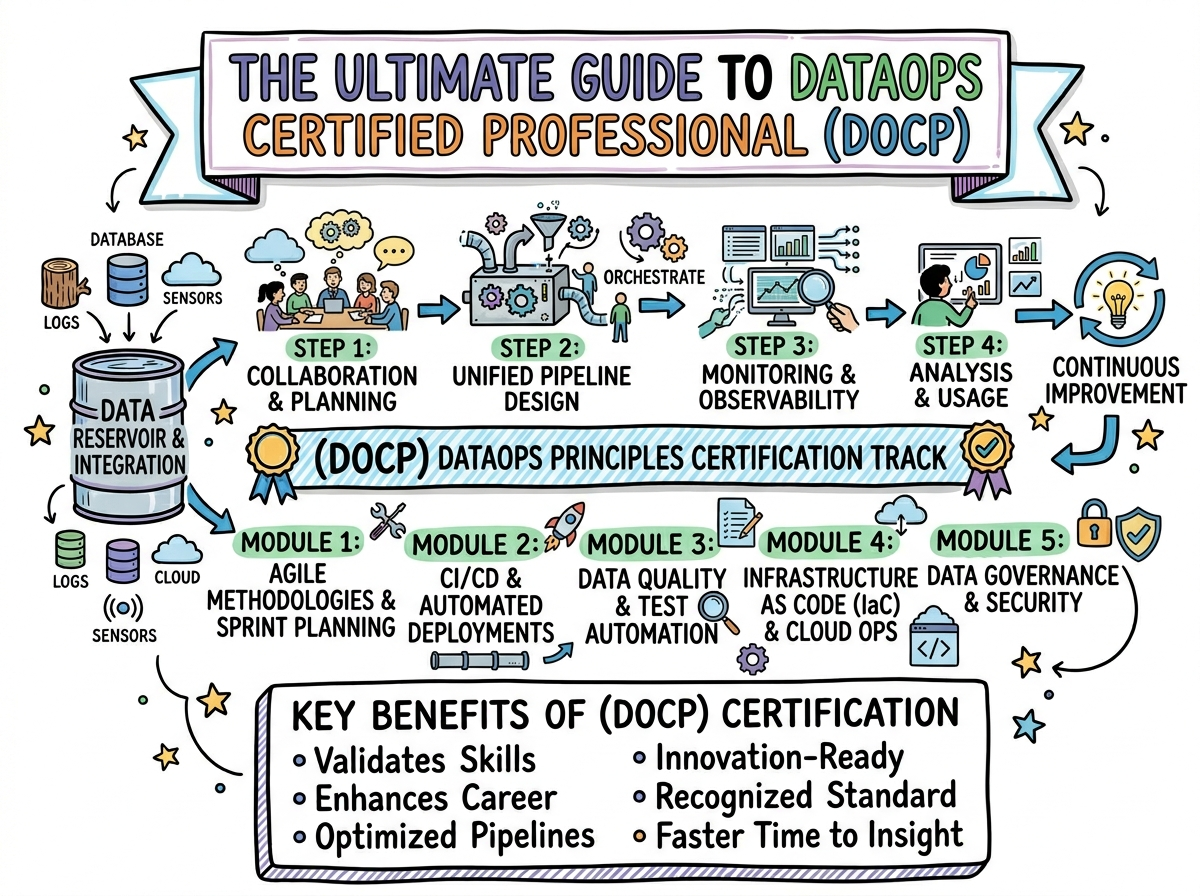
The DataOps Certified Professional (DOCP) is a comprehensive program designed to bridge the gap between data engineering and operational excellence. This guide is written for software engineers, data professionals, and platform architects who need to manage data pipelines with the same agility and reliability found in modern DevOps environments. As data becomes the backbone of every enterprise, understanding how to automate, monitor, and scale data workflows is no longer optional for those in cloud-native and platform engineering roles. This guide provides a clear roadmap to help you evaluate the certification’s impact and make informed decisions about your professional growth. You can explore the full curriculum through devopsschool and find additional resources on aiopsschool to see how these disciplines intersect.
What is the DataOps Certified Professional (DOCP)?
The DataOps Certified Professional (DOCP) represents a shift from manual data handling to an automated, process-driven approach. It exists to solve the problem of “data silos” and slow delivery cycles that plague large-scale enterprises today. Unlike theoretical courses, this program focuses on production-ready skills, emphasizing how to apply lean manufacturing principles to data development and operations. It aligns perfectly with modern engineering workflows by treating data as code, ensuring that every change is tested, tracked, and deployed without manual intervention.
Who Should Pursue DataOps Certified Professional (DOCP)?
This certification is highly beneficial for data engineers, SREs, and cloud architects who are responsible for the health of data platforms. Beginners looking to enter the data field will find a structured path, while experienced systems administrators can use it to pivot into high-demand data operations roles. Engineering managers and technical leaders in India and across the global market also pursue this to better understand how to structure their teams for rapid data delivery. It provides a common language for both developers and operations staff, making it a versatile asset for anyone in the technical ecosystem.
Why DataOps Certified Professional (DOCP)
The demand for DataOps expertise is growing as enterprises realize that simply having data is not enough; they must be able to use it quickly and reliably. This certification offers longevity because it focuses on methodologies and cultural shifts rather than just a single tool that might become obsolete in a few years. By mastering these principles, professionals stay relevant in an evolving market where automation is the standard. The return on investment is seen through faster career progression, higher architectural responsibilities, and the ability to lead complex digital transformation projects.
DataOps Certified Professional (DOCP) Certification Overview
The program is delivered via the official course page at and is hosted on the devopsschool platform. The certification is structured to validate practical competence through a mix of deep-dive learning modules and rigorous assessment phases. It covers the entire data lifecycle, from ingestion and transformation to orchestration and observability. Ownership of the certification rests with industry-recognized bodies that ensure the curriculum remains updated with the latest enterprise practices and open-source tool evolutions.
DataOps Certified Professional (DOCP) Certification Tracks & Levels
The certification is organized into foundation, professional, and advanced levels to cater to different stages of a career. The foundation level introduces core concepts like version control for data and automated testing, while the professional level dives into complex orchestration and CI/CD for data pipelines. Advanced levels focus on governance, security, and scaling architectures across multi-cloud environments. These levels allow professionals to align their learning with their current job requirements while providing a clear path for future leadership or specialist roles.
Complete DataOps Certified Professional (DOCP) Certification Table
| Track | Level | Who it’s for | Prerequisites | Skills Covered | Recommended Order |
| Core DataOps | Foundation | Beginners & IT Pros | Basic Linux & SQL | Git, CI/CD Basics, Data Pipelines | 1 |
| Engineering | Professional | Data Engineers/SREs | 2+ Years Experience | Orchestration, Monitoring, Testing | 2 |
| Architecture | Advanced | Tech Leads/Architects | Professional Level | Scaling, Governance, Multi-cloud | 3 |
| Leadership | Management | Managers/Directors | General IT Mgmt | Strategy, Team Topology, Metrics | 4 |
Detailed Guide for Each DataOps Certified Professional (DOCP) Certification
DataOps Certified Professional (DOCP) – Foundation
What it is
This certification validates a candidate’s understanding of the fundamental principles of DataOps, including the lifecycle of data and the importance of automation. It serves as an entry point for those new to the intersection of data and operations.
Who should take it
It is suitable for junior developers, system administrators, or data analysts who want to understand how modern data teams operate. It is also ideal for those transitioning from traditional database roles.
Skills you’ll gain
- Understanding the DataOps manifesto and core values.
- Basic version control for data schemas and code.
- Knowledge of automated testing for data quality.
- Familiarity with data pipeline orchestration concepts.
Real-world projects you should be able to do
- Setup a basic automated data ingestion pipeline.
- Implement version control on a small SQL project.
- Create simple automated alerts for pipeline failures.
Preparation plan
- 7–14 days: Focus on the DataOps manifesto, core vocabulary, and basic Git commands.
- 30 days: Complete the foundational hands-on labs and review data lifecycle documentation.
- 60 days: Conduct a mock project involving a local data pipeline setup to reinforce concepts.
Common mistakes
- Skipping the cultural aspects of DataOps to focus only on tools.
- Overlooking the importance of data quality testing in the early stages.
Best next certification after this
Same-track option: DOCP Professional
Cross-track option: DevOps Foundation
Leadership option: ITIL or Project Management
DataOps Certified Professional (DOCP) – Professional
What it is
The professional level validates the ability to design and manage complex, production-grade data environments. It confirms that the holder can handle high-velocity data changes without sacrificing stability.
Who should take it
This is meant for practicing data engineers, SREs, and DevOps professionals who have at least a year of experience working with automated systems and want to specialize in data.
Skills you’ll gain
- Advanced orchestration using tools like Airflow or Prefect.
- Implementing CI/CD specifically for data environments.
- Deep monitoring and observability of data health.
- Containerization of data workloads using Docker and Kubernetes.
Real-world projects you should be able to do
- Build an end-to-end CI/CD pipeline for a data warehouse.
- Implement a comprehensive monitoring dashboard for data latency and quality.
- Deploy a containerized data transformation engine.
Preparation plan
- 7–14 days: Master orchestration tool syntax and complex pipeline logic.
- 30 days: Work through advanced labs focusing on containerization and cloud integration.
- 60 days: Build a capstone project that simulates a production failure and recovery.
Common mistakes
- Neglecting the security aspects of data transit and storage.
- Failing to document the pipeline architecture properly.
Best next certification after this
Same-track option: DOCP Advanced
Cross-track option: DevSecOps Professional
Leadership option: Certified Data Management Professional (CDMP)
Choose Your Learning Path
DevOps Path
For those coming from a traditional DevOps background, the focus should be on applying existing CI/CD and infrastructure-as-code skills to the data layer. You will learn how to treat data pipelines as first-class citizens in the deployment process. This path emphasizes the technical bridge between application code and data persistence. It is ideal for engineers who want to manage full-stack infrastructure including complex data stores.
DevSecOps Path
This path focuses on “Shift Left” security for data, ensuring that compliance and encryption are integrated into the pipeline from the start. You will learn how to automate security scanning for data schemas and manage access controls programmatically. It is a critical path for those working in regulated industries like finance or healthcare. The goal is to ensure data remains secure without slowing down the delivery speed.
SRE Path
Site Reliability Engineers will focus on the “Reliability” part of DataOps, dealing with Service Level Objectives (SLOs) for data availability and latency. This path teaches you how to manage data incidents, perform root cause analysis on pipeline failures, and automate recovery. It is perfect for those who enjoy high-stakes operational environments and technical problem-solving. You will learn to apply error budgets to data quality.
AIOps Path
In this track, the focus is on using automation to manage the vast amounts of data generated by IT operations and monitoring tools. You will learn how to feed clean, reliable data into AI models that predict system failures or optimize performance. This is essential for engineers working on self-healing infrastructures. It bridges the gap between raw telemetry and actionable intelligent insights.
MLOps Path
This path is specifically designed for those supporting machine learning teams, focusing on the specialized pipelines required for model training and deployment. You will learn about data versioning for reproducibility and how to monitor models for “drift” in production. It ensures that the data used for AI is consistent and traceable. This is a high-growth area for engineers who want to be at the center of the AI revolution.
DataOps Path
The pure DataOps path is for those who want to become specialists in the entire data ecosystem from end to end. You will master everything from raw data ingestion to final business intelligence delivery, focusing heavily on lean principles and waste reduction. This path is about creating a culture of continuous improvement within data teams. It is the definitive route for becoming a DataOps Lead or Architect.
FinOps Path
This track explores the financial management of data workloads, teaching you how to optimize the cost of data storage and processing in the cloud. You will learn to identify “orphan” data assets and optimize expensive query patterns to save the organization money. It is an excellent choice for those who want to combine technical expertise with business value. You will learn how to make data operations both efficient and cost-effective.
Role → Recommended DataOps Certified Professional (DOCP) Certifications
| Role | Recommended Certifications |
| DevOps Engineer | DOCP Foundation, DOCP Professional |
| SRE | DOCP Professional, DOCP Advanced |
| Platform Engineer | DOCP Professional, DOCP Advanced |
| Cloud Engineer | DOCP Foundation, DOCP Professional |
| Security Engineer | DOCP Foundation, DevSecOps Specialist |
| Data Engineer | DOCP Professional, DOCP Advanced |
| FinOps Practitioner | DOCP Foundation, FinOps Specialist |
| Engineering Manager | DOCP Foundation, DOCP Leadership |
Next Certifications to Take After DataOps Certified Professional (DOCP)
Same Track Progression
After reaching the advanced level in DataOps, professionals should look toward mastering specific toolsets or cloud-specific data certifications. This allows you to become the go-to expert for a particular ecosystem, such as AWS Data Analytics or Azure Data Engineer. Deep specialization often leads to principal roles where you define the standards for the entire organization. It ensures you have both the broad methodology and the deep technical execution skills.
Cross-Track Expansion
Broadening your skills into related areas like DevSecOps or Site Reliability Engineering makes you a more versatile “T-Shaped” professional. Understanding how data security impacts the pipeline or how infrastructure reliability affects data flow provides a holistic view of the enterprise. This expansion is highly valued in startup environments or high-growth tech companies where roles often overlap. It helps in breaking down walls between different engineering departments.
Leadership & Management Track
For those looking to move away from hands-on coding, the leadership track focuses on strategy, budgeting, and team building. You will learn how to evangelize DataOps to stakeholders and how to measure the business impact of your technical initiatives. This transition is perfect for those who want to influence the direction of the company at a higher level. It prepares you for roles like Head of Data Operations or Chief Data Officer.
Training & Certification Support Providers for DataOps Certified Professional (DOCP)
DevOpsSchool
This provider is a leader in technical training, offering a wide range of certifications in DevOps and DataOps. They provide hands-on labs and real-world projects that are essential for mastering the DOCP curriculum. Their instructors are experienced professionals who bring practical industry knowledge to every session, ensuring that students are ready for the challenges of modern production environments.
Cotocus
A specialized consulting and training firm that focuses on high-end technical skills and cloud-native technologies. They provide tailored support for teams looking to adopt DataOps practices and offer certification paths that align with enterprise needs. Their approach is very practical, focusing on the integration of various tools and methodologies to create a cohesive workflow.
Scmgalaxy
This platform is a comprehensive resource for software configuration management and automation professionals. They offer extensive tutorials, community support, and certification guidance for those pursuing DataOps and related disciplines. It is an excellent place for engineers to stay updated on the latest trends and connect with other professionals in the field.
BestDevOps
Focusing on quality and excellence in DevOps education, this provider offers streamlined courses that help professionals quickly gain the skills they need. Their DataOps training is designed to be efficient yet thorough, covering all the essential components of the DOCP certification. They are known for their clear instruction and focus on career-ready skills.
devsecopsschool
This institution specializes in the intersection of security and operations, providing critical training for those who want to secure their data pipelines. Their contributions to the DataOps community include best practices for data governance and automated security testing. They are a vital resource for anyone working in a high-security environment.
sreschool
Dedicated to the principles of Site Reliability Engineering, this provider helps engineers build more reliable and scalable data systems. Their curriculum for DataOps focuses on monitoring, observability, and incident management. They provide the tools and knowledge necessary to ensure that data platforms meet their service level agreements.
aiopsschool
This provider focuses on the future of IT operations, where artificial intelligence is used to automate and optimize systems. Their DataOps training includes how to prepare and manage the data required for AI and machine learning models. It is a key resource for engineers looking to move into the AIOps and MLOps space.
dataopsschool
A dedicated platform for all things DataOps, offering deep dives into data orchestration, quality, and lifecycle management. They provide the most focused training for the DOCP certification, ensuring that every aspect of the methodology is covered. It is the go-to place for professionals who want to become specialists in data operations.
finopsschool
This provider helps professionals understand the financial side of cloud and data operations. Their training includes cost optimization strategies for data storage and processing, which is an essential part of a mature DataOps practice. They bridge the gap between technical execution and business value.
Frequently Asked Questions (General)
- How difficult is the DOCP certification for a beginner?
The foundation level is designed to be accessible, but the professional and advanced levels require a solid understanding of Linux, networking, and data concepts. It is challenging but manageable with dedicated study and hands-on practice. - How much time is required to prepare for the exam?
Most candidates spend between 30 and 60 days preparing, depending on their prior experience. Those already working in data roles may find they can prepare more quickly. - Are there any specific prerequisites for the foundation level?
- There are no formal prerequisites, but having a basic understanding of how databases work and some familiarity with the command line will be very helpful.
- What is the return on investment (ROI) for this certification?
The ROI is typically seen through increased job opportunities and higher salary potential. It also provides the skills needed to solve complex problems, which can lead to faster promotions. - In what order should I take the certifications?
- It is highly recommended to start with the Foundation level, followed by the Professional level, and then move on to specialized advanced tracks or leadership roles.
- Is this certification recognized globally?
Yes, the principles covered in the DOCP are universal and are highly valued by tech companies in India, the US, Europe, and other major markets. - How does this differ from a standard Data Engineering course?
While data engineering focuses on building pipelines, DataOps focuses on the operational excellence, automation, and reliability of those pipelines in a production environment. - Do I need to know how to code?
A basic understanding of scripting or a language like Python is very beneficial, as automation is a core part of the DataOps methodology. - How often does the certification need to be renewed?
The certification typically remains valid for two to three years, after which you may need to pass a renewal exam or demonstrate continued professional development. - Can I take the exam online?
Yes, most providers offer proctored online exams that you can take from the comfort of your home or office. - Are there hands-on labs included in the training?
Yes, reputable training providers include extensive hands-on labs that simulate real-world production scenarios. - Does this help in moving to a management role?
Yes, understanding the operational flow of data is a key skill for technical managers who need to optimize their team’s output and reliability.
FAQs on DataOps Certified Professional (DOCP)
- What specific tools are covered in the DOCP program?
- While the program is methodology-focused, it often uses popular tools like Airflow, Jenkins, Git, and various cloud-native data services for demonstrations.
- How does DOCP help with data quality issues?
It teaches you how to implement automated testing at every stage of the pipeline to catch errors before they reach the end user. - Is DOCP relevant for small companies?
Absolutely, because automation and lean principles save time and resources, which is critical for smaller teams with limited bandwidth. - Can an SRE benefit from DOCP?
- Yes, SREs find it very useful for managing the reliability and performance of data-heavy applications.
- Does the program cover data governance?
Yes, especially at the advanced level, where compliance and data security are integrated into the automated workflow. - What is the most common challenge in passing the DOCP exam?
Most candidates find the scenario-based questions the most difficult, as they require applying knowledge to solve practical problems. - How does DOCP integrate with existing DevOps workflows?
It extends DevOps principles—like CI/CD and monitoring—directly into the data engineering and data science departments. - Is there a community for DOCP certified professionals?
Yes, platforms like scmgalaxy and devopsschool host forums and groups where certified professionals can share knowledge and opportunities.
Final Thoughts: Is DataOps Certified Professional (DOCP) Worth It?
From a mentor’s perspective, the answer depends on your career goals. If you want to move beyond just writing scripts and start building resilient, enterprise-grade data systems, then this certification is an excellent investment. It provides a structured way to learn the discipline that is currently missing in many traditional IT roles. The industry is moving away from manual data management, and being ahead of that curve will give you a significant advantage. It is not about a piece of paper; it is about the practical ability to manage data with confidence and speed. If you are ready to put in the work, the rewards in terms of career growth and technical mastery are very real.