Introduction
While conventional travel hubs entice visitors with sleek modern skylines and sanitized resort corridors, Kolkata thrives on a poetic, unscripted intensity. Every crumbling colonial facade, alleyway, and sunlit river bank tells a story of artistic expression and living history.
Step away from over-commercialized destinations and enter a city where vintage yellow taxis cut through golden morning haze, and centuries-old heritage structures host daily human stories. For photographers, Kolkata is not merely a destination; it is an immersive canvas of unfiltered life.
Why Kolkata is a must-visit city
Kolkata serves as the cultural heart of East India, positioned gracefully along the Hooghly River. Its deep literary, artistic, and political legacy offers an incomparable urban narrative for visual storytellers.
The city seamlessly balances nostalgia with modern connectivity. Netaji Subhash Chandra Bose International Airport links the metropolis globally, while Howrah and Sealdah railway stations connect it across India.
Extensive metro lines, historic trams, and river ferries ensure smooth navigation across every creative circuit. From backpackers to luxury culture-seekers, the hospitality landscape accommodates every photographic expedition with warmth.
| Key Aspect | Details |
| Primary Attraction Type | Street, Heritage, Architectural, & Cultural Photography |
| Best Travel Months | October to March (Pleasant weather & grand festivals) |
| Logistical Access | Direct International Airport, Major Rail Hubs, Metro Network |
| Average Daily Budget | ₹1,200 (Budget) / ₹4,500 (Mid-Range) |
Best Places or Experiences
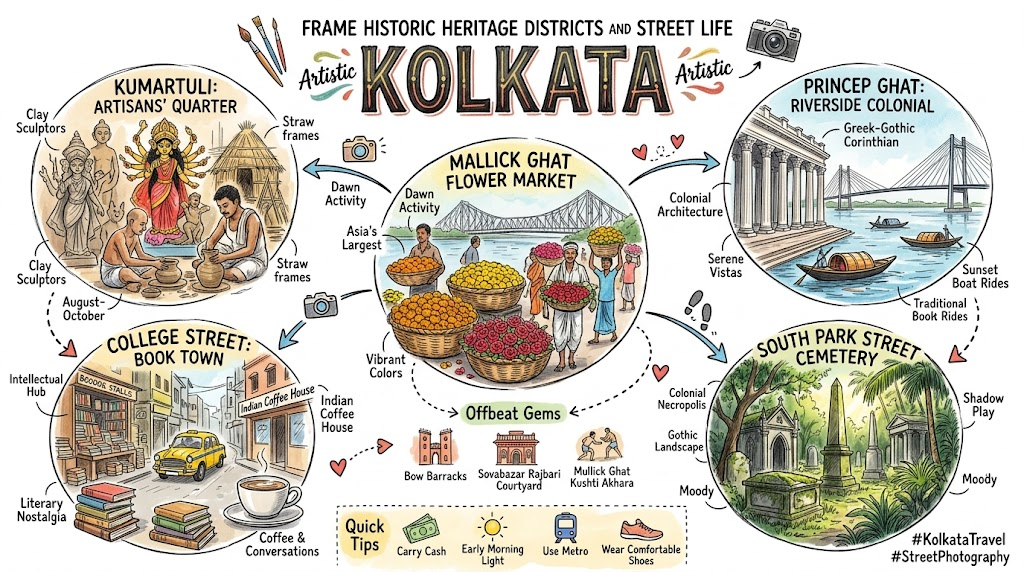
Kumartuli
In the narrow lanes of North Kolkata, generations of master artisans shape sacred idols out of raw Hooghly river clay. Walking through these historic alleys reveals an intimate window into divine craftsmanship, where straw frames gradually transform into breathtaking deities.
The ambient light filtering through bamboo studio roofs creates dramatic shadows across sculpted faces. Photographing here offers a soulful exploration of artistic devotion, sweat, and timeless heritage.
- Location: North Kolkata, 9 km from Howrah Railway Station
- Why it is worth visiting: World-famous traditional potters’ quarter capturing living artistic heritage.
- Best things to do: Document clay idol molding, capture portraits of artisans at work, and explore surrounding wooden alleys.
- Best time to visit: August to October (peak Durga Puja idol preparation) during early morning light.
- Ideal for whom: Street photographers, culture lovers, and portrait specialists.
- Travel tip: Always request permission before taking close-up portraits of working artisans.
Mallick Ghat Flower Market
Operating beneath the soaring iron trusses of the iconic Howrah Bridge, Mallick Ghat is Asia’s largest wholesale flower market. Thousands of flower vendors gather at dawn, creating a kaleidoscope of fiery orange marigolds, red roses, and white jasmine.
The contrast between soft floral textures and the industrial steel bridge backdrop provides dynamic composition options. The morning light reflecting off the Hooghly River elevates the market’s raw energy.
- Location: Strand Road under Howrah Bridge, 1.5 km from Howrah Station
- Why it is worth visiting: A sensory burst of high-density color and chaotic street action.
- Best things to do: Frame flower porters against the bridge, capture morning baths at adjacent ghats, and photograph vibrant flower piles.
- Best time to visit: 5:00 AM to 7:00 AM for peak market activity and soft golden light.
- Ideal for whom: Street photographers, candid action enthusiasts, and color-theory lovers.
- Travel tip: Wear sturdy non-slip footwear as the market lanes remain wet and slick from morning river water.
Princep Ghat
Built along the Hooghly riverbank during the British era, Princep Ghat features Greek Gothic Corinthian columns framed against the modern Vidyasagar Setu cable bridge. It provides one of the most serene riverside perspectives in the city.
During golden hour, traditional wooden dinghies float on shimmering waters, offering classic framing opportunities. It remains an ideal location for landscape and environmental portraiture.
- Location: Strand Road, South Kolkata, 5 km from city center (Esplanade)
- Why it is worth visiting: Perfectly blends colonial architecture with dramatic suspension bridge sunsets.
- Best things to do: Take a sunset wooden boat ride, capture long exposures of Vidyasagar Setu, and frame the illuminated Greek pillars.
- Best time to visit: 4:30 PM to 6:30 PM for sunset hues and twilight illumination.
- Ideal for whom: Architectural photographers, landscape enthusiasts, and pre-wedding portrait creators.
- Travel tip: Rent a private hand-rowed boat for 30 minutes to capture wide water-level shots of the bridge.
College Street
Known locally as ‘Boi Para’ (Book Town), College Street is the world’s largest second-hand book market. Miles of wooden bookstalls line the pavement, stacked to the ceiling with vintage titles, academic books, and rare prints.
Nearby, the historic Indian Coffee House preserves the intellectual spirit of the Bengal Renaissance. The old high-ceiling hall with waiters in traditional uniforms creates a nostaglic visual atmosphere.
- Location: Central Kolkata near Mahatma Gandhi Road crossing
- Why it is worth visiting: Iconic intellectual heartland filled with literary nostalgia and urban texture.
- Best things to do: Photograph towering paper stacks, capture classic coffee house conversations, and shoot passing yellow cabs through narrow lanes.
- Best time to visit: 11:30 AM to 3:00 PM when stabling operations are active and natural light floods stalls.
- Ideal for whom: Documentary photographers, urban storytellers, and vintage enthusiasts.
- Travel tip: Order a cold coffee at the Indian Coffee House balcony for an elevated view of the historic seating hall.
South Park Street Cemetery
Opened in 1767, this heritage colonial necropolis contains overgrown mossy tombs, soaring obelisks, and Gothic mausoleums. Dense tropical foliage creates a quiet atmosphere where sunlight filters through deep green canopy trees.
The interplay of light, shadow, and weathered stone offers dramatic moody compositions. It provides a serene, contemplative escape from the surrounding city bustle.
- Location: Park Street, Central-South Kolkata
- Why it is worth visiting: Eerie, beautiful Gothic landscape architecture covered in overgrown greenery.
- Best things to do: Capture shadow play across mossy obelisks, photograph intricate stone inscriptions, and document rare bird life.
- Best time to visit: 10:00 AM to 12:00 PM for directional sunbeams breaking through canopy trees.
- Ideal for whom: Fine-art photographers, heritage architecture buffs, and moody portrait creators.
- Travel tip: High-level professional video equipment requires a separate permit fee at the main gate.
Offbeat Exploration: Hidden Gems Tourists Miss
Bow Barracks
Hidden behind the bustling Bowbazar police station lies a narrow enclave of red-brick apartment blocks. Home to Kolkata’s Anglo-Indian community, this historic neighborhood features wrought-iron balconies, green wooden shutters, and vintage hanging laundry lines.
The quiet inner courtyards preserve an old-world charm, offering authentic street photography opportunities away from heavy traffic.
Sovabazar Rajbari Courtyard
While tourists flock to main monuments, entering the open-air central courtyard of Sovabazar Rajbari reveals classic 18th-century royal Bengali architecture. High archways, Corinthian columns, and vintage lanterns line the quiet estate.
Visiting during local festival rehearsals provides rare access to traditional rituals inside a historic royal setting.
Mullick Ghat Kushti Akhara
Located along the mud banks near Howrah Bridge, traditional mud-wrestling pits (Akharas) host wrestlers practicing ancient routines at dawn. The early sun illuminating dust, sweat, and muscular forms creates powerful sports and documentary opportunities.
Respectful observation reveals a dedicated physical culture thriving quietly alongside the modern city.
Detailed Practical Guidance for Travelers
| Destination | Standard Entry Fee | General Timings | Best Local Food Options Nearby | Recommended Nearby Attractions |
| Kumartuli | Free | 8:00 AM – 8:00 PM | Mitra Samaj (Kathi Rolls, Fish Fry) | Sovabazar Rajbari, Ahiritola Ghat |
| Mallick Ghat | Free | 4:00 AM – 6:00 PM | Street Kochuri & Chai stalls | Howrah Bridge, Burrabazar |
| Princep Ghat | Free | Open 24 Hours | Ghatside Pav Bhaji & Jhalmuri | St. Paul’s Cathedral, Victoria Memorial |
| College Street | Free | 10:00 AM – 7:30 PM | Indian Coffee House (Mutton Cutlet) | Marble Palace, Calcutta University |
| South Park Street Cemetery | ₹50 per person | 10:00 AM – 5:00 PM | Mocambo & Peter Cat (Park Street) | Quest Mall, Mother House |
Logistics & On-Ground Navigation
Local Transport Options
- Kolkata Metro: Fast and cheap way to cross North-South corridors.
- Yellow Taxis: Iconic vintage cabs ideal for quick street transfers; request meter usage.
- Auto-Rickshaws & E-Rickshaws: Shared routes connecting metro stations to inner neighborhood lanes.
- Ride-Hailing Apps: Uber and Yatri Sathi apps offer reliable fixed-rate pickups across the city.
- Ferry Services: Scenic, low-cost river transport connecting Howrah and Kolkata sides.
Budget Planning
- Backpacker Tier (₹1,000 – ₹1,500 per day): Stays in hostel dorms, street food dining, and public metro/bus transit.
- Mid-Range Comfort Tier (₹3,500 – ₹5,500 per day): Heritage boutique hotels, AC cabs, and dining at established restaurants.
Safety and Inclusivity Tips
- For Families: Footpaths in congested market zones can be tight; stick to spacious areas like Maidan and Princep Ghat during midday hours.
- For Couples: Riverside promenades offer welcoming spaces, but avoid poorly lit isolated park corners late at night.
- General Safety: Keep cameras securely strapped when navigating dense market crowds to prevent accidental bumps.
Strategic Travel Planning Guardrails
Travel Planning Tips for Kolkata
- Schedule early morning photowalks to capture peak golden hour light and manageable street crowds.
- Keep small cash notes (₹10, ₹20, ₹50) ready for quick street food purchases and small vendor transactions.
- Wear light, breathable cotton clothing and comfortable walking shoes for long urban treks.
- Carry a protective waterproof rain cover for camera gear during monsoon months (June to September).
- Use the Yatri Sathi app for hassle-free prepaid cab bookings at major rail stations.
Common Mistakes to Avoid
- Overpacking itineraries: Trying to cross from North Kolkata to South Kolkata during peak rush hour leads to heavy traffic delays.
- Ignoring early morning hours: Missing dawn light at the flower market means skipping the city’s best visual energy.
- Assuming digital payments everywhere: Small tea stalls, flower sellers, and rickshaws operate almost exclusively on cash.
- Skipping local street food: Sticking only to hotel buffets means missing out on legendary Kolkata rolls and sweets.
- Rushing artisan quarter walks: Walking quickly through Kumartuli prevents building authentic rapport with local creators.
Suggested Itinerary Blueprints
1-Day Quick Dash (Heritage Highlights Route)
Targeted at short-stay travelers seeking maximum iconic photo spots in a single daylight window.
Start at 5:30 AM at Mallick Ghat Flower Market for dawn colors beneath Howrah Bridge. Transition to College Street by midday for bookshop photography and lunch at Indian Coffee House. Conclude at Princep Ghat for golden hour river boat rides and lit suspension bridge framing.
2-Day Deep-Dive (North-South Contrast Route)
Designed for visual creators who want a balanced contrast between North Kolkata’s historical texture and South Kolkata’s leafy colonial zones.
- Day 1: Explore North Kolkata’s clay lanes in Kumartuli, wander Sovabazar Rajbari, and photograph yellow taxis along Central Avenue at dusk.
- Day 2: Walk through South Park Street Cemetery in the morning, explore the Victoria Memorial gardens, and capture sunset at Maidan.
Complete Weekend Travel Plan (Ultimate Photographer Loop)
An immersive three-day journey covering markets, sub-cultures, and riverside vistas.
- Friday: Arrive and spend late afternoon photographing low-angle tram tracks near Esplanade, followed by dinner on Park Street.
- Saturday: Early morning at Mallick Ghat Flower Market and wrestling akharas. Midday at College Street book stalls. Evening at Princep Ghat for blue-hour shots.
- Sunday: Early morning portrait sessions in Kumartuli, afternoon photowalk around Anglo-Indian Bow Barracks, and sunset street photography at Maidan.
Common Tourist Mistakes to Avoid
- Geographic Blunders: Combining North Kolkata (Kumartuli) and Deep South Kolkata (Rabindra Sarovar) on the same afternoon creates unnecessary transit fatigue. Group your activities by geographical zones.
- Commercial Traps: Spending prime shooting hours inside air-conditioned modern shopping malls deprives you of capturing the city’s rich street culture.
- Neglecting Modern/Alternative Zones: Focusing exclusively on decaying colonial structures misses out on vibrant art cafes and street art murals in Southern neighborhoods.
- Transport Overpayment: Accepting unmetered taxi quotes without checking app estimates first leads to unnecessary transport costs.
- Luxury Dining Bias: Relying solely on fine-dining restaurants skips out on Kolkata’s soul-stirring street gastronomy, from hot kachoris to aromatic biryani.
Frequently Asked Questions
1. What is the single best time of day for photography in Kolkata?
Early morning between 5:30 AM and 8:00 AM offers the best natural light, soft mist along river banks, and lively market activity before traffic congestion builds.
2. Are camera permits required at major Kolkata photography locations?
Most public street locations, ghats, and open markets are completely free for handheld photography. However, heritage sites like South Park Street Cemetery charge small nominal camera entry fees.
3. Is street photography safe in Kolkata’s crowded markets?
Yes, Kolkata is widely regarded as one of India’s safest metros for travelers. Locals are generally warm and receptive toward street photography. Always remain mindful of your belongings in dense crowds.
4. Can I photograph the artisans inside Kumartuli year-round?
Artisans work inside their studios throughout the year molding diverse seasonal idols. However, August through October provides the highest density of clay sculpting activity leading up to Durga Puja.
5. How do I get clean shots of yellow taxis without heavy traffic obstruction?
Focus on quieter North Kolkata lanes around Shyambazar or open expanses near Maidan during early Sunday mornings. This allows clean framing of vintage cabs against historic backdrops.
6. Which month offers the most vibrant visual experiences in the city?
October is exceptional due to Durga Puja celebrations when the entire city transforms into an massive open-air art installation filled with light and color.
7. Are professional tripods allowed at Princep Ghat and Victoria Memorial?
Handheld photography is freely permitted. Setting up heavy commercial tripods at Victoria Memorial lawn or heritage platforms may require prior clearance from venue authorities.
8. What lens focal length is recommended for Kolkata street photography?
A versatile 24-70mm lens handles broad architectural perspectives and tight market frames well. Alternatively, a 35mm or 50mm prime lens offers lightweight street mobility.
9. How do I travel efficiently between North and South Kolkata photo spots?
The Kolkata Metro rail system is the fastest way to travel between northern hubs (Shyambazar/Sovabazar) and southern points (Park Street/Rabindra Sadan), bypassing surface traffic congestion.
10. Is photography permitted inside the Indian Coffee House on College Street?
Casual handheld photography from your dining table is generally welcomed. Avoid disrupting busy waitstaff carrying trays along the narrow dining aisles.
11. What are the best photography spots near the Hooghly River?
Mallick Ghat Flower Market, Babu Ghat, and Princep Ghat offer rich riverfront frames combining historic piers, ferry movement, and suspension bridge backdrops.
12. How should photowalkers approach local residents for portrait shots?
A friendly smile, a gentle nod, and a polite gesture showing your camera works wonders. Showing the captured image on your screen often builds instant warm connections.
Conclusion
Photographing Kolkata rewards travelers who slow down and observe the extraordinary moments woven into everyday life. Unlike destinations built around staged tourist attractions, this city offers an authentic, soulful journey where history, art, and human emotion converge seamlessly. Pack your camera, embrace the vibrant urban rhythm, and let Kolkata reveal its timeless visual stories to your lens.