Introduction
While modern megacities often empty a traveler’s wallet on sterile entry passes and overpriced cabs, Kolkata stands out as a haven of authentic, accessible travel. It invites visitors into living history without commercial pretense, contrasting sharply with artificial and hyper-commercialized vacation destinations. Here, century-old trams clatter down leafy boulevards, roadside kettles simmer with aromatic spiced tea for pocket change, and grand public squares welcome curious wanderers without an entry fee. Exploring on a shoestring budget here is not an exercise in compromise; it is the most rewarding way to experience the city’s intellectual soul.
Why Kolkata is a must-visit city
Kolkata holds an essential place in Indian travel as the intellectual powerhouse of the nineteenth-century Bengal Renaissance and the former seat of the British Raj. Set beside the sacred Hooghly River, its geographical layout balances sprawling riverfront ghats with colonial avenues and maze-like artistic alleys. Getting here is straightforward and affordable, served by Netaji Subhas Chandra Bose International Airport alongside Howrah and Sealdah, two of the busiest and best-connected railway termini in Asia. Whether you are a solo backpacker, a heritage researcher, or a family traveling thoughtfully, the city provides an unmatched ratio of cultural depth to daily expenditure.
The core travel circuit connects three distinct zones: the stately colonial monuments of Maidan and Esplanade, the bohemian craft lanes of North Kolkata, and the calm residential retreats of South Kolkata. Navigating between them requires only a handful of rupees on public ferries and subterranean metro trains.
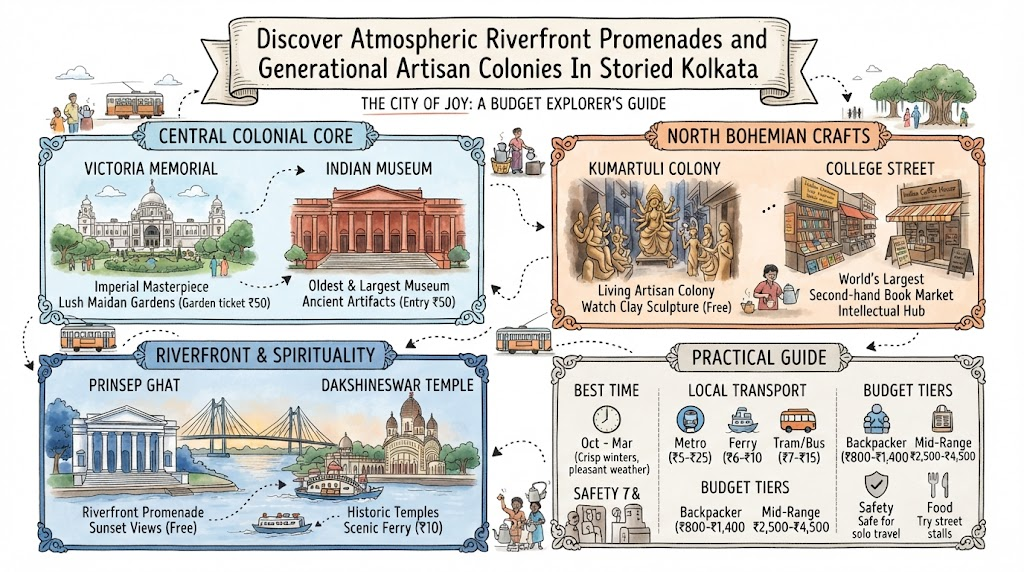
| Metric | Details |
|---|---|
| Geographic Hub | Eastern India (Lower Gangetic Plain) |
| Prime Travel Months | October through March (Mild, pleasant winters) |
| Primary Transit Gateways | Howrah Station (HWH), Sealdah Station (SDAH), Netaji Subhas Chandra Bose Airport (CCU) |
| Transit Costs | Metro: ₹5–₹25; Ferry: ₹6–₹10; Tram/Bus: ₹7–₹15 |
| Suggested Stay Length | 3 to 5 Full Days |
Best Places or Experiences
Victoria Memorial and Maidan Environs
Commissioned in 1906 and completed in 1921, the Victoria Memorial is an imperial masterpiece of brilliant white Makrana marble designed by William Emerson. Blending British and Mughal architectural traditions, this domed landmark stands in the middle of lush gardens that double as the city’s central green gathering space. The interior galleries hold a remarkable archive of colonial paintings, rare manuscripts, and period sculptures.
For the budget traveler, the true magic lies in the surrounding Maidan, Kolkata’s vast public commons. You can sit beside local chess players beneath banyan trees, watch amateur cricketers practice their swing, and view the monument’s exterior from the manicured perimeter gardens for a nominal garden ticket.
Victoria Memorial surrounded by emerald gardens.
- Location: Queens Way, Maidan, Central Kolkata (approx. 4 km south of Howrah Station).
- Why it is worth visiting: Exceptional Indo-Saracenic marble architecture surrounded by a vibrant, free-to-access public urban park.
- Best things to do: Admire the Royal Gallery paintings, stroll the sixty-four acres of lush gardens, and watch the sun set over the Maidan.
- Best time to visit: Early morning (6:30 AM to 9:00 AM) for cool weather and fewer crowds; late afternoon for soft golden light.
- Ideal for whom: History buffs, budget sightseers, and architectural photographers.
- Travel tip: Purchase a ₹50 garden-only ticket if you want to skip museum room queues and spend your afternoon relaxing outdoors.
Indian Museum on Jawaharlal Nehru Road
Founded in 1814 under the direction of Danish botanist Nathaniel Wallich, the Indian Museum is the oldest and largest multidisciplinary museum in the Asia-Pacific region. Housed inside an imposing neoclassical colonnaded mansion surrounding a central grassy quadrangle, the institution holds over one hundred thousand cataloged artifacts spanning paleontology, archeology, geology, and fine art.
Walking through its breezy, high-ceilinged corridors feels like stepping back into nineteenth-century scholarship. The archeological gallery displays rare Ashokan pillars, Gandhara Buddhist sculptures, and an authentic four-thousand-year-old Egyptian mummy, delivering an extraordinary historical survey for a modest entry fee.
Historic colonnaded corridors of the Indian Museum.
- Location: Jawaharlal Nehru Road, Park Street area, Central Kolkata (Park Street Metro Station exit).
- Why it is worth visiting: The cradle of Indian museum curation, offering immense historical collections at an accessible entry price.
- Best things to do: View the Gandhara Buddhist sculptures, study the Egyptian mummy, and photograph the sunny inner quadrangle.
- Best time to visit: Weekday mornings right at opening (10:00 AM) to beat school tours.
- Ideal for whom: Students, cultural researchers, and curious backpackers.
- Travel tip: Leave large backpacks in your hotel locker; cloakroom queues at the gate can cost you thirty minutes during peak hours.
Prinsep Ghat and Hooghly Riverfront
Constructed in 1841 in memory of Anglo-Indian scholar and antiquarian James Prinsep, this Palladian portico rests serenely along the eastern bank of the Hooghly River. With its fluted Ionian pillars, the monument pays homage to classical European river architecture while serving as a community hub for modern locals. The modern Vidyasagar Setu suspension bridge rises directly behind it, creating a striking contrast between old and new engineering.
The riverside promenade provides miles of paved, tree-lined walking paths without costing a single rupee. You can watch traditional wooden country boats navigate the currents, listen to passing vendors call out roasted treats, and enjoy the cooling river breeze as dusk settles over the water.
Prinsep Ghat resting beneath Vidyasagar Setu.
- Location: Strand Road, Hastings, Central-West Kolkata (approx. 5 km from Esplanade).
- Why it is worth visiting: Panoramic river views, peaceful open-air seating, and classical architecture with zero admission charge.
- Best things to do: Walk along the riverfront to Millennium Park, listen to live acoustic music played by locals, and share roadside chai.
- Best time to visit: 4:30 PM to 7:00 PM for scenic sunsets and breezy river views.
- Ideal for whom: Couples, budget travelers, and street photographers.
- Travel tip: Instead of renting a private rowboat, board the government passenger ferry from the nearby jetty to cross the river for less than ten rupees.
Kumartuli Clay Artisans Colony
Kumartuli is a traditional potters’ quarter in North Kolkata that has nurtured the art of sacred clay sculpture for nearly three centuries. Tucked along narrow, maze-like alleys, hundreds of generational artisan families take alluvial mud directly from the riverbed to shape life-sized effigies of Hindu deities. The smell of wet earth, raw jute, and straw creates an unforgettable sensory experience.
Visitors can walk freely through these workshop corridors, watching sculptors shape raw clay over bamboo skeletons before hand-painting the fine details of Goddess Durga. This open-air studio provides a genuine look into community-driven folk craft without tickets, gift shops, or tourist barriers.
Clay sculptors at work in Kumartuli.
- Location: Kumartuli, Sovabazar, North Kolkata (approx. 500 meters from Sovabazar Sutanuti Metro Station).
- Why it is worth visiting: An unvarnished living craft colony where world-renowned clay sculptures are fashioned entirely by hand.
- Best things to do: Watch master artisans sculpt clay faces, capture documentary photos, and explore the old neighborhood lanes.
- Best time to visit: August through October during the peak sculpting season, preferably between 10:00 AM and 2:00 PM.
- Ideal for whom: Documentary photographers, art historians, and cultural enthusiasts.
- Travel tip: Always ask permission before photographing individual artists inside their small, private workshops.
Dakshineswar Kali Temple and Belur Math Circuit
Built in 1855 by the philanthropist Rani Rashmoni on the eastern bank of the Hooghly, the Dakshineswar Temple is a nine-spire compound dedicated to Bhavatarini, an aspect of Goddess Kali. The sanctuary gained global renown through the nineteenth-century mystic Ramakrishna Paramahamsa, who served as its head priest. Across the river stands Belur Math, the headquarters of the Ramakrishna Mission, founded by Swami Vivekananda to blend Christian, Islamic, and Hindu architectural elements into a symbol of universal harmony.
Traveling between both spiritual centers is an affordable adventure in its own right. A ten-minute public ferry links the two riverbanks across the wide Hooghly, giving you a relaxing water cruise for only a few coins.
Riverside sanctum of Dakshineswar Kali Temple.
- Location: Dakshineswar (North Suburban Kolkata) and Belur (Howrah bank), linked across the river.
- Why it is worth visiting: Two historic pilgrimage sites joined by a scenic, inexpensive public ferry ride.
- Best things to do: Walk the quiet courtyards of Belur Math, view the twelve Shiva riverfront shrines at Dakshineswar, and cross the Hooghly by ferry.
- Best time to visit: 6:30 AM to 10:30 AM before afternoon temple closures and midday heat.
- Ideal for whom: Spiritual seekers, architectural buffs, and budget families.
- Travel tip: Leave shoes and mobile phones in the official free cloakroom counters before stepping onto the temple paths.
College Street Book Market (Boi Para)
College Street, known locally as Boi Para (Book Neighborhood), is the largest second-hand book market in the world, stretching for nearly a mile along historic university facades. Wooden bookstalls lean against the walls of Presidency University and Calcutta University, their shelves packed with rare first editions, vintage classics, and academic volumes. The air carries the rich scent of aged paper and printer’s ink.
At the center of this literary district sits the legendary Indian Coffee House, where generations of poets, filmmakers, and philosophers gathered to debate over cheap coffee and savory cutlets. Browsing the towering book collections and soaking in the lively conversation costs virtually nothing.
- Location: College Street, Central-North Kolkata (accessible via Central or Mahatma Gandhi Road Metro Stations).
- Why it is worth visiting: An authentic literary street bazaar with miles of book stalls and a storied intellectual heritage.
- Best things to do: Hunt for vintage out-of-print books, order an infusion black coffee at the Indian Coffee House, and admire Presidency University’s historic facade.
- Best time to visit: 11:30 AM to 5:00 PM (Monday through Saturday; stalls close on Sundays).
- Ideal for whom: Readers, collectors, students, and curious urban walkers.
- Travel tip: Practice polite bargaining when buying second-hand paperbacks, but respect fixed prices for rare vintage volumes.
Offbeat Exploration: Hidden Gems Tourists Miss
South Park Street Cemetery
Opened in 1767, this moss-covered necropolis holds one of the earliest non-churchyard burial grounds in the world. Towering Gothic pyramids, classical Grecian urns, and Roman sarcophagi rise under a heavy canopy of tropical ferns and wild fig trees. It provides a peaceful sanctuary away from the roar of the city, with a nominal maintenance fee of around twenty rupees.
Mullick Ghat Flower Market at Dawn
Resting directly beneath the eastern edge of Howrah Bridge, Mullick Ghat is the largest wholesale flower market in Asia. Before sunrise, thousands of flower farmers bring vibrant orange marigold garlands, blue lotuses, and fragrant jasmine into this covered bazaar. Walking through the fragrant aisles is completely free and offers one of the most vivid sensory scenes in India.
Bow Barracks Anglo-Indian Enclave
Tucked behind Bowbazar, this cluster of red-brick apartment blocks was originally built as military barracks during World War I and later became home to Kolkata’s Anglo-Indian community. Walking down its quiet central lane reveals louvered green shutters, vintage bicycles, and a close-knit neighborhood rhythm that feels untouched by modern high-rises.
Detailed Practical Guidance for Travelers
| Destination | Standard Entry Fee | General Timings | Best Local Food Options Nearby | Recommended Nearby Attractions |
|---|---|---|---|---|
| Victoria Memorial | ₹50 (Garden), ₹500 (Foreigners) | 10:00 AM – 5:00 PM (Gardens 5:30 AM) | Nizam’s Kathi Rolls, roadside Phuchka | St. Paul’s Cathedral, Maidan, Nandan |
| Indian Museum | ₹50 (Indians), ₹500 (Foreigners) | 10:00 AM – 5:00 PM (Closed Mon) | Kasturi Bengali Cuisine, Mocambo Snacks | New Market, Park Street, Asiatic Society |
| Prinsep Ghat | Free | Open 24 Hours (Best till 9:00 PM) | Badami tea, roadside Pav Bhaji, Kulfi | Vidyasagar Setu, Eden Gardens |
| Kumartuli | Free | 8:00 AM – 7:00 PM | Mitra Cafe Kabiraji, sweet Sondesh | Sovabazar Rajbari, Bagbazar Ghat |
| Dakshineswar Temple | Free | 6:00 AM – 12:30 PM, 3:30 PM – 8:30 PM | Temple khichuri prasad, Kochuri stalls | Belur Math (via ₹10 river ferry) |
| College Street | Free | 10:30 AM – 7:30 PM (Closed Sun) | Indian Coffee House, Paramount Sherbets | Calcutta University, Marble Palace |
Logistics & On-Ground Navigation
Local Transport Options
- Kolkata Metro: India’s first underground railway network remains its most affordable and efficient transit option, with single rides costing between ₹5 and ₹25.
- Hooghly River Ferries: Operated by the inland water transport board, scenic river ferries connect major ghats (such as Howrah, Fairlie, and Babughat) for only ₹6 to ₹10 per trip.
- Government & Private Buses: Blue, yellow, and state transport buses run across all major roads with fares starting at just ₹7.
- Electric Trams: Heritage trams still run along select heritage routes, offering an old-world commute through central avenues for ₹10.
- Shared Auto-Rickshaws: Operating on fixed point-to-point routes, shared autos link metro stations with neighborhood alleys for ₹12 to ₹20 per seat.
Budget Planning
- Backpacker Tier (₹800 – ₹1,400 per day): Stay in a shared dormitory around Sudder Street or Salt Lake (₹400–₹700), use the metro and walking routes (₹50), and enjoy street breakfasts and local rice plates (₹350–₹500).
- Mid-Range Comfort Tier (₹2,500 – ₹4,500 per day): Stay in a clean guesthouse or heritage homestay (₹1,800–₹2,800), combine app-based cabs with metro rides (₹400), and dine at heritage cafes and family-run restaurants (₹800–₹1,200).
Safety and Inclusivity Tips
- Families: Stick to daytime metro routes and open parks like the Maidan; keep a bottle of clean drinking water on hand during long walks.
- Couples: Public spaces such as Prinsep Ghat and Victoria Memorial are welcoming and safe; avoid poorly lit, deserted sections of large parks late at night.
- General Safety: Kolkata has consistently ranked among India’s safest metropolitan cities for solo and women travelers. Keep ordinary urban awareness in mind when walking through crowded markets like New Market.
Strategic Travel Planning Guardrails
Travel Planning Tips for Kolkata
- Always keep twenty- and fifty-rupee notes handy, as small tea stalls and local transport conductors rarely accept large currency or mobile payments.
- Carry a lightweight cotton scarf to cover your head and shoulders when stepping into traditional places of worship.
- Pack durable, broken-in walking shoes to easily handle uneven heritage flagstones and busy sidewalks.
- Arrange your travel between November and February to enjoy crisp, dry, and walkable winter weather.
- Download offline maps for North and Central Kolkata to navigate narrow neighborhood alleys when cell coverage drops.
- Pick up an electronic smart card at any metro station counter for a modest deposit to skip ticket token queues entirely.
Common Mistakes to Avoid
- Hailing an unmetered yellow taxi right outside railway stations without asking the driver to use the meter or cross-checking app fares.
- Planning museum visits or College Street book shopping on Mondays and Sundays when several major institutions remain closed.
- Staying exclusively inside air-conditioned cabs, which cuts you off from the sights and sounds of historic streets.
- Avoiding street food entirely out of caution; opt for busy vendors with rapid turnover where food is prepared fresh right in front of you.
- Packing heavy clothing outside the short December-to-January winter window, as the rest of the year stays quite warm and humid.
- Trying to cram distant North and South sights into a single half-day trip, which leaves you stuck in peak-hour traffic.
Suggested Itinerary Blueprints
1. Day Quick Dash (Central Heritage Express)
- Target Audience: Business travelers, short layover visitors, or weekend wanderers.
- Morning: Tour the Indian Museum right at opening, followed by a walk across the green Maidan to photograph the Victoria Memorial exterior.
- Afternoon: Head to College Street for book hunting and lunch at the Indian Coffee House.
- Evening: Catch the sunset at Prinsep Ghat with a warm clay cup of spiced tea along the water.
2. Day Deep-Dive (North-South Cultural Immersion)
- Day 1 (Old Calcutta & Artisans): Start early at the Mullick Ghat Flower Market, walk through Kumartuli’s sculpting workshops, tour Sovabazar Rajbari, and take an evening ferry across to Howrah.
- Day 2 (Colonial Core & South Arts): Explore St. Paul’s Cathedral and the Victoria Memorial gardens, browse South Park Street Cemetery, and spend a quiet evening along the cafes of Southern Avenue.
3. Complete Weekend Travel Plan (The Complete Heritage Loop)
- Friday Afternoon/Evening: Arrive, settle into your accommodation near Central Kolkata, and spend a relaxing evening sampling sweets along the street markets of Bowbazar.
- Saturday (The River & Spiritual Circuit): Take an early morning train or metro to Dakshineswar Kali Temple, cross the Hooghly by local passenger ferry to Belur Math, and return south for sunset at Prinsep Ghat.
- Sunday (Literary & Cultural Feast): Browse the stalls of College Street, enjoy a traditional Bengali lunch at an authentic mess cafe, visit the Indian Museum, and conclude with an evening stroll through the open grounds of the Maidan.
Common Tourist Mistakes to Avoid
Geographic Blunders
Attempting to combine a morning visit at Dakshineswar in the far north with an afternoon stroll at Kalighat or Dhakuria Lake in the deep south on the same afternoon creates unnecessary transit headaches. Group your days strictly into northern, central, and southern sightseeing clusters.
Commercial Traps
Spending your travel budget inside gleaming suburban malls in Salt Lake or Rajarhat wastes valuable time on chain stores found anywhere in the world. Spend your days instead in historic neighborhood markets like Gariahat, New Market, or Hatibagan.
Neglecting Modern/Alternative Zones
Many visitors focus exclusively on colonial heritage while skipping the vibrant modern neighborhoods of South Kolkata. Areas like Hindustan Park and Southern Avenue offer quiet, leafy lanes, independent art galleries, and charming neighborhood cafes that show the city’s contemporary character.
Transport Overpayment
Accepting high flat-rate quotes from yellow taxi drivers waiting outside railway gates is a common pitfall. Always ask drivers to use the official meter, look for pre-paid taxi booths, or book via ride-sharing apps to guarantee a fair price.
Look for the official pre-paid taxi booths outside Howrah and Sealdah stations, or use the local Yatri Sathi app for fair, regulated cab fares without negotiation.
Luxury Dining Bias
Eating all your meals in five-star hotel dining rooms misses the culinary heart of Bengal. You will find the city’s most authentic flavors at historic street-side counters serving piping-hot Kathi rolls, flaky fish fry, and clay pots of fresh Sondesh for a fraction of the cost.
Frequently Asked Questions
1. How cheap is daily local transport in Kolkata for a budget tourist?
Local transit in Kolkata is among the most affordable in the world. A single ride on the underground metro costs between ₹5 and ₹25, while cross-river passenger ferries cost only ₹6 to ₹10. Regular public buses start at ₹7, meaning you can easily explore the entire city for less than ₹70 to ₹100 per day.
2. Which neighborhood offers the best low-cost accommodation for solo travelers?
Sudder Street and the adjacent New Market area have traditionally served as the backpacker hub, offering budget guesthouses and dorm beds. Alternatively, residential neighborhoods like Gariahat and Salt Lake provide clean, reasonably priced homestays with direct, easy connections to central metro lines.
3. Are street-side food stalls in Kolkata safe to eat at on a budget?
Yes, street food in Kolkata is generally fresh, tasty, and reliable if you pick stalls with heavy foot traffic and quick turnover. Choose busy vendors who prepare their dishes over high heat right before you. For safety, always drink bottled or filtered water and skip raw vegetable garnishes.
4. What is the cheapest way to experience a boat ride along the Hooghly River?
Instead of booking an expensive private tourist boat, take the public commuter ferry from Prinsep Ghat, Babughat, or Fairlie Ghat across the river to Howrah. These scenic passenger rides cost only ₹6 to ₹10, offering wide river views and gentle breezes without private charter costs.
5. Can tourists enter the Victoria Memorial grounds without paying high museum fees?
Yes, visitors can buy a garden-only entry ticket for ₹50 at the gate counters. This provides complete access to the expansive sixty-four-acre manicured grounds, picturesque reflecting pools, and unobstructed exterior views of the marble monument without paying the higher gallery admission.
6. What free cultural attractions can travelers visit in Kolkata?
Kolkata features several premier attractions with no entrance fee. You can walk through the artisan workshops of Kumartuli, browse the endless book displays along College Street, visit the flower markets at Mullick Ghat, and explore the spacious green grounds of the Maidan without spending a single rupee.
7. How much daily budget is needed for an authentic culinary trip in Kolkata?
A food lover can eat exceptionally well on ₹300 to ₹500 per day. That budget easily covers a morning breakfast of kochuri and chai for ₹40, a hearty midday fish or vegetable rice plate for ₹120, an evening Kathi roll for ₹60, and classic sweets like mishti doi for ₹40.
8. Is the Kolkata Metro smart card useful for short three-day visits?
Yes, purchasing a rechargeable smart card from a station counter saves you from waiting in line for individual paper tokens during busy commute hours. Any unused balance, excluding the small card deposit, can be used across all operational metro routes throughout your stay.
9. Are second-hand books at College Street open to price negotiation?
Yes, polite bargaining is normal when purchasing used academic books and second-hand paperbacks from the roadside pavement stalls. In contrast, established, historic bookshops and rare antiquarian sellers generally maintain fixed prices that reflect the collectible value of their volumes.
10. What is the best way to avoid overpaying for taxis at Howrah Railway Station?
Avoid private drivers offering flat rates inside the station concourse. Walk directly out to the official Kolkata Police pre-paid taxi booth, or use regional ride-hailing apps like Yatri Sathi or Uber to book trips with clear, regulated, and transparent pricing.
11. When are Kolkata’s major public museums and libraries closed to the public?
Most government-run museums, including the Indian Museum, Victoria Memorial indoor galleries, and the National Library, are closed to visitors on Mondays and major national holidays. Make sure to schedule your museum visits between Tuesday and Sunday to avoid arriving at closed doors.
12. Is it customary to leave tips at budget eateries and cafes in Kolkata?
Tipping is not strictly mandatory at roadside stalls, food carts, or small neighborhood mess cafes. However, rounding up the bill or leaving a small tip of ₹10 to ₹20 is a welcome gesture of appreciation for friendly and hardworking service staff.
Conclusion
Exploring Kolkata on a budget is an enriching cultural journey that connects you with the living soul of one of India’s most evocative cities. By choosing historic trams over closed cars, river ferries over tour cruises, and open bookstalls over commercial malls, you trade artificial sightseeing for genuine human connection. The true reward of this journey lies in slow, thoughtful discovery, leaving you with lasting memories that cost remarkably little.