Introduction
The modern engineering landscape is shifting rapidly toward the intersection of machine learning and traditional operational excellence. This guide explores the MLOps Certified Professional (MLOCP), a rigorous program designed for those ready to bridge the gap between data science and production-grade engineering. Whether you are coming from a DevOps, SRE, or aiopsschool background, understanding how to operationalize AI is no longer an optional skill; it is a fundamental requirement for the next generation of platform engineering. This comprehensive breakdown serves as a roadmap for professionals seeking to validate their expertise and lead high-impact technical initiatives within their organizations.
What is the MLOps Certified Professional (MLOCP)?
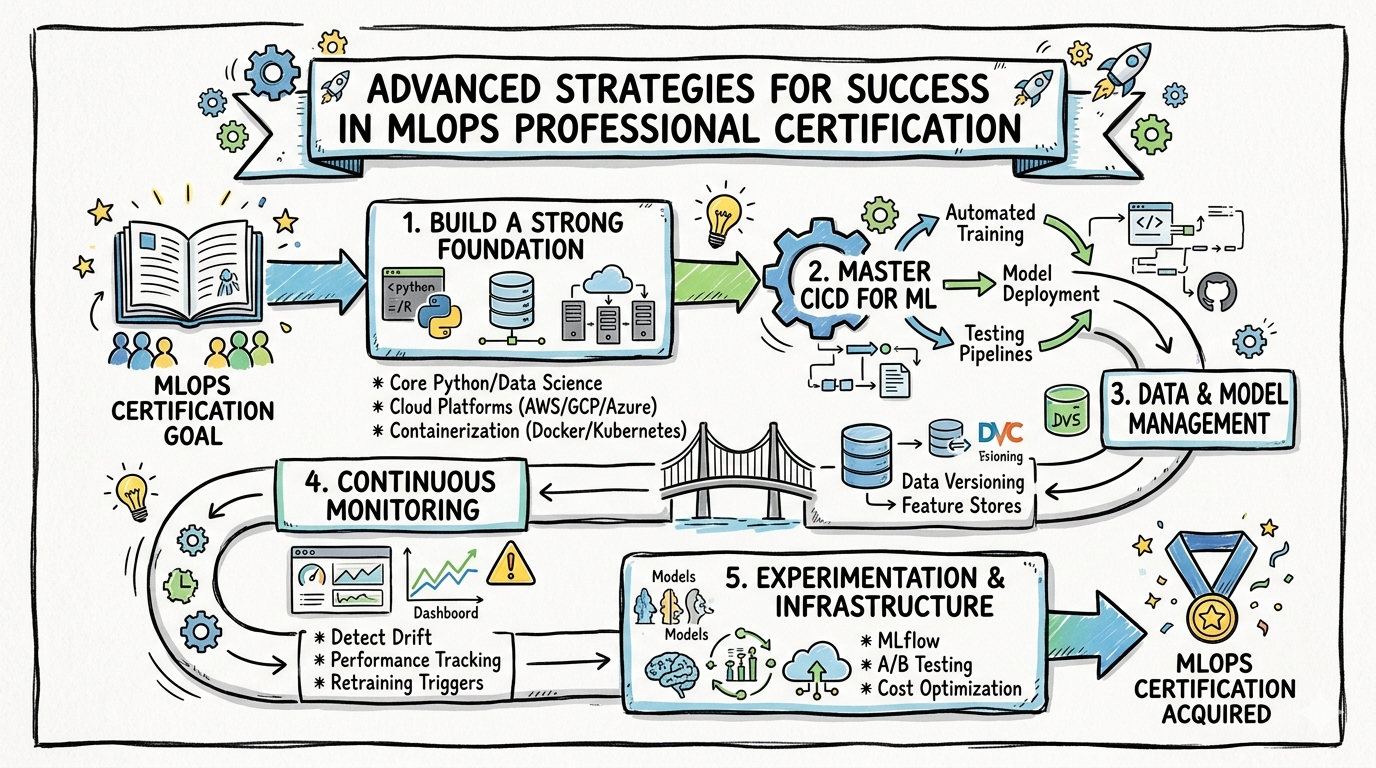
The MLOps Certified Professional (MLOCP) is a professional designation that signifies a practitioner’s ability to manage the entire lifecycle of machine learning models in a production environment. Unlike theoretical courses that focus solely on model building, this certification emphasizes the “Ops” in MLOps—focusing on CI/CD for ML, automated testing, and model monitoring. It represents a shift from manual, artisanal model deployment to scalable, reproducible, and reliable engineering workflows. For the modern enterprise, this certification ensures that engineers can treat ML code with the same rigor and systematic approach as any other mission-critical software.
Who Should Pursue MLOps Certified Professional (MLOCP)?
This certification is tailored for mid-to-senior level professionals who are already familiar with cloud infrastructure and software development but want to specialize in machine learning operations. It is highly beneficial for DevOps Engineers looking to expand into data-centric roles, SREs tasked with maintaining ML-driven services, and Data Scientists who want to understand the deployment side of their work. In India’s growing tech hubs and across the global market, engineering managers and technical leaders also pursue this to better manage teams building AI-powered products. It serves as a bridge for anyone responsible for the reliability and scalability of intelligent systems.
Why MLOps Certified Professional (MLOCP)
As organizations move past the “experimental” phase of AI, the demand for stable, repeatable delivery systems has skyrocketed. The MLOps Certified Professional (MLOCP) provides the framework to survive and thrive despite the constant churn of specific tools or frameworks. By mastering the underlying principles of model governance and pipeline automation, you ensure your skills remain relevant even as the industry evolves. This certification acts as a signal to employers that you possess the discipline to reduce “technical debt” in ML systems, which is currently one of the biggest challenges in enterprise software.
MLOps Certified Professional (MLOCP) Certification Overview
The program is delivered via the official course page and is hosted on the devopsschool platform. It is structured as a comprehensive journey that moves from foundational infrastructure concepts to advanced topics like model drift detection and automated retraining. The assessment approach is practical, often involving laboratory environments where candidates must solve real-world configuration and deployment challenges. This ensures that the credential represents actual hands-on capability rather than just the ability to pass a multiple-choice exam. The ownership of the program lies with industry veterans who update the curriculum to reflect current production standards.
MLOps Certified Professional (MLOCP) Certification Tracks & Levels
The certification is structured to support different career stages, starting with a Foundation level for those new to the ecosystem. The Professional level targets practitioners who handle daily deployments and pipeline management, while the Advanced level is reserved for architects designing complex, multi-cloud ML platforms. Specialized tracks are often integrated to allow professionals to align their certification with their specific domain, such as focusing on the security aspects of ML or the financial optimization of cloud-heavy training workloads. This tiered approach allows for a logical career progression, moving from individual contributor to high-level system designer.
Complete MLOps Certified Professional (MLOCP) Certification Table
| Track | Level | Who it’s for | Prerequisites | Skills Covered | Recommended Order |
| Core Operations | Foundation | Junior Engineers | Basic Linux & Python | Git, CI/CD, Containerization | 1 |
| Implementation | Professional | DevOps/Data Engineers | Foundation Level | Jenkins, Docker, MLflow | 2 |
| Architecture | Advanced | Senior Architects | Professional Level | Scalability, Model Monitoring | 3 |
| Security | Specialist | Security Engineers | Core DevOps Knowledge | DevSecOps, Model Governance | 4 |
Detailed Guide for Each MLOps Certified Professional (MLOCP) Certification
MLOps Certified Professional (MLOCP) – Foundation Level
What it is
This certification validates a candidate’s understanding of basic MLOps terminology and the fundamental differences between traditional software and ML models. It ensures the practitioner can navigate the basic tools used in a modern data pipeline.
Who should take it
It is suitable for software developers, junior DevOps engineers, or recent graduates who want to enter the world of machine learning operations with a solid conceptual base.
Skills you’ll gain
- Understanding the ML Lifecycle
- Version control for data and code
- Basic containerization with Docker
- Fundamentals of CI/CD pipelines
Real-world projects you should be able to do
- Set up a basic Git repository for an ML project
- Build a Docker image for a simple Python model
- Configure a basic automated build process
Preparation plan
- 7–14 days: Focus on high-level concepts, terminology, and the history of MLOps through official documentation.
- 30 days: Begin hands-on labs with Git and Docker, ensuring you can deploy a static model locally.
- 60 days: Perform full end-to-end mock exams and refine your understanding of data versioning concepts.
Common mistakes
- Over-focusing on ML algorithms instead of the deployment infrastructure.
- Ignoring the importance of data versioning compared to code versioning.
Best next certification after this
- Same-track: MLOps Professional Level
- Cross-track: Cloud Associate Certification
- Leadership: IT Project Management
MLOps Certified Professional (MLOCP) – Professional Level
What it is
The Professional level validates the ability to build and maintain production-ready ML pipelines. It confirms that you can automate the training, testing, and deployment of models at scale.
Who should take it
Experienced DevOps engineers, SREs, and Data Engineers who are responsible for the daily uptime and deployment of machine learning services in an enterprise.
Skills you’ll gain
- Advanced CI/CD for Machine Learning
- Infrastructure as Code (IaC) for ML platforms
- Automated model testing and validation
- Working with MLflow or Kubeflow
Real-world projects you should be able to do
- Create a Jenkins or GitLab CI pipeline for automated retraining
- Deploy a model to a Kubernetes cluster with auto-scaling
- Implement automated unit tests for data schemas
Preparation plan
- 7–14 days: Review advanced CI/CD patterns and Infrastructure as Code basics.
- 30 days: Deep dive into container orchestration and model registry tools like MLflow.
- 60 days: Build a complete production-grade pipeline from scratch as a final capstone project.
Common mistakes
- Neglecting security protocols within the ML pipeline.
- Failing to account for resource limits in containerized environments.
Best next certification after this
- Same-track: MLOps Advanced Level
- Cross-track: Certified DevSecOps Professional
- Leadership: Engineering Manager Certification
Choose Your Learning Path
DevOps Path
This path focuses on integrating ML into existing software delivery pipelines. Engineers learn to treat the model as a software artifact, applying standard DevOps principles like automated testing and deployment. It is ideal for those who want to ensure that ML does not become a bottleneck in the release cycle.
DevSecOps Path
The security path emphasizes the protection of the ML pipeline and the models themselves. It covers topics like data privacy, model poisoning prevention, and secure API access. This is critical for engineers working in regulated industries like finance or healthcare.
SRE Path
The Site Reliability Engineering path focuses on the observability and stability of ML systems. Practitioners learn to define SLIs and SLOs specifically for model performance and system latency. The goal is to ensure that ML services are as reliable as any other microservice in the stack.
AIOps Path
This path involves using machine learning to improve IT operations themselves. Engineers learn to implement anomaly detection and automated incident response using AI tools. It is a meta-approach where ML is used to manage the very infrastructure that hosts it.
MLOps Path
The dedicated MLOps path is the core journey for this certification. It focuses purely on the intersection of data science and operations, mastering the specific tools and cultures needed for model lifecycle management. It is the most direct route to becoming a specialist in the field.
DataOps Path
DataOps focuses on the “upstream” part of the pipeline, ensuring that the data used for training is high-quality and available. This path covers data engineering, data quality automation, and pipeline orchestration. It is essential for ensuring the “garbage in, garbage out” problem is solved.
FinOps Path
The FinOps path deals with the high costs associated with training and running ML models in the cloud. Engineers learn to monitor GPU usage, optimize storage costs, and implement budget alerts. It is vital for maintaining the economic viability of AI projects.
Role → Recommended (Topic name) Certifications
| Role | Recommended Certifications |
| DevOps Engineer | MLOCP Professional, DevSecOps Professional |
| SRE | MLOCP Professional, Certified SRE |
| Platform Engineer | MLOCP Advanced, Cloud Architect |
| Cloud Engineer | MLOCP Foundation, Cloud Professional |
| Security Engineer | MLOCP Professional, DevSecOps Specialist |
| Data Engineer | MLOCP Professional, DataOps Specialist |
| FinOps Practitioner | MLOCP Foundation, FinOps Certified |
| Engineering Manager | MLOCP Foundation, Leadership Track |
Next Certifications to Take After MLOps Certified Professional (MLOCP)
Same Track Progression
Once you have mastered the professional level, the next step is to pursue the Advanced MLOps Architect designation. This involves moving from managing single pipelines to designing entire organizational platforms that support hundreds of models. You will focus on multi-tenancy, high-level governance, and enterprise-wide automation strategies.
Cross-Track Expansion
To become a well-rounded “Full-Stack” Operations Engineer, consider moving into DevSecOps or SRE certifications. Understanding how to secure the pipeline or how to manage global-scale reliability complements your MLOps knowledge. This makes you an invaluable asset to any organization looking for versatile technical leadership.
Leadership & Management Track
For those looking to move away from individual coding, the transition to Technical Program Management or Engineering Management is a logical step. These tracks focus on the human and process side of technology, teaching you how to lead teams, manage budgets, and align technical strategy with business goals.
Training & Certification Support Providers for MLOps Certified Professional (MLOCP)
DevOpsSchool
This provider offers extensive hands-on training and is the primary source for the MLOCP curriculum. They focus on real-world scenarios and provide access to expert mentors who have worked in high-scale production environments. Their approach is highly practical and designed for working professionals.
Cotocus
A specialized consulting and training firm that focuses on high-end engineering transformations. They provide tailored bootcamps that help teams adopt MLOps practices quickly, focusing on the specific toolsets used by modern tech companies.
Scmgalaxy
A community-driven platform that provides a wealth of resources, tutorials, and forums for configuration management and DevOps. It is an excellent place to find supplemental learning materials and peer support during your certification journey.
BestDevOps
This portal focuses on curated content and certification paths for emerging technologies. They provide clear roadmaps and comparison guides to help professionals choose the right specialization within the vast DevOps ecosystem.
devsecopsschool
This provider focuses specifically on the security aspect of the software lifecycle. They are the go-to resource for learning how to integrate security scanning and compliance into your ML and DevOps pipelines.
sreschool
Dedicated to the principles of Site Reliability Engineering, this provider helps engineers master the art of system availability. Their training is essential for those who want to apply SRE rigors to machine learning deployments.
aiopsschool
This support provider focuses on the use of AI to manage complex IT environments. Their curriculum is perfect for those looking to automate the “Ops” part of their job using intelligent, self-healing systems.
dataopsschool
Focused on the data lifecycle, this provider ensures that engineers understand how to build robust data pipelines. They bridge the gap between raw data and the ready-to-use datasets required for ML training.
finopsschool
As cloud costs continue to rise, this provider offers essential training in cloud financial management. They teach engineers how to build cost-aware architectures, which is a critical skill for expensive ML projects.
Frequently Asked Questions (General)
- How difficult is the MLOCP exam compared to other certifications?The exam is moderately difficult as it requires both conceptual knowledge and hands-on skill. It is harder than basic cloud certifications but manageable for those with DevOps experience.
- How long does it typically take to prepare for the certification?Most working professionals spend between 30 to 60 days preparing, depending on their existing familiarity with containerization and CI/CD tools.
- Are there any mandatory prerequisites for the Foundation level?There are no strict mandatory prerequisites, but a basic understanding of Linux, Python, and Git is highly recommended for success.
- What is the return on investment (ROI) for this certification?Professionals often see significant salary increases and access to higher-level roles, as MLOps is currently one of the highest-paying niches in engineering.
- Should I learn Data Science before taking this MLOps course?No, you do not need to be a Data Scientist. You only need to understand the lifecycle of a model; the focus is on the operational infrastructure, not the math.
- How often does the certification curriculum get updated?The curriculum is reviewed annually to ensure it includes the latest industry tools and best practices for production environments.
- Is the certification recognized globally?Yes, the skills validated are based on industry-standard tools like Docker, Kubernetes, and Jenkins, which are used worldwide.
- Can I take the exam online?Yes, the certification is designed to be accessible globally through online proctored environments and digital assessment platforms.
- Does the certification focus on a specific cloud provider like AWS or Azure?While examples may use specific clouds, the principles are cloud-agnostic, focusing on portable tools like Kubernetes and MLflow.
- What is the passing score for the MLOCP professional level?The passing score typically ranges around 70%, but the focus is heavily weighted on completing practical tasks successfully.
- Do I need to renew the certification?Certification is usually valid for two to three years, after which a refresher or an upgrade to a higher level is recommended to stay current.
- Is there a community or alumni network I can join?Yes, candidates gain access to a network of professionals and mentors through the hosting platform’s community forums.
FAQs on MLOps Certified Professional (MLOCP)
Is the MLOCP certification suitable for beginners in IT?
While beginners can start with the Foundation level, the certification is best suited for those with at least a basic understanding of software development. It is a specialized field, so having some context in Linux or coding will make the learning curve much smoother.
How does MLOCP differ from a standard DevOps certification?
Standard DevOps focuses on traditional software, whereas MLOCP introduces challenges like data versioning, model drift, and high-compute hardware management (GPUs). It requires a unique set of skills tailored specifically to the non-deterministic nature of machine learning models in production.
Will I learn specific tools like Kubeflow or MLflow in this program?
Yes, the professional and advanced tracks involve hands-on work with industry-standard tools. You will learn how to use these tools to register models, track experiments, and orchestrate complex workflows across different environments.
Is this certification relevant for Engineering Managers?
Absolutely. Managers need to understand the workflow and bottlenecks of an MLOps team to set realistic deadlines and choose the right technology stack. The Foundation level provides the perfect high-level overview for leadership roles.
Final Thoughts: Is MLOps Certified Professional (MLOCP) Worth It?
From a mentor’s perspective, the value of a certification isn’t in the digital badge, but in the structured discipline it forces upon you. The MLOps Certified Professional (MLOCP) is worth the investment because it forces you to move beyond “scripts” and into the realm of “systems.” If you are looking to future-proof your career in an era where every company is becoming an AI company, this is a logical and practical step. It provides the technical vocabulary and the hands-on confidence needed to lead projects that actually make it to production, rather than dying in a research notebook. Focus on the labs, understand the “why” behind the automation, and the career growth will follow naturally.