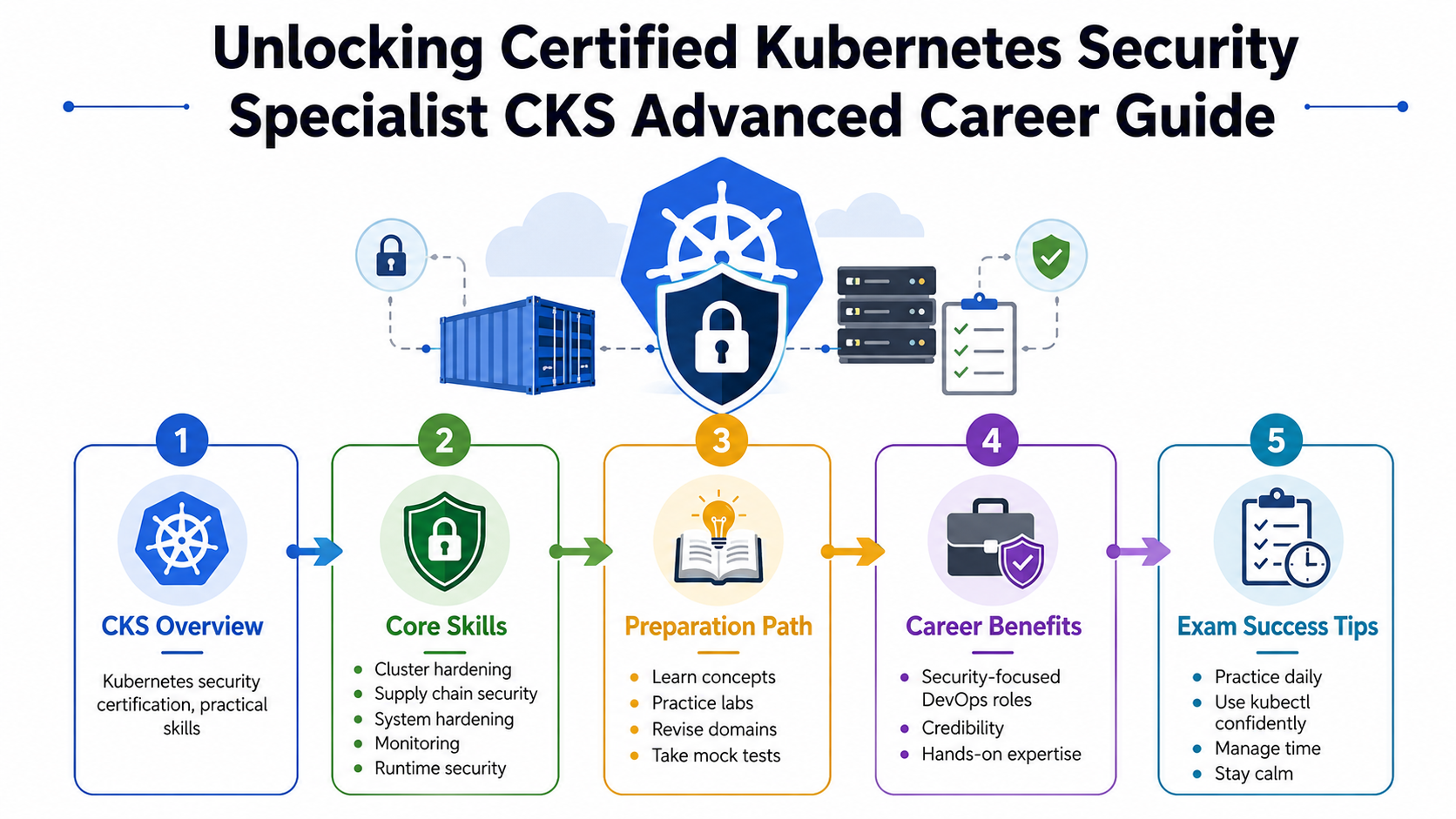
Introduction
The cloud-native landscape has evolved rapidly, moving from basic container orchestration to a strict focus on hardening production environments. The Certified Kubernetes Security Specialist (CKS) is a performance-based certification that validates an engineer’s ability to secure containerized applications and Kubernetes platforms throughout the entire build, deployment, and runtime lifecycle. This comprehensive guide is designed for systems professionals, security engineers, and technical leaders who need to make informed decisions about deep-skilling their teams or advancing their personal career trajectories. Navigating the complexities of cloud-native security requires a structured roadmap, and this analysis serves as an enterprise-grade blueprint to understand the true impact of mastering Kubernetes security. For professionals looking to broaden their operational expertise across modern paradigms like site reliability or automated operations, leveraging specialized ecosystems like aiopsschool can provide a significant edge.
What is the Certified Kubernetes Security Specialist (CKS)?
The Certified Kubernetes Security Specialist (CKS) represents the gold standard for verifying hands-on competence in securing cloud-native infrastructure. Unlike theoretical multiple-choice exams, this certification tests an engineer’s ability to solve real-world security challenges in a live, simulated Kubernetes cluster under tight time constraints. It exists because enterprise organizations require validated assurance that their infrastructure teams can mitigate vulnerabilities, restrict unauthorized access, and handle active security incidents. It aligns directly with production workflows by focusing on practical tasks such as configuring network policies, hardening cluster components, and analyzing container runtimes for malicious behavior.
Who Should Pursue Certified Kubernetes Security Specialist (CKS)?
This certification is highly beneficial for platform engineers, security analysts, site reliability engineers (SREs), and cloud architects who manage containerized workloads. Experienced systems professionals looking to bridge the gap between traditional infrastructure security and cloud-native engineering will find immense value in this path. While it is not intended for complete IT beginners due to its advanced scope, engineering managers and technical leads can also leverage its principles to establish robust compliance frameworks within their organizations. Globally and across competitive tech hubs in India, professionals holding this credential are in high demand as enterprises scale their secure digital transformation initiatives.
Why Certified Kubernetes Security Specialist (CKS)
The demand for specialized cloud security talent continues to outpace supply as compliance mandates and cybersecurity threats grow more sophisticated. Achieving this certification demonstrates long-term career resilience because the core security principles taught—such as least privilege, defense-in-depth, and continuous monitoring—remain valid even as specific software versions evolve. It helps professionals stay highly relevant by shifting their focus from basic infrastructure provisioning to advanced environment hardening and threat remediation. The return on time and career investment is substantial, frequently resulting in accelerated promotion timelines and increased technical authority within engineering organizations.
Certified Kubernetes Security Specialist (CKS) Certification Overview
The formal preparation program is delivered via devopsschool and hosted on the devopsschool platform. The assessment approach is entirely performance-based, requiring candidates to interact with multiple live Kubernetes clusters via a command-line interface to remediate vulnerabilities and configure secure environments. Ownership of this learning track resides with industry-recognized cloud-native authorities, ensuring the curriculum remains synchronized with current security best practices. The structural framework of the program emphasizes hands-on mastery over passive memorization, requiring a valid prerequisite certification to ensure foundational competency.
Certified Kubernetes Security Specialist (CKS) Certification Tracks & Levels
The certification framework is structured to guide professionals from foundational concepts up to advanced, specialized domain mastery. The foundational level ensures a comprehensive understanding of core container concepts and standard cluster operations before moving into advanced domains. The specialized security track focuses intensely on microservice isolation, supply chain security, and real-time monitoring of cloud-native systems. This progressive structure allows engineers to systematically align their learning milestones with their expanding job responsibilities and career goals.
Complete Certified Kubernetes Security Specialist (CKS) Certification Table
| Track | Level | Who it’s for | Prerequisites | Skills Covered | Recommended Order |
| Core Operations | Foundational | Systems Administrators | Basic Linux Skills | Cluster setup, basic networking, pod deployment | First |
| Application Security | Professional | Cloud Engineers | Core Operations | Secure application configuration, secret management | Second |
| Infrastructure Security | Advanced | Security Engineers | Certified Kubernetes Administrator | Cluster hardening, runtime security, vulnerability scanning | Third |
Detailed Guide for Each Certified Kubernetes Security Specialist (CKS) Certification
Certified Kubernetes Security Specialist (CKS) – Professional Security Level
What it is
This certification validates an engineer’s hands-on capability to secure container-based applications and Kubernetes platforms during build, deployment, and runtime phases.
Who should take it
DevSecOps engineers, senior infrastructure professionals, and security architects who possess a valid CKA credential and want to prove their cloud-native defense capabilities.
Skills you’ll gain
- Hardening Kubernetes cluster components and API configurations.
- Implementing strict network policies to enforce microservice isolation.
- Setting up automated image scanning and vulnerability assessment tools.
- Monitoring system calls and detecting runtime security anomalies.
Real-world projects you should be able to do
- Restrict API server access by configuring robust Role-Based Access Control policies.
- Audit and remediate a compromised cluster using runtime security tools like Falco.
- Build a secure CI/CD pipeline step that blocks vulnerable container images.
Preparation plan
- 7–14 days: Review the official exam curriculum, set up a multi-node practice cluster, and master the configuration of network policies.
- 30 days: Deep dive into third-party security tools such as Trivy, Falco, and AppArmor, practicing their deployment and troubleshooting.
- 60 days: Take multiple timed mock exams, focus on command-line speed, and refine your ability to quickly debug broken cluster configurations.
Common mistakes
- Spending too much time memorizing theory instead of practicing actual configuration on the command line.
- Forgetting to verify changes after applying a security policy, leading to silent configuration errors.
- Mismanaging the limited exam time by getting stuck on a single complex scenario.
Best next certification after this
- Same-track option: Advanced Cloud-Native Security Architect
- Cross-track option: Site Reliability Engineering Professional
- Leadership option: DevSecOps Team Lead / Enterprise Security Director
Choose Your Learning Path
DevOps Path
This path focuses on integrating automated operations with development workflows to accelerate software delivery cycles safely. Engineers learn to manage infrastructure as code, build scalable continuous integration pipelines, and maintain consistent environments across staging and production. The focus is on velocity, collaboration, and removing operational friction between distinct engineering teams.
DevSecOps Path
This trajectory embeds automated security controls directly into the core DevOps software delivery lifecycle from the very beginning. Professionals specialize in shifting security left by implementing automated code analysis, container image vulnerability scanning, and compliance checks within CI/CD pipelines. The goal is to ensure that speed does not compromise the overall security posture of the enterprise platform.
SRE Path
This roadmap centers on system availability, scalability, latency, and performance management through programmatic engineering practices. Engineers treat operational problems as software engineering challenges, designing highly resilient architectures capable of self-healing during failures. It bridges the gap between infrastructure maintenance and advanced software development for large-scale distributed systems.
AIOps Path
This specialty leverages machine learning models and big data platforms to automate continuous system monitoring and incident response workflows. Professionals learn to analyze massive volumes of log data, metric arrays, and traces in real time to proactively identify performance anomalies. The objective is to reduce mean time to resolution and automate complex event correlation across enterprise infrastructure.
MLOps Path
This track focuses on the operationalization, deployment, and scaling of machine learning models within reliable production environments. Engineers build robust pipelines for continuous model training, version control for data sets, and automated monitoring of model performance drift. It ensures that data science outputs are systematically integrated with stable, repeatable cloud-native infrastructure components.
DataOps Path
This architecture model concentrates on improving data quality, delivery speed, and collaborative integration across the entire enterprise data lifecycle. Professionals build automated pipelines for data ingestion, processing, and storage while ensuring strict governance and access controls are maintained. It treats data infrastructure with the same rigor and automation found in modern software engineering practices.
FinOps Path
This financial management practice focuses on optimizing cloud infrastructure spend through cross-functional engineering and finance collaboration. Professionals learn to implement detailed resource tagging strategies, analyze utilization metrics, and eliminate wasted cloud expenditures across multi-tenant environments. The goal is to maximize the business value derived from every unit of cloud computing spend.
Role → Recommended Certified Kubernetes Security Specialist (CKS) Certifications
| Role | Recommended Certifications |
| DevOps Engineer | Certified Kubernetes Administrator, Professional Security Level |
| SRE | Professional Security Level, Systems Performance Specialist |
| Platform Engineer | Advanced Infrastructure Security, Core Operations Specialist |
| Cloud Engineer | Certified Kubernetes Administrator, Application Security Track |
| Security Engineer | Professional Security Level, Advanced Cloud-Native Security Architect |
| Data Engineer | Data Infrastructure Specialist, Core Operations Track |
| FinOps Practitioner | Cloud Financial Optimization Specialist, Core Operations Track |
| Engineering Manager | Technical Leadership Foundation, Cloud-Native Overview |
Next Certifications to Take After Certified Kubernetes Security Specialist (CKS)
Same Track Progression
After achieving this milestone, professionals should focus on advanced cloud-native compliance and governance certifications. This includes deep-diving into specific cloud provider security specializations or mastering enterprise-wide service mesh security frameworks. This progression ensures you remain the definitive authority on protecting highly complex, multi-tenant container platforms.
Cross-Track Expansion
Broadening your engineering footprint involves pursuing specialized site reliability engineering or advanced automated observability certifications. Understanding how security configurations impact system performance, latency, and application reliability provides a well-rounded operational profile. This approach makes you highly valuable to organizations looking for multi-disciplinary platform engineers.
Leadership & Management Track
For those transitioning toward strategic roles, certifications in enterprise risk management, technical team leadership, and cloud governance are logical next steps. This path shifts the focus from writing configuration files to designing organizational security policies and managing engineering teams. It prepares technical experts to effectively communicate infrastructure risks and return on investment to executive stakeholders.
Training & Certification Support Providers for Certified Kubernetes Security Specialist (CKS)
DevOpsSchool provides comprehensive, instructor-led training programs featuring extensive hands-on laboratory environments specifically engineered to mirror actual exam scenarios. Their curriculum focuses deeply on practical troubleshooting and production-level configurations.
Cotocus offers specialized bootcamps designed for working professionals who need to master complex cloud-native security tools quickly and efficiently. Their training emphasizes real-world implementation methodologies.
Scmgalaxy deliver a vast repository of community-driven resources, technical documentation, and practice blueprints aimed at supporting self-paced engineering professionals. Their guides focus on foundational tools and installation steps.
BestDevOps focuses on delivering highly tailored enterprise group training sessions that align certification curriculums with specific organizational infrastructure goals. Their delivery model combines lecture with intensive lab marathons.
devsecopsschool focuses exclusively on the intersection of system security and automated deployment pipelines, offering targeted courses on cloud-native hardening. Their programs emphasize automation in security enforcement.
sreschool provides deep technical instruction centered on system reliability, performance tuning, and how platform security configurations impact overall application availability. Their labs simulate high-traffic production incidents.
aiopsschool delivers cutting-edge training programs that combine modern cloud architecture management with automated, machine learning-driven system monitoring and incident response frameworks.
dataopsschool specializes in educational tracks that teach engineers how to build secure, automated, and compliant pipelines for enterprise data processing workloads.
finopsschool focuses on educating engineering and financial teams on cloud financial management, resource optimization strategies, and cost-effective infrastructure architecture.
Frequently Asked Questions (General)
- What is the primary format of cloud-native infrastructure exams?
The exams are typically performance-based, meaning candidates must solve practical configuration and troubleshooting tasks in a live command-line environment rather than answering multiple-choice questions. - How long does it take an experienced engineer to prepare for these assessments?
An experienced professional spending consistent time each week can typically prepare thoroughly within 30 to 60 days, depending on their existing familiarity with command-line tools. - Are there mandatory prerequisites required before attempting advanced security exams?
Yes, advanced security assessments often require candidates to hold a valid, active foundational administration credential to ensure basic operational competency. - What is the typical validity period for these technical credentials?
Most high-level technical certifications are valid for two to three years, after which professionals must recertify to prove competency with updated software versions. - Can these certifications help me transition from traditional sysadmin roles to DevOps?
Absolutely, completing these validation programs demonstrates to employers that you possess the modern automated infrastructure skills required for cloud-native engineering. - What happens if I fail the practical examination on my first attempt?
Most certification programs include a free retake voucher with the initial purchase, allowing candidates to review their weak areas and try again. - How are the practical exam environments graded by the certification providers?
Grading is automated via scripts that check the final state of the cluster configurations, resources, and policy permissions against the required criteria. - Is a software development background required to pass infrastructure security certifications?
While deep coding skills are not mandatory, a solid understanding of shell scripting, YAML configuration file syntax, and basic automation logic is highly beneficial. - Do these programs cover specific cloud provider tools or open-source solutions?
The core programs focus heavily on vendor-neutral, open-source technologies, ensuring the skills learned are transferable across any public or private cloud platform. - How do enterprise organizations validate the authenticity of my certification?
Organizations can verify credentials through secure digital badge platforms or unique verification IDs provided by the hosting certification registry. - Why do companies prioritize hiring certified container security professionals?
Enterprises face strict compliance audits and sophisticated security threats, making validated hands-on competence critical for reducing operational risk. - Are internet-connected resources available to candidates during live practical exams?
Candidates are typically permitted to access specific, official online documentation subdomains within the exam browser tab for reference during the test.
FAQs on Certified Kubernetes Security Specialist (CKS)
- What makes the Certified Kubernetes Security Specialist (CKS) exam uniquely difficult compared to other IT certifications?
The difficulty lies in its performance-based nature, where you must secure live, intentionally misconfigured Kubernetes clusters under a strict two-hour time limit. Candidates must know exactly how to modify system manifests, write network policies from scratch, and debug broken cluster components using the command line without the aid of multiple-choice clues or traditional study guides. - Do I need to maintain an active Certified Kubernetes Administrator (CKA) status to take the CKS exam?
Yes, a valid and active CKA certification is a strict prerequisite for sitting the CKS exam. The certification authority enforces this rule because the security curriculum assumes you already possess comprehensive knowledge regarding cluster administration, troubleshooting, and core component operations. - Which third-party open-source security tools are explicitly tested within the official CKS curriculum?The curriculum tests your ability to configure, manage, and interpret output from several industry-standard tools, including Falco for runtime threat detection, Trivy for container image vulnerability scanning, AppArmor or Seccomp for kernel-level security profiling, and gVisor for secure container runtime sandboxing.
- How much weight does the exam place on securing the Kubernetes API server and etcd database?
A significant portion of the assessment focuses on cluster hardening, which directly involves modifying the API server configuration flags, disabling insecure ports, implementing strict Role-Based Access Control (RBAC), and configuring encryption at rest for sensitive data stored inside the etcd datastore. - Can I use the official Kubernetes documentation during the live CKS examination?
Yes, candidates are allowed to open one additional browser tab to access the official Kubernetes documentation, including the specific documentation pages for tools like Falco and AppArmor, but navigating away from these permitted domains can result in immediate exam disqualification. - What is the career return on investment for earning the Certified Kubernetes Security Specialist (CKS) credential?
Earning this credential significantly elevates your technical profile, shifting your career trajectory toward lucrative DevSecOps, Platform Engineering, and Cloud Security Architect roles. It provides independent verification that you can protect enterprise production environments, which often leads to increased organizational influence and higher compensation packages. - How should I structure my study environment to prepare effectively for the CKS exam challenges?
The most effective strategy is to build a multi-node Kubernetes cluster from scratch on local virtual machines or cloud instances. Practice breaking the control plane components, writing restrictive network policies, and intentionally introducing security vulnerabilities to learn how to identify and remediate them using the command line. - How frequently is the CKS exam curriculum updated by the Cloud Native Computing Foundation?
The exam curriculum is updated periodically to align with recent Kubernetes releases and evolving cloud-native security practices. This ensures that the tested domains, tool versions, and security recommendations accurately reflect what engineering teams are actively using in modern production environments.
Final Thoughts: Is Certified Kubernetes Security Specialist (CKS) Worth It?
Investing time and energy into securing this credential is a highly strategic move for any serious infrastructure professional. It forces you to look beyond simple application deployment and master the deep, underlying mechanisms that keep production systems safe from modern threats. This path requires dedication and regular hands-on practice, but the resulting technical expertise establishes you as a critical asset to any engineering organization. If you want to move past basic administrative tasks and become a true authority on cloud-native security, this certification path provides exactly the structured validation you need.