Introduction
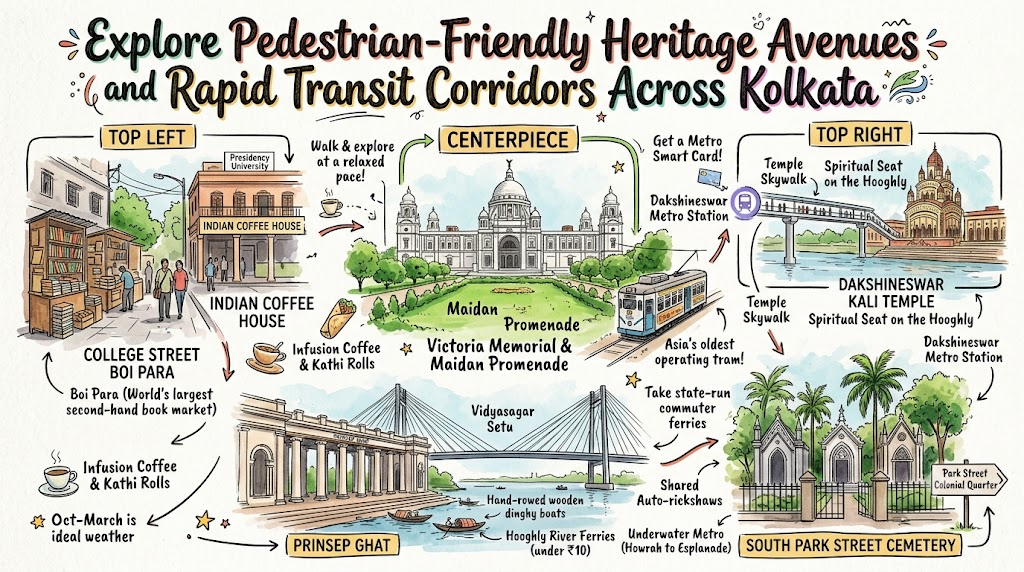
While modern megacities demand highway navigation and endless parking headaches, Kolkata thrives on a completely different rhythm. This is not a synthetic, car-dependent metropolis where travelers view culture through tinted vehicle glass. Kolkata is an intimate, sensory walking city linked by vintage electric trams, underwater river metros, shared auto-rickshaws, and hand-pulled ferries. Leaving the steering wheel behind unlocks genuine local authenticity, bringing you face-to-face with bustling street markets, century-old sweet shops, and colonial architecture at a relaxed, deeply rewarding human pace.
Why Kolkata is a must-visit city
Kolkata stands apart as the intellectual and cultural vanguard of the subcontinent. Anchored along the sacred Hooghly River, it offers an incredible mix of three hundred years of colonial history, literary revolutions, and living heritage arts. Unlike vast, sprawling regions that leave pedestrians stranded, Kolkata was engineered for mass community mobility long before personal vehicles became standard.
The public transit network forms a remarkably cohesive travel circuit. A single morning allows you to glide under the river on India’s pioneering underwater metro corridor, transition into a stately colonial tram, hop on an inexpensive river ferry, and finish your route on foot through historic neighborhoods.
| Metric | Highlights & Logistics |
|---|---|
| Primary Region | Kolkata Metropolitan Area, West Bengal |
| Ideal Season | October to March (Pleasant, walkable weather) |
| Top Transit Modes | Kolkata Metro (Blue & Green Lines), River Ferries, Shared Autos, Trams |
| Major Arrival Hubs | Howrah Junction (HWH), Sealdah (SDAH), Netaji Subhas Chandra Bose Airport (CCU) |
| Ideal Circuit Duration | 3 to 4 Days of car-free exploration |
Best Places to Visit in Kolkata Without a Car
Victoria Memorial and Maidan Promenade
Commissioned to commemorate Queen Victoria and completed in 1921, the Victoria Memorial is an architectural masterpiece crafted from pristine white Makrana marble. Combining British classical architecture with Mughal domes and Italianate colonnades, it anchors the expansive urban greenery known as the Maidan. For pedestrians, arriving on foot via the tree-shaded avenues captures the scale of the monument in a way no driving commute ever could.
The sprawling lawns and surrounding perimeter offer a quiet, contemplative stroll where the city’s creative pulse thrives. Local sketch artists, families, and solo book readers gather around the reflective water bodies, providing an authentic slice of everyday urban leisure.
Victoria Memorial surrounded by lush lawns.
- Location: Central Kolkata, directly accessible via Rabindra Sadan or Maidan Metro Station (approx. 500m walk).
- Why it is worth visiting: The finest example of Indo-Saracenic colonial marble craftsmanship, surrounded by 64 acres of peaceful gardens.
- Best things to do: Explore the royal gallery paintings inside, photograph the Angel of Victory rotating atop the central dome, and picnic along the sprawling south lawns.
- Best time to visit: 10:00 AM for museum entry, or 4:30 PM for garden walks during the golden hour.
- Ideal for whom: Architecture photographers, history enthusiasts, and solo walkers.
- Travel tip: Exit through Rabindra Sadan Metro Gate 1 to bypass vehicle traffic entirely and walk straight into the south garden entrance.
College Street Boi Para and Indian Coffee House
Spanning roughly one kilometer in North Kolkata, College Street is the largest second-hand book market on earth and the heart of the Bengal Renaissance. Flanked by historic institutions like Presidency University, Sanskrit College, and Calcutta University, the sidewalks are lined with hundreds of stacked wooden bookstalls selling rare first editions and academic papers.
Perched on the first floor of an unassuming colonial building right across Presidency University sits the historic Indian Coffee House. Entering its double-height hall feels like traveling back into the 1960s; whirling ceiling fans, turbaned waitstaff, and animated political conversations (‘adda’) fill the air alongside steaming cups of black infusion coffee.
The iconic hall of Indian Coffee House.
- Location: North-Central Kolkata, accessible via Central or Mahatma Gandhi Road Metro Station (approx. 600m walk).
- Why it is worth visiting: An unparalleled literary district where rare out-of-print books meet legendary intellectual coffeehouse culture.
- Best things to do: Browse rare literature at pavement wooden bookstalls, join an intellectual discussion over cold coffee, and visit the historic Sanskrit College facade.
- Best time to visit: 11:30 AM to 5:00 PM on weekdays (stalls are closed on Sundays).
- Ideal for whom: Avid readers, cultural researchers, and budget backpackers.
- Travel tip: Keep cash handy for rare book bargaining, and head to Coffee House before 1:00 PM to secure a table without queuing.
Dakshineswar Kali Temple via Green Line Metro
Positioned on the eastern bank of the Hooghly River, Dakshineswar Kali Temple is a sublime 19th-century temple complex built in traditional Navaratna (nine-spired) architectural style by Rani Rashmoni in 1855. It is celebrated globally as the spiritual seat where mystic saint Ramakrishna Paramahamsa experienced his profound devotional visions.
The temple courtyard opens directly toward the flowing river, featuring twelve twin Shiva shrines standing symmetrically along the river ghat. Visiting this sacred site used to require a grueling cross-city road trip, but it is now effortlessly reachable via Kolkata Metro’s elevated North-South line, letting travelers exit the train straight onto the temple skywalk.
Dakshineswar Temple along the Hooghly.
- Location: North Kolkata fringe, terminal point of Metro Blue Line (Dakshineswar Metro Station).
- Why it is worth visiting: An architectural and spiritual wonder accessible directly from the metro without needing road transport.
- Best things to do: Offer prayers at the Bhavatarini sanctum, walk through Ramakrishna’s preserved residential room, and sit along the quiet riverside bathing ghats.
- Best time to visit: 6:30 AM to 9:00 AM to avoid heavy afternoon devotee queues.
- Ideal for whom: Spiritual seekers, architectural historians, and transit-reliant travelers.
- Travel tip: Use the dedicated temple skywalk directly connected to the metro station platform; it shields you from road traffic and touts.
Prinsep Ghat and Heritage Riverfront Boardwalk
Erected in 1841 in honor of Anglo-Indian scholar James Prinsep, this Greek-Gothic monument features pale Palladian pillars standing right beneath the soaring Vidyasagar Setu cable-stayed bridge. It marks the focal point of the revitalized Kolkata Riverfront promenade, stretching past manicured landscaping, vintage lampposts, and riverside seating.
The true magic of Prinsep Ghat lies in its timeless pace of life. Traditional hand-rowed wooden dinghy boats glide along the riverbanks, offering quiet journeys across the gentle waves of the Hooghly as church bells and temple conches echo in the evening air
.
Prinsep Ghat framed by Vidyasagar Setu.
- Location: Strand Road, Hastings, connected directly by Prinsep Ghat Circular Railway Station and river ferry piers.
- Why it is worth visiting: A peaceful riverfront escape blending British colonial architecture with scenic water vistas.
- Best things to do: Take a 30-minute wooden boat ride on the Hooghly, stroll the illuminated pedestrian boardwalk, and enjoy local street snacks.
- Best time to visit: 4:30 PM to 7:00 PM for the sunset over Vidyasagar Setu.
- Ideal for whom: Photographers, couples, and evening walkers.
- Travel tip: You can reach Prinsep Ghat by taking a scenic, inexpensive river ferry from Babu Ghat or Howrah Station jetty for under ₹10.
Park Street Colonial Quarter and South Park Street Cemetery
Park Street (Mother Teresa Sarani) is the vibrant epicenter of Kolkata’s cosmopolitan culinary and cultural history. Beyond its buzzing modern cafes and legendary mid-century jazz lounges lies the South Park Street Cemetery, established in 1767. This lush necropolis contains imposing Gothic, Grecian, and Indo-Saracenic stone mausoleums shaded by massive tropical trees.
Walking down this historic avenue places you inside a living archive of community heritage. From vintage Anglo-Indian tearooms to historic bookshops and brick bakeries, the entire street is easily explored on foot from the nearby metro station.
- Location: Central Kolkata, directly linked by Park Street Metro Station (exit right into the avenue).
- Why it is worth visiting: A dynamic walking corridor connecting 18th-century heritage architecture with classic culinary legends.
- Best things to do: Walk the quiet mossy paths of South Park Street Cemetery, sample classic Kathi rolls, and pick up fresh pastries at Flurys.
- Best time to visit: 10:00 AM to 3:00 PM for the cemetery grounds; 5:00 PM onwards for dining and evening strolls.
- Ideal for whom: Cultural foodies, urban historians, and architecture lovers.
- Travel tip: Walk the entire one-mile stretch from Park Street Metro down to Rawdon Street on the pedestrian sidewalks, avoiding taxi fare surges.
Heritage Tram Route through Maidan Greenery
Operating continuously since 1873, Kolkata’s electric tramway is the oldest operational system of its kind in Asia. Riding a single-coach vintage wooden tram gliding gently across the green Maidan turf offers one of the most romantic, slow-travel experiences on the entire continent.
The tram car ambles leisurely through tree tunnels, while the conductor punches paper tickets to the gentle chime of the brass foot-bell. Looking out through the wide barred windows offers sweeping, peaceful views of cricket players, resting cattle, and colonial monuments.
Vintage tram cutting through Maidan.
- Location: Esplanade Tram Terminus, directly adjacent to Esplanade Metro Interchange.
- Why it is worth visiting: Asia’s oldest operating electric tram, delivering a peaceful journey through the historic Maidan.
- Best things to do: Ride the Esplanade-Gariahat or Khidirpur line, photograph the wooden interior finishes, and watch the driver switch the overhead trolley pole.
- Best time to visit: 8:00 AM to 10:30 AM on crisp mornings for soft lighting through the trees.
- Ideal for whom: Vintage transport enthusiasts, nostalgic travelers, and slow-travel backpackers.
- Travel tip: Board directly at the Esplanade Terminus loop to secure a window seat on the left side for the prettiest views across the grass.
Offbeat Exploration: Hidden Gems Tourists Miss
Bow Barracks Anglo-Indian Enclave
Tucked right behind the Central Metro Station, Bow Barracks is a collection of red-brick, multi-story garrison apartments originally built for colonial military troops. Today, it stands as the vibrant cultural heart of Kolkata’s close-knit Anglo-Indian community. Strolling through these quiet brick courtyards reveals lace-curtained windows, vintage pedal bicycles, and local bakeries selling homemade fruit wines and traditional cakes.
Kumartuli Clay Idol Alleys by Foot
Located just a brief walk from the Sovabazar Sutanuti Metro Station, Kumartuli is a maze of riverside artisan workshops where clay sculptors hand-craft sacred deities from Hooghly river mud. Exploring on foot allows you to peek into working studios, watch artisans weave bamboo skeletons, and see clay figures painted by hand under soft incandescent bulbs.
Old Chinatown Breakfast Trail at Tiretta Bazaar
Exiting the Poddar Court area near Central Metro at 6:30 AM brings you directly to Tiretta Bazaar, India’s oldest Chinese neighborhood. On morning sidewalks, local Chinese-Indian families set up small roadside tables selling steamed pork buns, wonton soups, and fried prawn crackers. It offers an incredible culinary immersion that disappears by 8:30 AM before road traffic even begins.
Detailed Practical Guidance for Travelers
| Destination | Standard Entry Fee | General Timings | Best Local Food Options Nearby | Recommended Nearby Attractions |
|---|---|---|---|---|
| Victoria Memorial | ₹50 (Indians), ₹500 (Foreigners) | 10:00 AM – 6:00 PM (Museum) | Nizam’s Kathi Rolls, Haldiram’s | St. Paul’s Cathedral, Academy of Fine Arts |
| College Street & Coffee House | Free (Food charged on order) | 9:00 AM – 8:30 PM | Infusion Coffee, Dilkhusha Cabin Snacks | Calcutta University, Thanthania Kalibari |
| Dakshineswar Temple | Free (VIP line ₹100) | 6:00 AM – 12:30 PM, 3:30 PM – 8:30 PM | Kachori Sabzi stalls, Radhaballabhi | Belur Math (via direct ferry), Skywalk |
| Prinsep Ghat Promenade | Free (Boats ₹300-₹500/hr) | Open 24 Hours | Street Pav Bhaji, Badam Shake, Kulfi | Vidyasagar Setu, Gwalior Monument |
| South Park Street Cemetery | ₹50 (Camera ₹100) | 10:00 AM – 5:00 PM | Peter Cat Chelo Kebabs, Mocambo Sizzlers | Mother House, Asiatic Society |
| Maidan Heritage Tram Ride | ₹7 to ₹20 per trip | 7:00 AM – 8:00 PM | Street-side lemon tea, Jhalmuri | Esplanade Curzon Park, Eden Gardens |
Logistics & On-Ground Navigation
Local Transport Options
- Kolkata Metro Network: The backbone of car-free transit. The Blue Line runs North-South, while the Green Line connects Howrah under the river to Salt Lake, avoiding surface congestion.
- River Ferries (WBTC): State-run commuter ferries cross the Hooghly every 15 minutes between Howrah, Fairlie Place, and Babu Ghat for just ₹6 to ₹10 per ticket.
- Electric Trams: Quiet, vintage transport running along reserved tracks through the Maidan and North Kolkata; fares start at ₹7.
- Shared Auto-Rickshaws: Fixed-route, hop-on auto-rickshaws bridge the gaps between metro stations and residential neighborhoods for ₹15 to ₹25.
- Walking Pathways: Downtown districts like BBD Bagh, Park Street, and the Riverfront Boardwalk feature dedicated, shaded sidewalks ideal for walking.
Budget Planning
- Backpacker / Slow-Travel Tier (₹1,000 – ₹1,800 per day): Travel exclusively via Metro tokens, public ferries, and trams (under ₹100/day). Stay in budget guesthouses around Sudder Street, and enjoy iconic meals at local cabins, sweet shops, and street stalls.
- Mid-Range / Comfort Tier (₹3,500 – ₹6,500 per day): Use air-conditioned Green Line and Blue Line metro cards, book scenic private country boat rides at Prinsep Ghat, stay in heritage hotels, and enjoy dining at classic historic restaurants.
Safety and Inclusivity Tips
- For Families: The Kolkata Metro has dedicated cars for women and senior citizens, along with modern elevators and escalators at all major underground stations.
- For Couples: Well-patrolled promenades like Prinsep Ghat and the Victoria Memorial gardens are welcoming, family-friendly spaces for quiet walks.
- General Safety: Kolkata is routinely recognized as one of India’s safest urban centers. Standard awareness on crowded commuter trains during rush hour is all that is required.
Strategic Travel Planning Guardrails
Travel Planning Tips for Kolkata
- Purchase a rechargeable Kolkata Metro Smart Card at your arrival station to bypass token counter queues during peak hours.
- Keep cash denominations of ₹10, ₹20, and ₹50 readily available for tram fares, ferry tokens, and pavement book stalls.
- Schedule walking-heavy outdoor explorations before 11:00 AM or after 3:30 PM to avoid the midday sun.
- Remove shoes and dress respectfully when entering temple ghats and monastic halls.
- Download an offline metro map to navigate subway transfers smoothly without relying on cell service.
Common Mistakes to Avoid
- Attempting to hire roadside yellow taxis for short distances under 2 km; walking or hopping on a shared auto is far faster.
- Taking surface vehicles across Howrah Bridge during morning rush hours when the Green Line metro cuts the same journey down to minutes.
- Forgetting that College Street stalls and specific museum facilities remain closed on Sundays.
- Skipping the local river ferries in favor of congested road bridges.
- Relying exclusively on mobile digital payments at tiny street snack stalls and heritage tea cabins.
Suggested Itinerary Blueprints
1. Day Quick Dash (The Underground & Colonial Heritage Loop)
- Target Audience: Short-stay travelers and transit passengers.
- Route: Arrive at Howrah Station, board the Green Line Metro directly under the river to Esplanade, walk through the historic Maidan to Victoria Memorial, ride a vintage tram, and wrap up with dinner along Park Street.
2. Day Deep-Dive (North-South Cultural Corridor)
- Day 1 (Colonial & Riverine Heart): Start at Esplanade, take the ferry to Prinsep Ghat, explore Victoria Memorial, and spend the evening enjoying dining along Park Street.
- Day 2 (Intellectual & Spiritual Heritage): Take the Blue Line Metro to Central for College Street and Indian Coffee House, explore the potter workshops of Kumartuli on foot, and take the metro to Dakshineswar Temple for sunset.
3. Complete Weekend Travel Plan (The Ultimate Car-Free Immersion)
- Friday: Check into your central hotel, take a walking architecture tour around BBD Bagh, and relax with an evening stroll down Park Street.
- Saturday: Explore Kumartuli’s artisan lanes, catch the ferry across the Hooghly to Belur Math, transfer to Dakshineswar, and take the metro back to Esplanade for a sunset tram ride.
- Sunday: Wake up early for Chinese breakfast at Tiretta Bazaar, spend midday book hunting on College Street, and spend a peaceful evening along the Prinsep Ghat riverfront.
Common Tourist Mistakes to Avoid
Geographic Blunders
Attempting to cross from the far northern fringes like Dakshineswar down to South Kolkata’s lake neighborhoods on the same afternoon creates unnecessary travel fatigue. Group your itinerary strictly around specific metro transit zones.
Commercial Traps
Spending your trip inside suburban air-conditioned shopping malls deprives you of the historic shopping passages, grand bazaars, and pavement stalls that make the city unique.
Neglecting Modern/Alternative Zones
Focusing solely on classical British imperial monuments causes travelers to miss out on peaceful art enclaves, independent cafes, and serene residential neighborhoods like Southern Avenue.
Transport Overpayment
Haggling with unmetered private cabs outside train stations often leads to inflated fares. Instead, head directly down into the connected metro station or board a government river ferry for a fraction of the cost.
Luxury Dining Bias
Eating only in upscale hotel dining rooms means missing the authentic culinary soul of Kolkata found at century-old street cabins, roll stalls, and sweet shops.
Frequently Asked Questions
1. Is it practical to travel across Kolkata entirely without hiring a private car?
Yes, Kolkata is arguably the easiest city in India to explore without a personal vehicle. The extensive underground and elevated metro networks, vintage electric trams, local river ferries, and pedestrian-friendly boulevards link nearly all major heritage landmarks directly, sparing you from road gridlock and expensive parking fees.
2. How does the underwater metro work between Howrah and Kolkata?
The Green Line metro runs deep beneath the Hooghly River bed through a state-of-the-art tunnel, connecting Howrah Railway Station to the central Esplanade junction in under a minute. It provides an ultra-fast, air-conditioned transit alternative that bypasses the busy traffic bottlenecks of the road bridges entirely.
3. Are Kolkata river ferries safe and reliable for daily tourists?
Yes, the ferries operated by the West Bengal Transport Corporation are safe, reliable, and run on fixed 15-minute schedules. They feature life-saving gear, spacious seating, and flat commuter fares under ₹10, making them both an economical transit option and a scenic sightseeing experience along the water.
4. Can I purchase a day pass for the Kolkata Metro network?
While single journeys use contactless tokens or mobile QR tickets, travelers can purchase a reusable Smart Card at any ticketing window for a small refundable deposit. Loading funds onto this card allows seamless entry across both the Blue and Green lines without waiting in line at counters.
5. Is College Street pedestrian-friendly for travelers visiting on foot?
College Street features continuous pavement walkways lined with vintage bookstalls, making it a wonderful area to explore on foot. However, you should watch your step around delivery carts and tram tracks, and wear comfortable walking shoes to comfortably navigate the busy book-lined alleys.
6. Which metro stations are best for exploring the colonial quarter on foot?
Esplanade, Chandni Chowk, and Central stations on the Blue Line serve as the best walking gateways into the colonial core. Exiting at Esplanade puts you within short walking distance of the Maidan, the Grand Hotel arcade, Curzon Park, and the vintage street tram terminus.
7. How do I get to Dakshineswar Kali Temple without taking a cab?
Simply board the North-South Blue Line Metro and ride all the way to its northern terminal at Dakshineswar Station. A dedicated, covered pedestrian skywalk connects the elevated metro platform directly to the temple complex gates, eliminating any need for surface street transport.
8. Are electric trams still actively running in Kolkata?
Yes, select heritage electric tram lines continue to operate through central corridors, particularly the scenic routes cutting through the Maidan toward Gariahat and Khidirpur. Boarding at the Esplanade Terminus provides the most dependable way to catch an active car for a relaxing, nostalgic ride.
9. What should I do if a shared auto-rickshaw does not use a meter?
Shared auto-rickshaws in Kolkata do not operate on private individual meters because they run on fixed neighborhood shuttle routes with set per-passenger fares. Simply ask the driver or fellow commuters for the fixed destination price, which typically runs between ₹15 and ₹25.
10. Is walking safe in Kolkata late at night for solo travelers?
Kolkata is widely considered one of the safest metropolitan cities in India for solo pedestrians. Main avenues such as Park Street, Southern Avenue, and the riverside ghats remain well-lit and active until late at night, though ordinary urban awareness is always recommended on quieter side alleys.
11. How accessible are the river ghats from the nearest metro stations?
Prinsep Ghat and Babu Ghat sit about 1.5 to 2 kilometers west of the Maidan and Esplanade metro stops. You can easily complete the scenic 20-minute walk through the green Maidan lawns, hop on a connecting tram, or take a short shared auto ride directly to the riverbank.
12. What is the most scenic transit route across the Hooghly River?
The commuter ferry ride between Howrah Station Jetty and Fairlie Place or Babu Ghat is the most picturesque crossing. For less than ₹10, passengers enjoy open-air breezes and sweeping, unobstructed views of the Howrah Bridge and the river skyline from the water.
Conclusion
Exploring Kolkata without a car transforms an ordinary vacation into an authentic, sensory journey through living heritage. By stepping aboard historic wooden trams, cruising across wide rivers on commuter ferries, and walking through vibrant literary avenues, you experience the genuine warmth of the city’s neighborhoods. Slowing down to the rhythm of the city rewards you with unforgettable memories, timeless architecture, and meaningful connections that driving in traffic could never match.