Introduction
Most modern metropolitan getaways reduce travel to a blur of identical glass skyscrapers, sanitized shopping malls, and hurried itineraries. Kolkata rejects that superficial pace entirely, welcoming travelers into an atmospheric world where time lingers among century-old banyan roots and peeling lime-plaster facades. The city does not perform for tourists; it simply lives out loud with unmatched artistic candor and intellectual warmth.
Stepping into this storied capital means trading predictable tourist enclaves for raw cultural authenticity. From the melancholic clatter of vintage tram tracks to the rich aroma of roasting robusta and slow-simmered mustard gravies, every corner presents an invitation to slow down. A weekend journey here is less about ticking sightseeing boxes and more about establishing an intimate communion with the living literary and culinary heart of India.
Why Kolkata is a must-visit city
Kolkata represents a monumental chapter in global history, anchoring the transition of the Indian subcontinent from the seat of the British East India Company to the fiery cradle of the national freedom struggle. Geographically cradled beside the tidal currents of the Hooghly River, it preserves an extraordinary architectural continuum encompassing neoclassical European mansions, red-brick administrative courts, and traditional courtyard rajbaris. Its sheer cultural gravity—fostering Nobel laureates, avant-garde filmmakers, and iconic modern poets—infuses daily life with an inspiring creative resonance rarely found in conventional commercial capitals.
For the modern traveler, practical accessibility is exceptionally straightforward. Netaji Subhas Chandra Bose International Airport seamlessly connects domestic and global flight corridors, while the dual rail giants of Howrah Junction and Sealdah link millions across the national network. Well-engineered expressways make road transit smooth, and hospitality spans charming boutique heritage homestays to five-star riverfront addresses.
The two-day travel circuit is strategically bifurcated into two distinct, high-impact geographic arcs:
- The North Kolkata Heritage Arc: Centered on intellectual legacy, artisanal clay molding lanes, ancestral mansions, and iconic colonial-era academic bistros.
- The Central-South Colonial & Riverfront Promenade: Anchored around expansive greens, majestic marble memorials, riverside ghats, and vintage bohemian dining avenues.
| Key Metric | Snapshot Summary |
| State & Geographic Zone | West Bengal, Lower Gangetic Delta |
| Primary Airport Code | Netaji Subhas Chandra Bose International (CCU) |
| Major Terminal Railheads | Howrah Junction (HWH), Sealdah (SDAH), Shalimar (SHM) |
| Ideal Travel Season | October to March (Crisp mornings, pleasant evening breezes) |
| Internal Transit Spine | Blue & Green Line Underground Metro, Heritage Yellow Taxis, Electric Ferries |
| Culinary Signature Staples | Kolkata Mutton Biryani, Kosha Mangsho, Mishti Doi, Sandesh |
| Recommended Minimum Stay | 48 to 72 Hours |
Best Places or Experiences
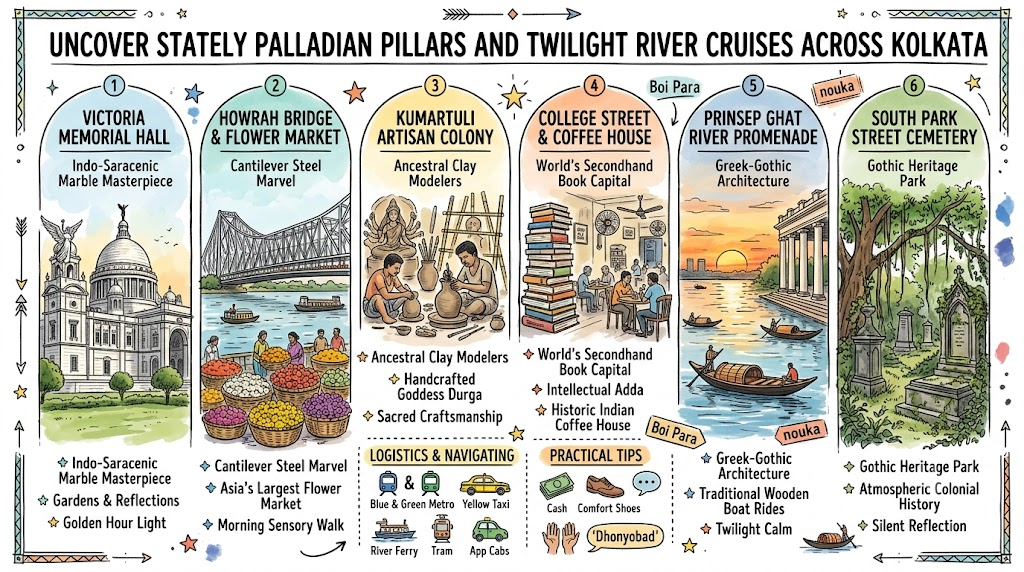
Victoria Memorial Hall
Commissioned in the early twentieth century to commemorate Queen Victoria, this colossal monument represents the pinnacle of Indo-Saracenic architectural ambition. Constructed from luminescent white Makrana marble sourced from the same quarries as the Taj Mahal, the edifice blends classical Italianate renaissance domes with Mughal miniature flourishes. Enclosed within sixty-four acres of lush manicured lawns, reflection pools, and gravel avenues, it offers an imposing visual gateway into imperial Calcutta’s administrative zenith.
Within its palatial galleries, the museum houses royal portraits, antique lithographs, rare navigational maps, and colonial-era weaponry that capture key political shifts. As dusk descends, specialized architectural illumination transforms the pale marble dome into a stunning beacon floating above the Maidan greenery. The surrounding walkways buzz with evening strollers, balloon sellers, and street vendors offering spicy gram mixtures.
- Location: Queens Way, Maidan, Central Kolkata (approx. 4 km south of B.B.D. Bagh administrative hub).
- Why it is worth visiting: It remains the most imposing marble monument of the British Empire in Asia, boasting priceless period art and museum artifacts.
- Best things to do: Admire the bronze Angel of Victory rotating atop the central dome, explore the Queen’s Gallery oil paintings, and walk the lake gardens during golden hour.
- Best time to visit: Late afternoon between 3:30 PM and 5:30 PM for gentle photographic light and cool breezes.
- Ideal for whom: Architectural admirers, fine art photographers, couples, and traveling families.
- Travel tip: Book your museum and gardens combo ticket online via the official national portal to bypass long lines at the southern iron gates.
Howrah Bridge and Mullick Ghat Flower Market
Suspended majestically without pylon supports in the riverbed, the cantilevered steel marvel of Rabindra Setu (Howrah Bridge) has stood as the city’s defining silhouette since 1943. Fabricated using high-tensile alloy supplied by Tata Steel, the colossal framework flexes dynamically with seasonal temperature shifts and heavy daily vehicular flow. Walking its pedestrian flanks provides an unmatched sensory immersion into the city’s morning awakening.
Directly beneath the southeastern ramps of the steel leviathan lies Mullick Ghat, home to Asia’s largest open-air wholesale flower market. In the pre-dawn hours, the riverfront explodes into an electrifying carnival of color, where porters balance towering mounds of marigold garlands, blue lotus blooms, and fragrant tuberose strings. The juxtaposition of delicate floral scents with the industrial rivets of the bridge overhead creates an unforgettable memory.
- Location: Strand Road, Bara Bazar riverside (directly beneath Howrah Bridge, 1.5 km west of Burrabazar Metro).
- Why it is worth visiting: Witnessing the intense commercial choreography of millions of fresh blossoms traded against a world-famous industrial backdrop.
- Best things to do: Walk the bridge deck for wide river perspectives, capture early-morning flower auctions, and watch ceremonial holy dips along the muddy ghat steps.
- Best time to visit: Early morning between 5:30 AM and 7:00 AM when auction trading reaches its peak.
- Ideal for whom: Street photographers, cultural explorers, and dawn walkers.
- Travel tip: Keep wet-weather footwear on hand, as the river mud and crushed flower stems make the ghat pathways slippery.
Kumartuli Idol-Makers Colony
Hidden along the maze of narrow lanes beside the northern riverbank lies Kumartuli, an ancestral clay modelers’ quarter operating continuously for nearly three centuries. Here, multi-generational master artisans transform biodegradable clay scooped from the sacred riverbed into magnificent, larger-than-life sculptures of Goddess Durga and other pantheon deities. The earthy fragrance of curing silt, wet hay, and natural plant varnishes fills every alleyway.
Walking through these dark, rustic open-air studios reveals an intimate look at spiritual craftsmanship. Bamboo scaffolds support straw silhouettes that artisans meticulously coat with fine alluvial clay before painting delicate, lifelike eyes during the sacred Chokkhudaan ceremony. It is a rare creative haven celebrating artistic devotion without industrial assembly lines.
- Location: Kumartuli, Hatkhola, North Kolkata (approx. 500 meters from Shobhabazar Sutanuti Metro Station).
- Why it is worth visiting: The unique opportunity to watch world-famous sacred clay idols crafted entirely by hand inside historic artisan workshops.
- Best things to do: Observe the straw armature shaping technique, watch master painters render facial features, and converse with senior sculptors.
- Best time to visit: Late mornings (10:00 AM to 1:00 PM) during August to October, when workshop preparations for Durga Puja reach full swing.
- Ideal for whom: Cultural documentarians, visual artists, and anthropology enthusiasts.
- Travel tip: Always ask for gentle permission before taking close-up portraits of artisans at work, and avoid touching the delicate, uncured wet clay statues.
College Street and the Indian Coffee House
Spanning roughly one and a half kilometers, College Street—affectionately known as Boi Para (Book Town)—is the largest secondhand book market in the world and the intellectual engine of Bengal. Flanked by venerable academies like Presidency University and the University of Calcutta, the sidewalks are lined with thousands of makeshift wooden stalls overflowing with rare first editions, academic volumes, and indie poetry zines.
At the core of this literary enclave sits the legendary Indian Coffee House on Bankim Chatterjee Street. Entering its cavernous, high-ceilinged hall under spinning antique fans feels like stepping into a mid-twentieth-century intellectual salon. Over cups of black infusion brew and mutton cutlets, academics, young student poets, and veteran journalists engage in fiery, open-ended intellectual debates (adda).
- Location: College Street, Central-North District (accessible via Central or Mahatma Gandhi Road Metro Stations).
- Why it is worth visiting: The intellectual epicenter of the Bengali Renaissance, offering unparalleled secondhand book treasures and historic café culture.
- Best things to do: Hunt down rare out-of-print books along the pavement stalls, enjoy an infusion coffee at Coffee House, and visit the historic Sanskrit College facade.
- Best time to visit: Mid-day from 11:30 AM to 4:00 PM when all wooden book kiosks are fully open.
- Ideal for whom: Bibliophiles, academic researchers, history enthusiasts, and solo travelers.
- Travel tip: Carry hard cash in smaller bills, as most pavement book vendors do not accept digital UPI payments for small-value paperbacks.
Prinsep Ghat and Hooghly Riverfront Promenade
Erected in 1841 along the river bank to honor the versatile Anglo-Indian antiquarian James Prinsep, this striking monument showcases refined Palladian Greek-Gothic architecture. Its restored fluted Ionian pillars frame sweeping, picture-perfect vistas across the water toward the modern cable-stayed Vidyasagar Setu overhead. The landscaped riverbank promenade is lined with vintage park lamps, stone benches, and manicured green borders.
As twilight falls, local boatmen steer traditional wooden dinghies (noukas) onto the water, using long oars to glide quietly with the river tide. Gliding beneath the massive steel suspension cables while listening to the distant temple bells along the far shore provides a deeply calming perspective of the city skyline away from street noise.
- Location: Strand Road, Hastings, South-Central Kolkata (adjacent to Prinsep Ghat Railway Station).
- Why it is worth visiting: The premier river vantage point in the city, blending European colonial architecture with serene, traditional wooden boat rides.
- Best things to do: Hire a traditional wooden boat for a thirty-minute sunset cruise, stroll the paved promenade toward Babughat, and sample local street snacks.
- Best time to visit: 5:00 PM to 7:00 PM to catch the sunset glow and illuminated bridge reflections on the water.
- Ideal for whom: Couples, sunset lovers, and families seeking open green spaces.
- Travel tip: Negotiate your private boat fare directly with boatmen at the water steps rather than through middlemen near the food stalls.
South Park Street Cemetery
Opened in 1767 to relieve crowded burial grounds within the old fort, South Park Street Cemetery represents one of the earliest non-churchyard burial sites in the Western world. Shaded beneath an overgrown canopy of banyan trees, creeping ivy, and elephant-ear plants, the grounds feature an extraordinary collection of grand burial structures. The moss-covered stone paths transport visitors into a serene, atmospheric world of forgotten colonial history.
The monuments feature an eclectic mix of styles, combining Indo-Saracenic domes, classical Grecian urns, Roman obelisks, and Gothic sarcophagi built from porous yellow sandstone. Notable figures laid to rest here include Sir William Jones (founder of the Asiatic Society) and the visionary young Anglo-Indian poet Henry Louis Vivian Derozio, making it an evocative open-air archive of early Calcutta life.
- Location: 52, Mother Teresa Sarani (Park Street), Mullick Bazar crossing, South-Central Kolkata.
- Why it is worth visiting: A Gothic heritage park that offers a peaceful, reflective sanctuary from the city’s midday traffic.
- Best things to do: Locate the historic obelisk of Sir William Jones, photograph mossy stone urns filtering dappled sunlight, and read the poetic stone epitaphs.
- Best time to visit: Morning hours between 10:00 AM and 12:30 PM for good natural lighting and minimal humidity.
- Ideal for whom: Heritage researchers, dark-tourism enthusiasts, photographers, and writers.
- Travel tip: Register your entry in the logbook at the main gate and carry insect repellent, as the thick botanical canopy harbors mosquitoes.
Offbeat Exploration: Hidden Gems Tourists Miss
The Marble Palace of Chorbagan
Tucked away in the densely packed lanes of North Kolkata sits this neoclassical gem, built in 1835 by the wealthy merchant Raja Rajendra Mullick. The mansion houses an eclectic collection of Italian marble statues, Belgian glassware, and original oil canvases attributed to Rubens and Reynolds, alongside a private aviary.
Access requires obtaining a free entry permit at least 24 hours in advance from the West Bengal Tourism Development Corporation counter at B.B.D. Bagh.
St. John’s Churchyard and Job Charnock’s Mausoleum
Constructed in 1787 using stone taken from the historic ruins of Gaur, St. John’s is one of Kolkata’s oldest public buildings. Within its tranquil, manicured churchyard rests the octagonal Moorish mausoleum of Job Charnock, long regarded as the city’s colonial founder, alongside the Black Hole memorial obelisk. Inside the quiet stone hall hangs Johann Zoffany’s historic painting of the Last Supper, which famously casts prominent early Calcutta residents as biblical figures.
Bow Barracks Anglo-Indian Quarter
Tucked behind the central Bowbazar police lines sits Bow Barracks, a distinctive enclave of red-brick tenement blocks originally built as garrison housing during the First World War. Today, it stands as the vibrant cultural home of the city’s Anglo-Indian community. Visiting here reveals a unique slice of local life, where neighbors trade stories across ornate wrought-iron balconies and home bakers craft traditional fruit cakes and spiced wines.
Detailed Practical Guidance for Travelers
| Destination | Standard Entry Fee | General Timings | Best Local Food Options Nearby | Recommended Nearby Attractions |
| Victoria Memorial Hall | ₹50 (Indians), ₹500 (Foreigners); Garden: ₹20 | Gardens: 5:30 AM – 6:15 PM; Gallery: 10:00 AM – 5:00 PM (Closed Mondays) | Hot kachoris and Victoria Vada outside southern exit gate | St. Paul’s Cathedral, Birla Planetarium, Maidan |
| Howrah Bridge & Mullick Ghat | Free entry | 24 Hours; Flower Market most active 4:30 AM – 10:00 AM | Traditional Puri-Sabzi & Kulhad Chai at Jagannath Ghat kiosks | Armenian Ghat, Rail Museum Howrah, Burrabazar |
| Kumartuli Artisan Quarter | Free (Photography fees apply during peak festival seasons) | 8:00 AM – 7:30 PM (Daily) | Fish fry and Mughlai Paratha at historic shops on Rabindra Sarani | Shobhabazar Rajbari, Bagbazar Ghat, Mayer Bari |
| College Street & Coffee House | Free entry; Café item costs vary (₹30 – ₹150) | Market: 10:30 AM – 7:30 PM (Closed Sundays); Café: 9:00 AM – 8:30 PM | Mutton Afghani at Indian Coffee House; Paramount Sherbets (Daab Sharbat) | Presidency University, Senate Hall, Calcutta Medical College |
| Prinsep Ghat Riverfront | Free; Boat rides: ₹300 – ₹500 per half hour | Open 24 Hours; Boat rides: 6:00 AM – 8:00 PM | Spiced roasted corn, Pav Bhaji, and handmade ice cream along the paved promenade | Vidyasagar Setu vantage, Babughat, Fort William |
| South Park Street Cemetery | ₹50 entry; ₹100 for still camera permit | 10:00 AM – 5:00 PM (Daily) | Chelo Kebabs at Peter Cat; Kathi Rolls at Kusum Rolls (Park Street) | South Park Street Assembly, Asiatic Society, Oxford Bookstore |
Logistics & On-Ground Navigation
Local Transport Options
Navigating Kolkata is an affordable, immersive experience when you choose the right mode of transport:
- Kolkata Underground & Underwater Metro: The Blue Line (North-South) provides fast access between central heritage spots like Esplanade, Park Street, and the northern quarters of Shobhabazar. The Green Line features India’s first underwater metro tunnel beneath the Hooghly River, connecting Howrah Station directly to the central esplanade in minutes.
- Classic Yellow Ambassador Taxis: These iconic metered vehicles remain a reliable choice for direct, point-to-point journeys. Ensure the driver turns on the electronic dashboard meter, or agree on the standard state-approved route fare before setting off.
- App-Based Ride Cabs: Uber, Ola, and the local state-backed Yatri Sathi app operate widely across the city, offering transparent, set pricing that avoids late-night or rainy-day negotiations.
- Electric Hooghly River Ferries: Government-run passenger ferries run between Howrah, Armenian Ghat, Fairlie Place, and Prinsep Ghat for around ₹6 to ₹10, delivering a fast, scenic river crossing without street traffic.
- Heritage Trams: A few operational heritage routes still run through the lush Maidan and Gariahat loops, offering a charming, slow-paced journey back in time.
Budget Planning
Kolkata remains one of the most budget-friendly cultural capitals in Asia, easily accommodating both backpackers and luxury travelers.
Budget / Solo Backpacker Tier: ₹1,500 – ₹2,500 per day
- Accommodation: Clean, fan-cooled guesthouses or traveler hostels near Sudder Street or Salt Lake (₹800 – ₹1,400/night).
- Meals: Authentic neighborhood street dining, including kathi rolls, vegetable thalis, telebhaja, and roadside clay-cup tea (₹350 – ₹500/day).
- Transit: Blue-Line Metro tokens, public ferry rides, and shared auto-rickshaws (₹100 – ₹180/day).
- Sightseeing: Public monument grounds and community heritage walking tours (₹250 – ₹400/day).
Mid-Range / Comfort Couple Tier: ₹5,500 – ₹9,500 per day
- Accommodation: Restored heritage townhouses, boutique retreats, or 4-star central hotels along Park Street or Ballygunge (₹3,500 – ₹6,000/night).
- Meals: Sit-down meals at heritage culinary spots like Peter Cat, 6 Ballygunge Place, or Mocambo (₹1,500 – ₹2,200/day).
- Transit: Point-to-point app cabs and private air-conditioned taxis (₹600 – ₹1,000/day).
- Sightseeing: Full museum admissions, camera clearances, and private wooden boat rides at sunset (₹600 – ₹1,200/day).
Safety and Inclusivity Tips
- For Families: The city is exceptionally welcoming to travelers with children and seniors. Pavements in older quarters can be uneven, so take advantage of affordable app cabs when moving between destinations.
- For Couples: Kolkata’s public spaces, especially the Maidan greens and Prinsep Ghat riverfront, are traditionally popular evening spots for pairs. Respectful, everyday public behavior is the norm across neighborhood temples and residential lanes.
- General Safety Awareness: The city ranks consistently among the safest metropolitan areas in India. Standard urban common sense applies: keep personal bags zipped in crowded markets like Burrabazar, and use pre-booked app cabs rather than hailing unmarked vehicles late at night.
Strategic Travel Planning Guardrails
Travel Planning Tips for Kolkata
- Timing Your Season Carefully: Plan your visit between late October and early March to enjoy clear, sunny days and comfortable walking weather.
- Balancing Cash and Digital Payments: While UPI payments are accepted in most shopping hubs, carry ₹1,000 in crisp, small-denomination banknotes (₹10, ₹20, and ₹50) for neighborhood tea stalls, tram conductors, and old book stands.
- Mastering the Art of “Adda”: Embrace the city’s leisurely pace; never rush shopkeepers or café staff, as friendly conversation and storytelling are an essential part of local business culture.
- Respecting Temple Dress Codes: When stepping inside functioning shrines like Kalighat or Dakshineswar, dress modestly with shoulders and knees covered, and remove leather accessories before entering sacred enclosures.
- Footwear Preparedness: Wear broken-in, slip-on walking shoes that can be easily removed at temples and comfortably handle cobbled, historic pavements.
Common Mistakes to Avoid
- Overpacking the Daily Itinerary: Trying to pack eight spread-out attractions into a single day will leave you stuck in heavy cross-city traffic.
- Assuming Kolkata Closes Late: While nightlife hubs along Park Street stay open past midnight, traditional markets, street food stalls, and public transit start winding down by 9:30 PM.
- Skipping the Street Food Counters: Avoid relying solely on hotel restaurants; you would miss out on authentic local specialties like freshly rolled parathas, phuchkas, and artisanal sweets.
- Ignoring the River Ferries: Sitting in road traffic across the bridges instead of taking the scenic five-minute public ferry wastes time and misses beautiful river views.
- Relying Exclusively on English: While English is widely spoken in hotels and restaurants, learning simple Bengali courtesies like Dhonyobad (Thank you) and Koto holo? (How much?) sparks instant smiles with locals.
Suggested Itinerary Blueprints
1. Day Quick Dash (Colonial Classics & Cultural Icons Route)
- Target Audience: Business travelers, short-layover visitors, and fast-paced explorers.
- 07:00 AM – 09:30 AM: Catch the early-morning flower auctions at Mullick Ghat, followed by a sunrise stroll on the pedestrian flanks of Howrah Bridge.
- 10:00 AM – 12:30 PM: Take the underwater metro across the river to Central Kolkata, explore the book stalls along College Street, and sit down for an infusion coffee at Indian Coffee House.
- 01:00 PM – 02:30 PM: Savor authentic Kolkata-style mutton biryani at a heritage dining room on Ripon Street.
- 03:00 PM – 05:00 PM: Tour the marble galleries and walk the manicured grounds of Victoria Memorial.
- 05:30 PM – 07:00 PM: Wind down with a peaceful sunset boat ride along the river at Prinsep Ghat.
- 08:00 PM – Late: Cap off your night with classic chelo kebabs and vintage dining along lively Park Street.
2. Day Deep-Dive (North-South Heritage & Artistic Living Route)
Day 1: Aristocratic North & Literary Heritage
- Morning: Start early at Mullick Ghat Flower Market, followed by a traditional breakfast of club kachoris in Burrabazar.
- Mid-Day: Explore the ancient clay-molding studios of Kumartuli, tour the courtyards of Shobhabazar Rajbari, and hunt for rare vintage prints on College Street.
- Lunch: Enjoy a traditional Bengali thali featuring mustard fish curry at a classic neighborhood eatery.
- Afternoon: Take an architectural walk past the neoclassical European facades of Dalhousie Square (B.B.D. Bagh) and visit historic St. John’s Church.
- Evening: Enjoy the sunset along the riverbank at Babughat before dining on classic rolls in New Market.
Day 2: Imperial Greens, Modern Arts & South Cafes
- Morning: Take a peaceful stroll beneath the overgrown banyans and historic monuments of South Park Street Cemetery.
- Mid-Day: Visit St. Paul’s Cathedral to admire its Gothic stained glass, followed by a walk through the museum halls of Victoria Memorial.
- Lunch: Head to Park Street for classic Continental dishes like deviled crab and sizzlers.
- Afternoon: Browse the Indian Museum’s archaeology collection on Jawaharlal Nehru Road, then take a stroll through the shaded lanes of Southern Avenue.
- Evening: Enjoy sunset views by the water at Prinsep Ghat, followed by artisan sandesh tasting and dinner in Ballygunge.
3. Complete Weekend Travel Plan (Grand Three-Day Cultural Arc)
- Friday Afternoon: Arrive and check into your hotel. Start with an architectural sunset walk around Victoria Memorial, followed by dinner and live jazz at a classic lounge on Park Street.
- Saturday (The Historic & Artisanal Arc): Take in the early-morning sights at Mullick Ghat Flower Market, walk across Howrah Bridge, take an artisan studio walk through Kumartuli, browse the bookstalls of College Street, and finish with a sunset wooden boat cruise at Prinsep Ghat.
- Sunday (Sacred Shrines & Contemporary Culture): Take an early morning river ferry north to explore Dakshineswar Kali Temple and the quiet riverside gardens of Belur Math. Return southward to tour the peaceful grounds of South Park Street Cemetery, and wrap up your weekend with artisan shopping and classic Bengali dining in Gariahat.
Common Tourist Mistakes to Avoid
Geographic Blunders
A common mistake first-time visitors make is trying to visit South Kolkata’s lake cafes and North Kolkata’s artisan colonies in the same half-day. Kolkata’s road traffic moves at a leisurely pace, and cross-town travel can quickly eat up your afternoon. Group your sightseeing into clear regional days: focus on North Kolkata and the historic center on Day 1, and save the South-Central monuments and southern residential quarters for Day 2.
Commercial Traps
Spending your limited travel time inside contemporary suburban shopping malls cuts you off from the city’s living history. Kolkata’s real charm thrives out in the open: in century-old community markets like Hogg Market (New Market) and Gariahat, where generations of shopkeepers trade hand-loomed textiles, hand-cut brass ornaments, and handmade sweets.
Neglecting Modern/Alternative Zones
While colonial monuments hold plenty of history, focusing solely on the past misses the exciting revival happening in South Kolkata’s creative neighborhoods. Areas like Hindustan Park and Southern Avenue feature restored Art Deco mansions turned into quiet lifestyle ateliers, indie publishing shops, and specialty tea rooms where young artists showcase modern Bengali culture.
Transport Overpayment
Accepting arbitrary, unmetered flat fares from aggressive street touts outside major rail hubs often leads to paying two to three times the actual rate. Always insist on using the dashboard meter in classic yellow taxis, book through official prepaid taxi booths inside station concourses, or use reliable ride-hailing apps like Yatri Sathi and Uber.
Luxury Dining Bias
Eating exclusively inside international hotel dining rooms keeps you from experiencing the city’s greatest pride: its diverse, accessible culinary scene. The true soul of local food lives on the street, from steaming earthen cups of ginger chai to flaky, hot kathi rolls and fresh mustard fish curries at neighborhood food stalls.
Frequently Asked Questions
1. Is two days truly enough time to experience Kolkata comfortably?
Yes, forty-eight hours provides the perfect window to experience the city’s top highlights if you organize your days by geographic zone. Dedicating your first day to the historic northern intellectual and artisanal quarters, followed by a second day exploring central colonial monuments, parks, and dining avenues, lets you take in the city’s rich character without feeling rushed.
2. Which area is best to stay in for a two-day visit?
The most convenient base for a short stay is the South-Central neighborhood around Park Street, Camac Street, or Chowringhee. This central location places you within easy walking distance or short cab rides of major sights like Victoria Memorial, the underground metro line, and top-tier heritage restaurants, helping you save valuable time in transit.
3. How do I travel directly from Kolkata Airport to the city center?
The most reliable option is to book a prepaid taxi at the official police-managed booth outside the arrivals terminal, or arrange a pickup through ride-hailing apps like Uber or Yatri Sathi. Depending on road traffic conditions, the drive into Central Kolkata takes roughly forty to seventy minutes and typically costs between ₹350 and ₹650.
4. Can tourists easily visit both Howrah Bridge and Victoria Memorial in one day?
Yes, you can comfortably visit both iconic landmarks in a single day by spacing them out between morning and afternoon. Catch the sunrise and early-morning flower market action at Howrah Bridge around 6:30 AM, spend your midday exploring nearby historic quarters, and head over to Victoria Memorial by 3:30 PM for soft golden-hour lighting.
5. Is the drinking water at street food stalls safe for foreign travelers?
It is best to skip unboiled municipal tap water and open ice cubes at small street stands to prevent stomach upsets. Always choose sealed bottled mineral water from reputable brands, or carry your own reusable filtered bottle, while enjoying piping-hot, freshly cooked street foods like kachoris and kathi rolls.
6. What are the must-try traditional Bengali dishes for a first-time visitor?
Be sure to sample Kolkata’s iconic mutton biryani (distinguished by its spiced potato and boiled egg), slow-braised Kosha Mangsho with hot luchis, and mustard-steamed fish (Bhetki Paturi). Wrap up your meals with classic Bengali dairy sweets like warm Baked Rosogolla, rich Mishti Doi, and freshly made seasonal Sandesh.
7. How do I access India’s first underwater metro route in Kolkata?
You can easily ride the underwater metro along the Green Line corridor connecting the historic Howrah Railway Station with the Esplanade transit station. The trains glide smoothly through a state-of-the-art tunnel beneath the Hooghly River, completing the scenic underwater river crossing in just around forty-five seconds for a simple single-journey token fee.
8. Are credit and debit cards widely accepted across Kolkata?
Major credit and debit cards are standard at larger hotels, established restaurants, and modern department stores across the city. However, smaller street food stalls, old bookshops along College Street, hand-pulled rickshaws, and public ferry counters run almost exclusively on cash or Indian domestic UPI apps, so always carry some physical currency.
9. What is the proper dress code for visiting religious sites and temples?
When visiting active religious sites like Kalighat, Dakshineswar, or local neighborhood mosques, wear modest clothing that covers your shoulders and knees. You will need to take off your footwear at designated shoe-check counters outside the main gate, and avoid bringing genuine leather belts or bags into inner sanctums.
10. What makes Kolkata’s street food culture so uniquely famous across India?
The city’s vibrant street food scene brings together a delicious mix of British colonial snacks, royal Awadhi culinary influences, and indigenous Bengali flavors. Freshly cooked, accessible, and deeply tied to neighborhood social life, iconic bites like flaky kathi rolls wrapped in layered parathas and crisp, tamarind-filled phuchkas are an essential part of daily living.
11. Are classic yellow taxis easy to hail for late-night airport trips?
While yellow cabs can be found outside major transit hubs at night, hailing one on the street in quiet residential neighborhoods after 10:30 PM can be hit-or-miss. For late-night airport runs, it is much safer and more convenient to pre-book a cab through Uber or Yatri Sathi to ensure a confirmed pickup.
12. Can you photograph inside the artisan workshops of Kumartuli without issues?
Artisans generally welcome polite visitors and photographers, but it is always good etiquette to ask for permission before taking close-up portraits of sculptors at work. During the busy festival preparations between August and October, some community workshops may request a small, nominal photography donation to support local community maintenance.
Conclusion
A two-day journey through Kolkata is much more than a routine weekend getaway; it is a warm encounter with an artistic culture that wears its heritage proudly. By stepping away from the rushed pace of modern commercial tourism, you will discover a city that rewards slow walks, friendly conversations, and curious explorers. As you leave behind the illuminated riverbanks, the lingering scent of old books, and the gentle evening breeze along the river, you carry home a deep appreciation for the enduring warmth, creative spirit, and timeless soul of the City of Joy.