Introduction
Traveling alone often feels like a balancing act between seeking solitude and wanting genuine connection. While mainstream tourist hubs overwhelm solo voyagers with aggressive commercialism and cookie-cutter sightseeing, Kolkata offers an entirely different, grounded reality. Here, an independent wanderer is never truly isolated; the city wraps around you like a familiar classic novel.
Every weathered doorway, historic alley, and riverfront step invites slow, unhurried observation. You can slip seamlessly into neighborhood tea gatherings, lose yourself in labyrinthine secondhand book markets, or watch wooden country boats drift along the holy river. Kolkata provides an authentic sanctuary where solo travel transitions from simple sightseeing into an enriching interior dialogue with living history.
Why Kolkata is a must-visit city
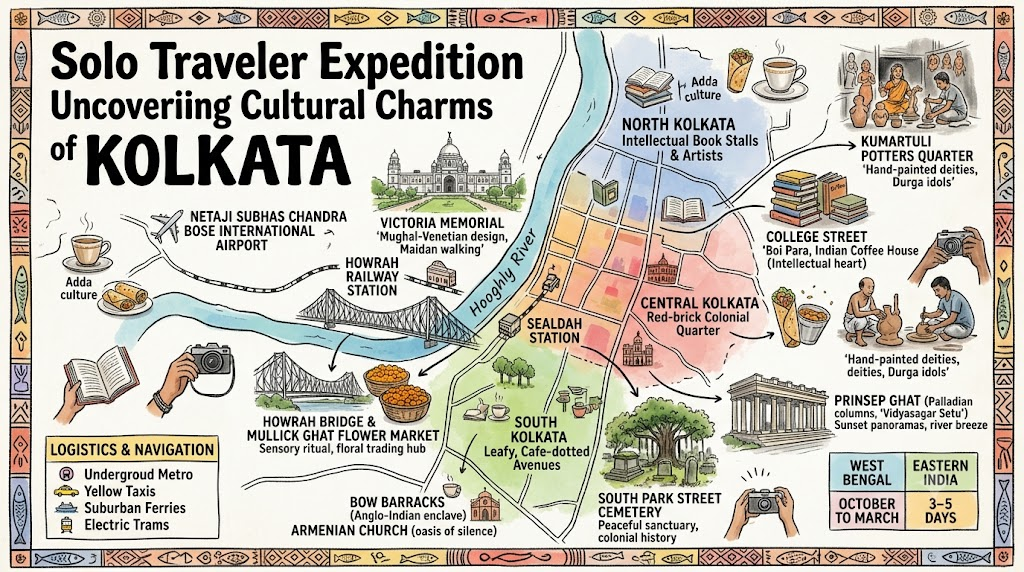
Kolkata stands as the intellectual and cultural anchor of India, carrying the legacy of the nineteenth-century Bengal Renaissance and imperial history. Geographically cradled along the eastern banks of the Hooghly River, it links ancient Gangetic trade with modern urban sprawl. For the solo traveler, the city is remarkably accessible via the Netaji Subhas Chandra Bose International Airport and the colossal rail termini of Howrah and Sealdah.
Its public transit network—comprising India’s oldest operational metro system, iconic yellow Ambassador taxis, suburban ferries, and legacy electric trams—makes independent navigation both economical and deeply evocative.
The general travel circuit divides into the nostalgic, red-brick colonial quarter of Central Kolkata, the intellectual book stalls of North Kolkata, and the leafy, cafe-dotted residential avenues of South Kolkata.
| Metric | Details |
| Primary Region | West Bengal, Eastern India |
| Best Travel Months | October to March (Pleasant, crisp winter mornings) |
| Nearest Transit Hubs | Howrah Railway Station (HWH), Kolkata Airport (CCU) |
| Local Travel Mode | Underground Metro, Suburban Ferries, Yellow Taxis, Auto-Rickshaws |
| Ideal Trip Length | 3 to 5 Days (Ideal for unhurried solo exploration) |
Top Places or Experiences
Victoria Memorial and the Maidan Greens
Commissioned in 1906 to commemorate Queen Victoria and opened to the public in 1921, the Victoria Memorial is an architectural triumph built from dazzling white Makrana marble. Combining Indo-Saracenic design with classical British, Venetian, and Mughal elements, the monument rises majestically over manicured green lawns and ornamental reflecting pools. For a solo traveler, the morning hours offer pristine tranquility as morning walkers, sketch artists, and readers scatter across the surrounding perimeter.
Inside, the grand hall houses extensive royal galleries, rare oil paintings, and imperial artifacts narrating the complex chapters of British India. Stepping outside onto the sprawling greens of the Maidan, you encounter an unbroken expanse where local cricket matches unfold against the backdrop of colonial spires and grazing horses.
- Location: Queens Way, Maidan, Central Kolkata (approx. 4 km south of B.B.D. Bagh).
- Why it is worth visiting: The ultimate symbol of Calcutta’s imperial architectural ambition, surrounded by the city’s largest open green space.
- Best things to do: Explore the portrait collection in the Queen’s Hall, sit by the north reflecting pool, and walk through the Maidan toward St. Paul’s Cathedral.
- Best time to visit: 8:00 AM to 11:00 AM for soft natural sunlight and quiet galleries.
- Ideal for whom: Solo explorers, history buffs, and architectural sketchers.
- Travel tip: Purchase garden-only tickets at automated kiosks or online to bypass long queues for the indoor museum.
College Street and the Indian Coffee House
Stretching nearly a mile in the heart of academic North Kolkata, College Street—affectionately known as Boi Para (Book Town)—is the world’s largest secondhand book market. Countless makeshift wooden stalls lean against historic university faculties, their shelves crammed with rare first editions, university treatises, and vintage literature. The air smells intensely of aged pulp, printer ink, and brewing Assam tea.
At the epicenter of this literary universe sits the legendary Indian Coffee House on Bankim Chatterjee Street. Entering its cavernous, high-ceilinged hall feels like stepping onto a historic theatrical stage, where turbaned waiters serve black infusion coffee amid the ceaseless buzz of student arguments and political debates.
- Location: College Street, Central-North Kolkata (approx. 2 km from Sealdah Station).
- Why it is worth visiting: The intellectual beating heart of Kolkata and a paradise for independent literary travelers.
- Best things to do: Hunt for rare vintage paperbacks among pavement stalls, order black coffee with mutton cutlets at Coffee House, and admire the facade of Presidency University.
- Best time to visit: 11:30 AM to 4:00 PM on non-Sunday afternoons when book stalls are open.
- Ideal for whom: Bibliophiles, solo writers, and cultural anthropologists.
- Travel tip: The upper balcony inside Indian Coffee House offers a quieter vantage point and panoramic views of the main floor.
Kumartuli Potters Quarter
Tucked along the riverbanks of North Kolkata lies Kumartuli, an ancestral artisans’ quarter with roots dating back over three centuries. Here, generations of skilled clay craftsmen transform river silt dredged from the Hooghly into intricate idols of Hindu deities, most notably Goddess Durga. Walking alone through these narrow, covered labyrinthine lanes reveals an artistic process completely untouched by industrial assembly lines.
Bamboo armatures are tied with golden straw, layered with smooth dark clay, and delicately hand-painted with fine squirrel-hair brushes. The quiet concentration of the sculptors inside their open studios provides a reverent, mesmerizing experience for mindful solo travelers who respect local boundaries.
- Location: Kumartuli, North Kolkata (approx. 500 meters from Shobhabazar Sutanuti Metro Station).
- Why it is worth visiting: An authentic, living craft neighborhood showcasing traditional clay modeling techniques.
- Best things to do: Observe artisans sculpting natural clay, photograph drying statues in soft alley lighting, and wander down to the adjacent Kumartuli Ghat.
- Best time to visit: August to October (pre-Durga Puja preparation) or early mornings year-round for quiet observations.
- Ideal for whom: Documentary photographers, cultural anthropologists, and creative artists.
- Travel tip: Always ask permission before photographing sculptors at work, and avoid touching unfired clay figures.
Howrah Bridge and Mullick Ghat Flower Market
Completed in 1943 during the height of World War II, the iconic Howrah Bridge (Rabindra Setu) is a cantilever steel marvel that spans the Hooghly without any intermediate pylons resting in the riverbed. Carrying hundreds of thousands of commuters each day, it serves as the vital lifeline between Kolkata and Howrah. Crossing the pedestrian boardwalk on foot as the morning mist clears is an unforgettable sensory ritual for any solo traveler.
Directly underneath the southeastern approach of the bridge sits the sprawling Mullick Ghat Flower Market, one of Asia’s largest floral trading hubs. Towering sacks of orange marigolds, fragrant jasmine garlands, and blood-red hibiscus form an ocean of color against the industrial steel trusses rising above.
- Location: Strand Road approach to Howrah Bridge, Central Kolkata.
- Why it is worth visiting: The raw visual contrast between monumental industrial steel and vibrant botanical commerce.
- Best things to do: Walk the eastern pedestrian span of Howrah Bridge, explore the floral lanes of Mullick Ghat, and watch traditional wrestlers practice along the river steps.
- Best time to visit: 5:30 AM to 8:00 AM for peak morning wholesale flower trading.
- Ideal for whom: Street photographers, morning walkers, and immersive cultural travelers.
- Travel tip: Watch your footing along the wet cobblestone pathways of the flower market and keep personal electronics secured in dense crowds.
South Park Street Cemetery
Opened in 1767 and closed to burials in 1790, the South Park Street Cemetery is one of the world’s earliest non-churchyard burial grounds. Shaded by dense banyan canopies, giant ferns, and creeping vines, this peaceful forested sanctuary contains hundreds of elaborate Indo-Gothic, classical, and Baroque tombs. It holds the remains of British administrators, soldiers, poets, and thinkers of the early colonial era.
For an independent traveler looking to escape urban noise, the cemetery offers profound silence and historical contemplation. The weathered stone pyramids, classical urns, and moss-covered obelisks provide a hauntingly poetic glimpse into the fragility of imperial life in tropical Bengal.
- Location: 52 Park Street, Park Circus Crossing, South-Central Kolkata.
- Why it is worth visiting: A peaceful green sanctuary steeped in colonial history, romantic architecture, and atmospheric decay.
- Best things to do: Locate the monument of Anglo-Indian poet Henry Louis Vivian Derozio, photograph the tomb of Sir William Jones, and enjoy quiet reading under the trees.
- Best time to visit: 10:00 AM to 1:00 PM for bright overhead daylight filtering through the tree canopy.
- Ideal for whom: Solitary walkers, poets, history buffs, and architecture researchers.
- Travel tip: Carry insect repellent, as the lush tropical foliage attracts mosquitoes year-round.
Prinsep Ghat and Vidyasagar Setu Boardwalk
Erected in 1841 along the banks of the Hooghly, Prinsep Ghat is a neoclassical monument framed by pale Palladian columns. Named after Anglo-Indian antiquarian James Prinsep, the pavilion stands directly beneath the soaring modern steel cables of Vidyasagar Setu (the Second Hooghly Bridge). The promenade along the riverbank has been carefully restored with garden walkways, riverside benches, and soft lantern lighting.
Late afternoons here provide the quintessential solo pause: watching traditional wooden dinghy boats glide across shimmering waters while the sun sets behind the western banks. The river breeze, combined with the gentle chiming of boat ropes against wooden docks, captures Kolkata’s unhurried romantic rhythm.
- Location: Strand Road, Hastings, South-Central Kolkata (approx. 5 km from Esplanade).
- Why it is worth visiting: Unrivaled sunset panoramas juxtaposing historic Victorian pavilions with modern bridge engineering.
- Best things to do: Hire a private wooden country boat for a solitary river float, walk the paved riverside promenade, and drink ginger chai from local earthen cups.
- Best time to visit: 4:30 PM to 7:00 PM for dramatic sunset and evening lighting.
- Ideal for whom: Contemplative wanderers, landscape photographers, and sunset watchers.
- Travel tip: Boatmen operate on a fixed rate per 30 minutes; negotiate politely before boarding and verify life jacket availability.
Offbeat Exploration: Hidden Gems Tourists Miss
Bow Barracks Anglo-Indian Enclave
Tucked quietly behind Central Metro Station, Bow Barracks is an atmospheric courtyard enclosed by red-brick apartment blocks built originally as World War I military quarters. Today, it remains the historic heart of Kolkata’s Anglo-Indian community. Walking here reveals green louvered shutters, potted hanging gardens, and quiet conversations that transport you to a distinct cultural chapter.
The Armenian Church of the Holy Nazareth
Hidden behind crowded spice and hardware stalls in Barabazar, this church was built in 1724 and stands as one of Kolkata’s oldest Christian places of worship. Step through its quiet wrought-iron gate to discover an oasis of silence, complete with centuries-old Armenian gravestones embedded in the stone courtyard floor.
Jorasanko Thakur Bari Inner Courtyards
While tourists frequently visit the main Tagore museum rooms, few take the time to sit quietly in the central brick quadrangle of the ancestral home of Nobel laureate Rabindranath Tagore. In early mornings, the red-ochre balconies and broad verandas reflect soft morning light, offering a meditative space celebrating Bengal’s greatest poet.
Detailed Practical Guidance for Travelers
| Destination | Standard Entry Fee | General Timings | Best Local Food Options Nearby | Recommended Nearby Attractions |
| Victoria Memorial | ₹50 (Indians) / ₹500 (Foreigners) | 10:00 AM – 6:00 PM (Gardens from 5:30 AM) | Nizam’s Rolls, Balwant Singh Dhaba | St. Paul’s Cathedral, Birla Planetarium |
| College Street | Free | 10:00 AM – 7:30 PM (Stalls closed Sundays) | Indian Coffee House, Paramount Sherbets | Presidency University, Marble Palace |
| Kumartuli | Free (Photography fees may apply) | Open 24 Hours (Best during daylight) | Mitra Cafe, Chitto Da’s Suruchee | Shobhabazar Rajbari, Bagbazar Ghat |
| Howrah Bridge & Mullick Ghat | Free | Open 24 Hours (Market best 5:00 AM – 9:00 AM) | Tewari Brothers, Local Kachori vendors | Armenian Ghat, Rail Museum |
| South Park Street Cemetery | ₹50 | 10:00 AM – 5:00 PM | Peter Cat (Chelo Kebab), Flurys tearoom | Mother House, Quest Mall |
| Prinsep Ghat | Free | Open 24 Hours | Street Pav Bhaji, Earthen Cup Chai | Millennium Park, Fort William |
Logistics & On-Ground Navigation
Local Transport Options
- Kolkata Underground Metro: Fast, ultra-safe, and incredibly cheap (₹5 to ₹25 per ride). The North-South line directly connects major hubs like Park Street, Esplanade, and Shobhabazar.
- Yellow Taxis & App Cabs: Yellow Ambassador taxis run by official meters or standard prepaid booths at railway hubs; apps like Uber and Yatri Sathi provide reliable, fixed pricing.
- Hooghly River Ferries: Operated between various ghats (e.g., Fairlie to Howrah Station) for just ₹6 per crossing, avoiding road gridlock while providing stunning waterside views.
- Electric Trams: Limited heritage routes run around the Maidan and Esplanade, perfect for a slow, cinematic ride.
Budget Planning
- Backpacker / Solo Hostel Tier (₹1,000 – ₹2,200 per day): Budget dorm beds in backpacker hostels around Central Kolkata, daily street food, and unlimited travel via metro and public ferries.
- Mid-Range / Private Studio Tier (₹4,500 – ₹8,000 per day): Boutique heritage stays in South Kolkata or Ballygunge, private app cabs, dining at historic colonial restaurants, and guided heritage walking tours.
Safety and Inclusivity Tips
- Solo Female Travelers: Kolkata consistently ranks among India’s safest metropolitan cities. Stick to metro transit after dark, use registered app cabs for late returns, and dress with modest everyday casuals when exploring conservative older neighborhoods.
- General Safety: Violent street crime is exceptionally rare. Keep your phone and wallet secure in dense bazaars like Barabazar, New Market, and Howrah Station approaches.
- Couples & Independent Explorers: Respect local cultural conventions near religious temples and ghats; public displays of affection should be kept discreet.
Strategic Travel Planning Guardrails
Travel Planning Tips for Kolkata
- Carry Paper Currency: While UPI and QR-code digital payments are widespread, small roadside tea stalls, ferry ticket counters, and tram operators accept only cash.
- Target the Winter Season: Schedule your trip between November and February to enjoy dry weather and comfortable walking conditions.
- Wear Easy Slip-On Shoes: You will frequently remove footwear when stepping into temples, heritage homes, and community centers.
- Drink Filtered or Packaged Water: While municipal tap water supplies historical fountains, solo travelers should use verified packaged water or personal filter bottles.
- Pack a Light Shawl or Jacket: Winter evenings along the riverfront can be surprisingly breezy and crisp.
- Embrace “Adda” Culture: Engage politely with neighborhood tea stall owners; a simple question often unlocks fascinating historical stories and local tips.
Common Mistakes to Avoid
- Overpacking Your Daily Itinerary: Trying to see five major sites across the city in one day will leave you exhausted in traffic; limit yourself to one geographic pocket per day.
- Relying Exclusively on Road Cabs: Skipping the metro and river ferries during rush hour (9:00 AM – 11:00 AM and 5:30 PM – 8:00 PM) will trap you in heavy bottlenecks.
- Bypassing Street-Side Chai: Ignoring fresh clay-cup tea from roadside stalls deprives you of Kolkata’s most beloved everyday ritual.
- Visiting College Street on Sunday: Book stalls remain closed on Sundays, turning the bustling literary street into an empty corridor.
- Haggling Aggressively with Craftsmen: Artisans in Kumartuli and roadside book vendors operate on slim margins; negotiate respectfully.
Suggested Itinerary Blueprints
1. Day Quick Dash (Classic Heritage Sprint)
- Target: Short layovers or business travelers with one free day.
- Route: Early morning flower market exploration at Mullick Ghat, followed by a walk across Howrah Bridge. Take the metro south to explore Victoria Memorial and St. Paul’s Cathedral. Wrap up your afternoon with lunch on Park Street and catch the sunset from Prinsep Ghat.
2. Day Deep-Dive (North-South Cultural Split)
- Day 1 (The Intellectual & Colonial North): Begin at Kumartuli watching idol artisans, ride the metro to College Street for rare books and lunch at Indian Coffee House, explore B.B.D. Bagh’s colonial edifices, and end the day with a ferry ride across the Hooghly.
- Day 2 (The Refined & Artistic South): Start with an early morning walk through the Maidan, tour Victoria Memorial, visit the tranquil South Park Street Cemetery, and spend a relaxed evening visiting artisanal cafes along Southern Avenue.
3. Complete Weekend Travel Plan (Comprehensive Solo Odyssey)
- Friday Afternoon: Arrive, settle into a central guesthouse, and take a relaxed evening walk through Bow Barracks followed by dinner at Peter Cat on Park Street.
- Saturday: Explore the dawn flower market, cross Howrah Bridge on foot, browse College Street book stalls, and finish with a quiet sunset boat float at Prinsep Ghat.
- Sunday: Discover the historic lanes of Jorasanko Thakur Bari, visit the ancient Armenian Church, wander through South Park Street Cemetery, and wrap up with dessert at a traditional sweet shop.
Common Tourist Mistakes to Avoid
Geographic Blunders
Attempting to jump from North Kolkata (Kumartuli or College Street) to South Kolkata (Kalighat or Southern Avenue) multiple times a day is a common error. Group your itinerary strictly into northern, central, and southern days.
Commercial Traps
Spending your valuable solo days inside new glass shopping malls in suburban townships ruins the trip. Kolkata’s magic lies in its traditional neighborhoods, historic tea corners, and outdoor river ghats.
Neglecting Modern/Alternative Zones
Focusing solely on crumbling colonial monuments means missing Kolkata’s thriving contemporary arts scene. Take time to explore indie cafes, art spaces, and tree-lined avenues in Hindustan Park and Southern Avenue.
Transport Overpayment
Never accept unmetered flat rates quoted by taxi operators waiting directly outside major rail terminals or luxury hotels. Always head to designated prepaid taxi kiosks or book through app services.
Luxury Dining Bias
Confining yourself to five-star hotel buffets disconnects you from the soul of Bengal’s cuisine. Savor local roll joints, heritage sweet shops, and traditional eateries for the most authentic flavors.
Frequently Asked Questions
1. Is Kolkata safe for a first-time solo female traveler?
Yes, Kolkata is widely recognized as one of India’s safest metropolitan cities for independent travelers. The local culture is deeply respectful and welcoming toward solo guests. For a hassle-free visit, stick to the well-connected underground metro, use reliable app cabs like Uber after dark, and choose accommodations in central neighborhoods like Park Street.
2. What is the most cost-effective way to get around the city alone?
The Kolkata Underground Metro combined with public river ferries offers the most affordable way to travel. A cross-city metro ticket costs between ₹5 and ₹25, while ferry rides across the Hooghly cost just ₹6. Both options help you bypass road traffic jams during busy morning and evening commuting hours.
3. When is the best time of year to visit Kolkata for solo exploration?
The winter window spanning from late October through March is the undisputed best season. Temperatures remain delightfully mild and pleasant, averaging between 15°C and 26°C. This makes long daytime walking tours through open book markets, historic river ghats, and colonial avenues comfortable without the draining humidity of the summer months.
4. How many days should an independent traveler spend in Kolkata?
A 3 to 4-day itinerary allows you to explore the city’s key cultural highlights without feeling rushed. This timeline lets you spend dedicated days across North, Central, and South Kolkata, browse historic book stalls, explore heritage riverbanks, and enjoy traditional culinary tastings at a relaxed, comfortable pace.
5. Can I use digital payments everywhere, or should I carry cash?
While UPI mobile payments are widely accepted at modern cafes, restaurants, and shopping centers, carrying cash remains essential for daily transit. Roadside tea vendors, ferry ticket counters, heritage tram conductors, and second-hand book sellers rely primarily on small paper currency notes for their daily transactions.
6. Where should a solo traveler base themselves for convenient sightseeing?
Central neighborhoods like Park Street, Chowringhee, and Camac Street offer the most convenient, safe bases. These areas place you within walking distance of key metro stations, diverse culinary dining, and historic landmarks like Victoria Memorial, while providing clean hostels, boutique hotels, and guesthouses suited for independent explorers.
7. Is street food safe to eat for international visitors?
Yes, provided you choose busy food stalls with high customer turnover where ingredients are cooked fresh right in front of you. Iconic options like Kathi rolls, hot samosas, and freshly steamed momos are generally reliable. Avoid pre-cut fruits exposed to the air and stick to bottled or filtered water.
8. Are local residents receptive to travelers striking up conversations?
Engaging with locals is one of the most rewarding aspects of traveling through Kolkata. Known as Adda, spontaneous cultural discussions about literature, arts, and politics unfold naturally at neighborhood tea stalls. Locals are genuinely warm, helpful with street directions, and proud to share their city’s history.
9. What should I pack when visiting Kolkata during the winter months?
Pack light, breathable cotton clothing for daytime sightseeing, along with a comfortable pair of slip-on walking shoes for touring temples and markets. Add a light jacket, sweater, or wrap for breezy morning ferry rides and cooler winter evenings, plus sun protection and insect repellent.
10. Do I need guided walking tours, or can I explore independently?
The city can easily be explored on your own using local metro rail and digital map navigation. However, joining an organized heritage walking tour through neighborhoods like the colonial quarter or Kumartuli can provide fascinating historical context that independent travelers might otherwise overlook.
11. Is tipping expected in cafes and local restaurants?
Tipping is customary but remains entirely voluntary. In sit-down casual restaurants and heritage cafes, leaving a 5% to 10% tip for good service is standard practice. At small street stalls, tips are not expected, though rounding up loose change for tea vendors is always appreciated.
12. What unique souvenirs should a solo traveler buy in Kolkata?
Look for handmade terracotta figurines, traditional handloom sarees (such as Jamdani or Baluchari), rare second-hand English and Bengali books from College Street, and locally produced Dokra metal crafts. For food lovers, picking up fresh packets of Bengali sweets like Sondesh or Nolen Gur makes a delicious gift.
Conclusion
Setting out on a solo journey through Kolkata offers far more than a checklist of colonial monuments and busy bazaars. It invites you to step into an unhurried, deeply poetic world where every street corner tells a story and strangers welcome you like an old friend. Long after you leave its riverside ghats and bustling lanes, the city’s literary heart, warm hospitality, and timeless charm will stay with you, proving that wandering alone is often the best way to feel truly connected.