Introduction
Planning for medical fertility support tests your patience and your wallet. Couples regularly face endless lists of facilities, confusing medical words, and variable price quotes. Moving across state lines or overseas introduces more travel headaches. You need direct, trustworthy facts before committing your savings. Good research lets you ask meaningful questions during initial clinical consults. An online resource named IVFHospitalsNow.com assists your early research journey. It presents neutral clinic information without sales spin or paid endorsements. The platform avoids medical recommendations and avoids ranking individual specialists. Instead, it provides clear facts so you control your family plans with total clarity.
What is IVFHospitalsNow.com
IVFHospitalsNow.com operates as an open educational database for patients seeking fertility services. It gathers center profiles, procedure breakdowns, and financial estimates under one digital roof. The team rejects sponsorship money from clinics seeking special placement. Anyone can search for local neighborhood practices or browse cross-border clinical alternatives. It breaks down complex medical jargon, modern lab equipment, and unexpected facility surcharges. It explains what bargain treatment packages leave off their advertised brochures. The site never prescribes medical treatments or directs you toward specific physicians. Instead, it lets you gather clinical details at your chosen pace. That knowledge empowers you to speak with a physician with complete confidence.
Start by Learning About IVF Clinics
An IVF clinic offers specialized medical services to assist people with family building. The acronym IVF means in vitro fertilization, uniting eggs and sperm inside a specialized laboratory dish. Doctors run diagnostic panels to identify why natural conception has stalled. Clinics supply hormone therapy, egg preservation, and IUI, which introduces concentrated sperm into the uterus. Many facilities use ICSI, where an embryologist injects a single sperm into an egg. Every center maintains unique laboratory tools, clinician counts, and billing tiers. Large medical universities manage massive facilities, while private groups run small offices. Because clinical standards and fees vary widely, you should evaluate several centers before signing agreements.
What Should You Check Before Choosing?
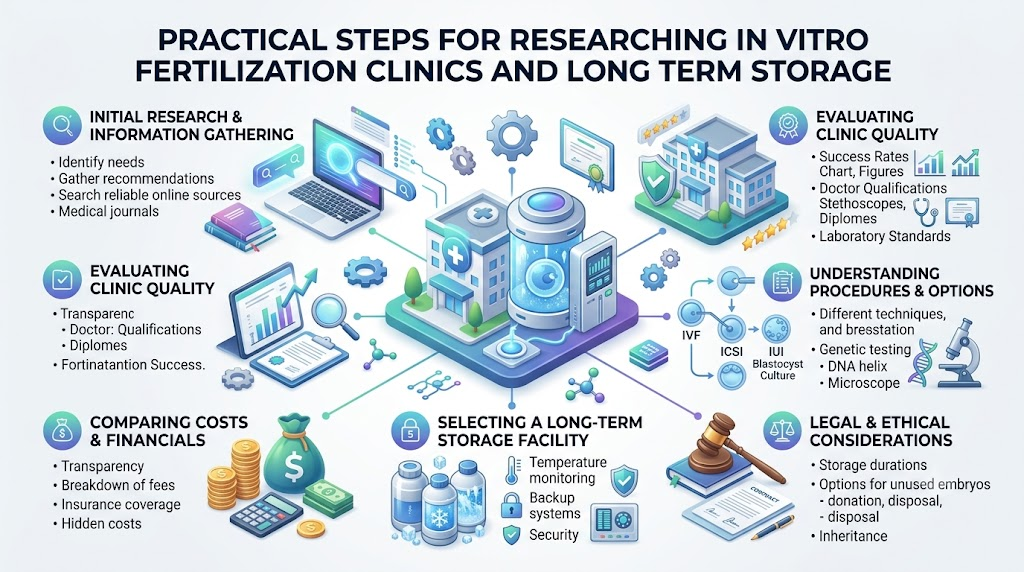
Patients must examine several critical items before booking care at any facility. You need a dedicated medical team that respects your health needs and financial limits. Begin by reviewing the exact procedures the physicians perform on a weekly basis. Then, examine the doctors’ clinical backgrounds and verify current laboratory accreditation. Confirm that the clinic provides compassionate emotional counseling, because treatment demands mental resilience. You must also note clinic distance and check patient acceptance guidelines. Certain centers establish strict age cutoffs or require pre-treatment diagnostic testing before accepting candidates. The table below outlines key items to inspect.
| Factor | Why It Matters |
| Treatment options | Shows what care the clinic offers |
| Doctor experience | Helps you understand the care team |
| Lab services | Supports IVF and embryo care |
| Full cost | Helps avoid surprise fees |
| Success data | Gives useful treatment context |
| Patient support | Helps with the care process |
| Location | Keeps travel and visits easy |
| Eligibility rules | Explains who the clinic can treat |
Understanding IVF Treatment Cost
The overall IVF treatment cost shifts depending on your personal medical history. Centers frequently publicize attractive entry rates, yet that starting number rarely covers every mandatory step. An entire cycle requires diagnostic bloodwork, sonogram checks, and minor egg collection surgery. It demands precise embryology work, embryo placement, and long-term freezing for leftover embryos. Furthermore, you must purchase specialty hormone injections, adding thousands of dollars to overall expenses. Facilities also bill recurring annual fees to house frozen eggs and embryos safely. If your first attempt fails, subsequent cycles add new bills. Therefore, insist on an all-inclusive, line-item price breakdown before starting treatment.
IVF Cost Comparison Table
Direct inquiries regarding every individual fee shield you from painful financial setbacks. Use this structured table when interviewing administrative staff about total cycle costs.
| Cost Area | Question to Ask |
| IVF cycle | What does the main fee cover? |
| Medicine | Are fertility medicines included? |
| Testing | Are tests included? |
| Egg collection | Is the procedure included? |
| Lab work | Are lab services included? |
| Embryo transfer | Is transfer included? |
| Freezing | Is freezing included? |
| Storage | What is the storage fee? |
How to Read IVF Success Rates
Facility statistics often mislead people who skim headline numbers too quickly. High success percentages never guarantee that you will leave the hospital with a baby. Actual IVF success rates depend on patient age, reproductive history, and egg cellular health. Male sperm parameters equally shape final embryo quality and clinical outcomes. Some centers inflate numbers by admitting only younger candidates with uncomplicated health profiles. Furthermore, some registries record simple positive pregnancy tests, while others track actual live births. Positive blood tests do not always result in a baby. Donor gametes also lift clinic averages significantly. Request tailored outcome statistics matching your exact age group and diagnostic background.
IVF Clinics Near Me or IVF Treatment Abroad?
Selecting IVF clinics near me enables you to rest in your own home each evening. You drop by the local office for scans without taking extended leaves of absence from your job. Conversely, numerous patients pursue IVF treatment abroad seeking reduced clinical fees. Others travel abroad because foreign jurisdictions permit third-party donor options that local statutes prohibit. However, international transit requires supplementary funds for airfare, lodging, and daily meals. You must also secure monitoring physicians at home for post-procedure care. Consequently, as you assess the IVF cost by country, incorporate living and travel expenses alongside base medical quotes.
Real-Life Scenarios / Experiences
- An urban couple questions their local doctor and learns that base invoices omit costly stimulation injections. They obtain an expanded quote to arrange their savings schedule without surprises.
- An ambitious professional investigates cryopreservation options across three regional clinics. She examines annual liquid nitrogen storage costs to budget five years of cold preservation.
- A married pair calculates cross-border clinical packages to reduce baseline medical expenses. Factoring in overseas flights, extended hotel stays, and lost wages demonstrates local care costs nearly the same amount.
- An individual with low semen parameters discusses micro-injection with their specialist. The physician explains that placing one sperm directly inside an egg improves fertilization rates for their specific profile.
ICSI vs IVF
Individuals frequently investigate the functional contrasts separating standard IVF from ICSI procedures. Standard IVF combines one egg with thousands of moving sperm cells within a small glass dish. The strongest sperm navigates through the egg membrane without technical intervention. In contrast, ICSI requires a lab technician to secure the egg and insert a single sperm using a microneedle. Clinicians employ ICSI whenever male partners display reduced sperm counts or irregular cellular motility. However, ICSI provides no inherent advantage for couples facing regular female-factor obstacles. It addresses specific sperm issues. Question your physician about why your case warrants ICSI before approving treatment contracts.
Fertility Treatment Options
Prospective parents have several medical routes aside from standard IVF cycles. Specialists frequently begin with oral medications that stimulate regular ovarian egg release. Another practical approach is IUI, placing prepared sperm directly into the uterus during natural ovulation. Doctors run routine hormone panels and ultrasound assessments to evaluate fallopian tubes and ovarian health. Many candidates freeze gametes early to safeguard future family building prospects. Each individual requires a unique clinical plan. For these reasons, discuss all available fertility treatment options alongside a certified endocrinologist before paying for complex interventions.
Egg Freezing Cost
Cryopreservation lets individuals preserve healthy eggs today for future family planning. The comprehensive egg freezing cost encompasses several distinct clinical phases. First, you administer daily hormone shots to develop multiple follicles over two weeks. Next, a surgeon retrieves the mature eggs using a brief ultrasound-guided procedure. Then laboratory technicians freeze the eggs immediately through vitrification techniques. You must budget an ongoing annual fee to store the samples securely in nitrogen tanks. When you decide to fertilize them later, expect extra charges for thawing, ICSI, and embryo transfer. Confirm how many months of free storage your initial package contains.
Common Mistakes to Avoid When Choosing Delhi Events
- Accepting promotional package prices: Initial estimates exclude medication charges, so request an itemized billing sheet.
- Evaluating only top-line clinic statistics: General percentages hide age realities, so demand statistics for your age group.
- Overlooking laboratory certifications: The laboratory protects your growing embryos, so verify valid medical credentials.
- Omitting travel budgets: Distant facilities necessitate accommodations and flights, so include living expenses in your plans.
- Forgetting long-term storage fees: Cryobanks charge recurring storage fees, so clarify annual preservation fees in advance.
- Trusting online marketing campaigns: Slick advertisements overpromise, so cross-reference third-party educational guides independently.
- Disregarding psychological assistance: Fertility care causes mental strain, so select centers offering licensed mental counselors.
- Escalating to invasive treatments prematurely: Simpler therapies often work, so explore mild therapies before pursuing major surgery.
Simple IVF Clinic Comparison Plan
- Select three to five licensed fertility centers in your area.
- Prepare a uniform list of questions concerning pricing, equipment, and safety.
- Compare available clinical techniques and laboratory tools across each facility.
- Obtain itemized fee statements encompassing bloodwork, procedures, and drugs.
- Study clinical outcome statistics tailored to your age bracket.
- Evaluate transit times to determine daily commuting stress.
- Confirm how on-call medical teams handle unexpected weekend emergencies.
- Review your collected clinic notes with a trusted medical specialist before making choices.
IVF Cost Areas to Check
| Cost Area | Question to Ask |
| IVF cycle | What does the main fee cover? |
| Medicine | Are fertility medicines included? |
| Testing | Are tests included? |
| Egg collection | Is the procedure included? |
| Lab work | Are lab services included? |
| Embryo transfer | Is transfer included? |
| Freezing | Is freezing included? |
| Storage | What is the storage fee? |
Role of IVFHospitalsNow.com
IVFHospitalsNow.com simplifies complex clinic research and prevents unnecessary decision fatigue. It publishes easy-to-read educational articles covering IVF, ICSI, and diagnostic fertility assessments. Users explore the site to locate qualified practitioners nearby or internationally. It clarifies common administrative bills so you catch hidden expenses before paying retainers. It also translates confusing government clinic registries into everyday language. The platform offers no diagnostic claims and never endorses a single center over another. Instead, it delivers objective information so you compare IVF clinics from an informed position.
Frequently Asked Questions
1. Which evaluations happen during initial consultations?
Physicians perform baseline health assessments for both individuals during an initial consultation. The specialist collects blood samples to measure hormone reserves and uses pelvic sonograms to inspect the uterus. The center also evaluates sperm samples. These tests uncover underlying obstacles, guiding the physician toward an appropriate clinical strategy.
2. Can daily injections create significant physical discomfort?
Individuals report minor skin pinches rather than intense physical pain from hormone needles. These medications utilize ultra-fine needles that penetrate just beneath the skin. Patients occasionally encounter mild abdominal swelling, localized tenderness, or emotional swings as ovaries produce eggs. Applying ice to the injection site numbs the skin quickly.
3. How many calendar weeks does an IVF cycle require?
Standard IVF protocols take about three to four weeks from start to finish. You self-administer hormonal drugs for roughly twelve days to encourage follicle development. Afterward, a physician harvests mature eggs and introduces sperm in the laboratory. The clinician transfers a resulting embryo into the uterus five days later.
4. How does IUI differ from an IVF protocol?
IUI injects concentrated sperm directly inside the uterus, allowing natural cellular fertilization inside your body. IVF removes human eggs from the body so technicians achieve fertilization within laboratory dishes. Because IVF involves surgical retrieval, embryology maintenance, and embryo transfers, it costs considerably more than intrauterine insemination.
5. Why do pharmacies charge high rates for fertility drugs?
Hormone medications contain delicate biological compounds requiring sterile laboratory synthesis. Drug manufacturers conduct extensive clinical trials to satisfy safety standards set by federal drug regulators. Fertility clinics do not produce these pharmaceuticals, so you purchase them through licensed specialty distributors that fix consumer prices.
6. Do patients maintain regular employment during cycles?
Most individuals maintain their typical office schedules throughout their treatment program. You schedule early morning appointments for bloodwork draws and rapid sonogram checks before your shift starts. However, you must schedule a full day off for surgical egg retrieval. Taking things easy after the embryo transfer reduces mental tension.
7. What happens to extra embryos after treatment completes?
Embryologists place surplus high-grade embryos into liquid nitrogen tanks for future family building. These vitrified specimens stay viable for decades without cellular decline. If you finish your family, you can maintain storage, donate the embryos to another couple, or authorize the facility to discard them ethically.
8. Does commercial air travel harm a fresh embryo transfer?
Aviation travel creates no measurable danger following an embryo transfer. Standard cabin air pressure and engine vibrations cannot dislodge an embryo from the endometrial lining. Nevertheless, doctors advise against carrying heavy travel bags or sprinting through airports. Drink plenty of water and stretch your legs periodically down the aisle.
9. Which clinical side effects accompany fertility care?
Patients occasionally encounter ovarian hyperstimulation syndrome when ovaries overreact to stimulation hormones. The retrieval needle also introduces a small chance of minor bleeding or infection. When doctors transfer multiple embryos, patients face higher odds of carrying twins, increasing premature delivery risks and low birth weights.
10. Does the initial IVF cycle work for every patient?
Many couples undergo two or three treatment rounds before achieving a live birth. While certain patients conceive immediately, others face unsuccessful initial cycles. Personal outcomes depend on biological age, baseline ovarian reserve, sperm parameters, and subtle structural concerns like uterine fibroids.
11. Can nutritional adjustments improve treatment success?
Consuming balanced meals and enjoying light walks enhances pelvic circulation and eases daily stress levels. Preserving a stable body weight helps the endocrine system process stimulation drugs smoothly. Nevertheless, optimal nutrition cannot reopen blocked fallopian tubes or overcome severe sperm deficits, which always demand clinical interventions.
12. Where can someone confirm a clinic’s regulatory credentials?
Government health boards maintain searchable public registries verifying whether a clinic possesses current operating licenses. Check that the facility employs board-certified reproductive endocrinologists and maintains valid lab inspection accreditations. Reputable facilities display their inspection records openly and observe the safety guidelines established by national fertility societies.
Conclusion
Deciding on fertility treatment requires thorough research and calm evaluation. Take sufficient time to compare overall fee schedules, clinician backgrounds, laboratory accreditations, and patient amenities before investing resources. Understand that published clinic data varies based on your personal health profile and age bracket. Educational platforms like IVFHospitalsNow.com offer independent foundational facts that help you locate accredited specialists without sales pressure. Organize your medical notes, list your practical questions, and discuss your personal health options with a certified fertility doctor today.