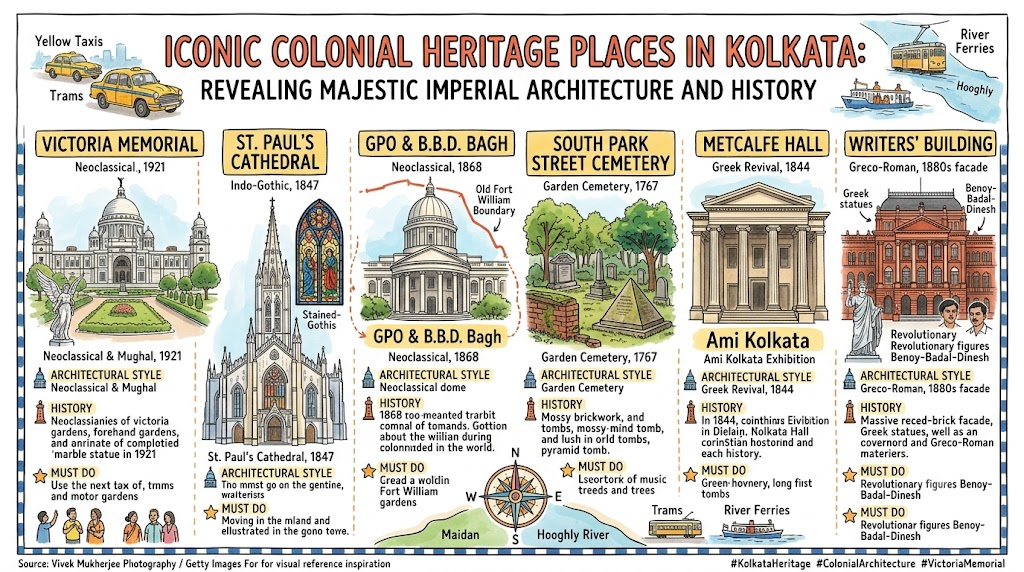
Introduction
While modern commercial hotspots offer predictable skylines and cookie-cutter tourist traps, Kolkata presents a profoundly layered historical encounter. As the former capital of the British Indian Empire until 1911, the city remains an open-air museum of monumental neoclassical, Gothic, and Indo-Saracenic grandeur. Walking down its historic avenues is not merely sightseeing; it is an intimate communion with past centuries etched permanently into weathered brick, Corinthian pillars, and Makrana marble.
Here, heritage is not tucked away behind velvet ropes or sterilized museum glass. It pulses dynamically through active courtrooms, working post offices, shaded colonial cemeteries, and vibrant neighborhood street corners. Travelers seeking soulful depth, architectural majesty, and literary nostalgia will find Kolkata an incomparable destination that rewards patient, observant exploration.
Why Kolkata is a must-visit city
Kolkata holds an extraordinary position in global travel as the crucible of the Bengal Renaissance and the administrative headquarters of British rule in South Asia for over a century. Its strategic location along the eastern bank of the Hooghly River fostered rapid maritime commerce, creating an architectural landscape unmatched across the subcontinent. For heritage enthusiasts, scholars, and everyday wanderers, the sheer density of palatial mansions, stately public offices, and spiritual sanctuaries creates an unforgettable urban tapestry.
Getting to and exploring Kolkata is seamless across every travel style. Netaji Subhas Chandra Bose International Airport (CCU) connects the metropolis to premier domestic and global destinations, while twin rail titans Howrah Junction and Sealdah welcome millions daily. Within the city, an extensive network of vintage yellow metered cabs, the heritage Kolkata Tramway, modern air-conditioned metro corridors, and scenic river ferries make navigating historical circuits effortless.
The primary colonial heritage circuit concentrates across Central Kolkata around the historic B.B.D. Bagh (Dalhousie Square), extends south along the lush Maidan towards the Victoria Memorial, and fans out eastward into the hauntingly serene Park Street district.
| Metric / Attribute | Destination Details |
|---|---|
| Primary Region | Kolkata District, West Bengal, Eastern India |
| Architectural Styles | Palladian, Neoclassical, Victorian Gothic, Indo-Saracenic |
| Best Travel Months | October to March (Pleasant, dry, and cool weather) |
| Nearest Transit Gateways | Howrah Railway Station (HWH), Kolkata Airport (CCU) |
| Local Heritage Transit | Trams, Yellow Taxis, Hooghly River Ferries, Metro Rail |
| Ideal Exploration Time | 3 to 5 Days for deep architectural immersion |
Best Colonial Heritage Places in Kolkata
Victoria Memorial
Commissioned following the death of Queen Victoria in 1901 and opened to the public in 1921, the Victoria Memorial stands as the pinnacle of British imperial architecture in India. Designed by Sir William Emerson, the majestic edifice seamlessly marries neoclassical foundations with subtle Mughal nuances, featuring a monumental central dome capped by a rotating bronze Angel of Victory. Built using the same pristine white Makrana marble sourced for the Taj Mahal, the monument commands a presence that defines the city’s skyline.
Surrounding the central palace are 64 acres of meticulously manicured royal gardens, adorned with bronze statues, ornamental pools, and whispering palm avenues. Inside, the grand galleries showcase an extraordinary collection of Raj-era royal oil paintings, rare postage stamps, archival lithographs by Thomas Daniell, and weapons from pivotal colonial campaigns.
The marble facade of Victoria Memorial.
- Location: Queens Way, Maidan, Central Kolkata (approx. 5 km south of Howrah Station).
- Why it is worth visiting: The grandest marble monument of the British Empire outside the United Kingdom, preserving magnificent colonial galleries.
- Best things to do: Walk through the Royal Gallery to view Queen Victoria’s piano, photograph reflections across the northern reflecting pool, and witness the evening light-and-sound exhibition.
- Best time to visit: 10:00 AM for empty galleries, or 4:30 PM for magnificent golden hour facade photography.
- Ideal for whom: Architecture connoisseurs, history scholars, families, and landscape photographers.
- Travel tip: Purchase museum combination entry tickets online beforehand to bypass the lengthy ticket counter lines at the south gate.
St. Paul’s Cathedral
Consecrated in 1847, St. Paul’s Cathedral is renowned as the first episcopal church built in Asia and an exquisite exemplar of Indo-Gothic architecture. Engineered by Major William Nairn Forbes under Bishop Daniel Wilson, the cathedral was constructed to replace the overcrowded St. John’s Church and withstand the humid, seismic climate of the Bengal delta. Its soaring spire, redesigned after devastating earthquakes in 1897 and 1934, closely echoes the bell tower of Canterbury Cathedral.
Stepping into the vast, column-free interior nave reveals a sublime atmosphere of solemn serenity. Sunlight filters softly through magnificent stained-glass Florentine frescoes designed by Sir Edward Burne-Jones, illuminating intricate cast-iron transepts, carved wooden pews, and delicate marble cenotaphs commemorating prominent officials of the British East India Company.
Gothic spire of St. Paul’s Cathedral.
- Location: Cathedral Road, adjacent to the Victoria Memorial, Maidan area.
- Why it is worth visiting: A masterpiece of Gothic Revival architecture featuring rare Burne-Jones stained-glass windows and historic military memorials.
- Best things to do: Admire the grand west window stained-glass artwork, sit in quiet reflection inside the column-free nave, and explore the memorial inscriptions along the inner walls.
- Best time to visit: 2:00 PM to 4:00 PM when the afternoon light illuminates the stained glass.
- Ideal for whom: Devotees, ecclesiastical art lovers, Gothic architecture enthusiasts, and solo walkers.
- Travel tip: Dress modestly with covered shoulders and knees; professional camera gear inside the sanctuary requires prior parish permission.
General Post Office (GPO) and B.B.D. Bagh
Erected between 1864 and 1868, the Kolkata General Post Office is an imposing neoclassical landmark commanding the western edge of historic Dalhousie Square (now B.B.D. Bagh). Designed by government architect Walter Granville, the building features an enormous rusticated base, a soaring semi-circular colonnade with towering Corinthian columns, and a majestic central dome. It stands directly over the original site of the first Fort William, which was captured during the siege of Calcutta in 1756.
The interior rotunda is an architectural marvel of natural lighting, housing the historic postal hall and a specialized philatelic museum displaying rare imperial stamps and antique brass postal scales. A brass line embedded into the stone floor outside commemorates the historical footprint of the old fort’s defensive curtain wall, offering a tangible link to 18th-century combat.
Neoclassical facade of Kolkata GPO.
- Location: Netaji Subhas Road, B.B.D. Bagh, Central Kolkata (1.5 km east of Howrah Bridge).
- Why it is worth visiting: The monumental epicenter of imperial communications, standing on the historic battleground of the original Fort William.
- Best things to do: Gaze up into the colossal hollow interior of the main dome, visit the postal philatelic museum, and trace the brass marker of the 1756 fort boundary.
- Best time to visit: 11:00 AM to 3:00 PM on weekdays to witness the working heritage postal sorting floor.
- Ideal for whom: Postal historians, civil engineering buffs, urban sketchers, and heritage walkers.
- Travel tip: Enter through the postal philately counter on the south side for quiet access to historic stamp archives without navigating general postal queues.
South Park Street Cemetery
Opened in 1767 and closed in 1790, the South Park Street Cemetery is one of the earliest non-church municipal burial grounds established anywhere in the world. Nestled within an overgrown, tranquil tropical forest canopy, the necropolis holds hundreds of dramatic monuments crafted in Gothic, classical Greek, and Indo-Saracenic styles. Its stone obelisks, urn-topped pyramids, cenotaphs, and ornate sarcophagi tell poignant stories of young civil servants, brave soldiers, and pioneering scholars who perished in tropical Bengal.
Wandering through its moss-laden stone avenues feels like stepping into a romantic Gothic novel. Among its most prominent inhabitants are Sir William Jones, founder of the Asiatic Society, Captain Robert Kyd, founder of the Royal Botanic Garden, and Rose Aylmer, whose tragic early demise inspired the immortal poetry of Walter Savage Landor.
Historic tombs in South Park Street Cemetery.
- Location: Park Street, Park Circus intersection, South-Central Kolkata.
- Why it is worth visiting: An exceptionally rare, atmospheric 18th-century garden cemetery featuring imposing Georgian, Roman, and Baroque funerary monuments.
- Best things to do: Locate the monumental pyramid tomb of Sir William Jones, read the poetic epitaphs engraved on weathered marble, and photograph nature reclaiming antique brickwork.
- Best time to visit: 10:00 AM to 12:00 PM when dappled sunlight penetrates the dense mahogany canopy.
- Ideal for whom: Literary pilgrims, Gothic romance lovers, genealogists, and quiet thinkers.
- Travel tip: Apply effective insect repellent before entering, as the dense, humid botanical canopy shelters active mosquitoes year-round.
Metcalfe Hall
Constructed between 1840 and 1844 to honor Charles T. Metcalfe, Governor-General of India who liberated the vernacular press, Metcalfe Hall is an imperial architectural wonder. Designed by city civil architect C.K. Robinson, its exterior is modeled faithfully on the classical Temple of the Winds in Athens. The building is enveloped by thirty monumental Corinthian columns standing upon a solid raised basement, originally fronting the active commercial docks of the Hooghly River.
Historically, this structure housed the original Imperial Library before it expanded into the National Library of India, along with the rare geological collections of the Asiatic Society. Following a sensitive restoration by the Archaeological Survey of India, the hall now features an evocative permanent multimedia exhibition titled “Ami Kolkata,” celebrating the city’s literary, artistic, and sociopolitical evolution.
- Location: Intersection of Strand Road and Fairlie Place, B.B.D. Bagh riverside.
- Why it is worth visiting: A pristine neoclassical Greek Revival masterpiece that championed the freedom of the free press in India.
- Best things to do: Marvel at the grand timber staircase leading to the upper gallery, explore the interactive “Ami Kolkata” multimedia exhibition, and admire river breezes through colonial louvers.
- Best time to visit: 11:00 AM to 4:00 PM (Closed on Mondays and national holidays).
- Ideal for whom: Political historians, book lovers, architecture students, and creative writers.
- Travel tip: Combine your visit with a brief stroll along the historic Fairlie Place railway heritage headquarters situated right next door.
Writers’ Building
Dominating the northern boundary of Lal Dighi (the great square tank of B.B.D. Bagh), the Writers’ Building is a gargantuan Greco-Roman red-brick landmark stretching nearly 150 meters. Originally built in 1777 by Thomas Lyon for junior clerks (“writers”) of the East India Company, the structure was dramatically remodeled in the 1880s by adding a magnificent French Renaissance classical facade, pediments, and allegorical statues representing Commerce, Agriculture, and Science.
Beyond its bureaucratic origins, the building is hallowed ground for India’s freedom struggle. In December 1930, three young revolutionaries—Benoy Basu, Badal Gupta, and Dinesh Gupta—executed an audacious armed raid on the Inspector General of Prisons inside these corridors, an act of valor immortalized by renaming Dalhousie Square to B.B.D. Bagh in their honor.
- Location: Binoy Badal Dinesh Bag North, B.B.D. Bagh, Central Kolkata.
- Why it is worth visiting: The red-brick epicenter of colonial governance and the legendary theater of the famous 1930 revolutionary battle.
- Best things to do: Examine the allegorical Greek rooftop statuary, photograph the grand terracotta-red facade across Lal Dighi water, and view the bronze statues of Benoy, Badal, and Dinesh.
- Best time to visit: 8:00 AM on Sunday mornings when vehicle traffic clears, enabling unobstructed wide-angle photography.
- Ideal for whom: Political history enthusiasts, architectural photographers, and freedom movement scholars.
- Travel tip: Ongoing structural restoration restricts casual interior walkthroughs; the most dramatic views and photographs are enjoyed from across the Lal Dighi promenade.
Offbeat Exploration: Hidden Gems Tourists Miss
St. John’s Church and Job Charnock’s Mausoleum
Constructed in 1787 out of stone quarried from the ruins of Gaur, St. John’s is the third oldest church in Kolkata. Hidden inside its quiet churchyard stands the octagonal Moorish-domed mausoleum of Job Charnock, the English administrator who established the East India Company’s trade settlement in 1690. Inside the vestry hangs Johann Zoffany’s controversial 1787 painting of “The Last Supper,” which cleverly depicted prominent Calcutta merchants as biblical disciples.
The Marble Palace Mansion of Muktaram Babu Street
Built in 1835 by wealthy Bengali merchant Raja Rajendra Mullick, this neoclassical residential palace is built using 126 distinct varieties of imported Italian marble. The residence remains inhabited by his descendants, housing an eclectic private collection of original oil canvases by Peter Paul Rubens and Sir Joshua Reynolds, Victorian porcelain, and Venetian glass chandeliers.
Armenian Church of the Holy Nazareth
Erected in 1724, this ancient sanctuary in the bustling Burrabazar district stands as testament to Kolkata’s oldest foreign merchant community, which settled here decades before British arrival. Its quiet courtyard contains gravestones dating back to 1630, while its serene interior features fine brass altars, biblical wall art, and an atmospheric clock tower erected in 1792.
Detailed Practical Guidance for Travelers
| Destination | Standard Entry Fee | General Timings | Best Local Food Options Nearby | Recommended Nearby Attractions |
|---|---|---|---|---|
| Victoria Memorial | ₹50 (Indians), ₹500 (Foreigners) | 10:00 AM – 6:00 PM (Tues–Sun) | Nizam’s Kathi Rolls, Haldiram’s Exotica | St. Paul’s Cathedral, Kolkata Racecourse |
| St. Paul’s Cathedral | Free | 9:00 AM – 5:00 PM (Daily) | Flurys (Park Street), Peter Cat | Victoria Memorial, Academy of Fine Arts |
| General Post Office | Free (Museum ₹10) | 10:00 AM – 4:00 PM (Mon–Fri) | Dacres Lane street stews, Indian Coffee House | Writers’ Building, Lal Dighi, Millennium Park |
| South Park Street Cemetery | ₹50 (Camera ₹100) | 10:00 AM – 5:00 PM (Daily) | Mocambo, Olypub, Kusum Rolls | South City Mall, Mother House |
| Metcalfe Hall | Free | 10:00 AM – 5:00 PM (Tues–Sun) | Deckers Lane Toast & Fish Fry, Babu Ghat Chai | Chandpal Ghat, High Court, St. John’s Church |
| Writers’ Building | Free (Exterior only) | Best viewed during daylight | Chitto Babur Dokan (Chicken Stew), Luchi stalls | Reserve Bank Museum, Standard Chartered Building |
Logistics & On-Ground Navigation
Local Transport Options
- Kolkata Metro (Blue & Green Lines): The cleanest, fastest way to bypass surface traffic between North and South Kolkata; stations like Maidan, Park Street, and Esplanade place you within footsteps of primary heritage zones.
- Iconic Yellow Ambassador Taxis: Plentiful across all road corridors; ensure drivers turn on digital fare meters or book through organized prepaid police booths at rail terminals.
- Ride-Hailing Apps (Uber & Yatri Sathi): Readily available with reliable GPS route tracking and standardized upfront rates, minimizing negotiation stress.
- Heritage Trams: Route 25 (Gariahat to Esplanade) offers an unhurried, nostalgic ride through leafy avenues at nominal cost.
- Hooghly River Ferries: Ultra-cheap state transit boats departing Fairlie Place or Babu Ghat offering unbeatable water-level panoramas of colonial riverfront facades.
Budget Planning
- Backpacker / Solo Explorer Tier (₹1,200 – ₹2,000 / day): Stay in heritage dorms or guesthouses around Sudder Street, utilize the Metro and public tram systems, and enjoy meals at Dacres Lane and traditional Bengali Pice hotels.
- Mid-Range / Heritage Comfort Tier (₹4,500 – ₹8,500 / day): Stay in atmospheric boutique properties like The Lalit Great Eastern or Elgin Fairlawn, commute in app-cabs, hire localized heritage guides, and dine in Park Street’s historic restaurants.
Safety and Inclusivity Tips
- For Families: Stick to pedestrian-friendly enclosures like the Victoria Memorial gardens and St. Paul’s precinct during daylight; pavements in Dalhousie Square can be congested with street food stalls.
- For Couples: Riverside promenades near Princep Ghat and Dalhousie are safe, welcoming, and scenic; avoid dimly lit corners of the Maidan open fields after 8:00 PM.
- General Safety: Kolkata is statistically recognized among India’s safest metropolitan centers for domestic and international travelers; basic urban awareness regarding wallets and bags in dense bazaars like Burrabazar is sufficient.
Strategic Travel Planning Guardrails
Travel Planning Tips for Kolkata
- Prioritize visits between November and February when winter daytime temperatures hover around an ideal 22°C to 26°C.
- Keep ample small cash denominations (₹10, ₹20, and ₹50 notes) for entrance tokens, local street chai, and ferry crossings.
- Wear broken-in, slip-on walking shoes to easily comply with temple and church floor etiquette while tackling long walking distances.
- Schedule interior museum visits for mornings to beat midday tourist buses, especially on weekends.
- Obtain an ASI (Archaeological Survey of India) digital entry ticket online where feasible to minimize gate delays.
- Carry a lightweight water bottle and an umbrella for sudden changes in weather or strong sun during walking tours.
Common Mistakes to Avoid
- Packing your itinerary so tightly that you miss out on leisurely adda (intellectual conversation) over Darjeeling tea at historic tea stalls.
- Attempting to explore both North Kolkata’s palatial alleys and South Kolkata’s sprawling heritage in a single afternoon.
- Relying exclusively on private cars, which frequently get caught in narrow heritage alley traffic bottlenecks.
- Assuming historical sites remain open every day; several government museums close completely on Mondays.
- Dining solely at international fast-food chains while ignoring the legendary street food hubs of Dacres Lane.
- Forgetting that colonial administrative buildings like the High Court and Writers’ Building prohibit unpermitted tripod photography.
Suggested Itinerary Blueprints
1. Day Quick Dash (Imperial Core Express)
- Target Audience: Business travelers, weekenders, or travelers on brief layovers.
- Morning: Start at 9:00 AM exploring St. Paul’s Cathedral before crossing over to the Victoria Memorial galleries and gardens.
- Afternoon: Head north to Dacres Lane for iconic street stews, followed by an exterior architectural walking loop around B.B.D. Bagh (GPO, Writers’ Building, and Lal Dighi).
- Evening: Wrap up with heritage colonial tea and Continental dinner along Park Street at Flurys or Mocambo.
2. Day Deep-Dive (From Company Rule to Renaissance Splendor)
- Day 1 (The Imperial Seat): Focus on the British administrative footprint. Spend the morning walking Dalhousie Square, visiting St. John’s Church, Metcalfe Hall, and the Reserve Bank Museum. Afternoon ferry ride from Fairlie Place to Princep Ghat for sunset views under Vidyasagar Setu.
- Day 2 (Monuments, Arts, and Epitaphs): Dedicate the morning to the Victoria Memorial galleries and Academy of Fine Arts. Afternoon quiet stroll under the mossy canopy of South Park Street Cemetery. Conclude with an evening musical visit to historic St. Paul’s Cathedral.
3. Complete Weekend Travel Plan (The Grand Calcutta Heritage Loop)
- Friday Afternoon: Arrive and check into a historic colonial hotel. Take an evening walk down Park Street, dining on iconic Chelo Kebabs at Peter Cat.
- Saturday: Embark on an early morning architectural photo walk around B.B.D. Bagh and the riverfront ghats. Visit GPO, Metcalfe Hall, and Marble Palace (by pre-obtained permit). Sunset tea at Princep Ghat.
- Sunday: Morning visit to South Park Street Cemetery, followed by comprehensive discovery of Victoria Memorial and St. Paul’s Cathedral. Complete your journey with an evening heritage tram ride along the Maidan.
Common Tourist Mistakes to Avoid
Geographic Blunders
Attempting to cross the entire length of the city between North Kolkata’s traditional aristocratic mansions and South Kolkata’s lake quarters during peak evening rush hours will trap you in bumper-to-bumper traffic. Cluster your sightseeing geographically by dedicating entire half-days specifically to Central (Dalhousie/Maidan), North (Shobhabazar/Burrabazar), or South (Park Street/Alipore).
Commercial Traps
Spending precious leisure time inside modern, generic shopping malls in Salt Lake or Rajarhat deprives you of Kolkata’s authentic vintage charm. Dedicate your shopping hours instead to the heritage stalls of New Market (Sir Stuart Hogg Market), opened in 1874, where generations of craftsmen sell handwoven silks, silver jewelry, and regional curios.
Neglecting Modern/Alternative Zones
While colonial monuments hold unmatched architectural weight, neglecting the leafy, residential, bohemian avenues of Southern Avenue and Hindustan Park overlooks Kolkata’s evolving contemporary soul. These southern neighborhoods host vibrant independent bookstores, contemporary art galleries, and experimental Bengali artisanal cafes.
Transport Overpayment
Hailing unmetered cabs directly outside major rail terminals or popular tourist attractions often results in drivers demanding inflated flat fares. Always insist that the yellow taxi meter is flagged, utilize prepaid police taxi counters at Howrah and Sealdah, or rely on ride-sharing applications that enforce transparent pricing.
Luxury Dining Bias
Confining your meals exclusively to five-star hotel buffets insulates you from Kolkata’s authentic culinary heritage. The city’s true gastronomic identity lives along its pavements—where century-old stalls serve slow-cooked Kolkata mutton biryani scented with saffron and kewra water, crispy egg-chicken kathi rolls fried on iron tawas, and fresh, warm sandesh.
Local Heritage Secret: When exploring B.B.D. Bagh, step into the quiet courtyard of St. John’s Church to see Johann Zoffany’s 1787 Last Supper painting. Most tourists miss the fact that Judas is modeled after the British magistrate of Calcutta whom Zoffany disliked!
Frequently Asked Questions
1. What makes Kolkata’s colonial architecture unique compared to other Indian metro cities?
Unlike Mumbai’s dominant Victorian Gothic style or New Delhi’s planned Lutyens layout, Kolkata served as the initial capital of the British Raj. Consequently, it showcases an older, broader range of neoclassical, Palladian, and Georgian structures built by the East India Company. This creates an authentic 18th and 19th-century European cityscape adapted directly to the humid Bengal delta.
2. Is it possible to explore the interiors of the Writers’ Building today?
Interior access to the Writers’ Building is heavily restricted because of extensive, ongoing structural restoration led by the state government. While high-level administrative functions temporarily shifted elsewhere, visitors can easily admire and photograph its magnificent French Renaissance exterior facade, Greco-Roman pediments, and historic statues from the open, pedestrian-accessible banks across Lal Dighi.
3. What is the best way to travel between different colonial heritage sites in Kolkata?
The most efficient method combines the air-conditioned Kolkata Metro rail system with short yellow taxi or walking legs. The Blue Line stations (Esplanade, Park Street, and Maidan) drop you within easy walking distance of major monuments. For riverside destinations like Metcalfe Hall, taking local app-cabs or hopping on scenic Hooghly river ferries avoids street congestion.
4. Are camera tripods allowed inside the Victoria Memorial grounds and museum?
Handheld personal cameras and smartphones are permitted inside the Victoria Memorial gardens and museum galleries upon purchasing a standard camera token. However, professional equipment, tripods, and commercial filming gear are strictly prohibited without prior written authorization from the Victoria Memorial administrative office, in order to protect visitor flow and security.
5. How much time should I set aside for visiting the Victoria Memorial complex?
You should reserve a minimum of two to three hours to appreciate the Victoria Memorial properly. This allows adequate time to tour the indoor royal portrait galleries, examine rare historical artifacts, and take a relaxed stroll through the expansive 64-acre landscaped gardens, lakes, and perimeter monuments without rushing.
6. Is South Park Street Cemetery safe for solo travelers to explore?
Yes, South Park Street Cemetery is completely safe for solo travelers, including female visitors. The site is an enclosed, ticketed historical monument maintained by the Christian Burial Board, featuring security guards stationed at the main gates. However, because of the dense tropical tree cover, bringing insect repellent is strongly recommended.
7. Can foreign nationals visit Marble Palace without special permissions?
Foreign and domestic travelers must obtain an official entry permit to visit the Marble Palace. This free permit must be secured at least 24 hours in advance from the West Bengal Tourism Development Corporation (WBTDC) office located on B.B.D. Bagh. Additionally, interior photography is strictly prohibited inside this private residence.
8. Which months provide the most comfortable weather for architectural walking tours?
The winter window between late October and early March provides the best conditions for outdoor heritage walking tours. During these dry months, daytime temperatures range comfortably between 18°C and 26°C with low humidity, making long morning and afternoon walks through the city’s heritage districts very pleasant.
9. Are guided heritage walking tours available around the B.B.D. Bagh colonial quarter?
Yes, numerous reputable heritage collectives, local historians, and the West Bengal Tourism Department conduct guided weekend morning walking tours around B.B.D. Bagh. These immersive walks unravel architectural histories, urban legends, and archival stories behind structures like the GPO, Writers’ Building, St. John’s Church, and the historic Lal Dighi water body.
10. What local food should I try when exploring the Central Kolkata heritage belt?
While exploring the Dalhousie business district, visit Dacres Lane (James Hickey Sarani) to sample famous chicken stew with buttered toast, fried fish fillets, and khichuri. In the afternoon, head down Park Street to taste original egg rolls at Kusum or Continental sizzlers and deviled crab at historic restaurants like Mocambo.
11. Is photography permitted inside St. Paul’s Cathedral?
Casual exterior photography of the cathedral’s Gothic towers, lawns, and gardens is freely permitted. However, interior photography of the main nave, choir stalls, and stained-glass altars is prohibited during daily prayer hours to preserve sacred sanctity. Occasional exemptions for researchers or special documentation require formal clearance from the Cathedral Presbyter.
12. What dress code is appropriate when visiting colonial religious sites in Kolkata?
Visitors to historical religious landmarks such as St. Paul’s Cathedral, St. John’s Church, and the Armenian Church should wear modest, respectful attire. Shoulders, chest, and knees should be adequately covered. Slip-on shoes are convenient, as select side chapels, memorial sanctuaries, or associated sacred grounds may ask visitors to step out of footwear.
Conclusion
Exploring Kolkata’s colonial architecture delivers an enriching intellectual and spiritual encounter that modern, commercialized tourist hubs simply cannot match. Every weathered brick in B.B.D. Bagh, every ray of colored light piercing St. Paul’s stained glass, and every stone monument resting silently beneath the moss of South Park Street Cemetery tells a tale of global trade, cultural exchange, artistic brilliance, and human resilience. By choosing to walk through these historic corridors, you trade generic tourist sightseeing for a timeless connection to the heart and soul of the City of Joy.