Introduction
While modern global tourism often herds crowds into sterile mega-resorts and manicured theme parks, Kolkata offers an entirely different encounter with the past. Walking the labyrinthine lanes of this city does not feel like touring an artificial museum preserved behind velvet ropes; it is an intimate conversation with living history. Crumbling neoclassical mansions, ornate cast-iron balconies, weathered colonial facades, and sacred river ghats exist in continuous dialogue with daily life.
To truly discover Kolkata, travelers must trade air-conditioned vehicles for comfortable walking shoes. Here, every alley reveals palimpsests of the British Raj, the intellectual fever of the Bengal Renaissance, and vibrant immigrant settlements from Armenians to Hakka Chinese. For culture lovers, these walking trails offer a grounded, authentic pilgrimage through the soul of India’s intellectual capital.
Why Kolkata is a must-visit city
Kolkata is the historical crucible of modern India, serving as the commercial capital of the British Empire until 1911. Geographically situated along the fertile delta of the Hooghly River, it transformed from three modest agrarian villages into a thriving imperial metropolis of palatial civic monuments. Beyond its imperial weight, Kolkata fostered legendary philosophers, Nobel laureates, poets, and freedom fighters whose ancestral spaces still stand intact.
Navigating Kolkata’s heritage circuit is straightforward thanks to extensive public transit networks. The city connects seamlessly via Netaji Subhas Chandra Bose International Airport (CCU), two massive railway terminals (Howrah and Sealdah), and India’s oldest operational underground metro line. Whether you are a solo backpacker, an architectural scholar, or a multigenerational family seeking generational roots, Kolkata welcomes visitors with warm hospitality.
| Travel Dimension | Heritage Circuit Specification |
| Geographic Focus | North, Central, and South Kolkata Heritage Quarters |
| Best Walking Season | October to March (Crisp mornings, low humidity) |
| Transit Access | Blue Line Metro, Heritage Trams, Yellow Ambassador Taxis |
| Pace of Exploration | 3 to 4 hours per walking circuit |
| Cultural Focus | Colonial Gothic, Neoclassical Mansions, Literary Havens |
Best Places or Experiences
Dalhousie Square and B.B.D. Bagh Colonial Walk
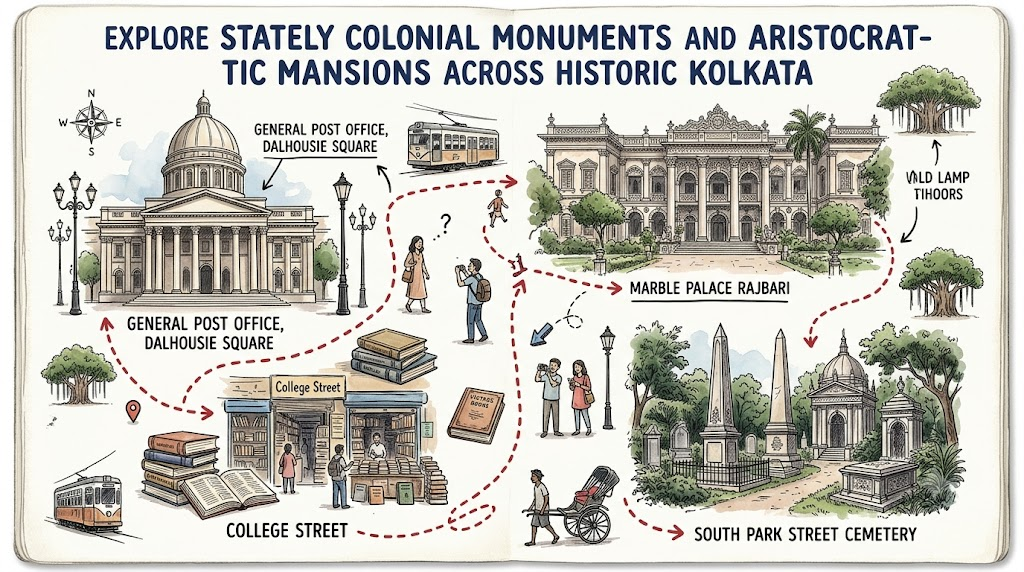
Dalhousie Square, officially renamed B.B.D. Bagh after revolutionary martyrs Benoy, Badal, and Dinesh, forms the administrative core of British India. Centered around the ancient Lal Dighi water tank, this walking precinct showcases monumental neoclassical, Baroque, and Greek-Revival civic architecture. The red-brick facade of the historic Writers’ Building and the towering neoclassical columns of the General Post Office evoke the days when mercantile empires governed across continents.
Strolling past St. John’s Church reveals Job Charnock’s mausoleum, constructed from distinctive Charnockite granite, alongside the poignant Black Hole memorial. Morning light illuminates Corinthian capitals, terracotta friezes, and grand rusticated archways that stand tall above modern street commerce.
- Location: Central Kolkata, Dalhousie Zone (approx. 2 km from Howrah Railway Station).
- Why it is worth visiting: The most concentrated collection of 18th- and 19th-century British imperial administrative architecture in Asia.
- Best things to do: Inspect the brass dome and Corinthian columns of the General Post Office, view the Job Charnock Mausoleum inside St. John’s Church courtyard, and photograph the red facade of Writers’ Building across Lal Dighi.
- Best time to visit: 7:00 AM to 9:30 AM on weekend mornings before administrative traffic peaks.
- Ideal for whom: Architectural historians, colonial heritage enthusiasts, and street photographers.
- Travel tip: Weekend mornings ensure quiet streets and clear sightlines for wide-angle architectural photography without vehicular obstruction.
College Street Boi Para Literary Circuit
Known affectionately as Boi Para (Book Town), College Street is the largest second-hand book market in the world and the intellectual engine of the Bengal Renaissance. Spanning nearly a kilometer, both flanks of the avenue are lined with hundreds of timber book stalls piled high with rare academic treatises, first-edition poetry, and modern literature. The street is anchored by storied academic institutions, including Presidency University, Calcutta University, and Sanskrit College.
A walk here leads directly to the Indian Coffee House on Bankim Chatterjee Street, an intellectual sanctuary with high ceilings and whirling ceiling fans. For decades, icons like Satyajit Ray, Amartya Sen, and Mrinal Sen gathered here to engage in spirited cultural and political debates over infusion black coffee.
- Location: Central-North Kolkata, College Square precinct (approx. 1.5 km from Sealdah Station).
- Why it is worth visiting: The intellectual heartbeat of Bengal, combining world-famous historic open-air book stalls with historic institutional campuses.
- Best things to do: Browse rare first-edition volumes at century-old wooden stalls, sip black infusion coffee inside the historic Indian Coffee House, and walk past the Gothic gate of Presidency University.
- Best time to visit: 11:30 AM to 4:00 PM on weekdays when all academic stalls and cafes operate fully.
- Ideal for whom: Bibliophiles, writers, student researchers, and cultural academics.
- Travel tip: Bargaining is polite but standard practice among second-hand book vendors; carry cash because many tiny bookstalls do not accept mobile payments.
North Kolkata Rajbari and Marble Palace Heritage Trail
North Kolkata represents the aristocratic native neighborhood that blossomed alongside European merchant settlements during the 18th and 19th centuries. Walking through Muktaram Babu Street, Beadon Street, and Sovabazar reveals sprawling Rajbaris—palatial aristocratic mansions blending European Neoclassical pillars with traditional Bengali courtyards. These estates feature cast-iron filigree railings, Venetian louvered shutters, and expansive open courtyards that host grand ancestral festivals.
The crown jewel of this walking trail is the Marble Palace, an opulent private mansion built in 1835 by merchant prince Raja Rajendra Mullick. Constructed with 126 varieties of Italian marble, its halls house rare Victorian mirrors, porcelain urns, and original oil paintings by master artists like Rubens and Reynolds.
- Location: Muktaram Babu Street, Jorasanko, North Kolkata (approx. 3 km from Esplanade).
- Why it is worth visiting: Rare glimpse into the private domestic grandeur and eclectic architectural fusion of wealthy Bengali merchant aristocrats.
- Best things to do: Admire masterwork paintings and antique chandeliers inside Marble Palace, explore ancestral courtyards along Beadon Street, and wander the courtyards of nearby Jorasanko Thakurbari.
- Best time to visit: 10:00 AM to 1:30 PM (closed Mondays and Thursdays).
- Ideal for whom: Fine-art connoisseurs, antiquarians, and vintage architectural buffs.
- Travel tip: Entry permits for the interior of Marble Palace must be obtained beforehand from the West Bengal Tourism Information Centre at B.B.D. Bagh.
South Park Street Cemetery Gothic Walk
Opened in 1767 on what was then the marshy southern boundary of the European settlement, South Park Street Cemetery is one of the earliest non-churchyard burial grounds in the world. Shaded beneath towering tropical trees, fern groves, and creeping moss, this necropolis contains hundreds of monumental tombs reflecting Indo-Saracenic, Gothic, and Classical aesthetics.
The monuments feature pyramidal obelisks, classical urns, Roman sarcophagi, and Grecian temples commemorating soldiers, botanists, civil administrators, and poets. Walking among these moss-covered stone inscriptions brings to life forgotten tales of trade, tragedy, and early colonial exploration.
- Location: Mother Teresa Sarani (Park Street) crossing Rawdon Street, South-Central Kolkata.
- Why it is worth visiting: Atmospheric 18th-century garden necropolis offering unparalleled peace and poignant stone monuments.
- Best things to do: Locate the tomb of poet Henry Louis Vivian Derozio, admire the massive stone pyramid of Sir William Jones, and sketch the moss-grown Gothic structures.
- Best time to visit: 3:00 PM to 5:00 PM when the late afternoon sun filters through the leafy tree canopy.
- Ideal for whom: Solitary strollers, photographers, and biographical historians.
- Travel tip: Apply insect repellent before entering, as the dense garden canopy shelters mosquitoes year-round.
Bow Barracks and Old Chinatown Cultural Corridor
Tucked behind the busy thoroughfare of Central Avenue lies Bow Barracks, a unique red-brick enclave originally constructed as quarters for British garrison troops during World War I. Shortly thereafter, it became home to Kolkata’s vibrant Anglo-Indian community, characterized by green timber shutters, wide verandas, and community courtyards. Walking through this enclave offers a glimpse into a lively neighborhood known for its musical traditions and handmade Christmas bakeries.
A brief stroll north connects to Tiretta Bazaar, India’s oldest Chinatown. Here, narrow lanes house historic Cantonese family associations, sea-goddess temples, and early morning artisanal dim sum stalls that showcase Kolkata’s diverse immigrant roots.
- Location: Bow Street and Central Avenue, Bowbazar area, Central Kolkata.
- Why it is worth visiting: A vibrant urban mosaic showcasing the enduring traditions of Anglo-Indian and Hakka Chinese communities.
- Best things to do: Explore historic Chinese clan associations like the Nam Soon Church, photograph the distinctive red-brick architecture of Bow Barracks, and sample freshly steamed pork bao and chicken wonton soup.
- Best time to visit: 6:30 AM to 9:00 AM for Tiretta Bazaar breakfasts, or late afternoons for Bow Barracks neighborhood strolls.
- Ideal for whom: Cultural anthropologists, culinary adventurers, and neighborhood explorers.
- Travel tip: Visit Tiretta Bazaar before 7:30 AM, as street food stalls sell out of fresh dim sum within two hours of opening.
Offbeat Exploration: Hidden Gems Tourists Miss
Sovabazar Natmandir and Royal Courtyards
While tourists pass through Central Avenue, the private Natmandir of Sovabazar Rajbari remains tucked away on Raja Nabakrishna Street. Founded in 1757, this expansive open-air pavilion features rhythmic multi-foliate arches supported by massive Doric pillars. It was here that Swami Vivekananda was warmly welcomed upon returning from the Parliament of the World’s Religions in 1897.
Magen David and Beth El Synagogues Trail
Situated along the busy wholesale wholesale junction of Canning Street and Brabourne Road, the Beth El and Magen David synagogues stand as grand testaments to Kolkata’s historic Baghdadi Jewish community. Magen David features a clock tower, stained-glass rose windows, and soaring vaults painted with floral patterns. Step inside to discover a peaceful, awe-inspiring refuge shielded from the bustling trade markets outdoors.
Girish Mancha and Old Bengali Theatre District
North Kolkata’s Bagbazar and Hatibagan neighborhoods formed the birthplace of modern commercial Indian theater during the late 19th century. Walking past historic venues like Star Theatre reveals vintage playbills, hand-lettered signage, and neighborhood cultural clubs that pioneered socially transformative Bengali stage performances.
Detailed Practical Guidance for Travelers
| Destination | Standard Entry Fee | General Timings | Best Local Food Options Nearby | Recommended Nearby Attractions |
| B.B.D. Bagh Circuit | Free (Church ₹20) | 24 Hours (Exteriors) | Street kachori at Stock Exchange, tea stalls | St. John’s Church, Lal Dighi, GPO |
| College Street | Free | 10:00 AM – 8:00 PM | Mutton cutlets at Indian Coffee House, Paramount sherbets | College Square, Presidency University |
| Marble Palace | Free (Permit Required) | 10:00 AM – 4:00 PM | Mughlai paratha at Royal Indian Hotel (Chitpur) | Jorasanko Thakurbari, Rammohun Roy Memorial |
| Park Street Cemetery | ₹50 (Camera fee ₹100) | 10:00 AM – 5:00 PM | Chelo kebabs at Peter Cat, Flurys pastries | South Park Street culinary hub, St. Xavier’s |
| Bow Barracks | Free | Open residential access | Traditional Anglo-Indian home cakes, Chinatown pork buns | Sea Ip Church, Central Metro station |
Logistics & On-Ground Navigation
Local Transport Options
- Kolkata Metro (Blue Line): The most practical transport option for heritage walking; stations like Central, Mahatma Gandhi Road, and Girish Park place you right beside heritage trails.
- Iconic Yellow Ambassador Taxis: Readily available at every street corner; ensure the driver turns on the official fare meter or negotiate based on standard rates.
- Heritage Tramways: The oldest operating electric tram system in Asia still services select routes connecting Esplanade and Gariahat at a relaxed, nostalgic pace.
- Hand-Pulled and Cycle Rickshaws: Ideal for navigating narrow, winding residential lanes in North Kolkata where passenger cars cannot fit.
Budget Planning
- Budget / Backpacker Tier (₹1,500 – ₹2,500 / day): Includes heritage guesthouse stays around Sudder Street or North Kolkata, public metro and tram commutes, street breakfasts (kochuri-cholar dal), and self-guided walking tours.
- Mid-Range / Comfort Tier (₹5,000 – ₹9,000 / day): Covers boutique heritage hotel accommodations, private air-conditioned cab rentals, licensed guided walks, and dining at historic culinary institutions.
Safety and Inclusivity Tips
- Families: Pavements across older quarters can feature broken stone slabs; travel with lightweight strollers or sturdy walking shoes.
- Couples: Heritage precincts like Park Street Cemetery and Prinsep Ghat are welcoming, safe, and peaceful for walking companions.
- General Safety: Kolkata is recognized among India’s safest metropolitan centers for solo and late-evening travelers; practice standard urban awareness regarding personal belongings in dense markets.
Local Secret: Do not attempt walking tours during the midday heat between 12:00 PM and 3:00 PM. Begin early at 6:30 AM when streets are empty, the light is golden, and air quality is at its clearest.
Strategic Travel Planning Guardrails
Travel Planning Tips for Kolkata
- Secure your special visitor entry permits for the Marble Palace at least one day in advance from the tourist office on Shakespeare Sarani or B.B.D. Bagh.
- Keep cash denominations of ₹10, ₹20, and ₹50 accessible, as vintage booksellers, tea vendors, and street-food stalls often do not accept digital payments.
- Schedule walking routes in North Kolkata for Sunday mornings to enjoy quiet lanes free of heavy commercial delivery trucks and cycle carts.
- Wear slip-on shoes with cotton socks, as several heritage courtyards, synagogues, and temple natmandirs require removing footwear prior to entry.
- Carry a reusable water bottle and oral rehydration packets to stay hydrated throughout your walks.
Common Mistakes to Avoid
- Packing your itinerary with far too many sprawling sites across geographically distant neighborhoods on a single afternoon.
- Planning outdoor architectural walking tours during the sweltering, humid monsoon months of July and August without rain gear.
- Believing that yellow metered taxis accept credit cards or digital app transfers; always keep physical cash handy.
- Overlooking the remarkable, tranquil interiors of Kolkata’s functioning historic synagogues while touring central market streets.
- Avoiding authentic street food stalls out of excessive caution; reputable vendors serving freshly prepared, boiling-hot foods offer exceptional local flavors.
Suggested Itinerary Blueprints
1. Day Quick Dash (Colonial & Literary Express)
- Target Audience: Short-stay travelers, business layovers, and first-time visitors.
- Route: Start at 7:30 AM with a heritage walk around Dalhousie Square, admire the General Post Office and St. John’s Church, take a 10-minute yellow taxi to College Street to browse bookstalls, and wrap up with an afternoon meal inside the Indian Coffee House.
2. Day Deep-Dive (Imperial Magnificence to Aristocratic Havens)
- Day 1 (Imperial & Cosmopolitan South): Walk through South Park Street Cemetery in the morning, visit the Victoria Memorial outer gardens, and explore Anglo-Indian heritage and dining along Park Street.
- Day 2 (Aristocratic North & Riverfront): Explore Muktaram Babu Street, visit the Marble Palace, walk through the aristocratic courtyard of Sovabazar Rajbari, and end your afternoon taking in sunset views over the river at Bagbazar Ghat.
3. Complete Weekend Travel Plan (Comprehensive Cultural Odyssey)
- Friday Evening: Check into your heritage hotel, take an evening stroll along the illuminated pathways of Prinsep Ghat, and enjoy dinner on Park Street.
- Saturday: Spend the morning exploring Dalhousie Square and St. John’s Church, browse through College Street Boi Para by midday, and attend an evening cultural performance or theatre production at Star Theatre.
- Sunday: Wake up early for Chinese dumplings at Tiretta Bazaar, walk through the quiet residential streets of Bow Barracks, visit the historic Magen David Synagogue, and conclude with a tour of the clay sculptors’ workshops in Kumartuli.
Common Tourist Mistakes to Avoid
Geographic Blunders
Attempting to jump from North Kolkata’s traditional lanes to South Kolkata’s modern avenues within a few hours traps you in peak traffic along Central Avenue. Always divide your days by geographic zones: explore North Kolkata’s heritage on one day, and South-Central Kolkata on another.
Commercial Traps
Spending your evenings inside air-conditioned shopping malls in Salt Lake or Rajarhat wastes valuable travel time. Kolkata’s authentic charm lives in its open-air tea stalls, street-corner debates, and historic arcades.
Neglecting Modern/Alternative Zones
Focusing solely on crumbling colonial ruins means missing the creative energy of contemporary South Kolkata. Residential neighborhoods like Hindustan Park and Southern Avenue offer restored art deco homes, indie bookshops, and cozy neighborhood cafes.
Transport Overpayment
Never accept unmetered flat fares from aggressive drivers at railway stations or outside airport terminals. Always use official prepaid taxi counters or ride-hailing platforms like Uber and Yatri Sathi to ensure fair rates.
Luxury Dining Bias
Eating exclusively at high-end hotel buffets cuts you off from the city’s legendary food traditions. Kolkata’s real culinary identity thrives in its century-old cabin eateries, street-side kathi rolls, and traditional Bengali sweetshops.
Frequently Asked Questions
1. What is the most scenic heritage walking trail for a first-time visitor in Kolkata?
The B.B.D. Bagh (Dalhousie Square) circuit is the most scenic route. It offers a dense concentration of 18th-century neoclassical civic architecture, historical monuments, and quiet water reflections along the Lal Dighi tank.
2. Are heritage walking routes in North Kolkata easy to navigate on foot?
Yes, though the narrow alleys and bustling bazaars can feel like a maze. Wear good walking shoes and use landmark references like Central Avenue, Rabindra Sarani, and Chittaranjan Avenue to keep your bearings.
3. How do I get permission to enter and tour the interior of the Marble Palace?
You must secure a free entry permit at least 24 hours in advance from the West Bengal Tourism Development Corporation office at B.B.D. Bagh or Shakespeare Sarani.
4. What are the best morning hours to explore the old Chinatown breakfast market?
Arrive at Tiretta Bazaar between 6:30 AM and 7:15 AM. By 8:00 AM, most artisanal street vendors have completely sold out of their steamed baos, dumplings, and wonton broths.
5. Is photography permitted inside the South Park Street Cemetery grounds?
Yes, casual photography is allowed. However, visitors carrying professional DSLR camera setups must pay an official photography fee of ₹100 at the main ticket counter.
6. Which metro stations provide the quickest access to Kolkata’s heritage zones?
Central and Mahatma Gandhi Road stations serve the College Street and Bow Barracks precincts, while Girish Park and Shobhabazar Sutanuti stations provide direct access to the North Kolkata Rajbari quarter.
7. Can non-Jewish visitors enter the historic synagogues in Central Kolkata?
Yes, visitors can access the Magen David and Beth El synagogues. You will need to show a valid government-issued photo ID at the entrance gate before entering.
8. Are organized guided heritage walking tours available across the city?
Yes, reputable local organizations such as the Calcutta Heritage Collective, Immersive Trails, and walking groups run informative guided tours led by historians on weekends.
9. What should travelers wear when touring conservative residential heritage neighborhoods?
Modest, lightweight cotton attire is ideal. Choose clothing that covers your shoulders and knees to show respect when visiting community courtyards, temples, and active places of worship.
10. What is a traditional heritage cabin restaurant in Kolkata?
Cabins are historic, modest eateries established during the late 19th and early 20th centuries. Featuring private wooden cubicles, they became famous for serving crumb-coated cutlets, fowl cutlets, and fish fry to intellectuals and freedom fighters.
11. Is it safe to take early morning or late-night walking tours through historic districts?
Kolkata is widely considered one of India’s safest metropolitan centers for independent walkers. Sticking to well-lit streets and keeping standard track of your belongings ensures a smooth, trouble-free walk.
12. How much cash should I carry during an average day of exploring heritage sights?
Carrying between ₹1,000 and ₹1,500 in small currency notes (₹10, ₹20, and ₹50) will comfortably cover street food, monument entrance fees, transport fares, and used books.
Conclusion
Exploring Kolkata on foot is an unforgettable cultural experience that rewards curious travelers with authentic human connections and architectural wonder. Walking these historic avenues takes you beyond the glossy surface of modern urban life, revealing a living city rich with poetic history, intellectual passion, and enduring artistic soul. Choosing this journey allows you to experience the authentic heartbeat of the City of Joy, creating travel memories that will stay with you long after your journey ends.