Introduction
Modern travel often funnels wanderers toward commercialized landmarks, crowded theme parks, and expensive ticket counters that drain your wallet while offering sanitized experiences. Kolkata completely subverts this transactional paradigm, greeting travelers with a vibrant soul that demands curiosity rather than cash.
The authentic heart of West Bengal’s capital lives along its historic riverside ghats, leafy colonial avenues, and sacred architectural corridors. Navigating Kolkata for free unlocks an intimate cultural immersion that high-priced package tours simply cannot replicate.
Why Kolkata is a must-visit city
Kolkata is a living monument to human thought, political revolution, and artistic brilliance. As the former capital of the British Indian Empire and the cradle of the nineteenth-century Bengal Renaissance, every corner carries immense cultural weight. Geographically hugging the Hooghly River, the city bridges ancient maritime traditions with an energetic metropolitan life.
Practical accessibility is exceptional across every traveler tier. Major arterial terminals—Howrah Junction, Sealdah Station, and Shalimar—connect seamlessly with the Netaji Subhas Chandra Bose International Airport via extensive highways and arterial flyovers.
The city’s urban travel circuit divides naturally into distinct experiential segments. North Kolkata holds centuries-old courtyards, narrow alleys, and literary salons. Central Kolkata showcases sweeping colonial esplanades and political architecture. Meanwhile, South Kolkata entices visitors with bohemian cafes, lakes, and contemporary art walks.
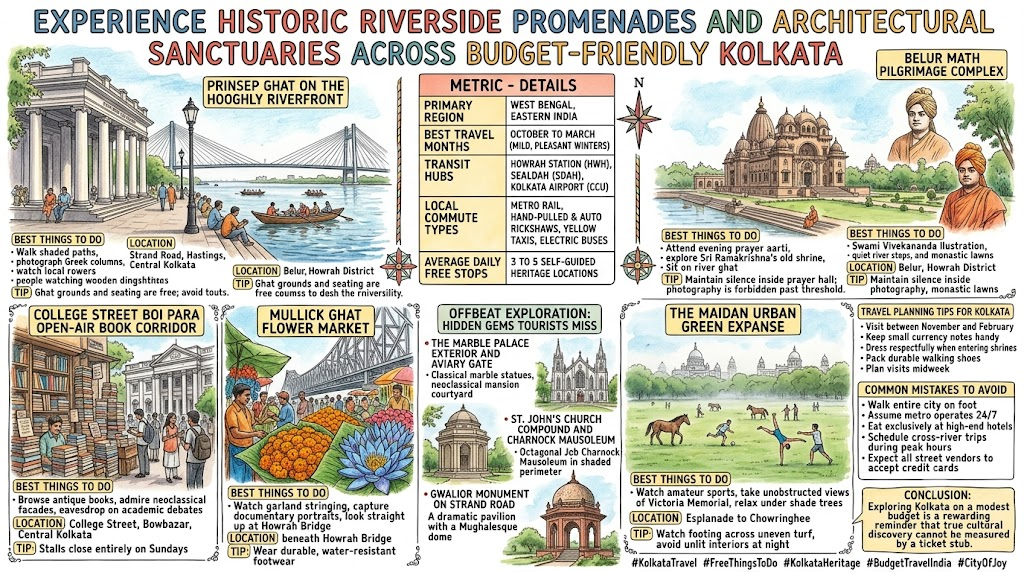
| Metric | Details |
|---|---|
| Primary Region | West Bengal, Eastern India |
| Best Travel Months | October to March (Mild, pleasant winters) |
| Transit Hubs | Howrah Station (HWH), Sealdah (SDAH), Kolkata Airport (CCU) |
| Local Commute Types | Metro Rail, Hand-pulled & Auto Rickshaws, Yellow Taxis, Electric Buses |
| Average Daily Free Stops | 3 to 5 self-guided heritage locations |
Best Places or Experiences
Prinsep Ghat on the Hooghly Riverfront
Prinsep Ghat stands as one of Kolkata’s most poignant riverfront monuments, built in 1841 along the banks of the Hooghly. Named after James Prinsep, the scholar who deciphered the ancient Brahmi script, its striking Palladian-style Grecian porch radiates classic elegance. As evening settles over the river, the white Corinthian columns contrast beautifully with the colossal, illuminated span of Vidyasagar Setu overhead.
Locals and travelers gather here to catch the cool evening breeze blowing off the water. The surrounding promenade is framed by vintage lamps and well-kept garden pathways, offering front-row views of traditional wooden dinghies drifting across the tidal river without paying a single rupee.
- Location: Strand Road, Hastings, Central Kolkata (approx. 5 km southwest of Howrah Junction).
- Why it is worth visiting: Mesmerizing neoclassical architecture paired with an unobstructed view of India’s longest cable-stayed suspension bridge.
- Best things to do: Walk the shaded riverside pathway, photograph the monumental Greek columns during golden hour, and watch local rowers maneuver the tidal river currents.
- Best time to visit: 5:00 PM to 7:30 PM for cooling breezes and twilight lighting.
- Ideal for whom: Sunset chasers, architecture lovers, and couples.
- Travel tip: The ghat grounds and seating benches are completely free; avoid touts claiming you need a ticket to sit on the riverside steps.
Belur Math Pilgrimage Complex
Spanning forty verdant acres on the western banks of the Hooghly River, Belur Math serves as the world headquarters of the Ramakrishna Math and Mission. Conceived by Swami Vivekananda and consecrated in 1938, the central temple is an extraordinary architectural synthesis that brings global faiths together. Its elevation weaves Christian cathedral transepts, Rajput chhatris, Islamic domes, and ancient Buddhist rock-cut motifs into a single cohesive structure
.
Belur Math’s harmonious multi-faith architecture. S
Entering the complex leaves the noise of the metropolitan core far behind. The serene internal courtyards, quiet river steps, and calm monastic lawns offer a profound environment for quiet reflection and self-guided spiritual exploration.
- Location: Belur, Howrah District (approx. 7 km north of Howrah Station).
- Why it is worth visiting: A masterclass in syncretic architecture where diverse world religions converge within a tranquil riverside estate.
- Best things to do: Attend the evening prayer aarti inside the main prayer hall, explore the old shrine room of Sri Ramakrishna, and sit on the river ghat steps at dusk.
- Best time to visit: 6:00 AM to 8:30 AM for morning calm, or 4:00 PM to 6:00 PM for the evening ritual.
- Ideal for whom: Spiritual seekers, architecture enthusiasts, and culture historians.
- Travel tip: Maintain complete silence inside the inner prayer hall; photography, videography, and mobile phone usage are strictly forbidden past the main threshold.
College Street Boi Para Open-Air Book Corridor
Stretching nearly a mile in Central Kolkata, College Street—affectionately called Boi Para (Book Town)—is the largest second-hand book market in the world. Flanked by premier institutions such as Presidency University, the University of Calcutta, and Sanskrit College, this historic street smells delightfully of vintage paper and intellectual curiosity. Hundreds of tiny wooden bookstalls lean against each other, displaying teetering towers of rare out-of-print titles, modern fiction, and antique folios.
The historic book stalls of College Street.
Wandering along this vibrant academic avenue costs nothing and functions like an open-air public library. Bibliophiles can browse rare journals, strike up casual conversations with multigenerational booksellers, and soak in the vibrant buzz that has fueled Bengal’s literary society for well over a century.
- Location: College Street, Bowbazar, Central Kolkata (approx. 2 km east of Sealdah Railway Station).
- Why it is worth visiting: The undeniable intellectual epicentre of Bengal, packing millions of historic books into a buzzing, walkable neighborhood.
- Best things to do: Browse teetering stacks of antique books, admire the neoclassical facade of the University of Calcutta, and eavesdrop on passionate academic street debates.
- Best time to visit: 11:00 AM to 5:00 PM on weekdays when all street stalls are open and active.
- Ideal for whom: Bookworms, literature students, and solo street wanderers.
- Travel tip: Stalls close entirely on Sundays; visit midweek to witness the book market running at full throttle.
Mullick Ghat Flower Market
Tucked directly beneath the southeastern ramps of the towering Howrah Bridge, the Mullick Ghat Flower Market is one of Asia’s largest wholesale flower bazaars. Established in the nineteenth century, it is a sensory explosion of color, frantic energy, and fragrant blossoms. Early every morning, thousands of rural flower farmers haul mountains of orange marigolds, fragrant tuberoses, and blue lotus blooms wrapped in banana leaves.
Sensory colors of the Mullick Ghat Flower Market.
Walking through the narrow, damp alleyways of the market lets you observe an unchanged slice of Kolkata’s daily commerce. The energetic calls of the vendors, set against the industrial backdrop of the river and bridge, create one of the most vivid cultural spectacles in urban India.
- Location: P.C. Tagore Ghat Street, Strand Bank Road, beneath Howrah Bridge (approx. 1 km from Howrah Station).
- Why it is worth visiting: An unscripted sensory spectacle where millions of fresh blooms transform the riverbank into a vivid mosaic.
- Best things to do: Watch vendors string elaborate marigold garlands, capture early-morning documentary street portraits, and look straight up at the underside of Howrah Bridge.
- Best time to visit: 5:00 AM to 7:30 AM for the freshest flowers and peak morning activity.
- Ideal for whom: Street photographers, early risers, and cultural explorers.
- Travel tip: Wear durable, water-resistant footwear; the stone alleys can get muddy from wet flower stems and river splashes.
St. Paul’s Cathedral Grounds and Sanctuary
Consecrated in 1847, St. Paul’s Cathedral is renowned as the first Anglican cathedral built across the British overseas empire. Designed in Indo-Gothic style with a towering steeple modeled after Norwich Cathedral, it stands serenely amid expansive, manicured lawns near the southern tip of the Maidan. The structure’s crisp white exterior features sweeping pointed archways, intricate stone carvings, and sweeping gables.
Indo-Gothic architecture of St. Paul’s Cathedral.
Stepping inside the cavernous nave brings immediate quiet and respite from the city traffic. You can walk through the sunlit aisles for free, admiring delicate stained-glass windows designed by Sir Edward Burne-Jones, elaborate carved wooden reredos, and peaceful historic memorial tablets.
- Location: Cathedral Road, Maidan area, South-Central Kolkata (approx. 4 km south of Esplanade).
- Why it is worth visiting: Exquisite Indo-Gothic religious architecture paired with cool, serene interiors and world-class stained-glass artistry.
- Best things to do: Admire the Florentine Renaissance-style frescoes, read the memorial plaques commemorating figures of early Calcutta, and stroll the quiet grounds.
- Best time to visit: 10:00 AM to 1:00 PM for bright natural light streaming through the stained glass.
- Ideal for whom: Art buffs, architecture students, and travelers seeking quiet contemplation.
- Travel tip: Dress modestly with covered shoulders and knees to enter the church; interior photography is strictly prohibited.
The Maidan Urban Green Expanse
Covering nearly one thousand acres from the Hooghly River to Chowringhee, the Maidan is Kolkata’s vast urban lung and civic gathering ground. Originally cleared around Fort William to create a defensive military field of fire, this sprawling green park now belongs entirely to the public. It is a vibrant communal playground where morning fog, grazing horses, and casual cricket games play out across the fields.
An evening walk across the open grass costs nothing while offering sweeping views of colonial domes and contemporary skylines. Here, you will find street performers, casual adda circles, and children learning gymnastics, highlighting the democratic spirit of the city.
- Location: Extends between Esplanade, Queens Way, and Red Road, Central Kolkata.
- Why it is worth visiting: The largest urban park in Eastern India, capturing the communal soul and sporting spirit of everyday Kolkata.
- Best things to do: Watch weekend amateur cricket and football matches, take in unobstructed exterior views of Victoria Memorial, and relax under shade trees.
- Best time to visit: 6:00 AM to 8:30 AM for morning exercise, or 4:30 PM to 6:30 PM for sunset gatherings.
- Ideal for whom: Picnickers, families, joggers, and street observers.
- Travel tip: Watch your footing across uneven patches of turf, and avoid the unlit deeper interiors of the park after total dark.
Offbeat Exploration: Hidden Gems Tourists Miss
The Marble Palace Exterior and Aviary Gate
Tucked away in the dense alleys of Muktaram Babu Street, this grand 1835 neoclassical mansion was built by Raja Rajendra Mullick. While entering the house requires a pre-approved permit, you can explore the outer courtyards, classical marble statues, and historic aviary for free, marveling at nineteenth-century merchant opulence from up close.
St. John’s Church Compound and Charnock Mausoleum
Located just off Council House Street, St. John’s is one of Kolkata’s oldest public buildings, constructed in 1787 out of stone and brick. While a nominal fee is sometimes collected for the church interior, walking the shaded perimeter grounds is often complimentary. Inside the compound sits the octagonal Job Charnock Mausoleum, dedicated to the man historically credited with founding the trading settlement.
Gwalior Monument on Strand Road
Overlooked by fast-moving traffic along Strand Road, this dramatic pavilion—locally known as the “Pepper Pot”—was built in 1847 to commemorate the Gwalior War. Constructed from bronze salvaged from captured enemy cannons and crowned with a Mughalesque dome, it offers a fascinating, quiet architectural discovery right along the Hooghly riverbank.
Detailed Practical Guidance for Travelers
| Destination | Standard Entry Fee | General Timings | Best Local Food Options Nearby | Recommended Nearby Attractions |
|---|---|---|---|---|
| Prinsep Ghat | Free | Open 24 Hours | Street Chai, Pav Bhaji stalls, Ice cream vendors | Vidyasagar Setu, Millennium Park |
| Belur Math | Free | 6:00 AM – 11:30 AM, 4:00 PM – 8:30 PM | Monastic Bhog (Lunch), Local Mishti shops outside | Dakshineswar Temple (via river ferry) |
| College Street | Free | 10:00 AM – 7:30 PM (Closed Sundays) | Paramount Sherbet, Indian Coffee House snacks | Presidency University, Sanskrit College |
| Mullick Ghat | Free | 4:30 AM – 8:00 PM (Best at dawn) | Kachori-Sabzi at street stalls, Hot Ginger Tea | Howrah Bridge, Armenian Ghat |
| St. Paul’s Cathedral | Free | 9:00 AM – 5:00 PM (Sundays open late morning) | Park Street eateries, Street Phuchka vendors | Victoria Memorial, Birla Planetarium |
| The Maidan | Free | Open 24 Hours | Roasted peanuts (Badam), Fresh lemon juice | Brigade Parade Ground, Eden Gardens |
Logistics & On-Ground Navigation
Local Transport Options
- Kolkata Metro Rail: The Blue and Green Lines are the most efficient ways to travel across north, central, and river circuits cheaply and avoid street gridlock.
- Public State Buses: State-run electric and diesel buses connect every major street corner with fares often under twenty rupees.
- Classic Yellow Taxis & Ride-Hailing Apps: Metered yellow ambassador taxis, alongside Uber and the state-backed Yatri Sathi app, provide reliable door-to-door rides across all neighborhoods.
- Shared Auto-Rickshaws: Operating fixed routes along neighborhood hubs, these shared three-wheelers offer an authentic, wallet-friendly ride.
Budget Planning
- Budget / Backpacker Tier (₹600 – ₹1,200 per day): Ideal for travelers staying in shared hostels around Sudder Street or central guesthouses. Rely entirely on walking, metro hops, free attractions, and roadside staples like egg kathi rolls, kachoris, and cha served in clay bhar cups.
- Mid-Range / Comfort Tier (₹2,500 – ₹5,000 per day): Best for visitors staying in boutique heritage hotels in South Kolkata. Covers private app cabs, leisurely museum stops, sit-down dinners at legacy Bengali restaurants, and artisanal coffees on Southern Avenue.
Safety and Inclusivity Tips
- Families: Kolkata is widely regarded as one of India’s safest metropolitan centers; broad public spaces like the Maidan and Prinsep Ghat welcome multi-generational families with children.
- Couples: Public displays of affection can draw unwanted conservative stares in older residential quarters, though riverfront promenades and the Maidan are popular casual dating spots.
- General Safety: Keep everyday valuables tucked safely away in crowded transit points like Sealdah, Howrah, or peak-hour metro platforms.
Strategic Travel Planning Guardrails
Travel Planning Tips for Kolkata
- Visit between November and February to enjoy dry weather, cool morning breezes, and pleasant walking conditions.
- Keep small currency notes (ten, twenty, and fifty-rupee denominations) handy; small tea sellers and auto drivers frequently cannot make change for larger bills.
- Remove shoes promptly and dress respectfully with covered legs and shoulders when stepping into shrines, math complexes, and active places of worship.
- Pack durable walking shoes with cushioned soles to easily navigate uneven stone curbs and older paved promenades.
- Plan your visits to academic hubs and local markets between Tuesday and Saturday, since many heritage shops close on Sundays.
Common Mistakes to Avoid
- Trying to walk across the whole city on foot rather than using the inexpensive metro for long cross-city journeys.
- Assuming the metro operates 24/7; trains wind down by 10:45 PM.
- Eating exclusively at high-end hotel buffets and missing out on Kolkata’s legendary street-side snack stalls.
- Scheduling cross-river trips across Howrah Bridge during peak morning rush hours (8:30 AM – 10:30 AM).
- Expecting all street vendors to accept credit cards or digital UPI apps without occasional network connection issues.
Suggested Itinerary Blueprints
1. Day Quick Dash (The Heritage Riverfront Arc)
- Target Audience: Short-stay business travelers or weekend layovers wanting an authentic experience on a tight schedule.
- Route Layout: Start early at 6:00 AM at Mullick Ghat Flower Market, walk up the walkway of Howrah Bridge, take an inexpensive metro down to the Maidan at noon, visit the grand sanctuary of St. Paul’s Cathedral, and finish with a peaceful sunset walk at Prinsep Ghat.
2. Day Deep-Dive (North-South Cultural Exploration)
- Target Audience: Solo travelers and culture buffs wanting an in-depth look at Kolkata’s twin personalities.
- Day 1 (Colonial Central & North Heritage): Spend the morning admiring the book alleys of College Street, explore the colonial architecture around BBD Bagh and St. John’s Church, and end with an evening stroll around Belur Math across the river.
- Day 2 (Parks, Art, and Southern Avenues): Start with an early morning jog across the open Maidan, visit St. Paul’s Cathedral, browse through the contemporary galleries of South Kolkata, and watch dusk settle over Rabindra Sarobar Lake.
3. Complete Weekend Travel Plan (The Definitive Circuit)
- Friday: Arrive in the late afternoon, check in, and spend the evening enjoying tea and river views at Prinsep Ghat beneath Vidyasagar Setu.
- Saturday: Wake up at dawn for the bustling flower market at Mullick Ghat, wander through the stacks at College Street, discover the quiet grounds of the Marble Palace exterior, and enjoy dinner near Park Street.
- Sunday: Attend morning prayer inside Belur Math, spend the afternoon walking the cool interior nave of St. Paul’s Cathedral, and watch the sun set over the Maidan as the street lamps turn on.
Common Tourist Mistakes to Avoid
Geographic Blunders
A frequent blunder is trying to combine North Kolkata’s traditional heritage lanes with South Kolkata’s lake neighborhoods on the exact same morning. Traffic congestion can turn cross-city drives into slow slogs; dedicate entire days to individual geographic quadrants.
Commercial Traps
Many travelers waste valuable vacation time inside modern shopping malls that look identical anywhere in the world. Instead, spend your hours in authentic, living spaces like College Street, vintage ghats, and open neighborhood plazas.
Neglecting Modern/Alternative Zones
Ignoring South Kolkata leaves you with an incomplete impression of the city. While the north preserves colonial history, leafy neighborhoods like Ballygunge and Hindustan Park highlight modern cafes, literary bookstores, and experimental art spaces.
Transport Overpayment
Never accept arbitrary flat rates from yellow taxi drivers waiting outside major transit hubs without turning on their digital meters. Instead, use the pre-paid police taxi booths or call cars through the Yatri Sathi app to guarantee fair government fares.
Luxury Dining Bias
Eating all your meals in five-star hotel dining rooms misses the true culinary soul of Kolkata. Some of the most memorable meals come from beloved, high-turnover street counters selling freshly fried singaras, spiced phuchkas, and steaming kochuris.
Frequently Asked Questions
1. Are the major heritage sites and monuments in Kolkata truly free to enter?
Yes, many of Kolkata’s most famous landmarks, including Prinsep Ghat, Belur Math, St. Paul’s Cathedral, and the Maidan, charge zero entry fees. You can freely walk the grounds, explore the architecture, and enjoy these historic public spaces without buying a ticket.
2. Is it safe to wander through the Mullick Ghat Flower Market at dawn?
Yes, the flower market is safe and welcoming to visit at dawn. It is an active commercial wholesale market where vendors and porters are busy working, so stay mindful of foot traffic and keep your camera secured as you move through the stalls.
3. Can budget travelers easily find inexpensive local food near these free sites?
Inexpensive food options are everywhere near these heritage destinations. You can easily find delicious street foods like kathi rolls, cholar dal with luchi, and clay-cup tea near College Street and the Maidan, keeping meal costs under one hundred to two hundred rupees.
4. How can I travel between free attractions in North and Central Kolkata without spending much?
The most affordable way to travel between these districts is the Kolkata Metro Rail network. Metro ticket fares typically cost between five and thirty rupees, making it quick and economical to travel between northern stops like Shobhabazar and central stations like Maidan.
5. What is the best season to explore Kolkata’s outdoor free spaces comfortably?
The ideal time to visit is during the winter months, from October through March. The weather is dry and pleasant, with daytime temperatures hovering between 15°C and 26°C, making long walking tours around open-air parks and river ghats very comfortable.
6. Do I need special permission to take photos inside Belur Math?
Casual photography is permitted across the external garden courtyards and riverfront ghats. However, taking photos or videos is strictly prohibited inside the main temple prayer hall, museum rooms, and original monastic shrines to maintain quiet and sacred decorum.
7. Can tourists sit and relax inside St. Paul’s Cathedral during the day?
Yes, visitors are welcome to enter the cathedral during visiting hours to pray, sit quietly, or admire the architecture. You only need to dress respectfully and keep your phone on silent mode during services or designated prayer times.
8. Is College Street open for book browsing on all seven days of the week?
No, College Street’s famous book stalls are generally closed on Sundays. To experience the bustling literary atmosphere, speak with veteran booksellers, and browse the towering shelves, plan your walking visit between Monday and Saturday.
9. Are boat rides at Prinsep Ghat free for the public?
While walking along the ghat, sitting under the Grecian pavilion, and enjoying the promenade are completely free, hiring a traditional wooden dinghy for a river ride costs money. You must negotiate a separate fee directly with the local boatmen.
10. What clothes should I wear when visiting religious or monastic landmarks for free?
Modest, respectful attire is best when visiting sites like Belur Math and St. Paul’s Cathedral. Make sure your clothes cover your knees and shoulders, and wear slip-on footwear so you can easily take your shoes off at temple thresholds.
11. Is the Maidan safe for travelers to walk across after sunset?
The outer, well-lit perimeter of the Maidan along Red Road and Queens Way is pleasant and safe into the evening. However, it is wise to avoid walking into dark, unlit grassy fields late at night, as visibility drops significantly.
12. Can I walk across the Howrah Bridge without paying any toll or fee?
Yes, walking across the Howrah Bridge on the designated pedestrian pathways is completely free of charge. It offers an incredible, close-up perspective of the cantilever steel engineering and scenic panoramic views of the river traffic below.
Conclusion
Exploring Kolkata on a modest budget is a rewarding reminder that true cultural discovery cannot be measured by a ticket stub. By stepping away from tourist traps and embracing historic riverbanks, peaceful temple courtyards, and bustling book corridors, you connect directly with the living pulse of this timeless city. The warmth of Kolkata’s streets, the depth of its architectural treasures, and the democratic openness of its public spaces will linger in your memories long after your journey draws to a close.