Introduction
While glossy travel brochures obsess over hyper-commercialized vacation resorts and curated tourist bubbles, Kolkata delivers something rare and grounded: raw, unhurried authenticity. The City of Joy does not demand lavish spending accounts or luxury reservations to unlock its spirit. Here, grand imperial architecture rubs shoulders with vintage book stalls, and peaceful riverfront sunsets cost literally nothing.
To explore Kolkata on a shoestring budget is not a compromise—it is the definitive way to connect with its living culture, historic avenues, and warm-hearted locals.
Why Kolkata is a must-visit city
Kolkata represents the intellectual and artistic heartbeat of India, bearing an immense historical legacy as the former capital of the British Raj and the birthplace of the Bengal Renaissance. Geographically flanked by the storied Hooghly River, this metropolis provides an extraordinary intersection of colonial heritage, vibrant street life, and unmatched culinary depth.
Unlike heavily commercialized metro cities, Kolkata remains remarkably affordable and accessible. Robust rail links through Howrah and Sealdah, an extensive road and highway network, and the Netaji Subhas Chandra Bose International Airport welcome travelers from every background. From backpackers staying in historic lanes to heritage travelers exploring palatial mansions, the local transit network ties the entire urban circuit together seamlessly.
| Key Metric | Traveler Fact Sheet |
|---|---|
| Location & State | Lower Gangetic Plains, West Bengal |
| Best Travel Months | October to March (Mild, dry winter days) |
| Primary Transit Gateways | Howrah Station (HWH), Sealdah Station (SDAH), Kolkata Airport (CCU) |
| Lowest Transit Fares | Metro tickets start at ₹5, River Ferry at ₹6 |
| Ideal Itinerary Duration | 3 to 4 Days |
| Atmospheric Character | Colonial-Gothic architecture, vintage tramways, intellectual adda |
Top Affordable Landmarks & Cultural Experiences
Victoria Memorial Hall & Gardens
Commissioned between 1906 and 1921 in memory of Queen Victoria, this colossal Indo-Saracenic and Classical marble monument stands as Kolkata’s most recognizable landmark. Built with brilliant white Makrana marble—the same stone used for the Taj Mahal—the monument features an ornate central dome topped by the rotating bronze Angel of Victory. The surrounding 64-acre landscaped grounds offer manicured lawns, reflective pools, and shaded benches where morning walkers and artists gather.
Stepping onto the grounds lets travelers soak in immense architectural grandeur without buying an expensive museum gallery pass. The perimeter gardens provide panoramic vantage points of the intricate marble relief sculptures, sweeping colonnades, and sprawling reflecting ponds.
Victoria Memorial surrounded by landscaped gardens.
- Location: Queens Way, Maidan, Central Kolkata (approx. 4.5 km from Howrah Railway Station).
- Why it is worth visiting: World-class classical architecture set within massive public gardens for a nominal garden entry ticket.
- Best things to do: Walk the perimeter ponds for symmetrical mirror reflections, admire the bronze Angel of Victory atop the central dome, and relax under mature banyan groves.
- Best time to visit: Late afternoon (3:30 PM to 5:30 PM) for golden-hour lighting across the white marble.
- Ideal for whom: Architecture enthusiasts, couples, landscape photographers, and budget backpackers.
- Travel tip: Purchase the garden-only ticket (₹50 for Indian nationals) if you want to skip the indoor portrait gallery lines and maximize outdoor photography time.
Indian Museum (Jadu Ghar)
Founded in 1814 by the Asiatic Society of Bengal, the Indian Museum is the ninth oldest regular museum in the world and the largest multidisciplinary museum in the Asia-Pacific region. Housed inside a sprawling neoclassical Italianate palace centered around a tranquil green quadrangle, the institution holds over 100,000 rare exhibits spanning archaeology, geology, zoology, and paleontology.
The sprawling double-height galleries display breathtaking artifacts, including 4,000-year-old Egyptian mummies, Ashokan Buddhist sculptures from Bharhut, prehistoric dinosaur fossils, and meteorites found across the subcontinent. The cool, shaded colonnades surrounding the interior courtyard offer a quiet, contemplative escape from the roaring midday traffic outside on Jawaharlal Nehru Road.
Neoclassical colonnaded courtyard of the Indian Museum.
- Location: 27 Jawaharlal Nehru Road, Colootola, Park Street area, Central Kolkata (approx. 3 km from Sealdah Station).
- Why it is worth visiting: An encyclopedic repository of human history, evolutionary biology, and ancient artifacts displayed within historic colonial halls for an unbeatable entry price.
- Best things to do: Inspect the genuine Ptolemaic-era Egyptian mummy, examine the ancient Bharhut stupa railings, and walk the central open-air courtyard colonnade.
- Best time to visit: Weekday mornings right at opening (10:00 AM) to experience the echoing galleries before school tour groups arrive.
- Ideal for whom: History buffs, solo backpackers, curious students, and families traveling with children.
- Travel tip: Cloakroom services at the front gate mandate bag checks; avoid bringing large rucksacks to speed up entry.
College Street (Boi Para) & Indian Coffee House
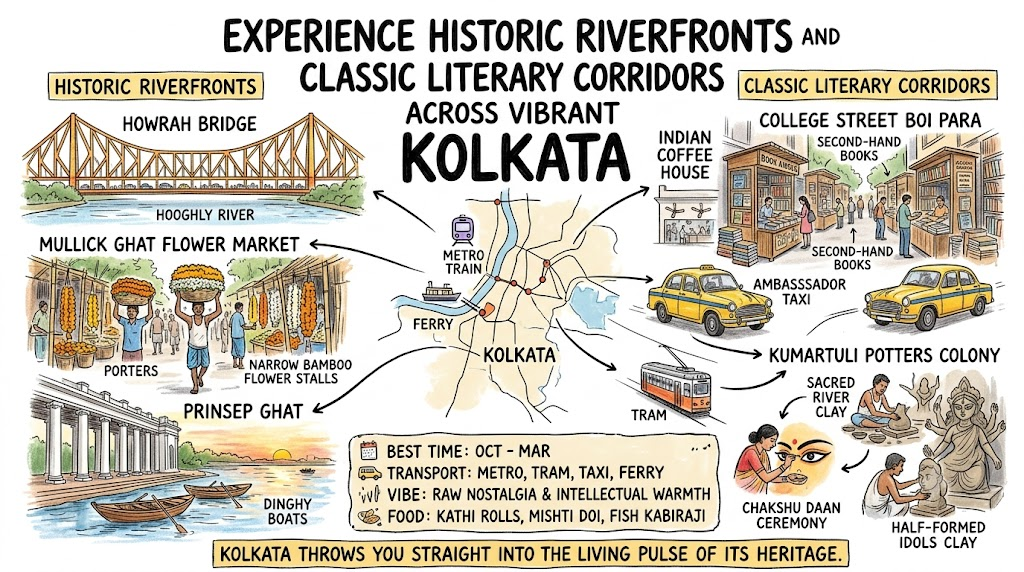
College Street—affectionately known among locals as Boi Para (Book Town)—is the largest second-hand book market on earth and the intellectual nucleus of Kolkata. Stretching across nearly one and a half kilometers, this bustling street is flanked by endless wooden stalls and makeshift kiosks brimming with rare manuscripts, classic Bengali poetry, out-of-print university texts, and contemporary novels. Surrounding this literary maze stand iconic institutions like Presidency University, University of Calcutta, and Sanskrit College.
At the heart of the district lies the legendary Indian Coffee House on Bankim Chatterjee Street. Entering its cavernous, high-ceilinged room—where spinning vintage fans and turbaned waiters in colonial uniforms carry small porcelain cups of infusion coffee—plunges you straight into historic debates and creative conversations (adda).
Wooden literary stalls along historic College Street.
- Location: College Street, Bowbazar/College Square, North-Central Kolkata (approx. 1.5 km from Sealdah Station).
- Why it is worth visiting: The world’s densest open-air book bazaar paired with India’s most celebrated intellectual café, offering rich atmosphere for the cost of a cup of coffee.
- Best things to do: Hunt for rare first-edition books among pavement stalls, climb the stairs of Indian Coffee House for hot black coffee (infusion), and sit beside College Square tank.
- Best time to visit: Late mornings or early evenings (11:00 AM to 6:00 PM), Monday through Saturday.
- Ideal for whom: Book lovers, aspiring writers, street photographers, and curious budget wanderers.
- Travel tip: Most independent wooden book shacks are closed on Sundays; plan your visit between Monday and Saturday for full access.
Prinsep Ghat on the Hooghly Riverfront
Constructed in 1841 in honor of Anglo-Indian scholar James Prinsep, this restored heritage ghat showcases a pale Palladian-Gothic portico with fluted Greek columns right on the eastern bank of the Hooghly. Standing beneath the neoclassical pediment, visitors enjoy an unobstructed view of the majestic cable-stayed Vidyasagar Setu suspension bridge rising directly overhead.
The riverside promenade stretches south toward Millennium Park, featuring clean paved pathways, manicured green lawns, vintage street lanterns, and open river vistas. In the late afternoon, traditional wooden country boats (dinghis) glide across the rippling river waters, framed against spectacular sunset hues.
Prinsep Ghat overlooking the illuminated Vidyasagar Setu.
- Location: Strand Road, Hastings, along the Hooghly riverbank (approx. 5 km southwest of central Esplanade).
- Why it is worth visiting: Completely free public heritage monument offering the best sunset and twilight views in the city.
- Best things to do: Savor clay-cup kulhad chai and hot ghoti gorom on the riverbanks, photograph the Greek columns against Vidyasagar Setu, and take an affordable wooden boat ride.
- Best time to visit: 4:30 PM to 7:00 PM for the sunset-to-twilight lighting transition.
- Ideal for whom: Couples, landscape photographers, solo travelers, and evening strollers.
- Travel tip: Board the Circular Railway from Prinsep Ghat station for an exceptionally scenic and cheap riverbank rail transit back toward North Kolkata.
St. Paul’s Cathedral
Completed in 1847, St. Paul’s Cathedral was the first episcopal church built in Asia and the first cathedral constructed outside the British Isles across the British Empire. Designed by William Nairn Forbes in the Indo-Gothic style, the structure features delicate flying buttresses, lancet windows, and a magnificent central spire reconstructed after earthquakes in 1897 and 1934.
The interior sanctuary boasts an enormous open nave with vaulted timber ceilings, Florentine-style frescoes, and exquisite stained-glass windows designed by Pre-Raphaelite master Sir Edward Burne-Jones. Stepping off the bustling Cathedral Road into this silent, sun-dappled hall delivers profound peacefulness within the urban core.
Gothic spires and tranquil grounds of St. Paul’s Cathedral.
- Location: 1A Cathedral Road, Maidan area, directly opposite Victoria Memorial (approx. 4 km south of Esplanade).
- Why it is worth visiting: Magnificent Gothic cathedral architecture, peaceful botanical gardens, and rare historical stained-glass artwork with free public entry.
- Best things to do: Admire the Burne-Jones stained-glass west windows, relax on the shaded churchyard lawns, and study the intricate marble memorial plaques lining the nave.
- Best time to visit: 10:00 AM to 1:00 PM or 3:00 PM to 5:00 PM on weekdays for quiet contemplation and optimal interior natural light.
- Ideal for whom: Architecture admirers, spiritual seekers, cultural historians, and solo explorers.
- Travel tip: Silence your mobile phone before entering the nave; photography is strictly prohibited inside the main prayer sanctuary.
South Park Street Cemetery
Opened in 1767 on what was then damp marshland along the city outskirts, the South Park Street Cemetery is one of the earliest non-churchyard colonial burial grounds in the world. Shaded under a dense canopy of ancient mahogany, moss-covered mossy trees, and wild climbing creepers, the grounds house roughly 1,600 dramatic tombs. These towering monuments are constructed as Classical Roman urns, Indo-Saracenic cupolas, pyramids, and Gothic obelisks.
Notable figures buried here include Sir William Jones (founder of the Asiatic Society), Captain Edward Cooke, and the brilliant young Anglo-Indian poet Henry Louis Vivian Derozio. Walking the stone paths feels like stepping through a real-world gothic novel, offering a moody, reflective counterpoint to the busy traffic of Park Street just outside the gate.
- Location: 52 Park Street, Mullick Bazar crossing, Park Street district (approx. 2.5 km from central Esplanade).
- Why it is worth visiting: An atmospheric, gothic historical park filled with unique hybrid architecture and rich colonial history for an entry fee of only ₹20.
- Best things to do: Spot the mysterious tomb of Major-General Charles Stuart (Hindoo Stuart), locate Sir William Jones’s soaring obelisk, and photograph tree roots embracing antique stone masonry.
- Best time to visit: Mid-afternoon (2:00 PM to 4:00 PM) when filtered sunlight cuts dramatically through the overgrown canopy.
- Ideal for whom: Heritage buffs, gothic art enthusiasts, solo writers, and atmospheric photographers.
- Travel tip: Use mosquito repellent on exposed skin, as the thick vegetation and historical water basins attract insects throughout the year.
Rabindra Sarobar (Dhakuria Lake)
Spread across 192 acres in South Kolkata, Rabindra Sarobar is an expansive artificial lake and designated national ecological reserve created in the 1920s. Encircled by towering rain trees, mahogany groves, water lilies, and flowering shrubs, this urban wetland serves as the breathing lung of South Kolkata.
The paved paths run for miles alongside the water, where morning rowers in sleek shells glide past migratory birds such as egrets, kingfishers, and cormorants. The park provides an authentic window into South Kolkata’s relaxed neighborhood life, where local residents practice yoga, discuss football, and read newspapers on waterside concrete benches.
- Location: Southern Avenue, Ballygunge/Dhakuria region, South Kolkata (adjacent to Rabindra Sarobar Metro Station).
- Why it is worth visiting: Free, lush waterfront sanctuary where you can observe native birdlife, rowing clubs, and neighborhood community life.
- Best things to do: Walk across the suspension footbridge to the lake island, watch morning rowing teams practice, and sip fresh lemon tea at lakeside kiosks.
- Best time to visit: Early morning (6:00 AM to 8:30 AM) or sunset (4:30 PM to 6:30 PM).
- Ideal for whom: Nature lovers, birdwatchers, fitness joggers, and budget backpackers seeking green open spaces.
- Travel tip: Take the North-South (Blue Line) Metro directly to the Rabindra Sarobar station for instant, cheap access to the main park gates.
Offbeat Exploration: Hidden Gems Tourists Miss
Kumartuli Clay Potters Quarter
Tucked alongside the riverbanks of North Kolkata, Kumartuli is a centuries-old settlement of master artisans who shape raw Ganga clay into breathtaking idols of Hindu deities, including Goddess Durga. Wandering through these narrow, straw-littered alleys lets you watch sculptors hand-tie bamboo skeletons, apply alluvial clay, and paint expressive eyes (Chokkhudan) onto divine effigies.
Visiting this creative neighborhood costs nothing, yet offers an unforgettable glimpse into traditional craftsmanship passed down through generations.
Tiretta Bazaar Early Morning Chinese Breakfast
Long before dawn breaks over Central Kolkata, the historic Anglo-Chinese community gathers along Sun Yat Sen Street in Tiretta Bazaar. From 5:30 AM to 7:30 AM, wooden tables line the street, serving steaming bowls of pork meatball soup, fresh shrimp wontons, hand-folded steamed bao buns, and crispy sesame fried spring rolls.
A hearty, delicious breakfast here rarely exceeds ₹100 to ₹150, offering an authentic taste of India’s oldest immigrant Chinatown culture.
Gwalior Ghat & Mullick Ghat Flower Market
Situated beneath the massive iron cantilevers of Howrah Bridge, Mullick Ghat is the largest open-air wholesale flower market in Asia. Every morning, hundreds of flower farmers and traders navigate mountain-high baskets bursting with bright orange marigolds, fragrant tuberoses, and pink lotus stems.
Wandering through this sea of scent and color lets you capture unforgettable street scenes and witness the city’s lively trade, all without spending a rupee.
Detailed Practical Guidance for Travelers
| Destination | Standard Entry Fee | General Timings | Best Local Food Options Nearby | Recommended Nearby Attractions |
|---|---|---|---|---|
| Victoria Memorial | ₹50 (Garden), ₹500 (Foreigners) | 5:30 AM – 6:15 PM (Gardens) | Camac Street Rolls, Maidan Phuchka stalls | St. Paul’s Cathedral, Birla Planetarium |
| Indian Museum | ₹50 (Indian), ₹500 (Foreigners) | 10:00 AM – 5:00 PM (Tues–Sun, Closed Mon) | New Market street kebabs, Aminia Biryani | New Market (Hogg Market), Sudder Street |
| College Street & Coffee House | Free (Entry) | 10:00 AM – 8:00 PM (Mon–Sat) | Coffee House Infusion, Paramount Sherbets | College Square, Presidency University |
| Prinsep Ghat | Free | Open 24 Hours | Ghoti Gorom vendors, Strand Road street food | Vidyasagar Setu, Babughat |
| St. Paul’s Cathedral | Free | 9:00 AM – 5:00 PM (Mon–Sat), 12–5 (Sun) | Exide Crossing cutlets, South Kolkata cha | Victoria Memorial, Academy of Fine Arts |
| South Park Street Cemetery | ₹20 (Indians & Foreigners) | 10:00 AM – 5:00 PM (Daily) | Peter Cat Chelo Kebab, Kusum Kathi Rolls | Mother House, Asiatic Society |
| Rabindra Sarobar | Free | 5:00 AM – 7:30 PM (Daily) | Southern Avenue artisanal cafes, Cha stalls | Lake Kali Bari, Golpark Market |
Logistics & On-Ground Navigation
Local Transport Options
- Kolkata Underground Metro (Blue & Green Lines): The cleanest, fastest, and most affordable transit network in the city. Fares range between ₹5 and ₹30, connecting North, Central, and South Kolkata effortlessly.
- Hooghly River Ferries: Operates between ghats (e.g., Fairlie Place to Howrah Station, or Babughat to Ramkrishnapur). Tickets cost between ₹6 and ₹10, offering a breezy river commute that bypasses roadway traffic jams.
- Iconic Yellow Taxis & Shared Auto-Rickshaws: Shared auto-rickshaws run fixed routes for ₹10 to ₹25 per seat. Yellow ambassador taxis operate via official meter rates; confirm the meter is flagged or book through the state-backed Yatri Sathi app for fair pricing.
- State Transit Buses & Vintage Trams: Blue and white government buses traverse all primary avenues for ₹8 to ₹20. The heritage electric tram running through the Maidan offers an ultra-cheap, nostalgic journey through greenery.
Budget Planning
- Budget Backpacker Tier (₹800 – ₹1,400 per day): Stay in dormitory hostels around Sudder Street or Salt Lake (₹450–₹700), use public metro and river ferries (₹50–₹100), eat authentic street food, kathi rolls, and traditional Bengali rice meals (₹300–₹500), and focus on free or low-cost monuments (₹50–₹100).
- Mid-Range Comfort Tier (₹2,500 – ₹4,500 per day): Stay in cozy heritage boutique guest houses or standard private hotels (₹1,600–₹2,800), travel via AC app cabs and metro (₹300–₹600), dine at heritage establishments like Peter Cat, Mocambo, or 6 Ballygunge Place (₹800–₹1,500), and purchase full museum gallery tickets (₹200–₹400).
Safety and Inclusivity Tips
- For Families: The Kolkata Metro and Maidan precinct are safe and family-friendly. Avoid visiting busy market crossings with strollers; light umbrella strollers or baby carriers work best on older pavements.
- For Couples: Prinsep Ghat, Rabindra Sarobar, and Victoria Memorial Gardens provide welcoming environments. Public displays of affection should remain modest to avoid unwanted attention in traditional public spaces.
- General Safety: Kolkata is routinely recognized as one of India’s safest major metro cities. Keep your backpack zipped in crowded shopping corridors like New Market, and keep small change handy for transit fares.
Strategic Travel Planning Guardrails
Travel Planning Tips for Kolkata
- Prioritize the winter travel season (November to mid-February) when the weather is cool and pleasant for outdoor walking.
- Carry cash in small bills (₹10, ₹20, ₹50, and ₹100); street-corner book stalls, chai vendors, and shared auto-rickshaws frequently face digital UPI network glitches.
- Plan around museum schedules: most government-managed historical institutions (including the Indian Museum and Victoria Memorial galleries) remain strictly closed on Mondays.
- Dress comfortably in breathable cotton clothing and sturdy walking shoes suited for stepping across high heritage stone curbs and tram lines.
- Always carry a light scarf or shawl when touring active religious sites like St. Paul’s Cathedral or Kalighat Temple to cover your shoulders and head.
- Pick up a reloadable Smart Card for the Kolkata Metro if staying more than two days to skip ticket counter queues.
Common Mistakes to Avoid
- Packing your itinerary by attempting to travel between North and South Kolkata during peak traffic hours (9:00 AM–11:00 AM and 5:30 PM–8:00 PM).
- Assuming public transit stays open past midnight; metro services wind down between 9:45 PM and 10:30 PM.
- Overpaying unmetered yellow taxis outside major rail junctions instead of using designated prepaid taxi counters or ride-hailing apps.
- Skipping classic street cuisine like kathi rolls, dimer devil (egg cutlets), and mishti doi out of health worries; choose busy stalls with high local turnover.
- Forgetting to confirm camera permit rules before bringing bulky DSLR zoom lenses into historical cemeteries and colonial churches.
Suggested Itinerary Blueprints
1. Day Quick Dash (Colonial Icons & River Sunset)
- Target Audience: Short-stay travelers and weekend backpackers looking for iconic landmarks.
- Morning: Ride the Blue Line Metro to Maidan; explore the peaceful marble grounds of Victoria Memorial and stroll through St. Paul’s Cathedral.
- Afternoon: Head north to Park Street; browse the historic stone tombs of South Park Street Cemetery and enjoy an affordable lunch of classic Kathi rolls.
- Evening: Take an auto-rickshaw to Prinsep Ghat; drink kulhad chai, watch the sunset paint Vidyasagar Setu, and take an evening ferry across the Hooghly River.
2. Day Deep-Dive (Colonial Splendor to Literary Lanes)
- Day 1 (Imperial & Heritage Core): Start at the Indian Museum exploring ancient archaeological treasures. Walk through the bustling arcades of New Market, take a lunch break along Park Street, and finish the day with sunset photography at Victoria Memorial Gardens.
- Day 2 (Literary Heart & River Life): Start early morning at Mullick Ghat Flower Market under Howrah Bridge. Take a yellow taxi to College Street; browse vintage book stalls and debate ideas over coffee at Indian Coffee House. Wrap up the day enjoying the evening breeze at Prinsep Ghat.
3. Complete Weekend Travel Plan (North-to-South Cultural Loop)
- Friday Afternoon: Check into your central accommodation; enjoy a late afternoon walk through South Park Street Cemetery, followed by dinner at a classic Park Street café.
- Saturday (North Kolkata & Literary Roots): Early morning walk through the clay artisan workshops of Kumartuli. Head down to College Street for afternoon book-hunting and lunch at Indian Coffee House. Catch the sunset from the lawns of Victoria Memorial.
- Sunday (Lakes, Cathedrals & Southern Cafes): Begin with a peaceful morning birdwatching stroll around Rabindra Sarobar (Dhakuria Lake). Head to St. Paul’s Cathedral by midday, tour the nearby Academy of Fine Arts, and conclude your weekend enjoying street food around Southern Avenue.
Common Tourist Mistakes to Avoid
Geographic Blunders
A frequent mistake travelers make is attempting to combine North Kolkata sites (such as Kumartuli and College Street) with far South Kolkata attractions (like Rabindra Sarobar) on the exact same morning. Traffic congestion along Central Avenue can eat up hours of your day. Group your days strictly into northern, central, and southern circuits.
Commercial Traps
Spending limited travel time and money inside air-conditioned suburban shopping malls cuts you off from Kolkata’s real charm. Authentic cultural interactions thrive inside traditional open-air bazaars like College Street, Gariahat, and New Market, where vintage architecture and local barter remain alive.
Neglecting Modern/Alternative Zones
Many visitors focus exclusively on colonial heritage buildings in Central Kolkata, missing the vibrant contemporary arts scene, open-air lakeside paths, and creative neighborhood cafes nestled throughout South Kolkata neighborhoods like Hindustan Park and Southern Avenue.
Transport Overpayment
Accepting flat, unmetered fare quotes from yellow taxi drivers waiting outside Howrah Station or Sealdah Station often results in paying double or triple the actual rate. Always use the official government prepaid taxi booths, insist on the electronic meter, or book through ride-hailing apps like Yatri Sathi.
Luxury Dining Bias
Confining your meals to five-star hotel dining rooms misses the culinary soul of Bengal. Kolkata’s finest culinary treasures—crispy egg rolls at Kusum, beetroot cutlets, fragrant Kolkata biryani with its signature potato, and fresh baked sandesh—are served fresh at neighborhood sweetshops and street corners for modest prices.
Frequently Asked Questions
1. What makes Kolkata an affordable travel destination compared to other Indian metros?
Kolkata maintains a very low cost of living, which translates to budget-friendly travel expenses. The underground metro system starts at just ₹5, river ferries cost ₹6, and historic museums have nominal entry fees. High-quality street food meals, such as Kathi rolls and traditional Bengali fish thalis, cost between ₹50 and ₹120, allowing budget travelers to explore comfortably for under ₹1,200 per day.
2. Which month provides the most budget-friendly conditions for exploring the city on foot?
The winter window between November and February is the ideal season for exploring Kolkata. Daytime temperatures average a pleasant 20°C to 26°C with low humidity, making long self-guided walking tours comfortable. While budget accommodation fills quickly around Christmas and New Year’s, visiting during November or late January offers great hotel rates paired with excellent walking weather.
3. How do I travel between Howrah Station and Central Kolkata without overpaying?
The most affordable and scenic way to travel is taking the public state river ferry from Howrah Ghat across to Fairlie Place or Babughat for roughly ₹6 to ₹10. The Green Line underwater metro also connects Howrah Station to Central Esplanade in minutes for ₹10 to ₹20. Both options bypass heavy roadway bridge traffic and avoid inflated taxi fares.
4. Can visitors enter the gardens of the Victoria Memorial without paying for the museum gallery?
Yes, authorities offer a dedicated garden entry ticket for just ₹50 for Indian citizens (and ₹500 for foreign nationals). This ticket grants full access to the 64-acre landscaped grounds, reflecting pools, and exterior viewing areas of the white marble monument, saving money and time if you want to skip the interior portrait queues.
5. Is the Indian Coffee House on College Street welcoming to solo budget travelers?
The Indian Coffee House warmly welcomes solo visitors, backpackers, and students. You can sit comfortably at the shared wooden tables for hours over a ₹25 cup of black infusion coffee without feeling rushed by the heritage staff. It remains a legendary space for people-watching, reading, and listening to lively political and literary debates (adda).
6. What are the best free cultural spots to visit in Kolkata?
Kolkata offers exceptional free attractions, including the riverside lawns of Prinsep Ghat, the quiet Gothic interior of St. Paul’s Cathedral, and the lakeside trails of Rabindra Sarobar. You can also explore the clay-sculpting alleys of Kumartuli, stroll through the vibrant morning Mullick Ghat Flower Market, and browse the bustling book stalls of College Street without spending an entry fee.
7. Are app-based cabs readily available for late-night transit across Kolkata?
Ride-hailing services like Uber and the state-backed Yatri Sathi app operate widely across the city 24/7. They are very reliable for early morning airport transfers or late-night returns from Park Street dining. Fares stay reasonable and upfront, removing the need to negotiate with private drivers or unmetered street cabs late at night.
8. Is Kolkata safe for solo female budget travelers exploring on foot?
Kolkata consistently ranks among the safest metropolitan areas in India according to National Crime Records Bureau statistics. Local residents are generally helpful and respectful toward travelers. Basic precautions apply: use public metro transport, stay along well-lit primary avenues after dark, use registered transit apps, and dress modestly when visiting traditional neighborhoods and religious landmarks.
9. Can I visit the artisan workshops of Kumartuli without hiring a private tour guide?
Yes, Kumartuli is a living residential neighborhood that is completely open to the public without tickets or guides. Take the Blue Line Metro to Sovabazar Sutanuti station and walk five minutes west toward the river. You can respectfully watch the potters work, though you should always ask permission before taking close-up portraits of individual artists.
10. How much should I budget daily for street food and authentic meals?
A comfortable budget for street-side dining ranges between ₹250 and ₹450 per day. A typical breakfast of hot kochuris and chai costs around ₹40, a lunchtime Kolkata biryani or fish-and-rice meal costs ₹120 to ₹180, an evening double-egg roll costs ₹60, and fresh mishti (rasgulla or sandesh) costs ₹10 to ₹20 apiece.
11. What is the standard payment method for local public transit and food stalls?
Cash remains essential for small transactions. While mid-range restaurants and larger retail shops readily accept digital UPI payments and credit cards, small tea vendors, roadside book stalls, shared auto-rickshaws, and government river ferries often operate on cash only. Always keep a supply of small currency notes (₹10, ₹20, and ₹50) in your pocket.
12. Do museums and heritage sites in Kolkata offer student discounts?
Yes, major government institutions, including the Indian Museum, Birla Industrial & Technological Museum, and Science City, offer discounted tickets for students with valid school or university identification cards. Carrying an official student ID can lower entry fees to nominal rates or even provide free access at select historical sites across the city.
Conclusion
Choosing an affordable journey through Kolkata is an enriching travel experience that connects you directly to the heartbeat of Bengal. By riding heritage wooden ferries, walking through quiet gothic churchyards, and joining lively literary conversations over clay cups of street chai, you discover the city’s true character. Long after leaving its historic avenues, you will find that the real magic of Kolkata lies not in expensive tickets, but in its welcoming spirit, timeless dignity, and poetic warmth.