Introduction
Modern enterprise software ecosystems demand cross-functional operational literacy as microservices, data processing pipelines, cloud infrastructures, and automated intelligent systems converge. Siloed operations frequently stall deployment velocity, impair incident resolution, and obscure cross-platform visibility across engineering teams. To resolve these cross-domain bottlenecks, XOpsSchool approaches multi-disciplinary operational engineering through an overarching framework that binds software delivery, telemetry, data platforms, and machine intelligence. An umbrella operational model brings cohesion to fragmented pipelines by aligning continuous integration, platform reliability, data transformation, and automated security under unified principles. Understanding this convergence allows practitioners and organizations to build resilient architectures, accelerate feedback loops, and eliminate redundant operational friction across interconnected cloud systems.
What Is XOps?
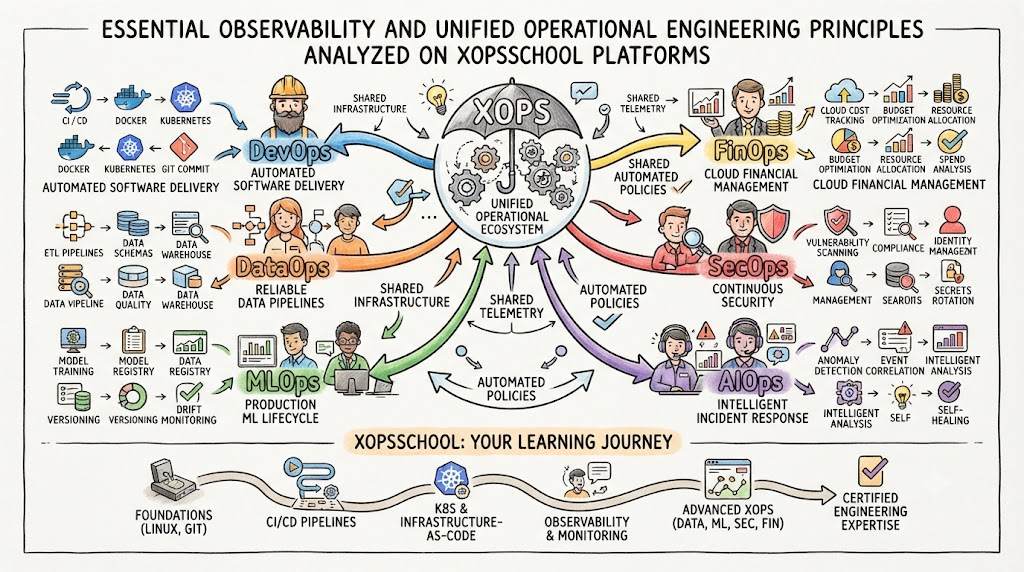
The concept of XOps represents an overarching engineering paradigm where the variable “X” stands for any specialized operational discipline required to sustain complex software estates. Rather than treating continuous delivery, telemetry, data pipelines, platform governance, and machine learning as isolated practices, this umbrella approach establishes shared operational contracts across engineering teams. For example, consider an enterprise recommendation engine that processes telemetry feeds: standard delivery pipelines deploy containerized services, while specialized data routines stream events, automated machine learning pipelines refresh scoring models, intelligent monitoring isolates anomalies, reliability systems govern error budgets, and cloud guardrails optimize operational expenditure. Because modern applications operate across these interdependent boundaries, unified operational principles establish reliable, end-to-end continuous feedback loops throughout the entire technology lifecycle.
What Does XOps Include?
Modern operational ecosystems integrate several specialized disciplines to support scalable, fault-tolerant infrastructure and accelerated business software delivery. While each branch addresses distinct engineering problems, they collectively share foundational practices like version-controlled configurations, automated validation, continuous telemetry, and declarative orchestration. The table below outlines how these critical operational areas divide responsibilities while reinforcing modern delivery standards:
| XOps Discipline | Primary Focus | Typical Responsibilities |
| DevOps | Software delivery lifecycle | Implementing automated CI/CD pipelines, containerization, and release engineering |
| DataOps | Data pipeline reliability | Orchestrating ETL workflows, ensuring schema validation, and tracking data lineage |
| MLOps | Machine learning lifecycle | Automating model deployment, tracking feature drift, and running retraining jobs |
| AIOps | Algorithmic telemetry analysis | Correlating operational alerts, detecting performance anomalies, and automated triage |
| SecOps | Continuous systems security | Enforcing static scanning, policy-as-code controls, and secret management workflows |
| FinOps | Cloud cost transparency | Tracking cloud usage allocation, unit economics, and architectural spend efficiency |
| SRE | Systems availability and uptime | Defining service level objectives (SLOs), managing error budgets, and incident review |
| InfraOps | Foundation systems stability | Provisioning cloud resources, operating compute nodes, and configuring networks |
| Platform Engineering | Developer enablement | Building internal developer platforms (IDPs) and self-service deployment blueprints |
What Is XOpsSchool?
Engineered as a dedicated vendor-neutral knowledge platform, the portal serves engineers, architects, and technical leaders who are examining how distinct operational workflows converge within production environments. Readers can systematically explore fundamental continuous delivery practices, declarative infrastructure orchestration, distributed tracing architectures, intelligent telemetry analysis, and enterprise data lifecycle management through structured, practical modules. The learning materials focus on real-world implementations, helping practitioners understand the connective workflows that tie container orchestrators, automated pipelines, distributed systems, and intelligent alerting engines together into dependable platforms.
Why Is XOps Important?
Modern digital architectures rely heavily on containerized microservices, distributed cloud topologies, and real-time streaming engines that quickly overwhelm rigid, fragmented operational teams. When code deployment pipelines operate without coordination alongside data workflows or automated machine learning updates, unnoticed schema changes disrupt dependent consumers, undetected security flaws compromise workloads, and cloud expenses spiral without accountability. A unified operational strategy breaks down organizational silos by standardizing continuous deployment patterns, centralized observability backbones, declarative infrastructure templates, and automated resilience policies. This cross-disciplinary approach ensures systems scale gracefully, run reliably under fluctuating traffic, maintain continuous regulatory governance, and preserve clear end-to-end accountability across platform teams.
Why Choose XOps Training?
Enrolling in structured operational training enables engineers to transcend narrow tooling boundaries and master end-to-end system architectures spanning modern cloud-native enterprises. Rather than understanding only isolated build scripts or server configurations, learners gain practical exposure to distributed logging, infrastructure automation, container orchestration, machine learning delivery workflows, and automated governance models. This broad, cross-functional understanding dramatically improves incident coordination, breaks down communication barriers between developers and operations personnel, and equips engineers to design reliable architectures. Expanding technical competence across these adjacent fields builds well-rounded practitioners capable of guiding complex technical migrations, standardizing developer platforms, and sustaining resilient enterprise cloud ecosystems.
How Does XOps Training Work in Practice?
A practical cross-operational curriculum begins with core Linux systems administration, modern networking primitives, shell scripting, and distributed Git collaboration workflows. Learners then build containerized workloads, configure continuous integration and delivery pipelines, and automate infrastructure deployments using declarative code across public cloud providers. Next, training introduces distributed observability platforms, automated vulnerability scanners, and site reliability principles such as error budgets and automated self-healing mechanisms. The sequence progresses into orchestrating data pipelines, automating model packaging and drift monitoring, and configuring intelligent alerting engines that correlate multi-cloud telemetry events. Real-world scenarios, broken lab environments, and production-like deployment failures ensure students develop deep troubleshooting intuition rather than relying on theoretical abstractions alone.
XOps Certification: What Should You Look For?
When evaluating professional operational certifications, candidates should prioritize curricula that assess real-world execution through hands-on technical environments rather than passive multiple-choice examinations. A valuable assessment validates practical proficiencies in declarative cloud provisioning, multi-stage deployment pipeline construction, container orchestration debugging, automated secret lifecycle management, and reliable data flow verification. Additionally, candidate assessments should feature realistic fault scenarios, such as debugging network policy misconfigurations, rectifying failing deployment rollouts, identifying data pipeline drift, and correlating distributed tracing anomalies. While earning recognized credentials validates focused study and structured technical knowledge, formal certifications should always complement deep hands-on experimentation, personal lab implementations, and demonstrable production engineering experience.
XOps Tools: Understanding the Technology Stack
Contemporary operational stacks avoid monolithic architectures in favor of modular, open, and interoperable tooling designed around declarative interfaces and programmatic automation. These tools integrate smoothly across software repositories, deployment targets, cloud control planes, and telemetry collectors to establish repeatable release mechanisms. The table below details foundational open-source and enterprise technologies across key operational domains:
| Operational Area | Example Tools | Practical Purpose |
| Version Control & GitOps | Git, GitHub, Argo CD, GitLab | Managing declarative state repositories and synchronizing infrastructure configurations |
| Continuous Integration | Jenkins, GitHub Actions, GitLab CI | Automating code validation, running automated test suites, and building containers |
| Container Orchestration | Docker, Kubernetes, containerd | Packaging microservices and coordinating scalable container workloads across nodes |
| Infrastructure as Code | Terraform, OpenTofu, Ansible | Provisioning reproducible cloud topologies and configuring bare-metal server states |
| Observability & Metrics | Prometheus, Grafana, OpenTelemetry | Collecting real-time system metrics, aggregating telemetry data, and rendering dashboards |
| Centralized Logging | Elastic Stack, Splunk, Fluent Bit | Ingesting distributed container logs, parsing event traces, and analyzing audit trails |
| Secrets & Security | HashiCorp Vault, Trivy, Kyverno | Managing dynamic API secrets, scanning container images, and enforcing runtime policies |
| Intelligent Telemetry | Dynatrace, Datadog, BigPanda | Correlating operational noise, tracing distributed calls, and detecting operational anomalies |
DevOps Training as the Foundation of XOps
Establishing reliable continuous integration, container orchestration, and automated cloud delivery serves as the non-negotiable architectural baseline for every subsequent operational methodology. Before an engineering group can orchestrate complex data transformation pipelines or deploy sensitive machine learning inference models, it must first master deterministic version control, reproducible build artifacts, automated test verification, and automated rollback workflows. Foundational deployment automation eliminates manual environment drift, simplifies configuration drift tracking, and instills the operational rigor necessary to sustain modern production environments. Once teams build fluency across infrastructure-as-code templates, container deployment lifecycles, and centralized log streams, they can confidently expand their capabilities into more specialized operational domains without introducing architectural debt.
AIOps Training: Adding Intelligence to Operations
Algorithmic operations platforms apply statistical analysis, machine learning models, and automated inference algorithms directly to mountains of system telemetry, distributed traces, and audit logs. By isolating subtle system degradations, grouping related notifications, filtering out repetitive telemetry noise, and suggesting root causes during cascading outages, these systems accelerate mean time to resolution across high-throughput microservices. However, engineering teams must recognize that automated intelligence engines are only as effective as the underlying telemetry data feeding them; incomplete log collection, inconsistent distributed tracing headers, or sporadic metric ingestion inevitably lead to false-positive alarms and unreliable operational insights. Establishing robust telemetry standards across all production services remains an absolute prerequisite before introducing automated triage or remediation bots.
MLOps Training: Taking Machine Learning Into Production
Taking predictive and analytical algorithms from experimental data science notebooks into resilient production environments requires disciplined engineering practices that bridge software development, data warehousing, and live systems reliability. Operational machine learning pipelines automate dataset version tracking, training step orchestrations, artifact containerization, and canary model rollouts across distributed compute clusters. Beyond day-one deployment challenges, production teams must implement continuous telemetry to detect data drift, concept drift, feature store inconsistencies, and inference latency degradation under sudden traffic spikes. By aligning model deployment workflows with established continuous delivery safeguards, automated testing suites, and real-time observability standards, organizations maintain robust model governance while accelerating deployment velocity across internal data platforms.
DataOps Training: Making Data Operations Reliable
Operationalizing enterprise data platforms requires applying agile software delivery principles, automated quality assertions, continuous schema validation, and end-to-end lineage tracking to complex ingestion pipelines. Without rigorous operational oversight, upstream table alterations silently break downstream analytics dashboards, unvalidated inputs pollute production databases, and uncontrolled pipeline failures cause costly data inconsistencies. A practical DataOps workflow introduces declarative orchestration frameworks, version-controlled transformations, automated unit testing for extracted records, and real-time pipeline monitoring to catch processing stalls early. Implementing continuous testing and automated verification at every ingestion, staging, and transformation phase guarantees that consumer applications, analytic models, and downstream microservices consistently receive reliable, accurate operational data.
Real-Life Scenarios / Experiences
- Microservice Telemetry Storms: A distributed retail platform experienced cascading timeouts during a flash sale, causing thousands of duplicate error traces to flood standard log dashboards and blinding on-call engineers to the actual root cause. The operations team routed the raw telemetry stream through an automated correlation engine, which suppressed redundant warnings, grouped alerts by dependent network calls, and traced the failure to a misconfigured connection pool in an upstream payment service.
- Silent Upstream Schema Breakage: An analytics platform quietly ingested malformed JSON records after an external API partner changed variable types without notice, producing corrupted records that broke internal revenue forecasting dashboards. The engineering team deployed an automated pipeline with inline schema validation rules and contract verification steps, ensuring future unexpected payload variations trigger immediate automated alerts and pause data ingestion before corrupted entries contaminate storage layers.
- Model Degradation in Fraud Detection: A financial institution’s credit assessment model began approving risky applications because shifting consumer spending patterns rendered the underlying training assumptions obsolete over several quarters. By instituting automated model performance tracking and automated drift monitors across inference endpoints, the platform now automatically flags performance drops, triggers reproducible retraining pipelines using validated datasets, and executes canary deployments for updated weights.
- Uncontrolled Infrastructure Sprawl: A development organization running distributed microservices across multiple public clouds experienced uncontrolled infrastructure costs due to unmonitored container clusters, orphan storage volumes, and over-provisioned virtual instances. Implementing automated policy-as-code scanners alongside cost attribution tags inside continuous delivery pipelines allowed the platform team to identify unused resources, mandate resource limits, and reduce monthly cloud expenditures significantly.
Common Mistakes to Avoid When Choosing Learning Resources
- Selecting Purely Theoretical Programs: Enrolling in courses that focus exclusively on slide presentations without offering interactive terminal sandboxes, production-like environments, or broken lab challenges prevents students from learning real-world troubleshooting skills.
- Focusing on Tool Names Over Core Principles: Memorizing specific command-line arguments for individual software utilities while ignoring foundational concepts like networking, distributed consensus, and idempotent automation leaves engineers unprepared when tool stacks evolve.
- Ignoring Foundational Linux and Networking Essentials: Attempting to configure complex container orchestrators, service meshes, or distributed data systems without a firm grasp of Linux processes, socket communication, file permissions, and subnets leads to severe implementation mistakes.
- Neglecting Cross-Domain Observability Techniques: Focusing solely on code deployment automation while treating distributed tracing, structured logging, and metric aggregation as an afterthought leads to fragile production systems that are difficult to debug during outages.
- Overlooking Security and Secrets Governance: Deferring security practices until after finishing deployment pipelines frequently introduces unsafe patterns, such as hardcoding plain-text credentials, deploying root-privileged containers, and bypassing runtime policy checks.
- Treating Certifications as Guarantees of Employment: Believing that memorizing multiple-choice answers for formal certifications can substitute for genuine hands-on engineering, personal homelabs, open-source contributions, and practical debugging experience.
- Skipping Site Reliability Fundamentals: Building complex deployment pipelines without defining clear service level objectives, tracking realistic error budgets, or establishing automated disaster recovery strategies undermines system availability.
- Pursuing Specialized Fields Too Soon: Jumping directly into complex operational disciplines like intelligent anomaly engines or machine learning operations before mastering container deployment pipelines, Git workflows, and infrastructure automation.
How XOpsSchool Can Support the Learning Journey
Engineers seeking to expand their architectural horizons can utilize the educational content and structured tutorials available through the knowledge portal to navigate the complexities of unified operations. The platform offers step-by-step guides covering container orchestration, declarative infrastructure management, continuous deployment workflows, dynamic observability strategies, and site reliability fundamentals. Rather than treating technical domains as isolated specializations, the platform’s educational resources illustrate how modern deployment pipelines interface smoothly with distributed data workflows, scalable model hosting infrastructures, and intelligent monitoring systems. This unified educational model helps practitioners bridge the gap between distinct engineering specialties, build reliable automation habits, and master the cross-functional competencies demanded by modern, high-velocity technology organizations.
How to Get the Most From an XOps Course
To build durable, real-world engineering competence from any operational course, practitioners must adopt an active learning methodology: Learn, Implement, Break, Troubleshoot, Document, Automate, and Measure. Passive video consumption rarely translates into production engineering capability; students must deploy real microservices, purposefully inject network latency, terminate dependent database nodes, and configure automated health probes to see how systems fail under stress. When an incident occurs in your test environment, analyze system traces methodically, identify the underlying root cause, record the debugging steps in post-incident documentation, and write automated remediation scripts to prevent recurrence. Continually evaluating deployment frequency, recovery duration, and system availability turns everyday lab exercises into practical engineering mastery that translates directly to production cloud platforms.
Frequently Asked Questions
1. What does the “X” in XOps stand for?
The variable “X” represents any specialized technical or operational discipline required across modern IT environments, including software delivery, data engineering, machine learning pipelines, cloud infrastructure, reliability engineering, and continuous platform security. It signifies a unified, cross-functional engineering framework rather than isolated operational teams.
2. How is XOps different from traditional DevOps?
Traditional DevOps focuses primarily on breaking down walls between software developers and IT operations through continuous integration and deployment. XOps expands this core philosophy across data pipelines, machine learning lifecycles, platform reliability, cloud financial management, and algorithmic telemetry correlation across multi-cloud environments.
3. Do I need to learn software programming to succeed in XOps?
While you do not need to build complex enterprise software applications, you do need a solid grasp of scripting and declarative programming. Writing Python scripts, shell automations, YAML declarations, and infrastructure-as-code manifests is essential for automating workflows across diverse operational systems.
4. Is it necessary to learn every Ops discipline at once?
No, attempting to master every operational domain simultaneously is counterproductive and overwhelming. Practitioners should establish a solid foundation in continuous delivery, containerization, and cloud infrastructure before gradually expanding into specialized disciplines like data operations, algorithmic monitoring, or machine learning infrastructure.
5. What are the key prerequisites before starting an operational course?
Learners should understand core Linux administration, file systems, shell commands, and essential networking concepts like TCP/IP, DNS, and HTTP routing. Familiarity with standard Git version control workflows and modern public cloud fundamentals will also accelerate your practical learning progress significantly.
6. Can a beginner start directly with MLOps or AIOps?
Entering advanced disciplines like machine learning operations without understanding container orchestration, automated continuous deployment, and infrastructure provisioning usually leads to significant frustration. Mastering foundational delivery pipelines and container management first ensures you have the necessary operational baseline to deploy and monitor complex models reliably.
7. How does FinOps fit into modern operational architectures?
Cloud financial management introduces real-time cost visibility and accountability into continuous deployment workflows and infrastructure configurations. By embedding cost governance policies directly into delivery pipelines, platform teams prevent accidental resource over-provisioning and keep infrastructure spending aligned with business priorities.
8. What is the role of Platform Engineering in an operational team?
Platform engineering teams build internal developer platforms and self-service deployment blueprints that abstract away underlying infrastructure complexities. This enables application developers to deploy code, provision test databases, and manage environments independently while maintaining consistent organizational standards for security, reliability, and observability.
9. Why is observability essential for operational cross-disciplines?
Observability combines system metrics, distributed traces, and centralized logs to provide deep visibility into complex, distributed microservices. Without comprehensive cross-system telemetry, diagnosing silent pipeline failures, latency spikes, cascading infrastructure crashes, or performance degradation across interconnected cloud components becomes nearly impossible.
10. Does earning a technical certification guarantee an engineering job?
A technical certification demonstrates disciplined study, dedication, and foundational knowledge, but it cannot replace practical, hands-on engineering experience. Hiring managers prioritize demonstrable technical competence, including the ability to troubleshoot production failures, build functional deployment pipelines, and design resilient, real-world cloud architectures.
11. What is the typical duration required to learn these operational concepts?
A dedicated engineer spending several hours each week on hands-on terminal labs can expect to master foundational deployment automation and containerization within four to six months. Expanding into advanced topics like data pipeline reliability, machine learning operations, and algorithmic telemetry generally requires an additional six to twelve months of practice.
12. Which open-source tools should a beginner learn first?
Beginners should start by mastering Git for version control, Docker for container packaging, Linux Bash for automation scripting, and Terraform for declarative infrastructure management. Once comfortable with these tools, they can progress to Kubernetes for orchestration and Prometheus and Grafana for system monitoring and observability.
Conclusion
Adopting a unified, cross-functional operational approach provides the necessary architectural blueprint to overcome modern enterprise engineering challenges, bridge siloed teams, and accelerate automated software delivery across cloud ecosystems. When organizations combine reliable continuous deployment pipelines, disciplined data governance, automated machine learning lifecycles, and resilient platform engineering, their technical systems scale smoothly while remaining fault-tolerant. Embracing these integrated workflows, focusing on hands-on practical troubleshooting, and cultivating cross-disciplinary technical literacy prepares engineers to manage complex, modern infrastructures effectively and build resilient digital platforms designed for long-term operational success.