Introduction
Welcome to Kolkata, a city where the past doesn’t merely live in textbooks—it breathes through the brickwork of century-old mansions, yellow ambassador taxis, and the lingering aroma of slow-brewed tea. For many travelers, India’s eastern gateway is synonymous with literary giants, mouth-watering street food, and unparalleled cultural energy.
However, looking at a comprehensive Kolkata travel guide reveals that this vibrant metropolis is much more than its modern culinary experiments or bustling street markets. It is an expansive living museum. Unlike cities that completely overwrite their past with glass and steel skyscrapers, Kolkata has fiercely held onto its soul.
From the architectural marvels of the British Raj to the ancestral homes of path-breaking Indian reformers, the city offers an incredible mix of culture, nature, food, adventure, heritage, peace, and local experiences. Whether you are an architectural enthusiast, a solo backpacker, or a family traveler seeking an educational vacation, exploring the best places to visit in Kolkata feels like stepping into a time machine.
Why Kolkata is a Must-Visit City
Kolkata holds a unique place on the global tourism map as a practical, deeply rewarding destination for every type of traveler. It isn’t a city built purely for artificial entertainment; rather, its charm lies in its authenticity.
- Diverse Travel Appeal: Families love the grand, sprawling museums; couples find romance in the misty mornings by the Hooghly River; and backpackers thrive on the affordability of its local stays and public transit.
- A Paradise for Heritage Lovers: As the former capital of the British Raj until 1911, the city features a dramatic concentration of colonial architecture blended seamlessly with traditional Bengali, European, and Jewish historical landmarks.
- Unmatched Affordability: Compared to other major Indian metros, your budget goes significantly further here. From historic tram rides to iconic sweet shops that have been serving customers for over a century, the city balances historic value with practical affordability.
Exploring the Historical Gems: Useful Guidance & Travel Tips
Before we dive into the specific landmarks, it is essential to understand how to navigate the historical landscape of the city. Heritage exploration here requires a blend of curiosity and smart Kolkata trip planning.
Best places to visit
To truly appreciate the evolution of the city, your itinerary should balance the massive imperial monuments located near the center with the dense, crumbling zamindari palaces hidden within the narrow lanes of North Kolkata.
Things to do
Don’t just look at the buildings. Take a slow walking tour, ride a historic hand-pulled rickshaw or an electric tram, document the intricate wooden shutters of local neighborhoods, and talk to locals at a traditional roadside adda (conversational gathering).
Entry fees if applicable
Most historical sites managed by the government have highly subsidized rates for Indian citizens (ranging from ₹20 to ₹75) and separate tickets for international tourists (typically around ₹500). Carrying an ID card is highly recommended to avail of student discounts.
Travel tips
Start your days early—around 7:30 AM or 8:00 AM. This allows you to beat the intense afternoon heat and photograph the stunning heritage architecture without thousands of commuters blocking your view.
Nearby attractions
Kolkata’s historical sites are clustered in distinct geographical zones. For example, if you are visiting the Victoria Memorial, you can easily walk to St. Paul’s Cathedral or the Birla Planetarium within five to ten minutes.
Food options
Never explore history on an empty stomach. Pair your heritage walks with historic culinary stops: stop by the century-old Flurys on Park Street for English breakfast, or drop by Mitra Cafe in North Kolkata for legendary fish cutlets.
Budget planning
Set aside a modest budget for entry tickets and local guides. Hiring a local guide at sites like Marble Palace or the Indian Museum can cost anywhere between ₹20 to ₹500, but the rich historical context they share is worth every rupee.
Safety tips
Kolkata is widely regarded as one of the safest cities in India for solo travelers and families alike. However, watch your step on uneven, historic pavements, and ensure your belongings are secure when exploring crowded market areas.
Local transport options
The city boasts a brilliant public transit network. Utilize the underground Metro to beat traffic, hop on a yellow taxi for short distances, or take a peaceful ferry ride across the Hooghly River to experience the city from the water.
Family-friendly suggestions
The Indian Museum and the Science City area are exceptional choices for kids, combining vast, green open spaces with deep educational value.
Couple-friendly suggestions
A quiet evening walk along Prinsep Ghat, watching the sunset under the massive structural pillars of the Vidyasagar Setu, offers one of the most romantic historical backdrops in the country.
Hidden or less-crowded options
If you want to escape the main tourist crowds, skip the midday rush at major monuments and spend an afternoon exploring the peaceful, quiet courtyards of the South Park Street Cemetery or the old Portuguese churches in central Kolkata.
Best Places or Experiences
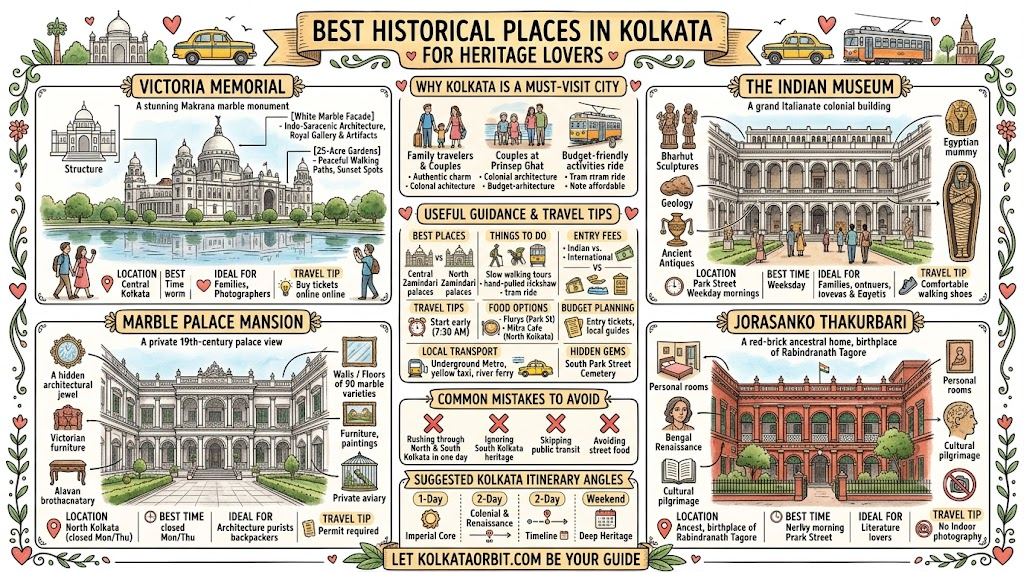
1. The Victoria Memorial
                +-------------------------+
                |    VICTORIA MEMORIAL    |
                +-------------------------+
                             |
         +-------------------+-------------------+
         |                                       |
[White Marble Facade]                   [25-Acre Gardens]
         |                                       |
- Indo-Saracenic Architecture          - Peaceful Walking Paths
- Royal Gallery & Artifacts            - Perfect Sunset Spots
Location
Queens Way, Maidan, Central Kolkata.
- Why it is worth visiting: This jaw-dropping white Makrana marble monument is arguably the most famous face of Kolkata’s heritage. Built between 1906 and 1921 to honor Queen Victoria, it features an incredible fusion of British, Mughal, and Venetian architectural styles. Inside, the grand galleries house a massive collection of colonial-era paintings, historic weapons, and rare artifacts.
- Best things to do: Walk through the Royal Gallery, photograph the reflection of the marble dome in the surrounding lakes, and stay for the enchanting Light and Sound show held in the evening.
- Best time to visit: Late autumn to winter (October to February) is wonderful. Plan to arrive around 10:30 AM for the museum galleries, or 4:00 PM to enjoy the breezy gardens.
- Ideal for whom: History buffs, family vacationers, photographers, and couples looking for a picturesque walk.
- Travel tip: Buy your tickets online in advance to bypass the long weekend ticket lines at the main entrance gates.
2. The Indian Museum
Location
Jawaharlal Nehru Road, Colootola, near Park Street.
- Why it is worth visiting: Founded in 1814 by Danish botanist Dr. Nathaniel Wallich, this is the oldest and largest multi-disciplinary museum not just in India, but in the entire Asia-Pacific region. Often called Jadu Ghar (House of Magic) by locals, its magnificent Italianate colonial building houses an unbelievable collection of ancient antiques, Egyptian mummies, Mughal miniatures, and Buddha relics.
- Best things to do: Explore the massive Bharhut Sculpture Gallery, view the ancient fossil collections in the Geology wing, and marvel at the 4,000-year-old Egyptian mummy exhibit.
- Best time to visit: Weekday mornings (Tuesday through Friday) right when it opens at 10:00 AM to beat the massive school tour crowds.
- Ideal for whom: Solo travelers, student groups, research scholars, and families with curious children.
- Travel tip: Wear highly comfortable walking shoes; the museum building is huge and exploring all the major galleries thoroughly requires walking a few kilometers.
3. Marble Palace Mansion
Location
Muktaram Babu Street, Jorasanko, North Kolkata.
- Why it is worth visiting: This hidden architectural jewel is a privately owned nineteenth-century palatial mansion that feels completely frozen in time. Built in 1835 by Raja Rajendra Mullick, the palace features stunning walls and floors made entirely from over ninety different varieties of imported marble. It houses an eclectic private collection of Western sculptures, Victorian furniture, and original paintings by European masters like Rubens and Reynolds.
- Best things to do: Admire the grand open-air courtyards, explore the beautiful crystal chandeliers in the ballrooms, and view the small, historic private aviary located on the grounds.
- Best time to visit: 11:00 AM to 3:00 PM. Note that the palace is closed to the public on Mondays and Thursdays.
- Ideal for whom: True architecture purists, art connoisseurs, and backpackers looking for unique hidden places in Kolkata.
- Travel tip: Because this remains a private residence, you must obtain a free entry permit from the West Bengal Tourism Information Bureau (located at BBD Bagh) at least a day before your intended visit.
4. Jorasanko Thakurbari
Location
Ganesh Chandra Avenue, Jorasanko, North Kolkata.
- Why it is worth visiting: This is the ancestral home of the Tagore family and the birthplace of Asia’s first Nobel Laureate, Rabindranath Tagore. Built in the late eighteenth century, this sprawling red-brick mansion is the ultimate cultural pilgrimage site for heritage lovers, offering an intimate look into the Bengal Renaissance that reshaped India’s literary and artistic landscape.
- Best things to do: Walk through the personal rooms where Rabindranath Tagore lived and wrote, view the beautiful collection of paintings by the Tagore family, and sit quietly in the peaceful central courtyard.
- Best time to visit: Any time of the year, but visiting during Rabindra Jayanti (May) or Poush Mela season brings a unique cultural energy to the space.
- Ideal for whom: Literature lovers, solo travelers, and cultural tourists eager to understand the artistic roots of Bengal.
- Travel tip: Photography is strictly prohibited inside the residential rooms and gallery spaces, so be sure to respect the rules and keep your camera packed away until you step outside.
Travel Planning Tips for Kolkata
| Planning Aspect | Actionable Practical Advice |
| Accommodation | Book your hotel rooms early if you are traveling during the peak winter season or the grand Durga Puja festival. |
| Local Transport | Rent vehicles or book app cabs only through verified, reputable services; ensure you carry all valid documentation. |
| Safety and Comfort | Avoid exploring poorly lit, unfamiliar lanes in the old dock or industrial districts late at night. |
| Financial Prep | Always carry physical cash; small street-side book stalls and heritage tea shops rarely accept international cards. |
| Cultural Respect | Remove your shoes and dress modestly when entering active historical places of worship, temples, or mosques. |
| Eco-Tourism | Help keep the heritage zones clean; avoid littering around old colonial monuments or throwing plastic into the river. |
Common Mistakes to Avoid
- Rushing through the Itinerary: Trying to see both North and South Kolkata in a single day is a recipe for exhaustion. The city’s cross-town traffic can be intense, so it is much smarter to divide your trip geographically.
- Ignoring the Rich Heritage of South Kolkata: Many travelers spend all their time focused on the old colonial center and North Kolkata, completely missing out on gorgeous South Kolkata highlights like the serene lakes, old elite residential neighborhoods, and unique art-deco houses.
- Skipping the Historic Local Public Transit: Relying purely on private AC cabs means you miss out on the authentic rhythm of local life. Make time to ride the historic metro system and the iconic local ferries.
- Overpaying for Souvenirs: When shopping around older market hubs like New Market or College Street, remember that polite bargaining is an accepted part of the local shopping experience.
- Avoiding the Traditional Street Food: Do not stick exclusively to high-end hotel restaurants. Kolkata’s food history is safe and legendary—missing out on a hot Kathi Roll or freshly made Rosogollas means missing a core pillar of the city’s living culture.
Suggested Kolkata Itinerary Angles
Depending on the length of your stay, here is how you can seamlessly fit these magnificent heritage experiences into your Kolkata itinerary.
1-Day Plan: The Imperial Core
- Morning: Start early with a majestic sunrise walk around the Maidan, followed by a visit to St. Paul’s Cathedral.
- Midday: Explore the rich galleries of the Victoria Memorial and grab a traditional lunch on Park Street.
- Afternoon: Spend a few hours exploring the vast historic collections inside the Indian Museum.
- Evening: Enjoy a peaceful sunset boat ride along the Hooghly River at Prinsep Ghat.
2-Day Plan: Colonial Heritage & Renaissance Roots
- Day 1: Follow the Imperial Core plan outlined above.
- Day 2: Head deep into North Kolkata. Start your morning exploring the Jorasanko Thakurbari, visit the breathtaking Marble Palace by afternoon, and wrap up your day browsing the iconic old book stalls of College Street.
Weekend Travel Plan: The Deep Heritage Experience
- Friday Evening: Arrive, settle into your stay, and enjoy dinner at a historic restaurant on Park Street.
- Saturday: Dedicate your full day to the grand architecture of Central Kolkata, including the General Post Office (GPO), Writers’ Building area, and the South Park Street Cemetery.
- Sunday: Take an early morning tram ride through the old quarters, visit the historic houses of Kumartuli (the potters’ quarter where traditional clay idols are sculpted), and finish your trip with local sweets in North Kolkata.
FAQs
1. Which is the best month to plan a heritage trip to Kolkata?
The best time for Kolkata trip planning is between October and March. The weather during these months is beautifully pleasant and cool, making it absolutely perfect for long, comfortable outdoor walking tours of the city’s historic districts.
2. Can I visit the famous Marble Palace without any prior permission?
No, you cannot. Because the Marble Palace remains a privately owned ancestral property, visitors must obtain a free formal entry permit from the West Bengal Tourism Bureau at least 24 hours before their visit.
3. Are the historical tram systems in Kolkata still operational?
Yes, a few iconic heritage tram routes are still running in the city. Riding them is one of the most delightful, historic things to do in Kolkata for a slow, old-world perspective of the bustling streets.
4. Is photography freely allowed inside all the heritage buildings?
Rules vary by location. While outdoor photography is welcome almost everywhere, places like the Jorasanko Thakurbari and specific galleries inside the Indian Museum strictly prohibit indoor photography to preserve the condition of the artifacts.
5. How can I safely travel between North and South Kolkata?
The fastest, most practical option is to use the underground Metro line, which runs directly north-to-south across the city. It allows you to completely bypass road traffic at a minimal cost.
6. Are there good English-speaking guides available at the major monuments?
Yes, major government-managed historical sites like the Victoria Memorial and the Indian Museum have certified, knowledgeable English and Hindi-speaking guides available for hire near the ticket counters.
7. Is Kolkata a safe destination for a solo female traveler?
Kolkata is consistently ranked as one of the safest major metropolitan cities in India. People are generally very hospitable, helpful, and respectful toward travelers, though standard safety precautions should still be followed at night.
8. What should I wear when exploring the old historical neighborhoods?
It is best to wear lightweight, breathable cotton clothing and highly comfortable walking shoes. When visiting any active places of worship, remember to dress modestly and ensure your shoulders and knees are covered.
9. Can I visit the grand Writers’ Building from the inside?
The Writers’ Building currently serves as a major government administrative office, so public entry inside the building is restricted. However, you can freely view and photograph its stunning Greco-Roman exterior architecture from the outside.
10. Where can I find reliable maps for a self-guided heritage walk?
You can find excellent, detailed neighborhood heritage maps, curated walking routes, and comprehensive local advice directly on kolkataorbit.com to help you navigate the city easily.
Conclusion
Kolkata is far more than just another stop on a tourist itinerary; it is an unforgettable emotion that stays with you long after you leave. For heritage lovers, its old buildings tell stories of a time when the city was the intellectual and political heart of the subcontinent. By planning your journey thoughtfully, respecting the local customs, and taking the time to explore beyond the usual crowded spots, you will uncover the true magic of this soulful city.
As you begin your journey, let kolkataorbit.com serve as your ultimate local travel companion. Our platform is dedicated to helping you make smarter travel choices, discover hidden neighborhood gems, and experience the timeless beauty of Kolkata like a true local. Pack your bags, bring your curiosity, and get ready to create memories that will last a lifetime.