Introduction
Moving to a new country is one of the biggest decisions you will ever make. It is a dream fueled by the desire for a better career, a safer environment for your family, and a higher quality of life. However, before you pack your bags or even book an English test, there is a crucial technical hurdle you must clear: the PR Points Calculator.
Most modern immigration systems—especially in popular destinations like Canada, Australia, and New Zealand—have moved away from “first-come, first-served” models. Instead, they use merit-based systems. They want the best and the brightest. To find them, they assign points to your profile.
If you don’t know your score, you are essentially flying blind. Checking your eligibility through a PR points calculator is the first step toward turning your immigration dream into a reality. This guide will break down exactly how these systems work, how to calculate your own score, and how to improve it if you fall short.
What Is a PR Points Calculator?
At its simplest, a PR Points Calculator is a digital tool or a set of criteria used by immigration authorities to rank candidates. Think of it like a university entrance exam, but instead of testing your knowledge of physics or history, it tests your “human capital.”
The Purpose of the Points System
Countries use these systems to manage high volumes of applications. Instead of reviewing every single person who wants to move, the government sets a “cut-off” score. If your points are above that line, you get an invitation to apply (ITA) for Permanent Residency (PR).
How It Works
The calculator looks at various factors in your life and assigns a numerical value to each. Common factors include:
- Age: Usually, younger professionals get more points.
- Education: Higher degrees (Masters/PhDs) equal higher scores.
- Work Experience: More years in a skilled role boost your profile.
- Language Skills: Your ability to speak English or French is a major point-earner.
Eligibility Score vs. Invitation Score
This is where many beginners get confused.
- Eligibility Score: This is the minimum score needed to enter the “pool” of candidates (e.g., 67 points for Canada’s FSWP).
- Invitation Score: This is the competitive score (like the CRS score) that determines if you actually get picked from that pool.
Example: You might be eligible to apply with 67 points, but you might need a much higher ranking score to actually receive your PR invitation.
How PR Points Systems Work: The Core Factors
Every country has its own flavor of the points system, but the ingredients are generally the same. Let’s look at the “Big Seven” factors that determine your success.
1. Age Points
Immigration is often used to combat aging populations. Therefore, most systems award the maximum points to candidates between 18 and 35. Once you hit 40, the points often start to drop significantly.
2. Education Points
The more you’ve studied, the more points you get. However, your degree must be recognized. Most countries require an Educational Credential Assessment (ECA) to prove your foreign degree is equivalent to their local standards.
| Education Level | Typical Points Impact |
| PhD / Doctorate | Maximum Points |
| Master’s Degree | High Points |
| Two or more Post-Sec Credentials | Medium-High Points |
| Bachelor’s Degree (3+ years) | Medium Points |
3. Language Proficiency
This is often the most “movable” factor in your score. Results from tests like IELTS, CELPIP, or PTE are converted into points. Being bilingual (e.g., English and French for Canada) provides a massive bonus.
4. Work Experience
Countries prefer “skilled” work experience. This usually means roles that require a degree or specialized training. Both domestic (in your home country) and international experience count, though local experience in the destination country is worth much more.
5. Job Offers
Having a valid job offer from an employer in the destination country can sometimes give you enough points to bypass other weaknesses in your profile.
6. Provincial or State Nomination
In Canada and Australia, specific regions (provinces or states) can “nominate” you if your skills match their local labor needs. A nomination often guarantees an invitation.
7. Spouse/Partner Factors
If you are applying with a spouse, their education, language skills, and work experience can either add to or slightly reduce your total score depending on how the specific calculator is weighted.
Canada PR Points Calculator (Express Entry)
Canada’s Express Entry is perhaps the most famous points-based system in the world. It uses the Comprehensive Ranking System (CRS).
The CRS Score Breakdown
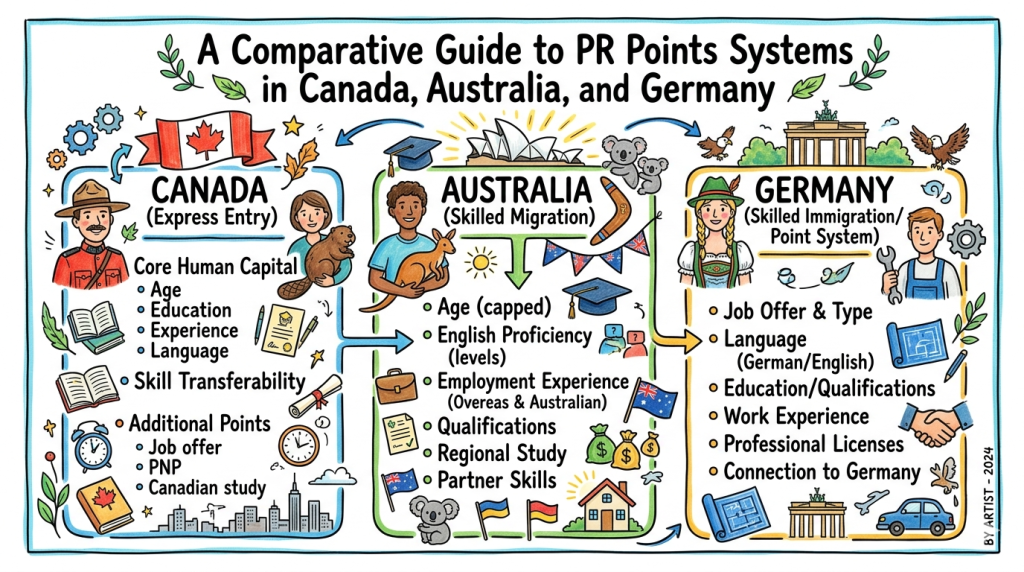
The CRS is out of 1,200 points. Most candidates focus on the “Core” 600 points, which are based on their own profile. The remaining 600 points are “Additional” points (like Provincial Nominations).
| Factor | Max Points (With Spouse) | Max Points (Without Spouse) |
| Age | 100 | 110 |
| Education | 140 | 150 |
| Language Proficiency | 150 | 160 |
| Canadian Work Experience | 70 | 80 |
| Total Core Points | 460 | 500 |
Provincial Nominee Programs (PNP)
If a Canadian province nominates you, you get 600 points automatically. This virtually guarantees you will receive an Invitation to Apply in the next draw.
Real-World Example: Meet Arjun
- Age: 29 (Max points)
- Education: Master’s Degree
- Language: IELTS 8.0 (CLB 9/10)
- Experience: 3 years as a Software Engineer
- CRS Score: Approximately 470–480.
- Outcome: Arjun is a strong candidate and likely to receive an ITA during a general draw.
Australia PR Points Calculator
Australia uses a points test for its General Skilled Migration (GSM) program. This primarily applies to Subclass 189, 190, and 491 visas.
The 65-Point Threshold
To even be considered, you must score at least 65 points. However, for competitive occupations like IT or Engineering, the actual invitation score often fluctuates between 85 and 100.
Points Table Overview
- Age (25-32): 30 points
- English (Superior): 20 points
- Work Exp (Outside Aus 8+ yrs): 15 points
- Education (Degree): 15 points
- Study in Regional Australia: 5 points
The SkillSelect System
You submit an Expression of Interest (EOI) through SkillSelect. The system ranks you against others, and the highest-ranked candidates are invited during “rounds.”
New Zealand PR Points Calculator
New Zealand’s Skilled Migrant Category (SMC) recently moved to a simplified 6-point system.
How the 6-Point System Works
Instead of the old 160-point scale, you now need 6 points from:
- Professional Registration, Qualifications, or Income: (3 to 6 points)
- Skilled Work Experience in NZ: (1 point per year, up to 3 points)
Note: You cannot combine points from professional registration and qualifications; you pick the one that gives you the most points.
The Green List
New Zealand also has a “Green List” of high-demand roles (like doctors and engineers) that offer a “Work to Residence” or “Straight to Residence” pathway, often bypassing the standard points struggle.
PR Systems in Other Countries
While Canada and Australia lead the pack, other nations are adopting similar “PR Points Calculator” logic to attract talent.
| Country | System Name | Focus |
| Germany | Opportunity Card (Chancenkarte) | Language (German), Age, Links to Germany |
| UK | Points-Based System | Job offer, Salary threshold, English skills |
| Japan | Highly Skilled Professional (HSP) | Academic background, Income, Research |
Benefits of Using a PR Points Calculator
Why should you use an online calculator early in the process?
- Instant Reality Check: It tells you immediately if you are eligible or if you need to work harder.
- Cost Savings: Don’t spend thousands on a lawyer or consultant only to find out your age or education level makes you ineligible.
- Strategic Planning: You can “play” with the numbers. “If I get a higher IELTS score, how much does my score jump?”
- Country Comparison: Maybe you don’t have enough points for Canada, but you are a perfect match for Australia.
Step-by-Step Guide to Calculate Your PR Points
Don’t guess your numbers. Follow this sequence for an accurate result:
Step 1: Gather Your Documents
You need your transcripts (to check your degree level) and your CV (to count exact months of work experience).
Step 2: Take a Mock Language Test
Your score depends heavily on your English/French level. Don’t assume you are “fluent.” Take a practice test to see where you sit on the IELTS or PTE scale.
Step 3: Get an ECA (If required)
For Canada, your degree isn’t “real” until an agency like WES or IQAS says it is. This can change your points significantly.
Step 4: Analyze Your Work History
Ensure your work falls under the correct NOC (National Occupational Classification) or ANZSCO code. If the job description doesn’t match your duties, those points might be rejected later.
Step 5: Add Spouse Factors
Calculate the score twice: once with your spouse as the main applicant, and once with you. Sometimes the “trailing” partner actually has a better profile for immigration!
How to Increase Your PR Score
If your score is currently too low to get an invitation, don’t lose hope. Most successful immigrants spend 6–12 months “boosting” their profile.
- Retake the Language Test: Moving from a CLB 8 to a CLB 9 in Canada’s system can result in a massive 20-30 point jump.
- Gain More Experience: Sometimes simply waiting another year at your current job gives you the “3-year” or “5-year” bonus points.
- Learn a Second Language: If you are heading to Canada, learning basic French can add significant “bonus points” that most applicants ignore.
- Target Provincial Nomination: Research provinces that need your specific skill set. A nomination is a “golden ticket.”
Common Mistakes to Avoid
- Overestimating Language Skills: Scoring a 7.0 when you needed an 8.0 can sink your application.
- Miscalculating Work Experience: Only post-qualification, paid, full-time work usually counts. Internships or part-time work during study often get zero points.
- Using Outdated Calculators: Immigration laws change monthly. Always use the official government tool or a verified, updated calculator.
- Ignoring the Expiry Date: Your language test and ECA have expiry dates (usually 2-5 years). If they expire while you are in the pool, your score drops to zero.
Real-Life Case Studies
Case Study 1: The Young Techie (Canada)
- Profile: Sarah, 24, Bachelor’s in CS, 1 year experience, IELTS 7.5.
- Initial Score: 430 (Too low for a draw).
- Improvement: Sarah worked for one more year and retook the IELTS, achieving an 8.5.
- Final Result: Score jumped to 485. Received ITA in 3 months.
Case Study 2: The Experienced Couple (Australia)
- Profile: David (38) and Elena (36). David is a Civil Engineer.
- Weakness: David’s age was losing him points.
- Improvement: Elena (a Teacher) took a skills assessment and a high-level English test.
- Final Result: Elena’s partner points pushed their total to 90, securing a Subclass 190 nomination.
Case Study 3: The Healthcare Worker (New Zealand)
- Profile: Amit, Nurse with 4 years experience.
- Initial Score: Struggling with the old point system.
- Improvement: Applied under the new Straight to Residence Green List pathway.
- Final Result: Points became irrelevant because his role was “Tier 1.” PR granted in record time.
Frequently Asked Questions (FAQs)
1. What is a PR points calculator?
It is a tool used by immigration departments to evaluate and rank your profile based on age, education, and skills.
2. What is a “good” CRS score for Canada?
While it changes with every draw, a score above 480–500 is generally considered very competitive in the current market.
3. Which country is easiest for PR based on points?
It depends on your profile. Canada is great for those with Master’s degrees, while Australia is excellent for specific trade occupations (plumbers, carpenters, etc.).
4. Can I apply if I don’t have enough points?
You can enter the pool if you meet the minimum eligibility, but you won’t get an invitation until your score reaches the “cut-off.”
5. How accurate are online calculators?
They are great for estimates, but the final word always belongs to the official government officer reviewing your documents.
6. Does age affect my PR eligibility?
Yes. Most systems favor people between 20 and 35. After 40, points usually decrease every year.
7. Can I add points for my brother or sister living in Canada?
Yes, having a sibling who is a PR or citizen in Canada can add 15 points to your CRS score.
8. Do I need a job offer to get PR?
Not always. Many people get PR through Express Entry (Canada) or Subclass 189 (Australia) without a job offer.
9. How long is my points score valid?
Your profile usually stays active in the system for 12 months. If you aren’t invited by then, you must re-submit.
10. What is an ECA?
An Educational Credential Assessment. It proves your degree from your home country is equal to a degree in the country you are moving to.
11. Can I update my score after submitting?
Yes! If you get a better test score or a new degree, you can update your profile, and your points will automatically increase.
12. Is IELTS the only test I can take?
No, most countries also accept PTE Academic or CELPIP, and French tests like TEF/TCF.
Conclusion
Understanding the PR Points Calculator is the difference between a successful move and a rejected application. These systems are designed to be fair, but they are also strict. By knowing exactly where you stand today, you can make a plan to be where you want to be tomorrow.
Don’t wait for the rules to change. Start gathering your documents, practice for your language tests, and use an eligibility calculator to see your path clearly. Your future self will thank you for the preparation you do today