Introduction
While commercial hill resorts and overcrowded coastal stretches often leave travelers exhausted by long transit queues, the rural countryside surrounding Kolkata preserves quiet, untouched historical chapters. Just an hour or two outside the city limits, modern highways dissolve into palm-fringed lanes, winding riverfronts, and sleepy hamlets rich in art and antiquity. Stepping into these quiet corridors allows you to engage directly with master weavers, riverboat crews, and ancient terracotta craftsmen whose lineages have endured for generations. It is a rare chance to swap noisy holiday crowds for profound cultural immersion, authentic regional flavors, and timeless rustic peace.
Why Kolkata is a must-visit city
Kolkata is not merely an urban epicenter; it serves as the ultimate springboard to an astonishing variety of historical, literary, and rural delta circuits. Anchored along the sacred Hooghly River, this regional cradle nurtured multiple European settlements, indigenous medieval dynasties, and the Bengal Renaissance. Its dense railway terminals at Howrah and Sealdah, combined with arterial four-lane expressways like NH 16 and NH 19, make regional day-tripping accessible for budget backpackers, weekend road-trippers, and family explorers alike.
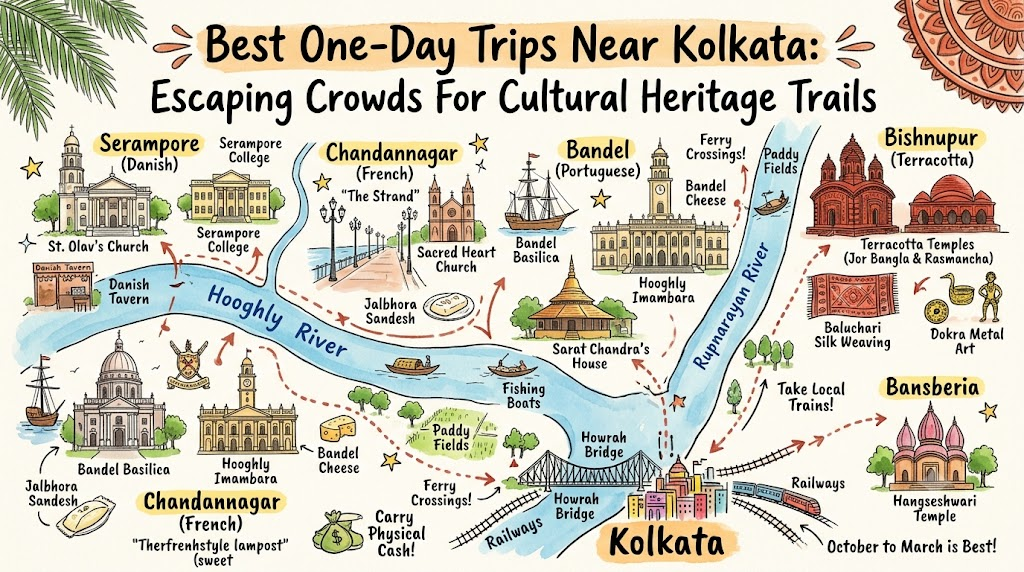
The immediate travel perimeter unfolds across diverse distinct corridors: the historic European Trading Posts along the Hooghly River basin (Portuguese Bandel, French Chandannagar, and Danish Serampore), the literary riverside sanctuary of Howrah’s countryside, and the red-soil terracotta kingdoms of the west.
| Circuit Dimension | Details & Metrics |
|---|---|
| Core Geographic Zone | Lower Gangetic Plains & Rarh Bengal Borderlands |
| Average Driving Radius | 35 km to 145 km from City Center |
| Best Travel Season | October through March (Misty mornings and pleasant afternoons) |
| Key Transport Terminals | Howrah Junction, Sealdah Station, Santragachi, Shalimar |
| Primary Highway Arteries | NH 16 (Kona Expressway / Mumbai Road), NH 19 (Durgapur Expressway), Grand Trunk Road |
Best Places or Experiences
Chandannagar French Riverside Strand
Chandannagar, formerly known as Chandernagore, was an autonomous French trading post until 1950, maintaining an identity completely distinct from British Calcutta. Walking along its breezy riverfront promenade, called The Strand, reveals majestic colonial edifices, wrought-iron lampposts, and leafy banyan trees looking out over the Hooghly River. The crown architectural jewel of this enclave is the Sacred Heart Church, inaugurated in 1884 with twin spires, imported French stained glass, and peaceful marble courtyards.
Beyond its European architecture, Chandannagar retains a distinctive, slow-paced café culture and an unhurried community life. Local residents gather on park benches along the river embankment at dusk, watching wooden country boats drift silently through twilight waters. The adjoining Dupleix Museum houses preserved treaty documents, French furniture, and Anglo-French war artifacts that tell the story of two centuries of colonial ambition.
The historic riverfront Strand at Chandannagar.
- Location: Hooghly District, approximately 45 km north of Kolkata. Holidify
- Why it is worth visiting: The only preserved French colonial riverfront promenade in Eastern India, blending French architecture with river views. Kolkata
- Best things to do: Walk along the paved Strand promenade, tour the Sacred Heart Church, and explore historical exhibits at the Dupleix Institute. Kolkata
- Best time to visit: Late afternoon (3:30 PM to 6:30 PM) for comfortable walking weather and sunset river reflections.
- Ideal for whom: Architecture enthusiasts, couples seeking peaceful waterfront walks, and solo heritage travelers. Kolkata
- Travel tip: The museum inside the Dupleix Complex remains strictly closed on Thursdays and Saturdays; schedule your trip accordingly.
Bandel Basilica and Historic Imambara
Bandel holds an important place in Bengal’s maritime trade history, serving as one of the earliest Portuguese colonies established in the late sixteenth century. The Basilica of the Holy Rosary, originally founded in 1599 and rebuilt after Mughal sieges, stands as the oldest Christian church in West Bengal. Inside its fortified brick walls, a restored ship mast gifted by a grateful captain after surviving a Bay of Bengal storm stands in the central courtyard as a testament to historical seafaring.
A short rickshaw ride downriver brings you to the grand Hooghly Imambara, built in the nineteenth century by philanthropist Haji Mohammad Mohsin. This Shia pilgrimage center features a soaring central clock tower with twin eighty-five-foot minarets and a sunlit courtyard facing the water. Climbing the circular stone stairs of the minarets rewards you with breathtaking panoramic views of the river bend and lush rural plains
..
The 16th-century Bandel Church.
- Location: Hooghly District, roughly 50 km north of Kolkata.
- Why it is worth visiting: Exceptional architectural convergence of early Portuguese maritime Catholicism and grand Islamic clock tower design.
- Best things to do: Climb the historic Imambara minarets, see the preserved ship’s mast in the church courtyard, and take a country boat across the river.
- Best time to visit: Early morning (8:00 AM to 11:00 AM) to climb the towers before midday heat sets in.
- Ideal for whom: History buffs, cultural photographers, and multifaith pilgrimage travelers.
- Travel tip: Wear slip-on shoes since footwear must be removed before entering the inner halls of the Imambara.
Serampore Danish Royal Settlement
Serampore, known as Frederiksnagore from 1755 to 1845 under the Danish crown, was a bustling hub of commerce, higher education, and printing technology. Recent restoration projects led by the National Museum of Denmark have revitalized its colonial quarter. The stately Government House, the Danish Tavern along the river, and the neoclassical St. Olav’s Church stand as architectural landmarks of Scandinavian influence in Bengal.
Serampore College, founded in 1818 by English Baptist missionary William Carey, features grand Ionian portico pillars and houses the country’s oldest operational hand-press printing relics. Strolling down the quiet riverfront reveals ancient banyan trees shading old brick warehouses, capturing the spirit of the early nineteenth-century print revolution.
Restored Danish architecture at Serampore.
- Location: Hooghly District, 28 km north of central Kolkata along Grand Trunk Road.
- Why it is worth visiting: India’s best-preserved Danish trading settlement, featuring carefully restored eighteenth-century Scandinavian landmarks.
- Best things to do: Photograph the spire of St. Olav’s Church, inspect antique printing presses at Serampore College, and dine at the historic Danish Tavern.
- Best time to visit: 10:00 AM to 3:00 PM when church gates and heritage museums are open to visitors.
- Ideal for whom: Bibliophiles, academic historians, and heritage conservation followers.
- Travel tip: St. Olav’s Church is an active place of worship; enter quietly and dress modestly with covered shoulders and knees.
Deulti and Samtaber Literary Retreat
Tucked away in the quiet rural interior of Howrah along the banks of the Rupnarayan River lies Deulti, a peaceful village of bamboo groves and lotus ponds. The hamlet is famous as the home of Samtaber, where celebrated Bengali novelist Sarat Chandra Chattopadhyay lived and wrote classics like Devdas, Palli Samaj, and Srikanta. His preserved two-story, Burmese-pagoda-style mud-and-timber residence sits peacefully inside a manicured garden.
The atmosphere here is marked by rural calm. Strolling along the river embankment reveals local fishermen casting nets into the muddy Rupnarayan currents as golden hour settles across paddy fields. It is a restful escape from city noise, filled with fresh country air and birdsong.
.
Author Sarat Chandra Chattopadhyay’s house at Samtaber.
- Location: Howrah District, approximately 60 km southwest of Kolkata via NH 16.
- Why it is worth visiting: An authentic rural literary heritage site offering a glimpse into the pastoral world that inspired classic Bengali novels.
- Best things to do: Tour Sarat Chandra’s preserved study and garden, walk the rural paths of Samtaber, and watch the sunset over the Rupnarayan River.
- Best time to visit: November through February, when morning mist blankets the countryside and walking is pleasant.
- Ideal for whom: Literature enthusiasts, solo writers, and families wanting a peaceful village picnic.
- Travel tip: Bring mosquito repellent and sunscreen, as shaded village paths and wetlands have active insects in the late afternoon.
Bishnupur Terracotta Temple Circuit
Rising above the laterite red earth of Bankura, Bishnupur was the fortified capital of the Malla kings from the seventeenth to eighteenth centuries. Because local stone was scarce, Malla artisans engineered a distinct temple style using baked mud and terracotta tiles. Complexes like the pyramidal Rasmancha, the twin-roofed Jor Bangla, and the intricately carved Madan Mohan temple tell stories from the Ramayana, Mahabharata, and Krishna legends on their clay facades.
Beyond its architecture, Bishnupur remains a living center of traditional crafts. The rhythmic clatter of handlooms echoes through family workshops where artisans craft Baluchari silk sarees with woven epic scenes. Local potters shape the iconic Bankura terracotta horses, and metalworkers preserve ancient lost-wax brass casting (dokra) in nearby hamlets.
Jor Bangla terracotta temple in Bishnupur.
- Location: Bankura District, roughly 140 km northwest of Kolkata.
- Why it is worth visiting: An exceptional concentration of seventeenth-century terracotta architecture and UNESCO-tentative temple complexes. GetYourGuide
- Best things to do: Marvel at the detailed carvings of Jor Bangla, watch master weavers spin Baluchari silk on drawlooms, and shop for genuine dokra metal art. Kolkata
- Best time to visit: Early morning or late winter afternoon, when warm sunlight highlights the red terracotta reliefs.
- Ideal for whom: Art collectors, architectural scholars, textile lovers, and road-trippers. Kolkata
- Travel tip: Buy an official Archaeological Survey of India (ASI) composite entry ticket at Rasmancha to access all protected monuments without re-queuing.
Offbeat Exploration: Hidden Gems Tourists Miss
Bansberia Ananta Basudeba and Hangseshwari Temples
Just ten kilometers north of Bandel sits the temple compound of Bansberia. While most visitors skip it for popular river ghats, it features two extraordinary architectural styles right next to each other. The 1679 Ananta Basudeba temple displays traditional terracotta reliefs depicting Vaishnavite battles, while the adjacent Hangseshwari temple, finished in 1814, features thirteen distinctive lotus-bud spires designed after human kundalini chakras.
Sabarna Sangrahashala at Barisha
Located on Kolkata’s southwestern edge, this community museum maintained by the historic Sabarna Roy Choudhury family tells the story of the land lease that laid the foundation for modern Kolkata in 1698. The private collection holds ancestral land deeds, medieval brass utensils, handwritten rare manuscripts, and genealogies dating back over four centuries.
Gadiara Confluence at Daybreak
At the meeting point of the Hooghly, Damodar, and Rupnarayan rivers lies Gadiara, a serene coastal-style river estuary. While daytime crowds visit for picnics, arriving at dawn allows you to watch local fishermen paddle wooden dinghies across vast misty waters, set against the ruins of the historic British-era Fort Mornington.
Detailed Practical Guidance for Travelers
| Destination | Standard Entry Fee | General Timings | Best Local Food Options Nearby | Recommended Nearby Attractions |
|---|---|---|---|---|
| Chandannagar Strand | Free (Museum: ₹20) | 24 Hours (Museum: 11 AM – 5 PM) | Red Cow Jalbhora Sandesh, French pastry at local bakeries | Sacred Heart Church, Patal Bari |
| Bandel Church & Imambara | Church: Free; Imambara: ₹20 | 8:00 AM – 5:30 PM | Bandel cheese cutlets, traditional Bengali fish thali | Hanseswari Temple, Zafar Khan Ghazi Dargah |
| Serampore Heritage Zone | Free (College Museum: Free) | 9:30 AM – 5:00 PM (Closed Sundays) | Traditional Anglo-Indian curry, colonial roast lunch at Danish Tavern | St. Olav’s Church, Baptist Mission Cemetery |
| Deulti & Samtaber | Free (House grounds: ₹10) | 9:00 AM – 5:30 PM | Steaming Hilsa / Rui fish curry and fresh sweet curd | Kolaghat riverfront, Rupnarayan mud flats |
| Bishnupur Temples | ₹25 (ASI composite for Indian citizens; ₹300 for foreigners) | 6:00 AM – 6:00 PM | Mecha sandesh, Postor Bora (poppy seed fritters) | Dalmadal Cannon, Baluchari weaving colonies |
Logistics & On-Ground Navigation
Local Transport Options
- Suburban Railway Network: Local trains run frequently from Howrah Station to Bandel, Chandannagar, and Serampore on the Main Line, taking 35 to 55 minutes at nominal fares. For Bishnupur, morning express trains like the Rupashi Bangla Express provide a convenient rail connection. Kolkata+ 1
- Toto (Battery E-Rickshaws): Clean, silent e-rickshaws wait outside suburban stations like Chandannagar and Deulti, offering inexpensive local rides across narrow heritage lanes.
- Country Ferry Boats: Frequent passenger ferries connect the eastern and western banks of the Hooghly between Serampore, Barrackpore, Chandannagar, and Jagatdal, letting you cross the water in minutes.
- Car Rentals & Self-Drive: Renting an air-conditioned cab for twelve hours is ideal for multi-stop circuits along the Grand Trunk Road or the long drive out to Bishnupur.
Budget Planning
- Backpacker / Solo Rail Explorer Tier: Expect to spend ₹450 to ₹900 per day. This covers round-trip local train tickets, shared e-rickshaw fares, local street-food lunches, and entry tickets for protected monuments. Kolkata
- Mid-Range Private Car Tier: Expect to spend ₹3,500 to ₹6,500 per day. This budget includes a dedicated air-conditioned rental car with fuel, highway tolls, a guide at key temple complexes, and a full sit-down lunch at a heritage hotel.
Safety and Inclusivity Tips
- For Families: The wide walkways along Chandannagar Strand and the open lawns of Serampore College make safe, stress-free walking zones for children and elders. Kolkata
- For Couples: Riverside paths and quiet literary spots like Deulti offer pleasant scenery; stay along main promenades and head back toward transit hubs before dark.
- General Safety: Rural Bengal is welcoming and safe for visitors. Keep small cash bills handy for rural crossings, and watch your step on older stone staircases that may become slippery during monsoon months.
Strategic Travel Planning Guardrails
Travel Planning Tips for Day Excursions
- Head out of Kolkata by 6:30 AM to clear city traffic choke points around the Vidyasagar Setu or Howrah Bridge ramps.
- Always carry ₹500 to ₹1,000 in physical cash; rural e-rickshaws, ferry crossings, and small sweet shops rarely take credit cards or digital UPI payments.
- Check local museum calendars beforehand, as many institutions shut their doors on Mondays, Thursdays, or national holidays.
- Wear breathable cotton clothes, sunglasses, and a wide-brimmed sun hat, even during mild winter afternoons.
- Sample local sweets at each town; every destination has its own culinary specialty, like Jalbhora in Chandannagar or Mecha Sandesh in Bishnupur.
Common Mistakes to Avoid
- Attempting to combine Bishnupur with the Hooghly European river circuit on the same day; they lie in completely different directions.
- Relying exclusively on mobile payment apps in deep rural pockets where mobile networks can drop out.
- Rushing your visits to catch trains; suburban local services run regularly every twenty to thirty minutes along main lines. Kolkata
- Skipping local sweet shops in favor of highway chain restaurants.
- Forgetting to arrange return transportation with local e-rickshaw drivers when visiting remote sites like Samtaber.
Suggested Itinerary Blueprints
1. Day Quick Dash (Little Europe River Corridor)
- Target Audience: Time-sensitive travelers, history lovers, and photographers. Kolkata
- Route: Board a morning local train from Howrah to Serampore. Tour St. Olav’s Church and the Danish Tavern, take an e-rickshaw north to Chandannagar to stroll the Strand and visit Sacred Heart Church, then cross by ferry to Barrackpore before taking a train back to Kolkata by early evening. Kolkata+ 1
2. Day Deep-Dive (Crafts, Clay, and Red Earth Trail)
- Day 1: Drive or take the morning express to Bishnupur. Spend the day exploring the Rasmancha, Jor Bangla, and Madan Mohan temples, then visit local weavers to learn how Baluchari silk sarees are woven on drawlooms. Kolkata+ 1
- Day 2: Visit the nearby metalworking village of Bikna to see traditional dokra brass casting, explore the historic Malla royal gateway, and return to Kolkata by dusk via NH 19.
3. Complete Weekend Travel Plan (Rupnarayan River Loop)
- Friday Afternoon: Drive out to the riverside town of Raichak or Diamond Harbour; check into a waterfront resort and watch ships glide down the Hooghly River.
- Saturday: Take a country boat trip to the river confluence at Gadiara; drive north along village roads to explore Sarat Chandra’s home at Samtaber in Deulti. LBB
- Sunday: Enjoy an early morning village walk through Deulti’s farms, stop by Kolaghat for a traditional fresh Hilsa fish lunch, and drive back to Kolkata over the Kona Expressway before Sunday evening traffic builds up.
Common Tourist Mistakes to Avoid
Geographic Blunders
A frequent mistake made by visitors is trying to cross opposite ends of the city on the same day. For example, scheduling a morning visit to the Hooghly River settlements in the north and then heading to rural South 24 Parganas leaves you stuck in cross-city bottlenecks for hours. Stick to one designated travel corridor per trip.
Commercial Traps
Spending day trips inside highway dining plazas or newly built suburban malls misses the point of rural Bengal travel. Skip generic fast-food stops and seek out century-old sweet shops, family-run roadside eateries, and traditional market stands for authentic regional dishes.
Neglecting Modern/Alternative Zones
Many travelers assume historical day trips are only about crumbling stone monuments and forgotten ruins. In reality, neighborhoods like Chandannagar and Serampore host vibrant artisan bakeries, restored colonial riverside hotels, and community cultural centers that highlight the living culture of the region.
Transport Overpayment
Unregulated auto-rickshaws outside major suburban rail hubs often quote inflated rates to arriving tourists. Always confirm regular shared fares with station staff first, cross-check routes on map applications, or hire battery e-rickshaws on a fixed hourly basis.
Luxury Dining Bias
Bypassing local street-side vendors means missing the culinary essence of Bengal. Authentic local items like Bandel cheese slices, freshly steamed fish cutlets, kachoris served in sal-leaf bowls, and clay-pot tea are found at humble roadside stalls rather than high-end dining rooms.
Frequently Asked Questions
1. What is the most convenient way to reach the European settlement trail from Kolkata?
The most practical option is taking a local train from Howrah Station along the main line to Serampore or Chandannagar, which takes forty-five minutes and avoids road bottlenecks. If traveling with family, hiring an air-conditioned cab via Grand Trunk Road or Delhi Highway allows flexible travel between multiple riverside towns in a single afternoon.
2. Can Bishnupur be comfortably covered within a single day trip?
Yes, you can do it in a day by boarding the morning Rupashi Bangla Express from Howrah at 6:00 AM, arriving in Bishnupur by 9:30 AM. You then have six hours to tour the main terracotta temples and silk workshops by auto-rickshaw before catching the late afternoon express train back to Kolkata.
3. Are foreign travelers required to carry special permits for day trips near Kolkata?
Most destinations in Hooghly, Howrah, and Bankura districts do not require special inland permits for foreign passport holders. However, you should carry original passports and valid visa photocopies, which are needed when buying Archaeological Survey of India (ASI) tickets or booking day rooms at hotels.
4. What unique regional food items should I look for in Chandannagar?
You should try the original Jalbhora Talsash Sandesh from local confectioners like Surya Kumar Modak, who invented this syrup-filled cottage cheese delicacy in the nineteenth century. Along the Strand, you will also find French-inspired bakery items, fish rolls, and fresh ice cream served late into the evening.
5. How accessible are the Hooghly Imambara and its towers for senior citizens?
The expansive brick courtyard, sunlit river terraces, and ground-floor prayer halls of the Imambara are flat and accessible for elderly visitors. However, climbing the twin eighty-five-foot minaret towers requires walking up steep, narrow circular stone staircases without handrails, which is not recommended for seniors or anyone with mobility limitations.
6. Is photography permitted inside the Bishnupur terracotta temple compounds?
Still photography for personal use is permitted across all ASI-protected monuments, including Rasmancha, Jor Bangla, and Shyam Rai temples. Using professional camera tripods, drone rigs, or commercial film equipment requires advance written permission and fee clearance from the Archaeological Survey of India.
7. What is the best local transport mode for moving around Deulti village?
Battery-powered e-rickshaws, locally known as Totos, are the easiest and most practical way to travel from Deulti railway station to Samtaber. You can reserve a driver for round-trip transit to wait outside the Sarat Chandra Kuthi while you explore the village paths and river embankment.
8. Are credit cards and mobile digital payments widely accepted on day excursions?
While large restaurants and established hotels along national highways accept major credit cards and digital UPI apps, cash remains essential for daily expenses. You will need small paper currency for local ferry crossings, e-rickshaws, ASI ticket counters, and roadside tea stalls.
9. Can you take private boat cruises along the Hooghly River near Bandel?
Yes, licensed wooden motorboats can be hired at the main ferry ghats near Bandel Church and the Imambara. Always negotiate and fix the price directly with the boat operator before stepping on board, and ensure proper life jackets are available on the vessel.
10. What should travelers pack for a winter day trip outside Kolkata?
Bring a light jacket or wool shawl for misty mornings, comfortable walking shoes for temple complexes, a reusable water bottle, sun protection, and insect repellent for late-afternoon village strolls. Carrying wet wipes and hand sanitizer is also helpful after touching old masonry or eating at local stalls.
11. Is it safe for solo female travelers to take local trains to suburban day destinations?
Yes, suburban local trains out of Howrah and Sealdah are regular, heavily patronized, and include dedicated women-only coaches (marked in green and yellow). Stick to busy daylight hours between 8:00 AM and 6:00 PM, and keep your phone charged with offline maps downloaded for your route.
12. Why is Bandel cheese unique, and where can travelers buy it?
Bandel cheese is an artisanal, dry-cured salted cheese originally introduced to Bengal by Portuguese settlers centuries ago. Available in both plain and smoked varieties, it has an earthy, salty profile used in salads and pastas, and can be purchased from small dairy stalls near the church gates.
Conclusion
Stepping beyond the bustling city limits of Kolkata reveals a rewarding landscape of rich heritage, traditional craft, and peaceful waterways. Whether tracing old European settlements along the Hooghly riverbanks, standing before ancient terracotta temples in Bankura, or enjoying a quiet village sunset by the Rupnarayan River, these excursions connect you with the enduring spirit of Bengal. Taking these road and rail trips trades noisy holiday crowds for thoughtful cultural discovery, timeless craftsmanship, and memories that linger long after you return home.