Introduction
While most mainstream holiday hubs trap visitors inside gridlocked taxi lines and commercial tourist corridors, Kolkata unlocks its authentic soul underground. India’s first operational rapid transit network is far more than a practical utility; it is a living subterranean museum pulsing with the daily rhythms of eastern India. Riding these rails bridges the gap between old-world colonial charm and futuristic engineering, offering an immersive cultural connection that generic sightseeing buses simply cannot match.
Why Kolkata is a must-visit city
Kolkata represents a magnificent convergence of intellectual revolutions, literary triumphs, and grand architectural heritage spanning over three centuries. Geographically anchored beside the sacred Hooghly River, it serves as the cultural gateway to Eastern India, seamlessly linked by Netaji Subhas Chandra Bose International Airport, Howrah and Sealdah railway stations, and arterial highway corridors. For cultural wanderers, budget backpackers, and luxury explorers alike, the metropolis delivers timeless hospitality paired with world-class transit efficiency.
The city’s transit network weaves northern temple towns, grand central colonial boulevards, quiet literary lanes, and dynamic modern IT tech hubs into a seamless travel loop.
| Metric | Details |
| Pioneering Milestone | India’s First Operational Metro Network (Inaugurated 1984) |
| Engineering Wonder | Country’s First Underwater Metro River Tunnel (Green Line) |
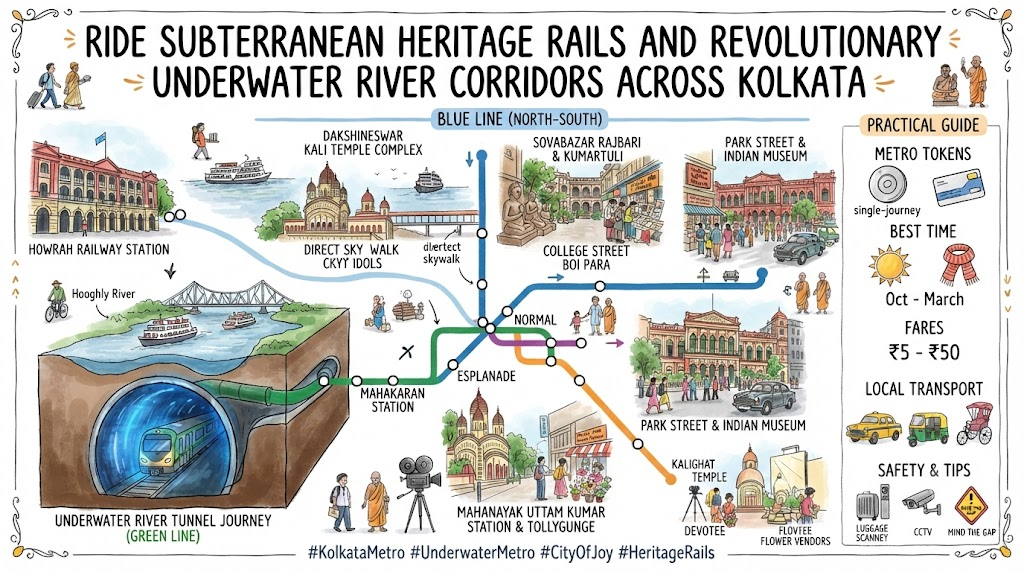
| Operational Lifelines | Blue Line (North-South), Green Line (East-West), Purple & Orange Lines |
| Standard Fare Bracket | ₹5 to ₹50 (Unmatched affordability across urban transit) |
| Ideal Exploration Window | October to March (Pleasant weather and vibrant festivals) |
Best Places to Visit in Kolkata at Night
Underwater River Tunnel Journey (Green Line – Howrah to Esplanade)
The underwater stretch of Kolkata’s Green Line represents an astonishing feat of civil engineering, burrowing deep beneath the mighty Hooghly River. Connecting the heritage railway terminal at Howrah to the central transit hub at Esplanade, this sub-river crossing plunges commuters dozens of meters beneath the riverbed. Gliding inside air-conditioned rakes through the illuminated tunnel offers a surreal contrast to the frantic ferry traffic paddling overhead.
As the train enters the underwater sector, special blue LED illumination washes over the tunnel walls, signaling your passage beneath the historic river. In under a minute, travelers move effortlessly between twin sister cities, dodging the legendary surface traffic of the bridges above.
- Location: Central transit corridor connecting Howrah Station to Esplanade (approx. 0 km from Howrah hub).
- Why it is worth visiting: India’s first underwater metro crossing, combining groundbreaking engineering with rapid city transit.
- Best things to do: Spot the illuminated blue tunnel markers, explore the deep multi-level Howrah Metro Station, and ride between riverbanks in under a minute.
- Best time to visit: 11:00 AM to 4:00 PM on weekdays to avoid morning and evening office crowds.
- Ideal for whom: Modern architecture admirers, transit buffs, and tech-curious families.
- Travel tip: Keep your phone ready before departing Howrah or Mahakaran to record the brief illuminated underwater sequence.
Dakshineswar Kali Temple Complex (Blue Line – Dakshineswar)
Standing majestically along the northern banks of the Hooghly River, the Dakshineswar Kali Temple is a monumental spiritual complex built in 1855 by the visionary philanthropist Rani Rashmoni. Designed in classical nine-spire Navaratna Bengali architectural style, the sanctuary grounds are intimately tied to the mystic legacy of 19th-century saint Ramakrishna Paramahamsa. The terminal station of the Blue Line drops visitors directly on a dedicated skywalk leading straight into the temple courtyard.
Stepping off the elevated platform reveals panoramic views of the riverbank, traditional bathing ghats, and the distant cantilever profile of Bally Bridge. The tranquil ambiance inside the sanctum provides a serene escape from the urban density of the central city.
- Location: Northern suburban periphery, approximately 14 km north of Esplanade.
- Why it is worth visiting: Iconic 19th-century temple architecture made instantly accessible via modern elevated metro rails and an integrated skywalk.
- Best things to do: Walk across the high-capacity Dakshineswar Skywalk, visit the twelve riverside Shiva shrines, and catch a quick ferry to Belur Math across the water.
- Best time to visit: Early mornings (6:30 AM to 8:30 AM) or late afternoons (4:30 PM to 6:30 PM).
- Ideal for whom: Spiritual pilgrims, photography lovers, and history researchers.
- Travel tip: Footwear and electronic devices must be deposited in dedicated lockers before entering the inner sanctum.
Park Street and Indian Museum Quarter (Blue Line – Park Street)
Serving as the cosmopolitan core of Kolkata, the Park Street Metro Station delivers passengers straight into a vibrant blend of colonial grandeur and lively culinary avenues. Just steps from the exit gates stands the grand colonnade of the Indian Museum, founded in 1814 as the oldest and largest multipurpose museum in the Asia-Pacific region. This historic precinct captures the intellectual elegance of 19th-century Calcutta alongside trendy, vibrant avenues.
Wandering along the boulevard reveals heritage tea rooms, historic bookshops, and grand neoclassical facades. By evening, warm streetlights illuminate the avenues, creating an inviting setting for open-air strolls and culinary exploration.
- Location: Jawaharlal Nehru Road, Central Kolkata (approx. 1 km south of Esplanade).
- Why it is worth visiting: Access the historic Italianate architecture of the Indian Museum and iconic dining spots right from the station exit.
- Best things to do: Explore the ancient Egyptian mummy gallery in the museum, walk down Park Street’s cafe strip, and browse vintage books at street corner stalls.
- Best time to visit: 10:30 AM to 5:00 PM for museum halls; 6:00 PM to 10:00 PM for street dining.
- Ideal for whom: Culinary explorers, cultural historians, and solo walkers.
- Travel tip: Park Street Station features side platforms; make sure to verify your directional stairwell before going down the turnstiles.
College Street Boi Para Heritage Circuit (Blue Line – Central or MG Road)
College Street, affectionately known among locals as Boi Para (Book Town), is the largest second-hand book market in the world and the intellectual nursery of the Bengal Renaissance. Flanked by the historic portals of Presidency University, Calcutta University, and Sanskrit College, this legendary district overflows with thousands of makeshift wooden bookstalls lining every sidewalk. Exiting at Central or MG Road stations drops travelers right into an ocean of literary treasures and quiet scholarly charm.
Tucked into this neighborhood is the legendary Indian Coffee House, where generations of poets, freedom fighters, and filmmakers have debated art and politics over steaming cups of black coffee. The scent of aging paper, roasting beans, and warm rain creates an unforgettable, nostalgic atmosphere.
- Location: College Street, North-Central Kolkata (approx. 2 km northeast of Esplanade).
- Why it is worth visiting: The world’s largest open-air secondhand book hub and the historic epicenter of Bengali intellectual life.
- Best things to do: Hunt for rare first-edition prints along roadside kiosks, drink black coffee at the Indian Coffee House, and admire the historic facade of Calcutta University.
- Best time to visit: 2:00 PM to 6:30 PM (markets are generally closed on Sundays).
- Ideal for whom: Bibliophiles, academic researchers, and vintage culture enthusiasts.
- Travel tip: Cash is essential here; independent bookstalls and the historic Coffee House rarely accept credit cards.
Kalighat Temple and South Kolkata Heritage (Blue Line – Kalighat)
Anchored in the southern sector of the city, Kalighat represents one of the 51 sacred Shakti Peethas and is the spiritual root from which the city’s modern name arose. Surrounding the 200-year-old temple complex is a maze of vibrant alleyways filled with flower vendors, brass artifact artisans, and traditional sweet makers. The nearby Kalighat Metro Station provides quick access to this historic pilgrimage neighborhood without needing to battle jammed roadways.
Beyond the temple walls, the surrounding lanes offer a look into classic South Kolkata residential life, complete with shuttered windows, high ceilings, and traditional red-oxide verandas. It offers a grounded, unvarnished look at local devotion and community culture.
- Location: Anami Sangha, Kalighat, South Kolkata (approx. 5 km south of Esplanade).
- Why it is worth visiting: One of the most sacred pilgrimage centers in Hinduism, set amidst a historic cultural neighborhood.
- Best things to do: Witness the morning temple aarti rituals, purchase handmade clay and brass souvenirs, and sample warm Sandesh from heritage sweet shops.
- Best time to visit: 6:00 AM to 9:00 AM to avoid peak afternoon temple crowds.
- Ideal for whom: Pilgrims, cultural anthropologists, and traditional architecture fans.
- Travel tip: Beware of aggressive touts (pandas) offering VIP entry tickets outside the gates; always enter through the official public queue.
Sovabazar Rajbari and Traditional North Kolkata (Blue Line – Sovabazar Sutanuti)
Exiting at Sovabazar Sutanuti station transports you straight into 18th-century Bengal, where the grand aristocratic mansions (rajbaris) of merchant princes still stand. The Sovabazar Rajbari, with its vast central colonnaded courtyard (thakur dalan), was the cradle of the iconic public Durga Puja celebrations pioneered by Raja Nabakrishna Deb in 1757. The surrounding labyrinth of cobblestone lanes is lined with historic mansions featuring classical Roman pillars and traditional green-slatted windows.
Walking through these historic alleys reveals quiet courtyards where generational families gather on stone verandas for evening conversations. The neighborhood captures a sense of old Calcutta that remains completely shielded from modern commercial trends.
- Location: Raja Nabakrishna Street, North Kolkata (approx. 4.5 km north of Esplanade).
- Why it is worth visiting: Pristine examples of 18th-century aristocratic residential architecture and heritage festival traditions.
- Best things to do: Photograph the neoclassical columns of the central courtyard, wander the historic residential alleys, and sample traditional sweets at nearby shops.
- Best time to visit: 3:30 PM to 6:30 PM for soft golden-hour lighting.
- Ideal for whom: Heritage photographers, historians, and architectural walk enthusiasts.
- Travel tip: The mansion courtyards are private properties; always ask courteously before snapping portraits of residents or interior rooms.
Offbeat Exploration: Hidden Gems Tourists Miss
Girish Park to Marble Palace Secret Walk
Just a short stroll from Girish Park Metro Station lies the neoclassical Marble Palace, tucked behind tall iron gates. Built in 1835, this private residence houses an astounding personal collection of Victorian sculptures, authentic Rubens paintings, and rare aviary species. Because free entry permits must be arranged in advance from the state tourism department, it remains beautifully secluded and peaceful.
Mahanayak Uttam Kumar Station (Tollygunge Studio District)
Named after the golden-age icon of Bengali cinema, this southern station opens directly onto the historic Tollygunge film studios. Wandering down these quiet side lanes reveals vintage movie poster art, technicians carrying vintage production props, and old tea stalls where classic cinema trivia still fuels animated local debate.
Central Station Printing Press Quarter (Bowbazar Lanes)
Few casual visitors venture into the narrow lanes surrounding Central Station, which harbor Kolkata’s century-old letterpress printing shops, traditional jewelry artisans, and woodblock craftsmen. The rhythmic clatter of vintage mechanical presses and the aroma of industrial ink offer a nostalgic journey into the city’s manufacturing past.
Detailed Practical Guidance for Travelers
| Destination | Standard Entry Fee | General Timings | Best Local Food Options Nearby | Recommended Nearby Attractions |
| Underwater Tunnel | ₹10 – ₹20 (Metro Token) | 07:00 AM – 09:45 PM | Howrah Station Food Plazas, Esplanade Street Carts | Howrah Bridge, Millennium Park |
| Dakshineswar Temple | Free | 06:00 AM – 12:30 PM, 03:00 PM – 08:30 PM | Kachori-Sabzi stalls, Mishti shops on skywalk | Belur Math (via ferry), Bally Bridge |
| Indian Museum | ₹50 (Indian), ₹500 (Foreigner) | 10:00 AM – 06:00 PM (Closed Mondays) | Peter Cat, Flurys, Nizam’s Kathi Rolls | St. Paul’s Cathedral, Victoria Memorial |
| College Street | Free | 10:00 AM – 07:30 PM (Closed Sundays) | Indian Coffee House, Paramount Sherbets | Presidency University, Marble Palace |
| Kalighat Temple | Free | 05:00 AM – 02:00 PM, 05:00 PM – 10:30 PM | Traditional Bengali Sweets, Radha Ballabhi | Kalighat Ghat, Lake Market |
| Sovabazar Rajbari | Free (Courtyard viewing) | 08:00 AM – 07:00 PM | Mitra Cafe (Fish Kabiraji), Chittaranjan Mistanna | Kumartuli Potters Colony, Bagbazar Ghat |
Logistics & On-Ground Navigation
Local Transport Options
- Kolkata Metro: The fastest, air-conditioned spine running across the city; purchase contact-free smart tokens or reloadable transit cards at ticketing counters.
- Yellow Taxis & App Cabs: Abundantly available outside metro station gates for quick last-mile connections to residential quarters.
- Shared Auto-Rickshaws: Economical fixed-route transit options departing from designated bays right outside suburban stations.
- Cross-River Wooden Ferries: Available from nearby river stations like Dakshineswar and Sovabazar to cross the Hooghly for just ₹6 to ₹10.
Budget Planning
- Backpacker & Student Tier (₹800 – ₹1,500 / day): Rely exclusively on Metro transit and river ferries (transit under ₹80/day), stay in central hostels, and enjoy delicious street-level rolls and kachoris.
- Mid-Range Comfort Tier (₹3,500 – ₹6,500 / day): Stay in heritage boutique guesthouses, use metro lines for longer journeys paired with app-cabs for last-mile transfers, and dine at iconic restaurants.
Safety and Inclusivity Tips
- Families: Kolkata Metro stations offer high security, luggage scanners, and well-lit platforms; avoid boarding during peak rush hours (9:00–11:00 AM and 5:30–8:00 PM) when traveling with small children.
- Couples: Metro premises and trains are monitored by extensive CCTV coverage; comfortable seating is available across all rakes.
- General Safety: Kolkata is ranked among the safest metropolitan cities in India; keep personal belongings and mobile devices zipped securely inside backpacks during crowded rush hours.
Strategic Travel Planning Guardrails
Travel Planning Tips for Kolkata Metro
- Purchase a reusable Kolkata Metro Smart Card at station counters if staying for more than two days; it saves significant time waiting in token queues.
- Carry small paper currency (₹10, ₹20, ₹50 notes) for ticket vending machines and nearby street tea stalls.
- Remember that Sunday metro services begin considerably later (usually around 9:00 AM on the Blue Line and 2:00 PM on the Green Line).
- Download an offline schematic map of the metro system on your phone to easily identify interchange points like Esplanade.
- Wear comfortable footwear suitable for climbing station stairwells, as escalators can occasionally experience maintenance downtime.
Common Mistakes to Avoid
- Attempting to travel during weekday office rush hours (8:45 AM – 10:30 AM and 5:30 PM – 7:30 PM) with heavy luggage.
- Discarding your single-journey plastic token before reaching the destination exit gate, as it is needed to open the turnstile.
- Photography without proper authorization inside platforms and track areas, which can attract warnings or fines from transit police.
- Assuming the Green Line and Blue Line connect directly at all points; Esplanade is the primary interchange station.
- Skipping local station kiosks that serve fresh tea and snacks right outside the entrance gates.
Suggested Itinerary Blueprints
1. Day Quick Dash (Underground Wonders & Heritage)
- Target Group: Day-trippers, business travelers, and rapid transit enthusiasts.
- Route: Board the Green Line at Howrah to experience the underwater tunnel to Esplanade; switch to the Blue Line heading north to Dakshineswar for lunch and temple views; return south to Park Street for evening dining.
2. Day Deep-Dive (North-South Cultural Exploration)
- Day 1: Explore North Kolkata heritage starting at Sovabazar Sutanuti, browse bookstalls at College Street via Central Station, and enjoy dinner near Park Street.
- Day 2: Begin early at Dakshineswar Temple, cross by ferry to Belur Math, take the Green Line underwater metro to Howrah, and spend the evening enjoying street food around Esplanade.
3. Complete Weekend Travel Plan (Grand Kolkata Metro Loop)
- Friday Evening: Arrive at Howrah Station, experience the underwater Green Line tunnel to Esplanade, check into your hotel, and dine along Park Street.
- Saturday: Explore the historic halls of the Indian Museum, take the Blue Line north to Sovabazar and Kumartuli, and wrap up with an authentic dinner at Mitra Cafe.
- Sunday: Visit Kalighat Temple early via the southern Blue Line, explore the serene cafes near Rabindra Sarobar, and complete your tour browsing rare books on College Street.
Common Tourist Mistakes to Avoid
Geographic Blunders
Attempting to combine far-northern Dakshineswar with far-southern Jadavpur or Behala on the same afternoon creates unnecessary travel fatigue. Group your itinerary strictly into distinct North, Central, and South metro clusters.
Commercial Traps
Spending your limited vacation time inside modern shopping malls deprives you of experiencing authentic heritage neighborhoods located right outside historic metro stations.
Neglecting Modern/Alternative Zones
Overlooking the newly expanded elevated metro branches prevents travelers from discovering modern cultural parks, ecological centers, and vibrant suburban cafe districts.
Transport Overpayment
Relying exclusively on private cabs stuck in congested street traffic wastes both time and money when the metro offers parallel routes for just ₹10 to ₹20.
Luxury Dining Bias
Eating only at high-end hotel restaurants prevents travelers from savoring world-famous street snacks like Kathi rolls, hot samosas, and traditional sweets right outside station exits.
Frequently Asked Questions
1. Which Kolkata Metro station connects to the underwater river tunnel?
The underwater tunnel operates on the East-West Green Line directly connecting Howrah Metro Station and Mahakaran Station beneath the Hooghly River. Travelers can easily board this line from Howrah Railway Station or interchange from the North-South Blue Line at Esplanade.
2. How much does a standard Kolkata Metro token cost for tourists?
Standard one-way fares on the Kolkata Metro range from ₹5 for short distances up to ₹50 for the longest routes across the network. Single-journey plastic tokens or paper QR tickets can be purchased directly at automated vending machines or ticket counters inside any station.
3. What are the operating hours of the Kolkata Metro on weekdays?
On standard weekdays, train services generally start operating at 06:50 AM and run until approximately 09:40 PM across primary lines. Timings can vary slightly between suburban extensions, so checking current platform boards when planning late-night return trips is always wise.
4. Where can tourists switch trains between the Blue Line and Green Line?
Esplanade Metro Station serves as the primary subterranean interchange junction connecting the North-South Blue Line with the East-West Green Line. Clear signage and underground pedestrian subways allow travelers to transfer between lines without stepping out onto surface streets.
5. Is photography permitted inside Kolkata Metro trains and platform areas?
Casual mobile phone snapshots are generally tolerated inside trains, but professional photography, tripods, and filming security infrastructure are strictly restricted. Always respect signage and heed transit security personnel instructions to avoid administrative fines or equipment confiscation.
6. Are luggage bags allowed inside Kolkata Metro passenger trains?
Yes, personal travel bags and standard passenger luggage are allowed after passing through security x-ray scanners at entry gates. However, oversized commercial goods and bulky freight baggage are strictly prohibited to maintain passenger comfort and avoid blocking crowded train doors.
7. Can tourists purchase a reusable smart card for short Kolkata visits?
Yes, travelers can buy a rechargeable Smart Card at any ticketing counter for a refundable deposit of ₹80 plus stored ride balance. Using a smart card lets you bypass token queues and offers a convenient discount on standard journey fares.
8. Is the Kolkata Metro accessible for travelers with mobility disabilities?
Most elevated modern stations and renovated underground stops provide functional elevators, tactile paving strips, and wheelchair-accessible entry fare gates. Ramps and staff assistance are widely available across major interchange points like Howrah, Sealdah, and Esplanade stations.
9. What is the fastest way to reach Dakshineswar Kali Temple using transit?
Take the Blue Line directly to its northern terminal at Dakshineswar Metro Station. The elevated platform connects directly to an enclosed pedestrian skywalk, leading visitors straight into the temple grounds without crossing congested roadways.
10. How crowded does the Kolkata Metro get during daily rush hours?
Trains experience significant commuter volume on weekdays between 08:45 AM to 10:30 AM and 05:30 PM to 07:30 PM. Leisure travelers and families should aim to travel between 11:00 AM and 04:30 PM for plenty of open seating.
11. Does the Kolkata Metro operate full schedules on Sunday mornings?
No, Sunday operations begin later than standard weekdays, with first trains departing around 09:00 AM on the Blue Line and early afternoon on the Green Line. Always verify holiday and Sunday schedules at station notice boards before setting out.
12. Are there designated coaches or seating reserved for women and seniors?
Yes, designated seating is reserved for women, senior citizens, and persons with disabilities in every coach across the entire network. Passengers are expected to vacate these clearly marked seats when eligible travelers board the train.
Conclusion
Navigating Kolkata via its historic and expanding metro network reveals a dynamic city where decades-old traditions effortlessly meet modern engineering marvels. Bypassing congested roadways to glide beneath the sacred Hooghly River or step directly onto temple skywalks offers a remarkably authentic, grounded view of eastern India. Choosing this underground voyage transforms ordinary travel into an unforgettable cultural passage through the beating heart of the City of Joy.