Introduction
Most modern travel hubs funnel visitors through prefabricated entertainment complexes, sterile observation decks, and cookie-cutter commercial avenues. Kolkata operates on an entirely different plane of human connection. The former imperial capital of British India does not dress itself up for tourist validation; it thrives in its raw, intellectual honesty, sprawling book markets, aromatic alleyways, and peeling neoclassical facades.
Stepping into this city means entering an ongoing, impassioned dialogue across centuries. From the rhythmic clatter of heritage tramcars gliding through street mist to the vigorous debates—adda—echoing through historic coffeehouses, Kolkata invites you to slow down. Unpacking your journey here is not about checking off generic sightseeing boxes, but packing with purpose to comfortably navigate one of the world’s most evocative, culturally layered living museums.
Why Kolkata is a must-visit city
Kolkata serves as the emotional and intellectual pulse of eastern India. Anchored along the sacred eastern bank of the Hooghly River, this metropolis was forged through centuries of indigenous art, Bengali Renaissance enlightenment, and imperial commerce. It offers an irreplaceable travel chapter where colonial neoclassical architecture stands shoulder-to-shoulder with terracotta temples and vibrant contemporary street art.
Navigating Kolkata is remarkably smooth for different travel styles. Netaji Subhas Chandra Bose International Airport links the city globally, while the monumental rail termini of Howrah Junction and Sealdah welcome trains from every corner of India. National highways connect the coastal mangrove belts to the Himalayan foothills. Within the urban core, an extensive network of subways, suburban rail lines, vintage yellow Ambassador taxis, and river ferries allows backpackers and luxury explorers alike to cross districts with ease.
The city’s classic travel circuit divides naturally into distinct geographical zones: the aristocratic heritage lanes and artisan colonies of North Kolkata, the colonial imperial corridors and museum plazas of Central Kolkata, and the cosmopolitan avenues, lakes, and contemporary arts spaces of South Kolkata.
| Category | Key Urban Metric & Fact |
| Geographic Coordinates | 22.5726° N, 88.3639° E (Hooghly River Basin) |
| Primary Transit Hubs | Howrah Railway Station (HWH), Kolkata Airport (CCU) |
| Prevailing Climate | Tropical Wet-and-Dry (Subtropical winters, humid monsoons) |
| Ideal Exploration Window | October through March |
| Daily Mid-Tier Budget | ₹2,500 – ₹4,000 ($30 – $48 USD) per traveler |
| Cultural Hallmark | UNESCO Intangible Cultural Heritage (Durga Puja), Bengali Literature & Gastronomy |
Best Places or Experiences
Victoria Memorial Hall and Maidan Expanses
Commissioned in memory of Queen Victoria and completed in 1921, this colossal monument represents the peak of Indo-Saracenic architectural synthesis. Designed by Sir William Emerson using pure white Makrana marble quarried from Rajasthan, its colossal domes and arched colonnades echo elements of the Taj Mahal alongside classical Italianate renaissance influences.
Surrounding the monument are sixty-four acres of manicured gardens, serene reflecting pools, and the sweeping green expanse of the Kolkata Maidan. Standing beneath the bronze Angel of Victory as early morning mist lifts reveals why this open lung remains the physical and spiritual anchor of Central Kolkata.
- Location: Queens Way, Maidan district, Central Kolkata (approx. 5 km from Howrah Junction).
- Why it is worth visiting: The finest surviving colonial marble edifice in Asia, holding royal portrait galleries, rare antique maps, and historical lithographs.
- Best things to do: Walk through the Royal Gallery to view colonial paintings; photograph reflections in the northern ornamental ponds; stroll the Maidan at dawn alongside cricket academies and grazing police horses.
- Best time to visit: November to February, between 6:30 AM and 9:30 AM for morning garden walks, or 4:00 PM for golden-hour photography.
- Ideal for whom: History buffs, architecture lovers, and landscape photographers.
- Travel tip: Buy tickets online via the ASI portal to bypass weekend queues, and remember that tripod photography requires advance bureaucratic permits.
Howrah Bridge (Rabindra Setu) and River Ferries
Suspended over the Hooghly River without a single supporting pillar in the water, the Howrah Bridge stands as a triumph of twentieth-century cantilever engineering. Fabricated using 26,500 tons of high-tensile alloy steel supplied almost entirely by Tata Iron and Steel, it opened in 1943 to replace a vintage pontoon crossing. Today, it remains one of the busiest cantilever bridges on earth.
Walking across its pedestrian footways offers an unforgettable sensory experience. Thousands of commuters, porters carrying towering wicker baskets of fresh produce, and wandering ascetic monks cross daily against a backdrop of industrial river barges, misty ghats, and circling river birds.
- Location: Spanning the Hooghly River between Howrah Station and Burrabazar, Central-West zone.
- Why it is worth visiting: A masterclass in steel engineering that serves as the dynamic lifework artery connecting twin urban districts.
- Best things to do: Take a ₹6 public passenger ferry from Howrah Ghat to Fairlie Ghat for panoramic river views; stroll the pedestrian walkway at dawn; explore the bustling Mullick Ghat flower stalls at its base.
- Best time to visit: Early morning between 5:30 AM and 7:00 AM, before daytime traffic fumes and crowds build up.
- Ideal for whom: Street photographers, cultural observers, and urban explorers.
- Travel tip: Photography directly on the bridge structure is strictly prohibited due to national security regulations; keep cameras discreet and capture wide shots from the river ferries instead.
Kumartuli Artisan Colony
Tucked inside the labyrinthine alleys of North Kolkata along the riverbanks, Kumartuli is a traditional potters’ settlement where art and mythology merge. For over three centuries, generational sculptors have fashioned elaborate statues of Hindu deities—most famously Goddess Durga—using bamboo framing, dried straw, and sacred alluvial clay drawn directly from the Hooghly River.
Wandering these narrow, dimly lit workshops lets you watch raw skeletons of wood transform into lifelike divine idols. Master artists hand-paint delicate almond-shaped eyes (Chokkhudaan) and drape deities in golden filigree (Daaker Saaj), keeping ancestral techniques alive without modern industrial machinery.
- Location: Kumartuli, North Kolkata (approx. 2 km north of Shobhabazar Sutanuti Metro Station).
- Why it is worth visiting: The world’s largest concentration of generational clay idol sculptors, preserving authentic folk-art traditions.
- Best things to do: Watch master artisans blend clay and straw inside heritage ateliers; photograph unpainted clay sculptures drying along sunlit alleys; explore the adjacent, lesser-known Bagbazar Ghat.
- Best time to visit: August through October during the peak sculpting season before Durga Puja, or peaceful mornings year-round.
- Ideal for whom: Cultural researchers, portrait photographers, and art collectors.
- Travel tip: Always ask artisans politely before pointing a camera lens into their workspaces, and pack an ultra-wide prime lens for narrow workshop alleys.
College Street (Boi Para) and the Indian Coffee House
College Street is the literary capital of South Asia, covering nearly a mile with makeshift wooden bookstalls, vintage publishing presses, and premier educational institutions like Presidency University and the University of Calcutta. Known locally as Boi Para (Book Neighborhood), it forms the world’s largest secondhand book market.
At its intellectual heart sits the historic Indian Coffee House on Bankim Chatterjee Street. Entering its cavernous, high-ceilinged halls, cooled by slowly spinning ceiling fans and tended by turbaned waiters in colonial attire, immerses you in the historic breeding ground of the Bengali Renaissance, Indian independence activism, and avant-garde art movements.
- Location: College Street corridor, Central-North district (accessed easily via Central or MG Road Metro Stations).
- Why it is worth visiting: An endless intellectual paradise where you can hunt down out-of-print first editions and soak in authentic local conversation culture (adda).
- Best things to do: Browse secondhand stalls for rare vintage manuscripts; order cold coffee and mutton cutlets at Indian Coffee House; admire the classical neoclassical facades of Presidency University.
- Best time to visit: Monday through Saturday between 11:30 AM and 5:00 PM (stalls remain shuttered on Sundays).
- Ideal for whom: Bibliophiles, scholars, backpackers, and creative writers.
- Travel tip: Polite bargaining is expected when shopping for secondhand books; carry a sturdy, water-resistant canvas tote to protect your literary finds.
South Park Street Cemetery
Established in 1767 during early British East India Company rule and shuttered in 1790, South Park Street Cemetery is one of the earliest non-churchyard burial grounds opened anywhere in the world. Shaded beneath towering tropical ferns, banyan roots, and mossy mahogany branches, it holds massive classical tombs, obelisks, and gothic urns that reflect 18th-century imperial ambitions and personal tragedies.
The stone epitaphs record the fleeting lives of soldiers, administrators, and scholars who succumbed to malaria, tropical fevers, and naval warfare, rarely surviving past thirty. It offers a remarkably quiet, meditative shelter right off one of the city’s most energetic restaurant avenues.
- Location: 52 Park Street, Park Circus intersection, South-Central Kolkata.
- Why it is worth visiting: An atmospheric historical necropolis boasting dramatic Indo-Gothic funerary monuments built without traditional church oversight.
- Best things to do: Locate the final resting place of Sir William Jones (founder of the Asiatic Society) and poet Henry Louis Vivian Derozio; photograph creeping banyan roots overtaking moss-covered stonework; enjoy a quiet walk away from the midday horns.
- Best time to visit: Winter afternoons between 2:00 PM and 4:30 PM, when filtered sunlight streams down through the leafy canopy.
- Ideal for whom: Dark-tourism enthusiasts, quiet travelers, and colonial history researchers.
- Travel tip: Carry insect repellent when exploring the shaded overgrown pathways, and note that the main gates close strictly at 5:00 PM.
Dakshineswar Kali Temple and Belur Math Circuit
Perched along the Hooghly River’s northern waters, the Dakshineswar Kali Temple was founded in 1855 by the visionary philanthropist Rani Rashmoni. Built in the classic nine-spire (Navaratna) architectural style of Bengal, this sacred complex is famous as the spiritual home where the 19th-century mystic Ramakrishna Paramahamsa experienced his deep spiritual visions.
Directly across the river sits Belur Math, the international headquarters of the Ramakrishna Mission established by Swami Vivekananda. Its main temple blends Hindu, Islamic, Buddhist, and Christian motifs into a single stone structure, honoring universal religious harmony.
- Location: Dakshineswar (North 24 Parganas border) and Belur (Howrah shore), connected directly by cross-river ferry.
- Why it is worth visiting: The twin epicenters of modern Bengali spirituality, showcasing unique indigenous temple forms and riverside architecture.
- Best things to do: Meditate inside the riverside shrines along the Dakshineswar courtyard; take the cross-river passenger boat to Belur Math; sit beside the quiet water ghats during evening prayer chants (arati).
- Best time to visit: Early morning at 6:30 AM or late afternoon from 3:30 PM to 6:30 PM to avoid long midday lines and scorching open stone floors.
- Ideal for whom: Spiritual pilgrims, cultural seekers, and comparative architecture students.
- Travel tip: Shoes, leather belts, and mobile phones must be placed in lockers outside both temple compounds; wear easily slip-on footwear and carry modest shoulder-covering attire.
Offbeat Exploration: Hidden Gems Tourists Miss
Mullick Ghat Flower Market at Pre-Dawn
Hidden directly beneath the southeast span of Howrah Bridge, this 160-year-old market is one of the largest wholesale floral bazaars in Asia. Around 4:30 AM, growers from across rural Bengal arrive to unload towers of vibrant orange marigolds, lotus blossoms, and fragrant jasmine. The vibrant clash of colors, humid river mist, and shouting auctioneers create an unforgettable spectacle of pure sensory energy.
The Marble Palace of Chorbagan
Tucked down a narrow alleyway in North Kolkata, this private 1835 mansion built by merchant prince Raja Rajendra Mullick remains an extraordinary curiosity. Constructed with over a hundred varieties of European marble, it houses private, uncurated collections featuring original paintings by Rubens, Reynolds, and Titian, alongside Venetian chandeliers, Victorian clocks, and an eclectic private menagerie.
Bow Barracks Anglo-Indian Enclave
Nestled behind Bowbazar in Central Kolkata sits a secluded cluster of red-brick apartment blocks built originally as World War I military barracks. Today, it remains the historic home of Kolkata’s close-knit Anglo-Indian community. Visiting in late December reveals festive fairy lights, acoustic carols, and home-brewed plum and ginger wines, offering a look into an authentic pocket of urban heritage often missed on standard itineraries.
Detailed Practical Guidance for Travelers
| Destination | Standard Entry Fee | General Timings | Best Local Food Options Nearby | Recommended Nearby Attractions |
| Victoria Memorial | ₹50 (Indians), ₹500 (Foreigners) | 10:00 AM – 5:00 PM (Gardens 5:30 AM) | Nizam’s Kathi Rolls, Haldiram’s Exotica | St. Paul’s Cathedral, Indian Museum |
| Howrah Bridge | Free (Pedestrian) | Open 24 Hours Daily | Shri Hari Mishtanna Bhandar, Burrabazar snacks | Mullick Ghat, Rail Museum Howrah |
| Kumartuli | Free (Photography tips optional) | 8:00 AM – 7:00 PM Daily | Mitra Cafe (Brain chop, Mutton Kabiraji) | Sovabazar Rajbari, Bagbazar Ghat |
| College Street | Free (Public Street) | 10:30 AM – 7:30 PM (Closed Sun) | Indian Coffee House, Paramount Sherbets | Presidency University, Marble Palace |
| South Park Street Cemetery | ₹50 per person | 10:00 AM – 5:00 PM Daily | Peter Cat (Chelo Kebab), Mocambo, Flurys | Asiatic Society, Birla Planetarium |
| Dakshineswar Temple | Free (Special queues vary) | 6:00 AM – 12:30 PM, 3:30 PM – 8:30 PM | Hinger Kochuri stalls, Jolbhora Sandesh | Belur Math, Bally Suspension Bridge |
Logistics & On-Ground Navigation
Local Transport Options
- The Kolkata Metro (Blue & Green Lines): The oldest underground rail network in India, offering clean, air-conditioned, and cheap transit connecting North and South districts directly. The Green Line under-river tunnel connects Howrah to Esplanade in minutes.
- Iconic Yellow Taxis: Metered Ambassador and modern compact cabs available across all major intersections. Always insist on the meter, or use the pre-paid taxi kiosks at Howrah, Sealdah, and the airport.
- App-Based Cab Services: Uber and the regional government-backed Yatri Sathi app operate reliably across the city, removing language barriers and fixed-rate arguments.
- River Ferries: The cheapest and most scenic way to beat road gridlock along the Hooghly River, operating between major ferry ghats every fifteen minutes for under ₹10.
- Auto-Rickshaws: These run strictly on fixed, shared routes connecting metro stations to surrounding neighborhoods. Fare is paid in cash upon boarding or arrival.
Budget Planning
- Budget/Backpacker Tier (₹1,000 – ₹1,800 / day): Includes heritage hostel dorms around Sudder Street or Salt Lake, rides via Metro and local ferries, and street-food meals like kathi rolls, kochuri, and machh-bhaat thalis.
- Mid-Range/Comfort Tier (₹3,500 – ₹7,000 / day): Includes stays in boutique heritage guesthouses around South Kolkata or Park Street, app-cab transit, guided heritage walks, and meals at legendary dining spots like Peter Cat, 6 Ballygunge Place, and Oh! Calcutta.
Safety and Inclusivity Tips
- Family Travelers: Kolkata is remarkably hospitable for multi-generational families. Stick to air-conditioned metro transit during humid midday hours, and consider booking private cabs for excursions to Dakshineswar and Belur Math.
- Couples: Public affection remains conservative across traditional public spaces, though romantic river walks along Prinsep Ghat and cozy cafe visits in South Kolkata are beloved local pastimes.
- General Safety: Kolkata consistently ranks among India’s safest metropolitan cities for solo and women travelers. Violent crime is rare, but watch for pickpockets in crowded transit points like Sealdah Station and Burrabazar, and use standard travel common sense late at night.
Strategic Travel Planning Guardrails
Travel Planning Tips for Kolkata
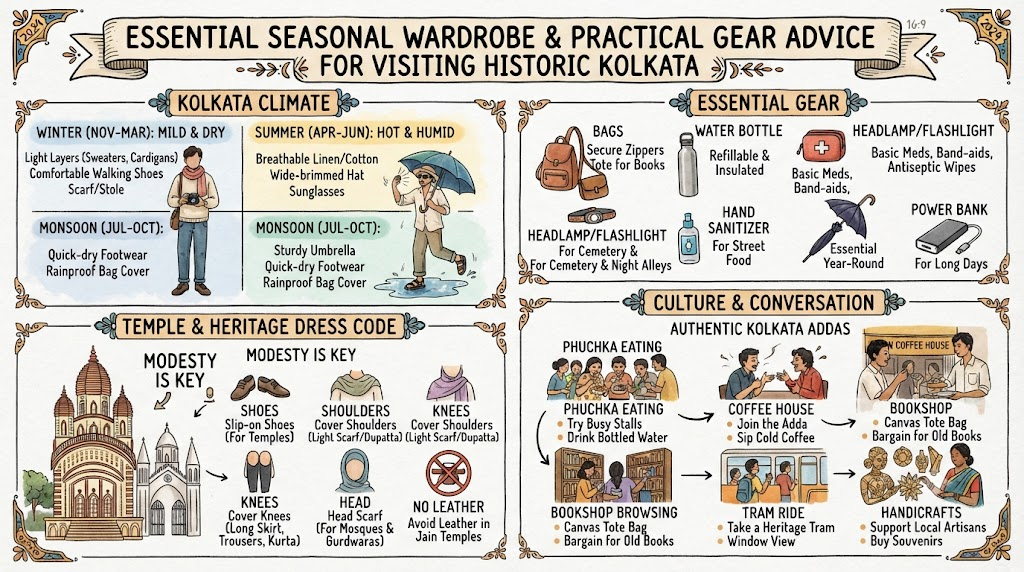
- Pack for High Humidity: Even during the mild winter season, midday humidity can spike; carry loose, breathable linen or cotton garments, sweat-wicking socks, and a wide-brimmed sun hat.
- Carry Cash Reserves: While UPI and digital scanning are widely used in shopping malls, small second-hand bookstalls, street food vendors, and auto-rickshaws operate almost exclusively in cash. Always carry small bills (₹10, ₹20, ₹50, and ₹100).
- Pack Proper Footwear: Prepare for uneven sidewalks and broken heritage paving stones; sturdy, breathable walking sneakers or supportive travel sandals are essential. Keep shoes easy to slip on and off for visits to temples and historic homes.
- Manage Temple Dress Codes: Dress conservatively when entering sacred spaces like Kalighat, Dakshineswar, or Nakhoda Mosque; keep shoulders and knees covered, and carry a lightweight cotton scarf (dupatta) for spontaneous visits.
- Bring Water Protection: Sudden monsoon downpours happen from June to September. Always carry a compact umbrella, waterproof dry bags for your electronics, and an extra pair of quick-drying shoes.
Common Mistakes to Avoid
- Underestimating Traffic Gridlock: Do not schedule meetings or flights close to road crossings over the river during evening rush hours; rely instead on the underground metro and cross-river ferries.
- Skipping Street Food Out of Fear: Avoid missing out on iconic regional street foods like phuchka, singara, and kathi rolls; choose busy stalls with rapid customer turnover where water is bottled and food is fried fresh in front of you.
- Relying Exclusively on English: While English is widely understood in commercial centers, knowing a few polite Bengali phrases—like Koto? (How much?), Dhonnobad (Thank you), and Cholun (Let’s go)—earns warm smiles and friendly interactions.
- Disregarding Monday Closures: Don’t plan your cultural museum visits on Mondays, as institutions like the Indian Museum, Victoria Memorial galleries, and National Library remain shuttered.
- Overbooking Your Daily Itinerary: Kolkata is built around slow exploration and relaxed conversations (adda). Packing more than three major sights into a single day will leave you exhausted by traffic and heat.
Suggested Itinerary Blueprints
1. Day Quick Dash (Colonial & River Heritage Loop)
- Target Group: Travelers on business layovers or short 24-hour city stops.
- Morning: Arrive at Victoria Memorial gardens at 7:00 AM; admire adjacent St. Paul’s Cathedral, then ride the Metro up to Esplanade.
- Afternoon: Browse the rare vintage stalls along College Street; settle in for cold coffee and cutlets at Indian Coffee House.
- Evening: Walk the pedestrian footway of Howrah Bridge at sunset, board a commuter river ferry down to Prinsep Ghat, and wrap up with dinner and live jazz on Park Street.
2. Day Deep-Dive (North-South Cultural Journey)
- Day 1 (Aristocratic & Spiritual North): Start early at Kumartuli watching idol artisans at work; tour the magnificent courtyard of Sovabazar Rajbari; take the river ferry to Dakshineswar Kali Temple; cross the water to Belur Math for quiet evening prayers.
- Day 2 (Colonial Center to South Hubs): Explore South Park Street Cemetery in the morning; browse contemporary galleries and handicrafts at Dakshinapan; spend your late afternoon walking the shaded paths around Rabindra Sarobar Lake before enjoying an authentic Bengali dinner at 6 Ballygunge Place.
3. Complete Weekend Travel Plan (Total Kolkata Immersion)
- Friday Evening: Check into a central heritage boutique hotel; head straight out for an evening walk along Park Street, savoring Chelo Kebabs at Peter Cat followed by pastries at Flurys.
- Saturday: Spend the dawn hours taking in the energetic chaos of the Mullick Ghat Flower Market; explore the sprawling halls of the Indian Museum; browse books on College Street; catch a classic arthouse cinema screening at Nandan.
- Sunday: Take a guided morning heritage walk through Dalhousie Square (B.B.D. Bagh) to admire the colonial architecture; explore the hidden alleys of Bow Barracks; conclude with a peaceful sunset boat ride along the river from Prinsep Ghat.
Common Tourist Mistakes to Avoid
Geographic Blunders
A frequent mistake first-time visitors make is scheduling North Kolkata sites (like Kumartuli or Dakshineswar) alongside South Kolkata locations (like Kalighat or Jodhpur Park) on the same afternoon. City traffic along congested arterial avenues can stretch a short 10 km journey past two hours. Group your itinerary strictly into Northern, Central, and Southern clusters to make the most of your days.
Commercial Traps
Spending long vacation afternoons wandering through air-conditioned mega-malls along the Eastern Metropolitan Bypass strips your trip of Kolkata’s unique character. Modern malls look identical across the globe. Swap them for the historic market halls of New Market (Sir Stuart Hogg Market), the artisan stalls of Dakshinapan, or the traditional sari shops along Gariahat Road.
Neglecting Modern/Alternative Zones
While history lovers naturally gravitate toward old colonial avenues, ignoring Kolkata’s artistic expansions leaves you with an incomplete picture. Take time to explore the bohemian cafes, art hubs, and restored deco houses of Hindustan Park and Southern Avenue, where independent publishing houses and indie fashion labels are reinventing contemporary Bengali lifestyle.
Transport Overpayment
Unsuspecting travelers stepping out of major railway stations often fall victim to taxi drivers quoting inflated flat rates. Avoid hailing private curbside cabs without meters. Instead, use official prepaid taxi booths managed by local traffic police, or book rides via the Yatri Sathi and Uber apps to lock in fair, government-regulated pricing.
Luxury Dining Bias
Confining all your meals to high-end five-star hotel dining rooms cuts you off from the city’s culinary heart. Kolkata is celebrated as India’s premier street food capital. Savoring fresh kathi rolls from Nizam’s, spiced water-filled phuchkas outside Vivekananda Park, or hot mishti doi from a heritage neighborhood sweet shop is essential to experiencing the city’s true soul.
Frequently Asked Questions
1. What clothing should I pack for visiting Kolkata during the winter months?
Pack lightweight cotton clothing, breathable long trousers, and a couple of light layers like a pashmina, denim jacket, or cardigan. While daytime winter temperatures hover around a pleasant 25°C, early mornings and river evenings can dip to a breezy 12°C. Sturdy, comfortable walking shoes are essential for exploring broken historic sidewalks, along with a pair of easily removable slip-ons for stepping inside temples.
2. Is it safe to drink tap water or eat street food across Kolkata?
Never drink untreated municipal tap water; always carry a reusable insulated bottle and refill from verified reverse-osmosis (RO) hotel stations, or purchase sealed mineral water bottles. Street food is exceptionally flavorful and generally safe if you patronize bustling stalls with rapid turnover. Opt for freshly fried snacks like kachoris and samosas, and avoid tap-water-diluted chutneys or uncovered, pre-cut fruit platters.
3. How many days are ideal for a complete, unrushed trip to Kolkata?
A 3- to 4-day itinerary is the sweet spot for taking in Kolkata without exhausting yourself in traffic. This allows one full day for Central colonial monuments and museums, one day for the cultural and artisan quarters of North Kolkata, a third day exploring South Kolkata’s artistic cafes and riverfronts, and extra time for spontaneous river ferry rides and lively bookshop visits.
4. When is the best time to experience the iconic Durga Puja celebrations?
Durga Puja takes place annually between late September and late October, depending on the lunar calendar. This transforms the entire city into an open-air art installation featuring thousands of handcrafted neighborhood pavilions (pandals). To experience it fully, arrive during the primary six days—from Maha Sasthi through Vijaya Dashami—and pack breathable clothing and comfortable walking sandals for long nighttime walking tours.
5. How do I get from Kolkata Airport to the city center affordably?
The most convenient and transparent method is booking through ride-hailing apps like Yatri Sathi or Uber from the designated airport pickup zone. Alternatively, use the official Bidhannagar Police prepaid yellow taxi counter located directly outside the arrivals terminal. For budget travelers, air-conditioned Volvo express buses run frequently from the airport to major hubs like Esplanade, Howrah, and Ultadanga for under ₹100.
6. Do I need special permits to photograph historic landmarks and monuments?
Standard handheld camera and smartphone photography is permitted at most public monuments, including Victoria Memorial gardens and the Indian Museum, though small ticketed camera fees often apply. Professional tripod setups, drone videography, and commercial fashion shoots require formal advance permits from the Archaeological Survey of India or local police. Photography is strictly prohibited on Howrah Bridge and inside working temple sanctums.
7. What items are essential to pack for traveling during Kolkata’s monsoon season?
If visiting between June and September, packing smart for intense tropical downpours is crucial. Bring a sturdy, wind-resistant travel umbrella, a lightweight breathable raincoat, waterproof dry bags to safeguard delicate camera gear and passports, mosquito repellent containing DEET, and quick-drying shoes with non-slip rubber soles to safely navigate wet, mossy heritage marble and slippery stone steps.
8. Is Kolkata accessible and easy to navigate for non-Bengali speakers?
Yes, Kolkata is very welcoming and easy to navigate for domestic and international travelers. English and Hindi are widely spoken across metro transit systems, hotels, restaurants, and shopping markets. Street signage is almost always printed in Bengali, English, and Hindi. Learning basic polite Bengali phrases is appreciated by local shopkeepers and auto drivers, but English will easily see you through day-to-day encounters.
9. What are the best authentic cultural souvenirs to buy before leaving Kolkata?
Skip generic mass-market gifts and hunt for authentic local handicrafts. Top keepsakes include handloom Baluchari and Jamdani silk sarees from government handloom emporiums, Dokra bell-metal folk figurines, hand-painted Kalighat patachitra scrolls, fragrant Darjeeling first-flush tea tins from historic tea merchants, and vacuum-sealed containers of authentic Nolen Gur (date palm jaggery) or traditional canned Rosogollas from heritage confectioners like KC Das.
10. How reliable and user-friendly is Kolkata’s underground Metro system?
Kolkata’s Metro network is exceptionally clean, reliable, punctual, and safe. The original North-South Blue Line connects key cultural districts from Noapara through Dum Dum, Esplanade, Park Street, and Kalighat. The newer Green Line features an engineering marvel—an underwater tunnel running deep beneath the Hooghly River to link Howrah Station with Central Esplanade in minutes, bypassing notorious road congestion.
11. What is the traditional tipping etiquette for hospitality and transport in the city?
Tipping is customary across Kolkata’s dining establishments; leaving 7% to 10% is standard practice when a service charge is not automatically included in the bill. For street porters (coolies) handling luggage at Howrah or Sealdah railway stations, tip ₹50 to ₹100 per heavy bag. Yellow taxi and auto-rickshaw drivers do not expect formal tips, though rounding up the fare to the nearest ₹20 or ₹50 note is appreciated.
12. Are religious and sacred sites subject to strict dress codes?
Yes, places of worship across Kolkata—including Kalighat Kali Temple, Dakshineswar, Nakhoda Mosque, and St. Paul’s Cathedral—require modest, respectful attire. Both men and women should wear clothing that covers their shoulders, chests, and knees; avoid shorts, sleeveless tank tops, and tight gym wear. Shoes must be deposited at temple shoe counters before stepping onto sanctum premises, and leather accessories are often restricted inside traditional Hindu temples.
Conclusion
Choosing Kolkata over a standard vacation spot is a commitment to experiencing a city with soul. It is a city that does not merely entertain visitors, but invites you into its enduring rhythm—where every peeling colonial facade tells a story, every street corner welcomes lively debate, and every copper cup of sweet tea grounds you in the present. By packing thoughtfully and exploring with an open mind, you leave behind tourist superficiality to discover an authentic, moving chapter of world culture that stays with you long after your bags are unpacked.