Introduction
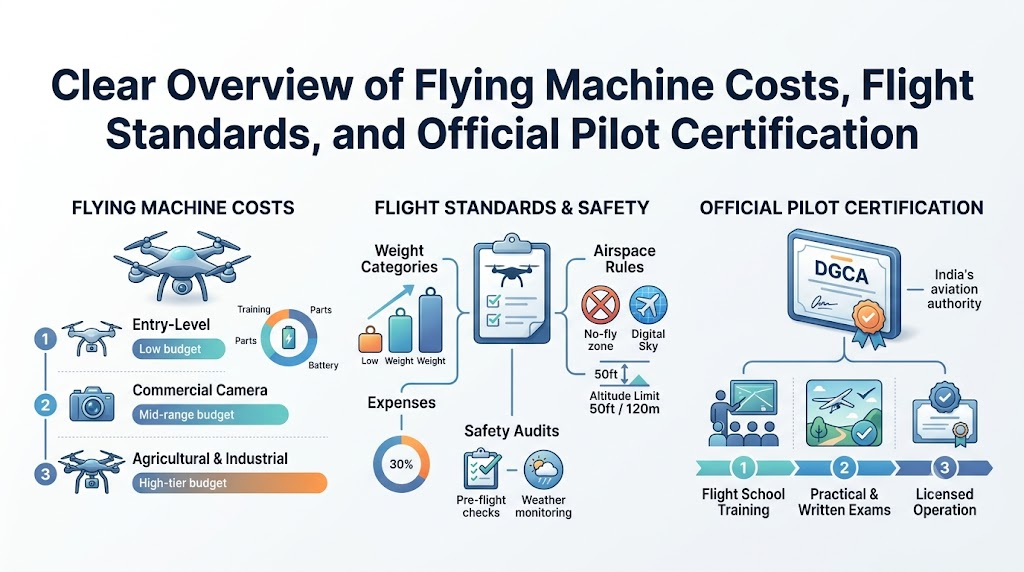
Across towns and farming villages, battery-powered aircraft transform how we map land, protect crops, and create cinema. Today, countless hobbyists and business owners look for drones in India to tackle complex outdoor tasks without hassle. Engineers fly these smart crafts across construction sites to inspect tall towers, bridges, and highways with high speed. This straightforward handbook guides you through every vital step of choosing dependable flying tools for your exact work. You will learn about genuine purchase rates, mandatory aviation permissions, and official government flight rules across states. In addition, you will discover how to select recognized training colleges and hire licensed flight contractors. Exploring specialized platforms like DronesNow.in lets you study equipment specs and verified pilot networks before you spend cash. Getting started with airborne technology takes only simple safety guidance, careful research, and regular flying practice.
Why Drones Are Growing in India
Modern remote aircraft solve demanding logistical problems across farms, production plants, and sprawling cities. Village agriculturists pilot automated sprayers over lush green fields each dawn to nurture healthy crops. Land survey crews steer multi-rotor crafts across rocky plateaus to generate accurate boundary charts. Media professionals hoist stabilized lenses above public festivals to produce vivid aerial footage for online channels. Disaster response squads launch sensor-packed quadcopters into flooded zones to pinpoint stranded villagers and deliver emergency supplies. India currently supports thousands of licensed aviators who conduct commercial flight missions every single day. Supportive national aviation policies encourage domestic manufacturers to develop resilient airframes and responsive control software. Power utilities also deploy camera flyers along high-voltage transmission lines to identify cracked porcelain insulators safely. These rapid surveys prevent hazardous utility accidents, lower maintenance costs, and keep line workers safe on the ground.
What to Check Before Buying a Drone
Prudent consumers examine critical hardware specifications before swiping credit cards on a brand-new flight kit. First, verify the complete ready-to-fly weight of the quadcopter on an accurate digital kitchen scale. Operating overweight aircraft without formal paperwork triggers hefty fines and swift visits from law enforcement officers. Next, assess the optical sensor quality to ensure your device captures crisp, bright images in sunlight. You must also examine battery endurance under average wind conditions across open outdoor fields. High-capacity lithium packs deliver twenty to thirty minutes of continuous hovering time over wide parks. Low-quality cells, however, trigger low-voltage alarms and cause bumpy descents into thick bushes within five minutes. Look for forward-facing obstacle avoidance sensors that halt forward motion before hitting walls, fences, or tree branches. Lastly, ensure that the regional distributor maintains a reliable inventory of replacement propellers, motors, and fast repair services.
Choosing the Right Flying Device
| Need | Drone Type | Main Feature | Best Use |
| Beginner Fun | Micro Quad | Lightweight frame under 250 grams | Flying safely indoors and around backyard gardens |
| Family Vacations | Travel Camera Craft | Three-axis motorized camera stabilizer | Shooting scenic holiday videos and family gatherings |
| Plant Health Care | Agricultural Sprayer | Large liquid container and wide mist nozzles | Spraying organic fertilizers and watering farm plots |
| Topographical Maps | Survey Aircraft | Multi-band satellite positioning receiver | Measuring industrial properties and mining quarries |
Drone Price in India
The drone price in India shifts substantially based on motor construction, computer chips, and mounted sensors. Inexpensive plastic quadcopters with basic push-button transmitters sell for modest amounts at local toy outlets. Intermediate camera aircraft demand a bigger investment because they feature physical balance gimbals and automated flight paths. Enterprise-grade agricultural sprayers and industrial mapping rigs command multiple lakh rupees on corporate purchase orders. These professional systems run on carbon fiber frames, heavy battery systems, and electronic speed controllers. Buyers must also allocate capital for auxiliary accessories to keep their main equipment airborne and safe. You will need additional rotor pairs, rugged transport cases, multi-port chargers, and protective lens filters. Budget-conscious pilots also reserve funds for official remote pilot schooling and scheduled motor overhauls throughout the year.
How to Buy Drones Online in India
Web buyers evaluate and buy drones online India through authorized digital marketplaces every single week. Jot down your exact flight requirements in a notepad before opening browser tabs or visiting merchant sites. Compare popular machines side by side to pick the best drones in India for your projects. Review motor efficiency ratings, video transmission range, and emergency return features to safeguard your funds. Browse authentic customer feedback to see how smoothly the aircraft fights against gusty coastal breezes. You must always confirm that the vendor supplies a verified government digital identity registration number. Legitimate digital retailers present clear specification tables so you make informed, secure technology purchases. They state explicit terms for return policies, manufacturer warranties, and authorized service centers across regions. Select a seller who issues a compliant tax invoice and provides rapid replacement parts for repairs.
Drone Pilot Training in India
Navigating a fast multi-rotor machine through breezy outdoor skies demands focused attention and methodical aviation routines. Enrolling in drone pilot training in India provides newcomers with essential hands-on flight experience. Experienced flight coaches demonstrate how temperature pockets, moisture, and sudden gusts disrupt craft stability. Students inspect carbon airframes, motor bearings, and antenna connections before flipping any transmitter switch. Next, tutors help learners execute balanced control movements during open-air morning training sessions. Trainees practice precise hover boxes and figure-eight maneuvers until they avoid obstacles without hesitation. Courses cover restricted airspace maps, no-fly perimeters, and personal privacy rights across residential suburbs. Participants master practical routines that stop mid-air mishaps and protect pedestrians walking on public streets below.
DGCA Certified Drone Pilot Training
The Directorate General of Civil Aviation regulates flight rules across our sovereign national airspace. This aviation agency protects public safety by inspecting airframes, licensing training schools, and auditing flight plans. To secure recognized credentials, always select DGCA certified drone pilot training that complies with national aviation laws. Certified academies fly registered aircraft, use approved training fields, and employ licensed flight instructors for daily drills. Finishing this rigorous course earns you an authentic remote pilot certificate of competency. That legal credential allows you to take on paid commercial flight projects for business clients. India currently lists over two hundred officially authorized drone training organisations from coast to coast. Always review the public government aviation database to verify an academy’s standing before sending course tuition.
How to Choose Drone Training Institutes in India
Selecting proper drone training institutes in India requires diligent scrutiny of campus grounds, gear, and coaching staff. Ensure that the academy displays genuine civil aviation accreditation documents inside its admissions office. Next, ask the chief flight instructor for the precise number of solo flight hours each trainee receives. Outstanding flight schools provide abundant outdoor stick time instead of making candidates stare at computer screens. Check the physical condition of the training quadcopters and handheld remotes stored in their hangars. Inquire about the complete fee schedule to avoid hidden fees for syllabus notes, fuel, or simulator time. Verify that the teaching pilots possess extensive field experience across agriculture, cinematography, and construction surveys. A reputable aviation academy responds to your inquiries transparently and guides your journey toward professional flight work.
Finding Certified Drone Pilots in India
Purchasing commercial-grade flight gear makes poor financial sense for a one-time company marketing video. Under these conditions, hiring certified drone pilots in India saves substantial time, effort, and business capital. Qualified commercial pilots provide airworthy equipment, charged battery packs, and current flight clearances for the site. They fly safely past cellular towers, stadium light poles, and tall tree lines without panicking. Licensed aviators hold third-party liability insurance coverage that protects your project from expensive property damage claims. Always demand to review a pilot’s official remote operator license before signing commercial agreements. Then, examine high-resolution samples from their past portfolio to verify their framing and piloting precision. Hiring a practiced technician guarantees sharp aerial imagery while freeing you from gear storage and repair tasks.
Picking the Best Flying Solution
| Need | What to Check | Why It Matters |
| Travel Photography | Collapsible motor arms and low total mass | It allows creators to carry gear easily inside standard backpacks. |
| Cadastral Land Surveys | High-resolution camera and RTK satellite link | It captures sub-centimeter geographic data across expansive tracts. |
| Orchard Canopy Spraying | Large chemical reservoir and pressurized mist bars | It coats dense fruit trees without demanding frequent refill stops. |
| Industrial Tower Work | Official pilot credentials and verifiable flight logs | It shields corporate project sites from safety hazards and legal penalties. |
Drone Services in India
Commercial companies throughout the country hire specialized drone services in India to handle dangerous field assignments. Civil engineering firms engage drone operators to inspect high suspension bridges, concrete dams, and factory chimneys. High-resolution flying sensors spot stress fractures and rusty rivets without forcing human workers onto high scaffolding. Mining supervisors run automated mapping flyers to measure open-pit rock volume in less than half an hour. Insurance firms dispatch remote camera aircraft to inspect storm-damaged commercial roofs after heavy hailstorms. Municipal planners assemble dense three-dimensional elevation maps for flood control projects using rapid aerial surveys. Medical teams also fly temperature-controlled containers across rugged mountain valleys to deliver life-saving vaccines to remote clinics. Using specialized flight contractors condenses complex industrial inspections from several weeks down to a single morning.
Agricultural Drone Services in India
Traditional crop cultivation improves drastically with the aid of agricultural drone services India across diverse farming zones. Rural producers hire professional flight crews to survey their green acreage from one hundred feet in the air. Multispectral sensors pinpoint dehydrated plants, fungal infections, and nitrogen shortages before green leaves turn yellow. Subsequently, heavy-lift agricultural flyers glide over expansive grain fields to apply liquid nutrients with pin-point accuracy. An automated flight rig sprays an entire hectare of wheat in ten minutes without spilling valuable chemicals. This targeted application technique conserves fresh water reserves and keeps field laborers away from chemical exposure. A chili grower can isolate an insect attack early and protect his entire harvest from destruction. Consequently, agricultural producers spend less money on inputs and harvest heavier, healthier crops each season.
Real-Life Scenarios
- A cotton grower books an automated spray crew to treat his forty-acre parcel in two short hours.
- An event photographer uses a compact, quiet quadcopter to capture wedding arrivals from above.
- A highway authority flies an autonomous surveyor to map a thirty-kilometer road alignment safely.
- A solar farm operator deploys a thermal imaging craft to spot defective photovoltaic panels on roof arrays.
How DronesNow Can Help
Understanding equipment specifications, price points, and regulatory protocols often overwhelms beginners exploring the skyways. The DronesNow digital ecosystem simplifies this journey by presenting models, costs, and training paths in a clean hub. The platform lists over one hundred distinct flying models along with detailed technical specifications and operating metrics. Its clear comparison tools let you contrast payload capacities, sensor specs, and battery parameters side by side. The service helps motivated learners discover certified pilot schools operating in nearby cities and towns. When companies require prompt aerial execution, they can find verified flight pilots ready for immediate hire. Visitors also read instructional write-ups, view practical gear tests, and browse vetted drone accessories. It serves as an informative launchpad for anyone building an aerial business or hobby in India.
Common Mistakes to Avoid When Choosing Flying Gear
- Purchasing an aerial craft without checking its exact gram weight and corresponding pilot certification rules.
- Leaving for remote flight locations without spare battery packs, leaving the quadcopter grounded after one run.
- Launching aircraft near military bases, international airports, or sensitive government properties.
- Enrolling in unaccredited flight courses that lack current civil aviation authorization certificates.
- Operating in severe gusts, which drains battery power and pushes the drone off its intended heading.
- Skipping pre-flight checks of rotor blades, motor screws, and transmitter signal strength.
- Contracting unauthorized flyer operators who fly without legal pilot licenses or active liability insurance.
- Traveling to distant flight assignments without packing replacement propellers and precision hand tools.
Frequently Asked Questions
1. Does an individual need an official pilot license to fly a tiny nano craft?
A hobbyist can operate a mini craft weighing under 250 grams without holding a government pilot license. Aviation rules designate these ultra-light models as nano quadcopters for private leisure and simple indoor practice. You must still fly below fifty feet, respect citizen privacy, and avoid crowded streets. Never navigate any aerial device near active aerodromes, military checkpoints, or busy outdoor stadiums.
2. What financial investment should a beginner expect for a reliable camera drone?
Plan to invest roughly forty thousand to one lakh rupees for a dependable photographic aircraft in India. Reliable machines in this price bracket offer physical three-axis stabilization gimbals, satellite positioning, and automated return switches. Substandard cheap alternatives wobble in light winds and crash whenever outdoor gusts pick up. Spending a little more secures brushless motors and safeguards your aircraft during flight.
3. How many minutes of flight time does a standard aircraft battery deliver?
Most consumer-grade camera quadcopters stay aloft for twenty-five to thirty-five minutes on a full battery charge. Fighting strong head winds or mounting external gear reduces flight duration down to fifteen minutes. Experienced drone handlers always carry two or three charged backup batteries inside their field cases. You can recharge these batteries using mobile vehicle adapters or portable power stations between flights.
4. What regulatory responsibilities does the civil aviation authority manage?
The national aviation authority establishes air safety standards, inspects aircraft designs, and licenses commercial training facilities nationwide. It drafts clear operating parameters so jetliners, rescue helicopters, and unmanned flyers share airspace without danger. The department registers commercial quadcopters via unique serial identifiers to prevent unauthorized flights above vital infrastructure. Adhering to these civil standards keeps the nation’s airways safe and functional for all.
5. How many days does an approved pilot training syllabus usually take?
A recognized commercial remote pilot course requires five to seven consecutive days of instruction from start to finish. Trainees dedicate the initial two days to studying airspace charts, emergency procedures, and basic weather conditions inside classrooms. The remaining days focus on direct flight practice on dedicated airfields under instructor supervision. Students pass written exams and outdoor flying assessments to earn their formal qualification.
6. Do agricultural drone spraying services save money for farming families?
Agricultural spraying drones lower farming expenses by depositing uniform, fine spray droplets onto green foliage. The rotor downdraft pushes the liquid mist deep into crop canopies, killing pests hiding on leaf undersides. This focused method slashes chemical fluid requirements by up to forty percent compared to backpack sprayers. Farmers spend less cash on chemicals while avoiding toxic liquid exposure during application days.
7. What happens when a flying machine loses contact with its handheld transmitter?
Modern aerial systems initiate an automatic return-to-home command the moment they lose radio contact with the pilot. The onboard flight processor reads satellite memory points and flies straight back toward the original launch position. Pilots must secure a firm satellite connection before takeoff so the computer saves coordinates correctly. Always clear the launch perimeter of power wires, branches, and metal awnings.
8. Is nighttime drone operation permitted under standard Indian flight laws?
Standard civilian flights must wrap up before sunset across every Indian state and union territory. Flying after dark requires special government exemptions, anti-collision strobe lighting, and licensed commercial crews on location. Evening darkness obscures overhead electrical lines, radio antennas, and tree canopies that shatter spinning propellers. Restrict your flights to bright daylight hours to prevent painful accidents and safeguard your equipment.
9. Why does hiring a freelance pilot make better sense than buying survey gear?
Hiring a certified pilot saves capital if your firm needs topographical surveys only once or twice a year. Purchasing enterprise survey quadcopters, satellite base units, and photogrammetry licenses consumes huge business capital. A professional contractor supplies calibrated hardware, handles flight permits, and brings active liability insurance to your site. This workflow yields accurate terrain maps without requiring equipment maintenance or storage.
10. How can prospective students verify the accreditation of a drone institute?
Aspiring aviators can check school credentials by visiting the official civil aviation portal named Digital Sky. The public directory contains a verified list of every approved remote pilot training organisation across all Indian states. Never transfer admission deposits to unlisted schools, regardless of steep discounts or promotional advertising. Genuine training centers proudly display their government approval letters right in their campus reception areas.
11. Can quadcopters navigate safely during monsoon downpours?
Standard consumer and commercial aircraft cannot handle heavy rains because moisture enters motor housings and shorts delicate electronic boards. Wet rotors also lose lift, causing the drone to drop rapidly toward the ground. Specialized industrial airframes offer water-resistant seals for light mist, but they cost substantial sums. Prudent aviators pack their equipment away as soon as dark rain clouds form on the horizon.
12. What primary features and resources can researchers find on DronesNow?
The DronesNow portal provides comprehensive specifications, operating limits, and price insights for more than one hundred distinct aircraft models. Consumers use the website to compare different options before buying gear from certified distributors. The portal also connects users with accredited training academies and licensed commercial pilots in their region. Browsing their straightforward buying guides helps enthusiasts make wise choices in this evolving sector.
Conclusion
Finding an ideal aerial machine depends upon your unique operational targets, piloting skills, and financial resources. Enthusiasts can start their journey with light backyard quadcopters to build hand-eye coordination safely and affordably. Commercial practitioners must pursue formal certified training to master aviation rules, emergency handling, and payload sensors. Respect national flight laws, keep clear of sensitive installations, and honor privacy rights whenever you operate outdoors. Thorough research into flyer costs, airframe limits, and certified flight academies saves money and shields you from legal headaches. Informative resources like DronesNow make exploring hardware, tracking down schools, and hiring skilled pilots fast and convenient. When you fly with caution and prepare with care, remote aircraft open exciting possibilities across our skies.