Introduction
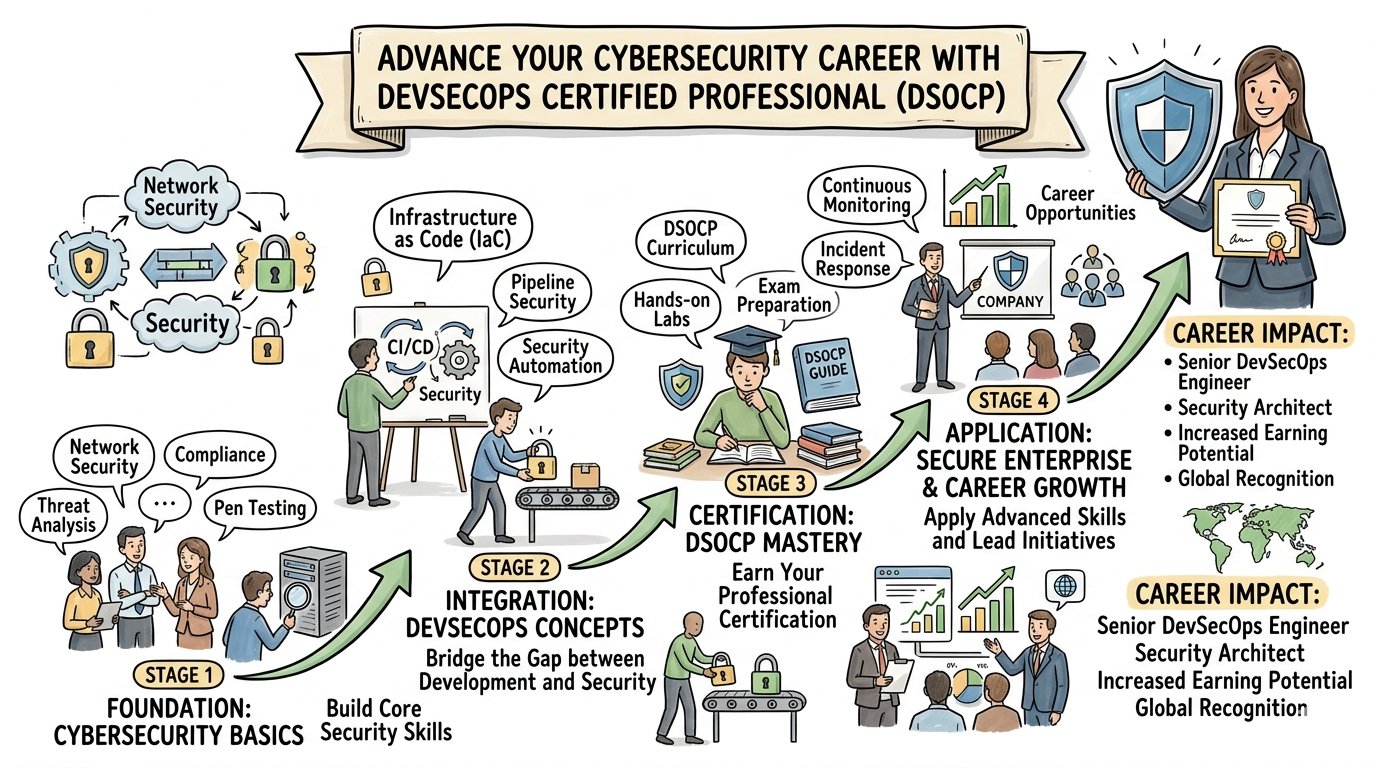
The DevSecOps Certified Professional (DSOCP) is a comprehensive validation of your ability to merge security seamlessly into the DevOps lifecycle. This guide is designed for engineers, architects, and managers who recognize that “security as an afterthought” is no longer a viable strategy in modern software delivery. As we navigate a landscape dominated by cloud-native architectures and rapid deployment cycles, understanding how to automate security is the primary differentiator for top-tier talent. This guide provides the clarity needed to evaluate how this certification fits into your specific career trajectory, helping you make an informed decision on your professional development.
What is the DevSecOps Certified Professional (DSOCP)?
The DevSecOps Certified Professional (DSOCP) represents a shift from theoretical security knowledge to hands-on, production-ready implementation. It exists to bridge the gap between traditional siloed security teams and the fast-paced world of continuous integration and delivery. Unlike certifications that focus solely on compliance or auditing, DSOCP emphasizes the “shift-left” philosophy, teaching you how to embed automated testing, vulnerability scanning, and compliance checks directly into the pipeline. It aligns perfectly with modern enterprise practices where speed must be balanced with robust, verifiable security measures.
Who Should Pursue DevSecOps Certified Professional (DSOCP)?
This certification is built for a wide spectrum of technical professionals, ranging from DevOps engineers and SREs to dedicated security analysts and cloud architects. Beginners looking to enter the high-demand field of security automation will find a structured path, while experienced leads can use it to formalize their expertise in DevSecOps culture. In the Indian market and globally, there is a massive surge in demand for “Security-First” engineers who can manage complex distributed systems. Managers and technical leaders should also consider this path to better understand the tooling and cultural changes required to protect their organization’s digital assets.
Why DevSecOps Certified Professional (DSOCP)
As we move through 2026, the complexity of the software supply chain has made security the most critical component of the platform engineering stack. Enterprise adoption of DevSecOps is no longer optional; it is a regulatory and operational necessity. Earning the DSOCP ensures you stay relevant even as specific tools evolve, because it focuses on the fundamental principles of automation and risk management. The return on investment is significant, as professionals with verified DevSecOps skills often command higher salaries and have access to more resilient career paths in a volatile tech market.
DevSecOps Certified Professional (DSOCP) Certification Overview
The DevSecOps Certified Professional (DSOCP) program is delivered via the official and is hosted on devopsschool. The program utilizes a practical assessment approach, moving away from simple multiple-choice questions toward scenario-based evaluations. It is structured to cover the entire software development life cycle (SDLC), ensuring that candidates understand the ownership of security at every stage. The curriculum is maintained by industry practitioners who ensure the content stays aligned with current threat landscapes and toolsets.
DevSecOps Certified Professional (DSOCP) Certification Tracks & Levels
The DSOCP ecosystem is divided into three distinct levels to mirror professional growth: Foundation, Professional, and Advanced. The Foundation level focuses on core concepts and culture, while the Professional level dives deep into CI/CD integration and tool chaining. The Advanced level is designed for architects who must design secure ecosystems at scale. Beyond levels, the tracks allow for specialization in areas like Cloud Security, Container Security, or DevSecOps for AI/ML, allowing you to align your certification with your specific job function or future career goals.
Complete DevSecOps Certified Professional (DSOCP) Certification Table
| Track | Level | Who it’s for | Prerequisites | Skills Covered | Recommended Order |
| Core DevSecOps | Foundation | Aspiring Engineers | Basic Linux/Git | SCA, SAST, DAST basics | 1st |
| Engineering | Professional | DevOps/SREs | 2+ Years Experience | Pipeline Security, Vault | 2nd |
| Architecture | Advanced | Lead Engineers | Professional Level | Compliance as Code | 3rd |
| Cloud Sec | Specialization | Cloud Architects | Cloud Fundamentals | IAM, CSPM, CWPP | Optional |
Detailed Guide for Each DevSecOps Certified Professional (DSOCP) Certification
DevSecOps Certified Professional (DSOCP) – Foundation
What it is
This entry-level certification validates a candidate’s understanding of the DevSecOps mindset and the fundamental tools used to secure a basic CI/CD pipeline.
Who should take it
It is ideal for junior developers, system administrators, or traditional security professionals who want to understand the modern DevOps workflow and how security fits in.
Skills you’ll gain
- Understanding the Shift-Left philosophy.
- Basic Static Analysis Security Testing (SAST).
- Fundamentals of Software Composition Analysis (SCA).
- Introduction to Docker and container security basics.
Real-world projects you should be able to do
- Integrate a basic linting tool into a GitHub Actions pipeline.
- Perform a vulnerability scan on a container image.
- Identify hardcoded secrets in a codebase using automated tools.
Preparation plan
- 7–14 Days: Focus on the “Cultural” aspects of DevSecOps and learn the terminology of the SDLC.
- 30 Days: Set up a simple local pipeline and experiment with open-source security tools like SonarQube or Trivy.
- 60 Days: Deep dive into the official course materials and take practice assessments to identify knowledge gaps.
Common mistakes
- Focusing too much on a specific tool rather than the underlying security principle.
- Underestimating the importance of “Culture” and “Collaboration” questions on the exam.
Best next certification after this
- Same-track option: DSOCP Professional.
- Cross-track option: SRE Certified Professional.
- Leadership option: DevSecOps Manager Track.
DevSecOps Certified Professional (DSOCP) – Professional
What it is
The Professional level validates advanced skills in automating security across complex, multi-stage pipelines and managing secrets in production environments.
Who should take it
This is for mid-level DevOps engineers, SREs, and Security Engineers who are responsible for building and maintaining enterprise-grade delivery systems.
Skills you’ll gain
- Implementing Dynamic Analysis (DAST) in automated workflows.
- Managing secrets using tools like HashiCorp Vault.
- Infrastructure as Code (IaC) scanning and remediation.
- Runtime security and monitoring in Kubernetes.
Real-world projects you should be able to do
- Build a fully automated Jenkins pipeline that halts on critical security vulnerabilities.
- Deploy a secure Kubernetes cluster with Network Policies and RBAC.
- Automate the rotation of database credentials using a secrets manager.
Preparation plan
- 7–14 Days: Review advanced pipeline configurations and DAST tool integrations.
- 30 Days: Build a project that includes IaC (Terraform) and perform automated security audits on the code.
- 60 Days: Conduct mock “break-fix” scenarios where you must identify and patch a vulnerability in a live environment.
Common mistakes
- Ignoring the performance impact of security tools on the developer experience.
- Failing to understand the nuances of shared responsibility models in the cloud.
Best next certification after this
- Same-track option: DSOCP Advanced.
- Cross-track option: FinOps Certified Professional.
- Leadership option: Technical Program Manager (Security focus).
Choose Your Learning Path
DevOps Path
This path focuses on the seamless integration of development and operations. You will learn to treat security as a standard quality gate alongside unit tests and functional tests. The goal is to ensure that code is “secure by design” before it ever reaches a staging environment.
DevSecOps Path
This is the specialized route for those who want to be the bridge between traditional security and modern engineering. It covers deep-dive security topics like penetration testing automation and compliance-as-code, ensuring that your infrastructure meets regulatory standards automatically.
SRE Path
The Site Reliability Engineering path focuses on the “Run” phase of the lifecycle. Here, security is viewed through the lens of availability and resilience. You will learn how to handle security incidents as high-priority outages and build systems that can withstand attacks while remaining operational.
AIOps / MLOps Path
In this modern path, you focus on securing the data science lifecycle. This includes protecting training data, securing model endpoints, and ensuring that the AI models themselves are not susceptible to injection or poisoning attacks.
DataOps Path
Data security is the core of this path. You will focus on securing data pipelines, implementing fine-grained access controls, and ensuring that PII (Personally Identifiable Information) is masked or encrypted as it moves through the analytics stack.
FinOps Path
This path explores the intersection of security and cost management. You will learn how insecure configurations (like orphaned snapshots or open buckets) lead to “bill shocks” and how to use security visibility to optimize cloud spending and reduce waste.
Role → Recommended DevSecOps Certified Professional (DSOCP) Certifications
| Role | Recommended Certifications |
| DevOps Engineer | DSOCP Foundation & Professional |
| SRE | DSOCP Professional & SRE Foundation |
| Platform Engineer | DSOCP Advanced & Kubernetes Security |
| Cloud Engineer | DSOCP Professional & Cloud Provider Security |
| Security Engineer | DSOCP Professional & Advanced |
| Data Engineer | DSOCP Foundation & DataOps Specialty |
| FinOps Practitioner | DSOCP Foundation & FinOps Certified |
| Engineering Manager | DSOCP Foundation & Leadership Track |
Next Certifications to Take After DevSecOps Certified Professional (DSOCP)
Same Track Progression
Once you have mastered the DSOCP Professional level, the logical step is the Advanced level. This involves shifting from “implementation” to “architecture,” where you design the security frameworks that multiple teams will use, focusing on enterprise-wide governance and scalability.
Cross-Track Expansion
To become a truly versatile engineer, consider branching into SRE or FinOps. Understanding how security impacts system reliability and cloud costs will make you a much more valuable asset to any organization, allowing you to speak the language of both the CFO and the CTO.
Leadership & Management Track
For those looking to move into people or program management, look toward certifications that focus on DevSecOps leadership. This helps you transition from “doing the work” to “enabling the team,” focusing on metrics, ROI, and organizational culture change.
Training & Certification Support Providers for DevSecOps Certified Professional (DSOCP)
DevOpsSchool: A premier destination for hands-on technical training, DevOpsSchool offers deep-dive DSOCP courses that focus on industry-standard tools and real-world deployment scenarios.
Cotocus: Known for its boutique consulting and training approach, Cotocus provides specialized mentorship for professionals looking to master complex cloud-native security workflows.
Scmgalaxy: A massive community-driven platform, Scmgalaxy is an excellent resource for documentation, tutorials, and shared knowledge regarding source code management and security.
BestDevOps: Focuses on providing streamlined, efficient learning paths for busy professionals who need to gain high-impact skills in a short amount of time.
devsecopsschool: A dedicated niche platform that lives and breathes DevSecOps, offering specialized modules on everything from SAST/DAST to compliance-as-code.
sreschool: If your focus is on reliability, SREschool provides the context needed to integrate security into your monitoring and incident response frameworks.
aiopsschool: As AI becomes more prevalent, AIOpsschool helps you understand how to use machine learning to detect security threats and automate responses.
dataopsschool: Focuses on the unique security challenges of big data and analytics, ensuring your data lakes and warehouses remain compliant and secure.
finopsschool: Teaches you the critical link between security configurations and cloud cost optimization, helping you reduce the “security tax” on your cloud bill.
Frequently Asked Questions (General)
How difficult is the DSOCP exam?
The exam is moderately challenging as it requires a mix of conceptual knowledge and practical, hands-on understanding of automation tools.
How much time does it take to prepare?
Most professionals with a DevOps background find that 4 to 8 weeks of consistent study is sufficient to clear the Professional level.
Are there any prerequisites for the Foundation level?
No formal prerequisites exist, but a basic understanding of Linux commands and Git is highly recommended for success.
What is the ROI of getting DSOCP certified?
Certified professionals often see a 15-25% increase in salary opportunities due to the extreme scarcity of skilled DevSecOps engineers.
In what order should I take these certifications?
It is best to follow the natural progression: Foundation first, then Professional, and finally Advanced or a specific specialization track.
Does this certification expire?
Most technical certifications require renewal every 2-3 years to ensure your skills stay aligned with the latest technological advancements.
Is the DSOCP recognized globally?
Yes, it is highly regarded by enterprises worldwide, particularly those in the fintech, healthcare, and e-commerce sectors.
Can I take the exam online?
Yes, the certification is designed to be accessible globally via secure online proctoring platforms.
Do I need to know how to code?
While you don’t need to be a software developer, the ability to read and write simple scripts (Bash, Python, or YAML) is essential.
Does DSOCP cover cloud-specific tools?
Yes, the curriculum includes security practices for major cloud providers like AWS, Azure, and Google Cloud Platform.
How does DSOCP differ from CISSP?
CISSP is broad and management-focused, whereas DSOCP is highly technical and focused specifically on the automation of security in DevOps.
Are there lab environments provided?
Yes, most authorized training providers include cloud-based lab environments to practice the integration of security tools.
FAQs on DevSecOps Certified Professional (DSOCP)
How does DSOCP address the “Culture” of security in DevOps?
What specific SAST and DAST tools are covered in the curriculum?
Is container security a major part of the DSOCP Professional level?
How does the certification handle “Infrastructure as Code” security?
Are there specific modules for securing Kubernetes clusters?
How does DSOCP prepare me for a “Security Architect” role?
Does the course cover secret management and encryption at rest?
What kind of real-world scenarios are used in the final assessment?
The DSOCP certification is designed to provide deep clarity on these topics. It focuses on breaking down the walls between developers and security teams by providing a common technical language. It covers industry-leading tools like SonarQube, Snyk, and Vault while ensuring you understand how to secure Docker and Kubernetes environments effectively. By the end of the program, you will have a comprehensive toolkit for automating security at every stage of the modern pipeline.
Final Thoughts: Is DevSecOps Certified Professional (DSOCP) Worth It?
From a mentor’s perspective, the answer is a resounding yes—but with a caveat. A certification alone won’t solve your engineering challenges, but the process of earning the DSOCP will force you to confront the most difficult aspects of modern delivery. It moves you past the “how-to” of tools and into the “why” of secure architecture. If you are looking to future-proof your career and move into the most resilient and high-paying sector of the cloud economy, this is a practical and honest investment in your professional self. Stop treating security as a checkbox and start treating it as a core engineering discipline.