Introduction
Smartphones and computers connect our society every minute, from morning alarms to grocery delivery apps. Whenever those platforms freeze up, users immediately jump to rival services. Site Reliability Engineering keeps these critical digital services working without unexpected pauses. This discipline combines regular computer coding with system administration tasks to stop big crashes. Engineers write custom software to check server health and repair bugs automatically. Readers will discover core principles that keep digital networks stable under heavy traffic. You will also see how engineers catch glitches before customers see any slowdowns. Exploring these engineering methods opens rewarding pathways for curious learners and builders. SRESchool.in provides structured learning paths for people building dependable system skills. These simple explanations will help you understand how experts maintain reliable digital platforms.
What Is Site Reliability Engineering?
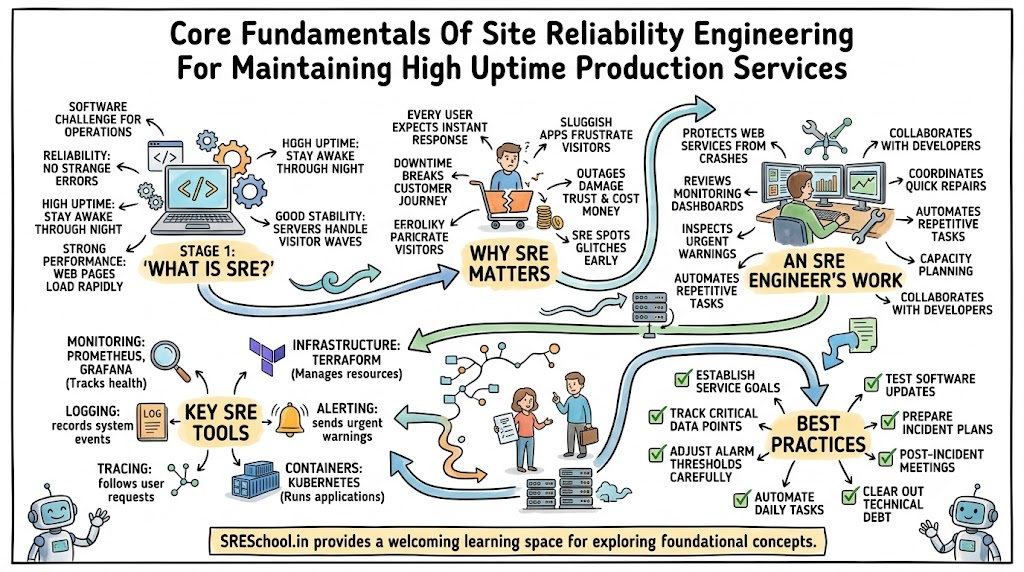
Site Reliability Engineering treats computer operations like a pure software problem. People use the short name SRE for this technical field. The primary objective centers on keeping software accessible, fast, and completely bug-free. It protects platform uptime so visitors never see blank screens. High uptime means users can access accounts whenever they choose. SRE also defends system speed because slow responses frustrate paying customers. Quick response times keep users satisfied and engaged. SRE brings consistency so traffic surges do not crush the database. Workers use automation scripts to handle repetitive duties without manual clicks. Automatic processes save hours because machines execute routine chores unaided. Teams also place active tracking tools across all servers. These tracking displays show real-time warnings whenever memory usage rises above safe limits.
Why Does SRE Matter?
Every user wants web applications to load instantly every single day. System outages happen when a server crashes and drops user connections. Offline platforms trigger serious trouble because buyers cannot send payments or finish work. Sluggish pages also upset customers and ruin positive brand reviews. Service interruptions damage sales volume and destroy hard-earned consumer trust quickly. SRE enables technical teams to identify system faults before buyers see any error. Automated alarms wake on-call specialists the second failure counts creep upward. These engineers locate root causes to keep identical bugs from returning later. They examine past system faults to construct safer digital defenses. Consequently, software applications stay healthy while businesses expand with satisfied, loyal audiences.
What Does an SRE Engineer Do?
Every SRE Engineer shields production networks from unforeseen software disasters. These specialists study visual operational boards to evaluate server performance and network traffic. They tune alarm settings so only real crises trigger emergency notifications. When an app stops working, they take charge and direct the repair effort. They code lightweight scripts to eliminate repetitive everyday administration tasks. They also direct resource planning so machines never run out of disk space. They review cloud infrastructure settings to confirm safe compute boundaries. Whenever tricky bugs surface, they investigate lines of code to identify the break. They collaborate with feature developers to deploy application updates without downtime. Once they fix an outage, they write an open report about the event. Imagine a popular ticketing site releasing concert seats on Friday morning. Millions of fans hit the checkout button during the exact same minute. The reliability engineer increases server count immediately, which preserves smooth transactions without any failure.
What Is SRE Training?
Site Reliability Engineering Training teaches learners how complex internet platforms operate. Students begin with Linux fundamentals, the operating system behind most internet infrastructure. Next, they master monitoring techniques that measure system health indicators. They also practice observability, which reveals internal application behavior during execution. Students examine Service Level Indicators, which measure specific user experience metrics. They set Service Level Objectives, which define internal reliability standards for engineering teams. They review Service Level Agreements, which form formal reliability contracts with enterprise clients. Learners balance error budgets, which establish acceptable downtime thresholds for feature releases. Coursework covers cloud environments that provide remote computing power across the web. Students package applications into neat units using containerization software. They direct Kubernetes, a powerful tool that orchestrates thousands of containers across clusters. Finally, they study infrastructure management tools that generate servers from text files.
Why Consider SRE Certification?
A Site Reliability Engineering Certification validates your grasp of core operational standards. Earning a certificate shows that you finished a comprehensive study plan with discipline. It guides your study routine and confirms your comprehension of basic principles. Even so, actual hands-on engineering remains the most critical qualification in tech. Passing a multiple-choice exam cannot replace hands-on incident response during real crises. Learners must experiment with practical server setups and build personal lab environments. You should write scripts that monitor application health without human help. Blending hands-on practice with certification prep delivers the strongest career preparation. A solid credential outlines your study path, while your finished projects prove your practical value.
What Should an SRE Course Include?
A comprehensive SRE Course provides an organized curriculum that advances operational proficiency. The following step-by-step path transforms beginners into confident production engineers:
- Beginner SRE concepts: Master reliability basics, core terminology, and fundamental operational philosophy.
- Linux and system basics: Run terminal commands to navigate directories, manage permissions, and track active processes.
- Monitoring and alerts: Configure collection agents that gather performance statistics and dispatch emergency warnings.
- SLI and SLO concepts: Establish target goals and monitor remaining error budget balances.
- Incident management: Direct practice outages efficiently and publish honest post-incident summaries.
- Cloud and containers: Encapsulate software services inside containers and deploy them onto cloud hardware.
- Automation: Construct Python scripts to replace repetitive manual administration tasks.
- Infrastructure management: Write declarative files that configure compute instances and databases safely.
- Reliability projects: Deploy a multi-tier application and observe its behavior during simulated server failures.
- Production practice: Release rolling updates to live environments without degrading the active user experience.
SRE Training in India
Cloud technology adoption continues to surge across major commercial hubs in India. Many multinational organizations manage their core systems through technical centers located throughout India. These enterprises seek capable professionals who keep distributed cloud architectures running without interruptions. Consequently, employment opportunities for DevOps and site reliability professionals continue to expand. Domestic specialists frequently collaborate with distributed teams across multiple continents and time zones. They must master cloud resources, container orchestration, and rapid debugging techniques. Hands-on laboratory work helps learners develop confidence when configuring production environments. SRESchool.in provides guided instructional options for students pursuing SRE Training in India. It assists engineers in gaining automation competencies that safeguard mission-critical web applications.
SRE Tools
Production specialists utilize specialized software suites to run, track, and protect network platforms. The table below outlines core tooling categories, their functions, and industry-standard examples:
| Tool Area | What It Does | Example Use | Popular Tools |
| Monitoring | Evaluates operational stability | Inspects processor speed and available memory | Prometheus, Grafana |
| Logging | Aggregates system occurrences | Identifies error traces following unexpected crashes | Elasticsearch, Fluentd |
| Tracing | Follows customer transactions | Flags slow service calls within complex architectures | Jaeger, OpenTelemetry |
| Alerting | Dispatches critical warnings | Alerts primary responders when errors spike | Alertmanager, PagerDuty |
| Infrastructure | Coordinates technical assets | Provisions remote servers from declarative code files | Terraform, Ansible |
| Containers | Packages software components | Executes isolated applications across various environments | Docker, Kubernetes |
Mastering these systems helps you understand how distributed architectures communicate, isolate errors, and recover quickly.
SRE Best Practices
Operational health improves when engineering groups maintain reliable habits day after day. Review these essential SRE Best Practices to keep your production software dependable:
- Set clear service goals: Establish exact performance expectations with product teams and end users.
- Track useful metrics: Gather only essential data points that truly indicate user experience quality.
- Create useful alerts: Configure notification systems so only critical issues awaken on-call engineers.
- Reduce alert noise: Silence low-priority notifications that distract engineers from real problems.
- Automate repeated work: Build automated tools so machines handle routine daily server operations.
- Test system changes: Validate all software modifications inside staging environments before deploying to production.
- Prepare for incidents: Document explicit emergency runbooks so responders handle crises with confidence.
- Review incidents: Analyze system failures with empathy to learn how defensive checks broke down.
- Reduce technical debt: Refactor unstable code structures before they jeopardize core system stability.
- Plan system capacity: Provision extra server resources ahead of predictable consumer shopping surges.
- Learn from failures: Treat every production outage as valuable feedback that strengthens overall system durability.
Real-Life Scenarios
These real-world operational scenarios illustrate how site reliability practices function during active production incidents:
- Handling traffic spikes on a shopping site: An online retailer dropped a flash discount on electronics at midday. Thousands of active shoppers attempted to purchase items simultaneously. Because the SRE team had already implemented dynamic cloud scaling policies, the infrastructure responded automatically. As soon as server utilization crossed seventy percent, the control plane launched eight additional compute nodes. The web storefront maintained normal transaction speeds, and customers completed checkouts without seeing error pages.
- Fixing a broken database connection: A scheduled software deployment introduced a missing credential inside a production database configuration file. Every subsequent customer attempt to access account dashboards produced an error message. Automated health checks registered the sudden drop in valid logins within fifteen seconds. The alerting service woke the designated on-call engineer, who checked server logs immediately. The engineer triggered a rollback to the prior release package within four minutes. Customers regained account access while the software developers corrected the typo safely inside their local branches.
Common SRE Mistakes to Avoid
Inexperienced teams frequently run into preventable pitfalls when introducing reliability frameworks. The table below presents typical missteps alongside actionable solutions:
| Common Mistake | Practical Solution |
| Triggering alarms for minor blips | Configure urgent notifications exclusively for errors that actively degrade user interactions. |
| Criticizing team members during outages | Scrutinize system design flaws and process oversights rather than attacking individual engineers. |
| Performing server modifications manually | Code simple scripts to handle routine maintenance and configuration updates. |
| Demanding flawless zero-downtime operations | Define attainable availability objectives and reserve error budget capacity for product experiments. |
| Neglecting application log centralization | Route all diagnostic log outputs into a single searchable dashboard. |
| Skipping emergency failure simulations | Organize regular disaster recovery drills during standard working hours. |
| Adopting excessive third-party utilities | Select a focused suite of tools that your team can maintain easily. |
| Abandoning operational runbook updates | Audit and revise emergency troubleshooting documents whenever system architecture changes. |
How SRESchool.in Can Support SRE Learning
Mastering production operations can seem overwhelming when you navigate technical documentation alone. SRESchool.in provides a clear educational framework through organized Site Reliability Engineering Training. Beginners can follow an introductory SRE Tutorial to grasp foundational principles step by step. The platform assists students in mastering standard SRE Tools that real engineering teams utilize daily. You can examine proven SRE Best Practices to discover how top companies maintain uninterrupted uptime. For learners who prefer structured instruction, the platform provides a complete SRE Course. These modular tracks help engineers who are preparing for an industry SRE Certification. Learners gain practical operational abilities that prepare them for the demands of an SRE Engineer. The curriculum also delivers relevant direction for candidates seeking SRE Training in India. Structured modules convert complex technical subjects into clear, approachable lessons for any student.
SRE Learning Roadmap
You can achieve operational mastery by advancing through these five practical phases:
- Learn: Study basic Linux terminal commands, network protocols, and client-server communication channels.
- Practice: Deploy open-source metric collectors on your workstation to observe real-time resource data.
- Build: Create a simple microservice, package it as an image, and deploy it onto a cloud server.
- Test: Terminate application processes intentionally to observe how your monitoring rules report the outage.
- Improve: Construct simple recovery scripts that restart stopped containers automatically without human intervention.
Frequently Asked Questions
1. What does SRE mean in simple words?
Site Reliability Engineering applies software coding principles to system administration tasks. Instead of fixing dead servers by clicking around manually, engineers write clever programs that govern computers automatically. This practice ensures that online services stay quick, secure, and available when millions of visitors arrive at once.
2. Is SRE hard for beginners to learn?
Beginners can master this field if they approach the subject step by step. SRE covers several areas like code, networks, and cloud architecture, which feels intimidating initially. You can start with basic operating system mechanics, practice simple commands, and build confidence through small experiments.
3. Do I need to know coding to start SRE?
Basic scripting knowledge helps you complete operational tasks effectively. You do not need to design advanced mobile games or complex graphical interfaces. However, you must know how to write short automation scripts using languages like Python or Go to eliminate repetitive maintenance chores.
4. What is the difference between DevOps and SRE?
DevOps describes a cultural movement that breaks down barriers between software creators and operations teams. SRE delivers an explicit framework that implements this cultural philosophy using engineering techniques. DevOps promotes shared accountability, while SRE provides concrete operational rules like error budgets and metric targets.
5. What is an error budget?
An error budget measures the total downtime an application can experience without violating customer expectations. Perfect uptime remains impossible across complex distributed networks. This budget permits a calculated amount of downtime each quarter, which teams use to ship exciting features and try creative ideas safely.
6. What is an SLI in system reliability?
A Service Level Indicator measures a specific dimension of application performance directly. For instance, an SLI might calculate the percentage of successful web requests over twenty-four hours. This metric provides a hard number that reveals whether your service is operating smoothly or struggling with errors.
7. What is an SLO?
A Service Level Objective represents the target reliability percentage that the engineering team commits to hitting. Your group might decide that ninety-nine percent of web requests must complete within two hundred milliseconds. If numbers breach this threshold, engineers stop new feature work to fix performance bottlenecks.
8. What is an SLA?
A Service Level Agreement establishes a binding contract between a service vendor and its paying customers. It defines the explicit uptime percentage that the business guarantees. If service reliability falls below this legal promise, the provider pays financial penalties or issues refunds to affected clients.
9. Why is Linux so important for SREs?
Most internet cloud hosts run Linux distributions under the hood. Reliability engineers interact with Linux constantly to read system files, inspect memory allocation, and run services. Learning shell commands allows you to troubleshoot issues directly on the server when emergencies occur.
10. Can I learn SRE on my home laptop?
You can practice modern reliability concepts on standard personal hardware without paying expensive fees. Open-source utilities like Docker, Prometheus, and virtual Linux machines run smoothly on consumer laptops. You can spin up sample projects and trigger mock crashes to observe alarms in real time.
11. What is an incident post-mortem?
An incident post-mortem provides an honest analysis written after engineers resolve a production outage. It explains what failed, why it broke, and how the team fixed the underlying defect. It avoids blaming individual workers and focuses on strengthening automated guardrails across the entire system.
12. How does SRE help normal business goals?
Reliability practices safeguard corporate earnings by keeping digital storefronts accessible to customers around the clock. When websites remain fast and responsive, customers complete checkout steps without abandoning carts. SRE also cuts operational waste because software automation reduces manual firefighting and prevents expensive unplanned outages.
Conclusion
Reliable system engineering safeguards modern platforms so everyday users enjoy dependable digital experiences. This guide explained how automated health checks, explicit service goals, and disciplined operational habits protect servers from crashes. You also saw why proactive monitoring enables engineers to fix defects before visitors experience any delays. Building hands-on competence with terminal scripts and open-source tools will elevate your technical skills over time. SRESchool.in offers an accessible learning environment where students explore core reliability principles and practice real system management. Adopting these practical operational methods helps you build resilient cloud services that thrive under heavy demand.