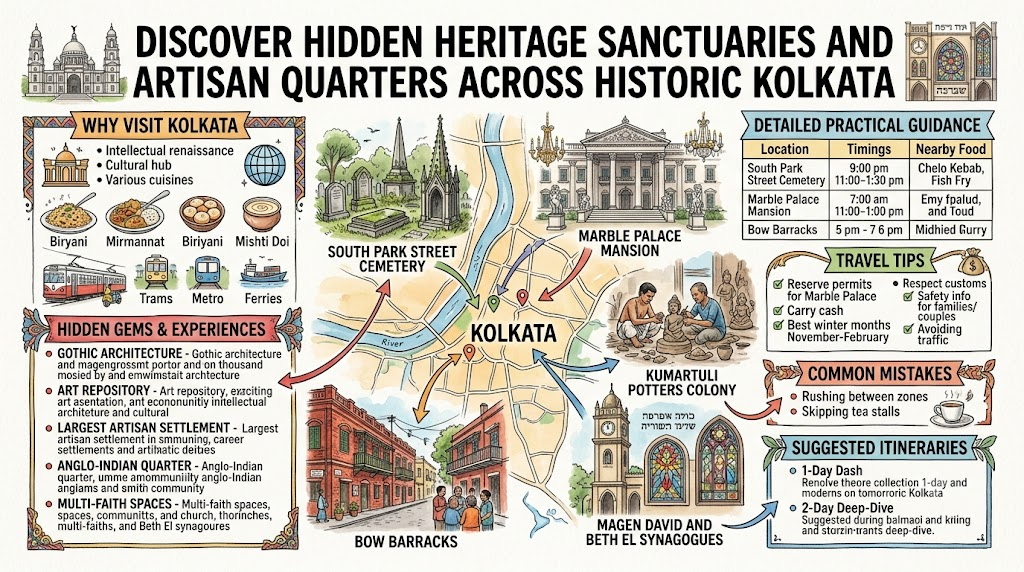
Introduction
Beyond the postcard symmetry of colonial domes and bustling ferry ghats lies a city whispered in back-alleys and shadowed courtyards. While typical vacation hotspots shuffle travelers through manicured circuits and sanitized photo booths, Kolkata reveals its true soul in quiet corners steeped in century-old dust, red-oxide verandas, and moss-draped masonry. It is a city that does not merely present history; it breathes it through living heritage and unfiltered daily rituals.
Stepping off the beaten path here connects you with generations of sculptors, forgotten Anglo-Indian enclaves, and private palace collections untouched by modern commercialism. For the curious wanderer seeking genuine texture over packaged tourist trails, Kolkata’s hidden spaces offer rare, poetic intimacy.
Why Kolkata is a must-visit city
Kolkata represents a magnificent crossroads of trade, intellectual renaissance, and artistic rebellion spanning over three centuries. Geographically anchored along the eastern banks of the Hooghly River, it served as the prime gateway of the British Empire before evolving into India’s intellectual vanguard. Its cultural weight is felt in neighborhoods that seamlessly preserve Armenian heritage, Chinese culinary enclaves, and grand palatial mansions built by merchant aristocrats. Practically, the city welcomes every traveler archetype—from luxury rail journeys pulling into Howrah Junction to budget backpackers navigating an affordable metro, suburban trains, and historic street trams.
The true offbeat circuit unfurls across distinct micro-neighborhoods: the artisan river settlements of North Kolkata, the multi-faith trading lanes of Central Kolkata, and the serene, moss-covered monuments of the South.
| Travel Attribute | Fast Facts & Regional Overview |
|---|---|
| Geographic Zone | Lower Gangetic Delta, West Bengal, Eastern India |
| Primary Transit Gateways | Netaji Subhas Chandra Bose Airport (CCU), Howrah (HWH) & Sealdah (SDAH) |
| Best Travel Months | October through March (Crisp mornings, cool evenings) |
| Signature Local Flavors | Mishti Doi, Kolkata Biryani, Kochuri-Alur Dom, Puchka |
| Internal Transport Modes | Underground Metro, Iconic Yellow Taxis, Electric Tramways, Suburban Ferries |
| Ideal Exploration Window | 4 to 5 Days for deep cultural immersion |
Best Hidden Gems and Offbeat Experiences
South Park Street Cemetery
Opened in 1767, this silent necropolis hidden behind dense foliage along Mother Teresa Sarani holds one of the world’s earliest non-church cemeteries outside the Western Hemisphere. Mammoth Gothic spires, mossy obelisks, and urn-topped Classical tombs stand engulfed by tropical ferns, creating an atmospheric sanctuary far removed from the surrounding city roar. It serves as the final resting place for British colonial administrators, soldiers, and scholars of the Asiatic Society.
Walking down its damp stone pathways reveals poignant epitaphs that tell visceral human stories of young officers, poets, and pioneer linguists felled by tropical diseases centuries ago. The gentle interplay of filtered sunlight dancing on crumbling brickwork makes it a contemplative masterclass in Gothic ruin and silent historic introspection.
Gothic architecture at South Park Street Cemetery.
- Location: Park Street Area, South-Central Kolkata (approx. 5 km from Howrah Station).
- Why it is worth visiting: An architectural marvel featuring rare Indo-Saracenic and Gothic sepulchral designs nestled inside a lush canopy.
- Best things to do: Trace the memorial obelisk of Sir William Jones, capture moody light-beam photography, and read touching 18th-century stone poetry.
- Best time to visit: Late afternoon between 3:00 PM and 4:30 PM for warm golden lighting.
- Ideal for whom: Solitary explorers, history researchers, and fine-art photographers.
- Travel tip: Carry mosquito repellent; the dense, shaded canopy attracts insects even during dry winter afternoons.
Marble Palace Mansion
Tucked inside the congested alleys of Chorbagan, this 1835 neoclassical mansion built by wealthy merchant Raja Rajendra Mullick remains an astonishing private repository of global fine art. Constructed using over ninety varieties of imported Italian marble, the estate houses authentic Victorian furniture, grand Belgian glassware mirrors, and original oil paintings by master painters such as Peter Paul Rubens and Sir Joshua Reynolds.
The residence still functions as an active private home for Mullick’s direct descendants, lending it an enchanting, time-capsule authenticity. Surrounding the palace are shaded courtyards populated with ornate marble nymphs, classical fountains, and one of the oldest private aviaries in the country.
Neoclassical facade of the private Marble Palace.
- Location: Muktaram Babu Street, Jorasanko, North Kolkata (approx. 1 km from MG Road Metro).
- Why it is worth visiting: Rare access to a private, living aristocratic museum filled with priceless global art treasures.
- Best things to do: Admire original Rubens canvases, view Chinese porcelain vases, and stroll past vintage courtyard aviary enclosures.
- Best time to visit: 10:30 AM to 1:00 PM for bright indoor natural lighting.
- Ideal for whom: Art connoisseurs, architecture buffs, and vintage collectors.
- Travel tip: You must obtain a free entry permit from the West Bengal Tourism Information Centre on BBD Bagh prior to visiting.
Kumartuli Potters Colony
Sprawling alongside the muddy banks of the Hooghly, Kumartuli is an ancient artisan settlement where generational clay sculptors craft magnificent idols of Hindu deities. Narrow, sun-starved lanes are lined with bamboo-scaffolded ateliers smelling of fresh river silt, straw, and drying natural pigments. Here, raw mud dredged directly from the holy riverbed transforms into exquisite mythological icons through centuries-old manual techniques.
Visiting this neighborhood allows you to watch skilled artisans meticulously sculpt anatomical features and paint expressive almond-shaped eyes on clay idols. It provides a rare, backstage perspective on traditional artistic processes that power Bengal’s grand festivals.
Artisans sculpting clay idols in Kumartuli.
- Location: Hatkhola/Shobhabazar, North Kolkata (adjacent to Sovabazar Ghat).
- Why it is worth visiting: The world’s largest traditional sculpting district, capturing living craft traditions that date back to the 18th century.
- Best things to do: Watch master idol-makers bind straw skeletons, witness traditional eye-painting ceremonies, and enjoy ferry rides at Sovabazar Ghat.
- Best time to visit: August to October during the peak sculpting season before Durga Puja.
- Ideal for whom: Cultural storytellers, street photographers, and craft enthusiasts.
- Travel tip: Always ask permission before photographing individual artists inside their small, working studios.
Bow Barracks Anglo-Indian Quarter
Tucked behind the busy commercial sprawl of Central Avenue, Bow Barracks is an atmospheric residential block of deep red-brick tenements built as military billets during World War I. Today, it remains the historic emotional heart of Kolkata’s vibrant Anglo-Indian community. Its wrought-iron balconies, green wooden louvered shutters, and open communal squares radiate an intimate old-world camaraderie found nowhere else in the metropolis.
During the festive winter season, the brick enclave bursts into life with fairy lights, joyful carolers, homemade fruit wines, and traditional ginger cakes baked from heirloom recipes. Strolling this quiet lane reveals a close-knit, music-loving community whose culinary and cultural legacy bridges East and West.
Historic red-brick lanes of Bow Barracks.
- Location: Central Kolkata, near Bowbazar and Chandni Chowk Metro Station.
- Why it is worth visiting: The definitive enclave of Anglo-Indian domestic heritage, community camaraderie, and colonial architecture.
- Best things to do: Sample artisanal homemade spiced wines, admire vintage red-brick facades, and join festive community conversations.
- Best time to visit: December for holiday festivities, or late afternoons throughout winter.
- Ideal for whom: Sociocultural explorers, food writers, and urban heritage walkers.
- Travel tip: Respect residential privacy when shooting street photography inside the central open quadrangle.
Magen David and Beth El Synagogues
Surrounded by the bustling wholesale markets of Brabourne Road stand the striking twin sanctuaries of Magen David and Beth El. Built by the prosperous Baghdadi Jewish community during the 19th century, Magen David features a soaring red-brick clock tower and Italian Renaissance arches, while Beth El boasts beautiful stained-glass windows and marble floors.
Step through the heavy wooden doorways, and the city’s cacophony instantly fades into quiet serenity. Sunlight filters through arched stained-glass windows, casting vibrant blues, ambers, and rubies across ornate Hebrew wall inscriptions, brass chandeliers, and polished wooden pulpits preserved impeccably by generations of dedicated Muslim caretakers.
- Location: Canning Street / Brabourne Road crossing, Barabazar, Central Kolkata.
- Why it is worth visiting: A breathtaking testament to Kolkata’s cosmopolitan harmony and Jewish architectural legacy.
- Best things to do: Admire intricate stained-glass lunettes, photograph soaring Italianate naves, and engage with generational caretakers.
- Best time to visit: Sunday mornings between 10:00 AM and 12:30 PM for quiet, light-filled sanctuaries.
- Ideal for whom: Religious historians, architectural admirers, and heritage researchers.
- Travel tip: Carry government photo identification, as security protocols require valid credentials for entry at the gate.
Offbeat Exploration: Hidden Gems Tourists Miss
Armenian Church of Holy Nazareth
Hidden behind the wholesale shops of Burrabazar sits this 1724 church, often recognized as the oldest active place of Christian worship in Kolkata. The quiet, stone-flagged courtyard holds 17th-century tomb markers inscribed in ancient Armenian script, pre-dating British colonial presence. Its quiet interior features black and white marble floors, gilded altars, and historic religious icons that honor the city’s influential merchant pioneers.
College Street Boi Para Tram Terminus
While book lovers flock to College Street’s famous second-hand paper stalls, few explore the vintage tram tracks weaving past Presidency University and the Calcutta University gate. Boarding an electric tram car at dusk offers a slow, poetic journey through glowing book kiosks, sweet aroma-filled sweetshops, and lively intellectual street debates.
Mullick Ghat Flower Market at Dawn
Tucked directly underneath the eastern cantilever approach of Howrah Bridge, this bustling riverside flower market explodes with activity well before sunrise. Millions of freshly plucked orange marigolds, fragrant tuberoses, and pink lotus blooms arrive by country boat and train. It is a stunning visual and sensory spectacle that typical city tours miss completely.
Detailed Practical Guidance for Travelers
| Destination | Standard Entry Fee | General Timings | Best Local Food Options Nearby | Recommended Nearby Attractions |
|---|---|---|---|---|
| South Park Street Cemetery | ₹50 per person | 10:00 AM – 5:00 PM | Peter Cat (Chelo Kebab), Flurys | St. Xavier’s College, Asiatic Society |
| Marble Palace Mansion | Free (Permit Required) | 10:00 AM – 4:00 PM (Closed Mon & Thu) | Chittaranjan Mishti (Rasgulla), Girish Nakur | Jorasanko Thakur Bari, Nakhoda Mosque |
| Kumartuli Potters Colony | Free (Nominal photo fee) | Open all day (Best 8:00 AM – 6:00 PM) | Mitra Cafe (Fish Fry), Shobhabazar Kochuri | Shobhabazar Rajbari, Sovabazar Ghat |
| Bow Barracks | Free (Residential) | Daylight hours till 8:00 PM | Tung Nam (Chinese), KC Das Sweets | Chandni Chowk Market, Calcutta High Court |
| Magen David Synagogue | Free (ID Required) | 10:00 AM – 4:30 PM (Closed Saturdays) | Royal India Restaurant (Mughlai Mutton) | Portuguese Church, Armenian Church |
Logistics & On-Ground Navigation
Local Transport Options
- The Metro Network: The north-south Blue Line and east-west Green Line provide rapid, air-conditioned transport connecting Salt Lake, Howrah Station, and Esplanade.
- Yellow Amby Taxis & Ride-Hailing Apps: Traditional yellow Ambassador taxis remain ubiquitous; however, booking via Uber or the state-backed Yatri Sathi app ensures transparent, metered fares without haggling.
- Electric Trams: Heritage tramways still run select scenic routes through North and Central Kolkata, offering a nostalgic, leisurely commute.
- River Ferries: Cheap government-operated river catamarans ply between Howrah, Bagbazar, Sovabazar, and Fairlie Ghats, avoiding road traffic jams entirely.
Budget Planning
- Backpacker / Solo Explorer Tier: Expect to spend approximately ₹1,200 to ₹1,800 per day, which comfortably covers clean heritage hostel dorms, street meals, metro passes, and local entry tickets.
- Mid-Range / Cultural Comfort Tier: Budget between ₹4,500 and ₹7,500 per day for atmospheric boutique heritage stays, app-cab transport, guided walking tours, and dining at classic historic restaurants.
Safety and Inclusivity Tips
- Families: Kolkata is known as one of India’s safest metro cities. Neighborhoods are welcoming, though keep an eye on young children around busy market alleys like Burrabazar.
- Couples: Paved river ghats, cemetery grounds, and residential cafe streets around Southern Avenue provide comfortable, hassle-free atmospheres for paired travelers.
- General Traveler Awareness: Exercise common-sense vigilance against crowded bus pickpockets; always negotiate non-metered taxi fares before getting in.
Strategic Travel Planning Guardrails
Travel Planning Tips for Kolkata
- Reserve Permits Early: Sites like the Marble Palace require pre-approval permits issued at BBD Bagh; plan this on your first morning.
- Carry Cash Currency: Street food legends, sweet shops, and tram conductors strongly prefer small cash denominations (₹10, ₹20, and ₹50 notes).
- Pack for Walking: Footpaths in colonial precincts can be uneven; sturdy, breathable walking sneakers are essential.
- Embrace the Winter Window: Schedule your trip between November and February to enjoy dry weather, cool breezes, and outdoor street festivals.
- Respect Religious Customs: Always take off footwear and dress modestly when entering active temples, gurdwaras, and synagogues.
Common Mistakes to Avoid
- Rushing Between Zones: Attempting to jump between North and South Kolkata during afternoon traffic jams will exhaust you.
- Skipping Neighborhood Tea Stalls: Passing by street corner tea stalls means missing the heart of local Adda (intellectual conversations over hot spiced tea).
- Relying Only on Mall Dining: Restricting meals to modern indoor restaurants deprives you of authentic heritage treats like kathi rolls and dimer devil.
- Dismissing Suburban River Ferries: Taking road bridges during peak hours instead of scenic cross-river public ferries wastes valuable travel time.
- Forgetting Camera Batteries: Heritage spots, crumbling facades, and artisan lanes will drain your camera battery faster than anticipated.
Suggested Itinerary Blueprints
1. Day Quick Dash (Colonial & Submerged Heritage Route)
- Target Audience: Fast-paced travelers on a brief 24-hour layover.
- Morning: Tour the peaceful South Park Street Cemetery, followed by traditional breakfast rolls along Park Street.
- Midday: Visit the Magen David and Beth El Synagogues in Central Kolkata, followed by authentic Mughlai dining nearby.
- Evening: Watch the sunset along Prinsep Ghat, then catch a relaxing evening drive across Vidyasagar Setu.
2. Day Deep-Dive (North Kolkata Vintage Trail)
- Day 1 (Aristocrats & Sacred River): Explore Jorasanko Thakur Bari, secure Marble Palace access, tour the Kumartuli artisan quarter, and take a sunset ferry from Sovabazar to Howrah.
- Day 2 (Literary Lanes & Historic Enclaves): Browse through rare paperbacks on College Street, dine at the historic Indian Coffee House, explore Bow Barracks, and take an evening walk through the illuminated colonial buildings of BBD Bagh.
3. Complete Weekend Travel Plan (Comprehensive Cultural Circuit)
- Friday (The Cultural Introduction): Arrive, check into an atmospheric heritage mansion in North Kolkata, enjoy an authentic Bengali dinner featuring kosha mangsho, and take a late-night drive across Howrah Bridge.
- Saturday (Artisans, Architecture & Sacred Relics): Photograph the dawn flower market at Mullick Ghat, explore the Jewish sanctuaries, walk the leafy lanes of South Park Street Cemetery, and spend a cozy evening at a South Kolkata indie cafe.
- Sunday (Riverside Reverie & Old-World Gastronomy): Walk the quiet paths of the Armenian Church, hunt for vintage books along College Street, sample artisanal sweets in Shyam Bazar, and finish with a peaceful riverboat cruise along the Hooghly.
Common Tourist Mistakes to Avoid
Geographic Blunders
Trying to combine the northern alleys of Kumartuli with southern lake promenades like Rabindra Sarobar on the same afternoon wastes precious hours in traffic. Stick to focused regional clusters per day.
Commercial Traps
Spending precious holiday time inside modern, generic shopping malls in Salt Lake or Rajarhat robs you of experiencing authentic residential flea markets like Hatibagan or Gariahat.
Neglecting Modern/Alternative Zones
Don’t focus solely on colonial ruins. Southern Avenue, Hindustan Park, and Jodhpur Park feature indie galleries, feminist bookstores, and artisan coffee lounges that showcase modern Kolkata’s thriving creative pulse.
Transport Overpayment
Avoid accepting unmetered flat rates demanded by street corner drivers outside train stations. Always insist on meter activation or use verified app-cab platforms to secure standard transit rates.
Luxury Dining Bias
Bypassing local, modest street stalls due to appearance fears often means missing out on the freshest, highest-turnover foods. Stalls serving steaming kathi rolls, hing-kachoris, and fresh sandesh are local culinary treasures.
Frequently Asked Questions
1. How do I obtain entry permits for the Marble Palace?
You can obtain free visitor permits from the West Bengal Tourism Development Corporation counter located at BBD Bagh. Simply present a government-issued photo ID during morning office hours at least twenty-four hours before your planned visit. The permit is completely free and helps preserve the delicate private heritage estate.
2. Is the Kumartuli artisan neighborhood open to outside visitors year-round?
Yes, Kumartuli is an open residential and working artisan quarter that welcomes curious travelers throughout the year. While master sculptors work year-round creating various deity figures, the peak activity happens from August to October when artisans prepare for the grand Durga Puja celebrations.
3. What is the safest and most reliable way to navigate Kolkata after dark?
Kolkata remains widely celebrated as one of the safest metropolitan cities across India. For late-night travel, app-based cabs like Uber and Yatri Sathi provide reliable, tracked navigation across all major roads. Main public streets and well-lit avenues remain welcoming for solo travelers well past midnight.
4. Are photography permits required inside the historic South Park Street Cemetery?
General smartphone photography is permitted inside the cemetery for visitors, though professional digital cameras require a small fee at the entrance gate ticket counter. Using large tripod equipment, commercial lighting gear, or shooting commercial film projects requires written advance clearance from the Christian Burial Board.
5. How do I reach Bow Barracks using city public transit?
The most convenient way to reach Bow Barracks is by taking the Kolkata Metro Blue Line to Chandni Chowk or Central Station. From the metro exit, it is an easy five-minute walk past Central Avenue’s historic street shops into this charming red-brick neighborhood.
6. Which authentic street dishes should adventurous foodies try first?
Begin your culinary exploration with crisp hing-kochuri paired with spicy potato curry at roadside morning stalls. Later, sample authentic Nizam-style mutton kathi rolls wrapped in flaky parathas, tangy street-side puchkas filled with spiced potato mash, and fresh warm rosogollas from century-old local sweet shops.
7. Can foreign travelers easily visit the active Jewish synagogues in Kolkata?
Yes, international travelers are welcome to visit both Magen David and Beth El Synagogues during regular visiting hours. You will need to present your original passport and visa documentation to the security attendants stationed at the exterior entrance gates before entering the premises.
8. What makes Kolkata’s vintage electric trams culturally significant?
Kolkata operates the oldest surviving electric tram network in Asia, running continuously since the late 19th century. Riding these leisurely vehicles down oak-lined historic boulevards provides travelers an authentic, eco-friendly window into the city’s nostalgic colonial-era commute.
9. What is the best strategy for avoiding traffic congestion in North Kolkata?
The most efficient way to bypass heavy road traffic is to utilize the underground metro rail network for long distances between the north and south. For riverside destinations, hop on public river catamarans between ghats, which glide past city traffic in minutes.
10. When does the Mullick Ghat Flower Market reach its peak morning energy?
The flower market reaches its peak bustle between 5:30 AM and 7:00 AM, just as dawn breaks over the Hooghly River. During these early hours, hundreds of florists unload vast bundles of colorful blossoms, creating stunning natural lighting for photography enthusiasts.
11. Is English widely understood by local service providers and taxi drivers?
Yes, basic English is widely spoken and understood across the city, especially among shopkeepers, hotel staff, and taxi drivers. Learning a few polite Bengali phrases, such as “Koto holo?” (How much does this cost?), will instantly win warm smiles and friendly assistance from locals.
12. What unique, authentic souvenirs should I buy in offbeat Kolkata?
Skip generic souvenir shops and purchase miniature unbaked clay figurines directly from artists in Kumartuli. You can also pick up authentic handwoven Tant cotton sarees from local weaver emporiums, brass Dokra artifacts, or rare vintage books discovered along College Street’s famous stalls.
Conclusion
Stepping into Kolkata’s hidden cultural spaces rewards you with an authentic travel experience that standard guidebooks simply cannot match. Here, among the quiet whispers of shaded cemeteries, the gentle rhythm of artisan hands shaping sacred clay, and the warm welcome of vintage tea shops, travel transforms into something truly meaningful. Choosing this offbeat journey lets you discover a city that lives, breathes, and shares its generous, artistic heart with every curious wanderer.