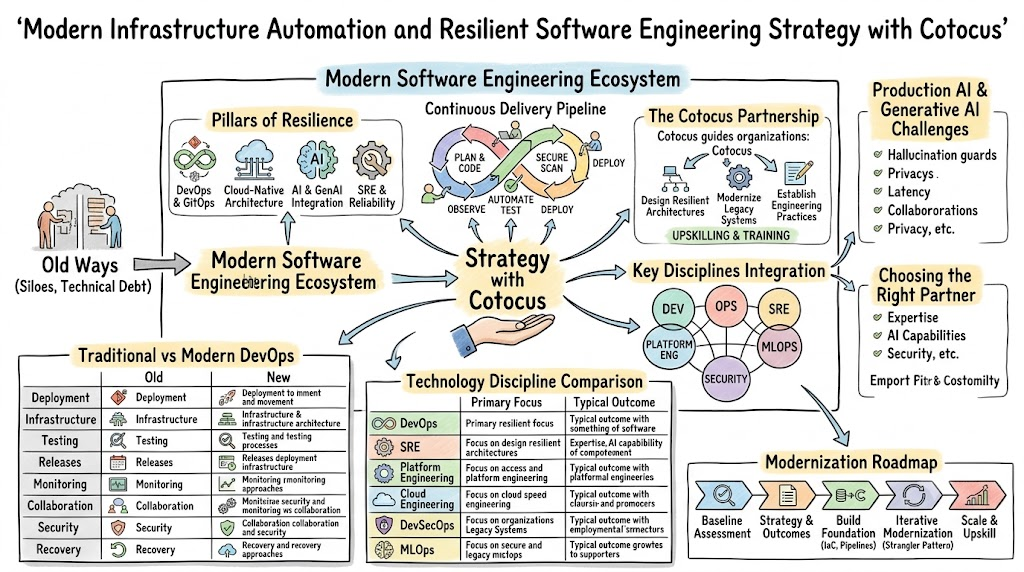
Introduction
Modern software engineering is changing rapidly because customer expectations and competitive pressures demand continuous digital innovation. Today, businesses must seamlessly connect artificial intelligence, multi-cloud platforms, DevOps, site reliability engineering, platform engineering, and scalable SaaS models to achieve true operational excellence. Many organizations face acute challenges, including fragmented toolchains, mounting technical debt, brittle release pipelines, and persistent reliability issues in distributed environments. This comprehensive guide outlines the foundational disciplines necessary to navigate modern digital transformation and establish resilient engineering practices. Along this journey, specialized technology service providers such as Cotocus help engineering organizations bridge strategic vision and hands-on operational delivery without disruptive rewrites.
What Is Modern Software Engineering?
Modern software engineering is an integrated, product-oriented practice that unifies cloud infrastructure, automated software delivery, continuous observability, strict security policies, and artificial intelligence into everyday workflows. In sharp contrast to traditional development, which relied heavily on isolated development silos and quarterly manual deployments, modern engineering emphasizes modular microservices, rapid feedback loops, and automated verification. Development teams now use Infrastructure as Code, container orchestration, and real-time telemetry to build highly resilient digital platforms. Ultimately, this paradigm shift treats operational reliability, security, and developer productivity as core architectural requirements rather than secondary considerations.
Why Businesses Are Moving Toward AI-Powered Software
Businesses are rapidly adopting artificial intelligence to automate routine operational tasks, extract actionable insights from unstructured data, and improve customer experiences. Organizations deploy intelligent search, conversational customer support agents, smart recommendation engines, predictive analytics, and automated document processing pipelines to scale business processes effectively. However, while artificial intelligence offers substantial competitive advantages, it is not a universal solution for every software challenge. Forward-thinking leaders balance these powerful automation capabilities with realistic constraints, such as data privacy compliance, inference latency, hardware resource costs, and occasional model hallucinations.
What Are Generative AI Development Services?
Professional Generative AI Development Services enable enterprises to build production-grade applications that leverage large language models, autonomous agents, and retrieval-augmented generation architectures. Instead of relying solely on generic foundation models, these specialized services integrate private vector databases, document parsers, semantic caching, and strict data sanitization guardrails into enterprise workflows. A dependable production architecture continuously monitors token consumption, validates model output accuracy, mitigates prompt injection risks, and enforces strict corporate data privacy standards. Consequently, organizations can safely implement intelligent document comprehension, internal code assistants, and automated customer service agents without compromising sensitive intellectual property.
AI Software Development Company — What Should You Expect?
Engaging a capable AI Software Development Company requires a structured evaluation of their end-to-end engineering, security, and operational capabilities. A trustworthy technology partner does not merely string API calls together; they architect robust data pipelines, establish continuous evaluation benchmarks, optimize cloud inference latency, and enforce comprehensive security guardrails. To select the right development firm, engineering leaders should assess each candidate using this targeted technical checklist:
- Production Architecture Expertise: Proven capability in orchestrating vector databases, semantic caches, context retrieval pipelines, and private model deployments.
- Rigorous Model Evaluation: Structured frameworks for measuring hallucinations, contextual relevance, answer accuracy, and inference latency under variable loads.
- Comprehensive Data Protection: Robust zero-data-retention agreements, enterprise role-based access controls, and strict compliance with global privacy standards.
- Cloud Infrastructure Optimization: Practical experience in managing scalable inference clusters, serverless orchestration, and cloud compute cost management.
- Lifecycle Maintenance Support: Proactive model monitoring, automated retraining workflows, and post-deployment performance fine-tuning.
Custom Software Development — When Is It Necessary?
Collaborating with a dedicated Custom Software Development Company becomes essential when off-the-shelf software cannot satisfy distinct operational workflows or deliver meaningful competitive differentiation. Custom software engineering encompasses high-performance web applications, native mobile experiences, scalable internal tooling, and robust enterprise API ecosystems designed around specific business needs. While commercial commercial products offer rapid onboarding, custom systems give businesses full control over architecture, proprietary intellectual property, integration roadmaps, and security standards. Nevertheless, companies must carefully balance these long-term strategic advantages against initial capital expenditures, custom software maintenance overhead, and longer delivery timelines.
SaaS Product Development — From Idea to Scalable Product
Partnering with an experienced SaaS Product Development Company allows digital ventures to navigate the complete software lifecycle from initial concept validation through high-scale multi-tenant production. Architects must resolve demanding operational challenges, including secure tenant isolation, flexible subscription billing engines, unified identity management, and comprehensive usage telemetry. Engineering teams must also build resilient API integrations, implement zero-downtime database migration strategies, and maintain elastic cloud infrastructure that scales smoothly with user growth. By prioritizing clean API design and automated horizontal scaling from the very beginning, SaaS businesses avoid costly architectural refactoring down the road.
Cloud Consulting Services and Modern Infrastructure
Engaging comprehensive Cloud Consulting Services helps organizations design, optimize, and manage resilient cloud infrastructure across Amazon Web Services, Microsoft Azure, and Google Cloud Platform. While standard cloud migration simply rehosts existing virtual machines into cloud environments, true cloud modernization re-architects legacy applications into cloud-native microservices using Kubernetes, serverless platforms, and automated Infrastructure as Code. Expert cloud consultants also establish automated disaster recovery strategies, enforce granular security guardrails, and implement robust FinOps practices to eliminate unnecessary cloud expenditure. Through deliberate modernization, engineering teams achieve genuine elastic scaling, superior operational resilience, and significantly shorter development lifecycles.
DevOps Consulting Services — Improving Software Delivery
Engaging experienced DevOps Consulting Services empowers organizations to establish automated continuous integration and continuous delivery pipelines, standardized version control practices, and rapid release cadences. True DevOps maturity requires cultivating a blameless engineering culture and shared operational ownership rather than simply purchasing modern automation tools. By incorporating declarative GitOps workflows, automated security testing, containerized runtimes, and end-to-end telemetry into development lifecycles, teams eliminate risky manual deployments and brittle handoffs. As a result, software organizations deliver secure, high-quality features to production frequently, predictably, and with absolute operational confidence.
Traditional vs Modern DevOps
Transitioning from traditional IT management to a modern automated engineering ecosystem fundamentally reshapes how development and operations teams collaborate across every phase of delivery.
| Area | Traditional Approach | Modern DevOps Approach |
| Deployment Cadence | Infrequent, high-risk manual deployments scheduled outside business hours | Frequent, fully automated, low-risk continuous deployments |
| Infrastructure Management | Manually provisioned physical servers and untracked virtual machines | Declarative Infrastructure as Code managed through version control |
| Testing Strategies | Slow, manual end-to-end regression testing before major releases | Automated unit, integration, and security tests within CI/CD pipelines |
| Release Management | Complex coordination meetings and manual release runbooks | Progressive delivery using blue-green, canary, and feature flags |
| Monitoring & Telemetry | Fragmented server metrics and reactive, user-reported system outages | Unified observability combining distributed traces, metrics, and logs |
| Team Collaboration | Siloed development, quality assurance, and operations teams | Cross-functional squads with shared accountability for production |
| Security Governance | Perimeter audits performed late in the software development lifecycle | Shift-left security with automated code, secret, and dependency scanning |
| Disaster Recovery | Manual restores relying on outdated documentation and backups | Automated self-healing, immutable infrastructure, and tested failover |
SRE Consulting Services — Making Reliability Measurable
Professional SRE Consulting Services apply software engineering methodologies directly to infrastructure operations, making system reliability, availability, and performance mathematically quantifiable. Site reliability engineers establish concrete Service Level Indicators, realistic Service Level Objectives, and formal error budgets that objectively balance feature release velocity against platform stability. Through automated alerting, actionable observability, proactive capacity planning, and blameless post-incident reviews, teams identify systemic vulnerabilities long before major customer-facing outages occur. Engineering resilience into software platforms proactively protects brand reputation, satisfies contractual obligations, and ensures uninterrupted operational performance.
Platform Engineering Services and Developer Productivity
Implementing modern Platform Engineering Services enables organizations to build dedicated Internal Developer Platforms that deliver self-service infrastructure, standardized toolchains, and frictionless delivery workflows. Unlike traditional operations teams that handle manual provisioning tickets, platform engineers provide pre-approved infrastructure templates, automated compliance guardrails, and unified telemetry as a curated internal product. This approach reduces cognitive load for software engineers, accelerates developer onboarding, eliminates repetitive setup tasks, and guarantees consistent organizational security standards. Consequently, application developers can focus on writing business logic rather than troubleshooting infrastructure configuration files.
How DevOps, SRE and Platform Engineering Work Together
Modern technical organizations achieve operational excellence by coordinating DevOps, site reliability engineering, platform engineering, cloud engineering, DevSecOps, and MLOps into a unified delivery framework. Cloud engineers manage underlying hyper-scale infrastructure, while platform engineers build self-service portals and standardized application templates on top of that foundation. DevOps workflows automate testing and artifact deployments, DevSecOps practices embed continuous security guardrails, and SRE teams define operational reliability metrics and incident response workflows. Concurrently, MLOps specialists maintain dedicated pipelines for packaging and serving machine learning models, ensuring seamless cross-disciplinary collaboration across the software lifecycle.
Technology Discipline Comparison
Understanding the individual boundaries and operational outcomes of each engineering discipline allows business leaders to align technical investments with strategic business goals.
| Discipline | Primary Focus | Typical Outcome |
| DevOps | Continuous integration, automated delivery, and team collaboration | Rapid, automated, and repeatable software deployments |
| Site Reliability Engineering | Operational availability, performance thresholds, and error budgets | Quantifiable platform stability and systematic incident management |
| Platform Engineering | Internal developer platforms, golden paths, and self-service portals | Reduced developer cognitive load and higher feature velocity |
| Cloud Engineering | Cloud architecture, network provisioning, and compute scalability | Resilient, cost-optimized, and elastic cloud infrastructure |
| DevSecOps | Shift-left security automation, vulnerability scanning, and compliance | Secure release pipelines with continuous policy enforcement |
| MLOps | Machine learning lifecycle, model deployment, and data monitoring | Reliable, reproducible, and scalable production AI workflows |
Digital Transformation Consulting
Strategic Digital Transformation Consulting aligns technology modernization directly with core enterprise business outcomes, customer experiences, and operational processes. True transformation requires rethinking legacy organizational structures, upgrading data governance models, and modernizing foundational architectures rather than merely migrating legacy applications into the cloud. Consultants guide executives through identifying what business capabilities need modernization, explaining why organizational changes are necessary, and executing structured technological roadmaps. By uniting modern software architectures with updated cultural practices, businesses build durable, agile organizations capable of adapting to shifting market conditions.
Corporate DevOps Training
Investing in comprehensive Corporate DevOps Training ensures that internal engineering teams master the technical skills required to build, operate, and maintain modern software systems independently. Hands-on learning programs tailored to an organization’s specific technology stack allow developers and systems engineers to master Kubernetes, container runtimes, declarative infrastructure, DevSecOps, and platform engineering patterns. Practical training accelerates developer onboarding, eliminates costly reliance on external contractors, and helps retain high-performing engineering talent seeking continuous professional growth. By grounding educational programs in real-world codebases, enterprises build self-sufficient engineering cultures capable of driving continuous digital innovation.
Real-Life Scenarios / Experiences
Examining how different organizations modernize their technical ecosystems highlights the practical value of integrating modern engineering disciplines into production environments.
- High-Growth Fintech Scaling Challenges: A rapidly growing payment provider faced severe latency spikes and unpredictable database locking during peak shopping holidays. By adopting site reliability engineering methodologies, establishing clear error budgets, and re-architecting payment pipelines into event-driven microservices on Kubernetes, the team eliminated unannounced downtime and scaled throughput threefold.
- Legacy Healthcare Cloud Modernization: An enterprise healthcare organization struggled with quarterly release cycles and compliance audit delays caused by manual server configurations. By partnering with cloud and DevSecOps consultants to implement automated Infrastructure as Code and continuous compliance scanning, the engineering team reduced release cycles from ninety days to three hours while maintaining strict data privacy compliance.
- E-Commerce AI Search Implementation: An international retail platform suffered from high cart abandonment rates driven by poor search relevance and rigid product taxonomy filters. By integrating a retrieval-augmented generation search pipeline backed by semantic vector embeddings and automated caching layers, the company improved product discovery and lifted digital conversion rates by twenty-two percent.
How to Choose the Right Technology Partner
Selecting an engineering partner requires evaluating practical technical competence, architecture standards, security maturity, and transparent communication practices rather than polished sales presentations. Technology leaders should look for demonstrated expertise across artificial intelligence, cloud architectures, automated delivery pipelines, site reliability engineering, and continuous developer training. Furthermore, prospective partners must provide clear technical documentation, define post-launch maintenance expectations, and demonstrate a track record of upskilling their clients’ internal teams. Choosing a partner that emphasizes knowledge transfer guarantees that your organization builds lasting operational capability rather than permanent external dependencies.
Where Cotocus Fits Into Modern Digital Engineering
Operating as a specialized technology consultancy, Cotocus assists startups, digital enterprises, and technology-first organizations with building, modernizing, and maintaining complex digital platforms. The firm delivers end-to-end engineering support across custom software development, SaaS product architectures, cloud consulting, and modern platform engineering. In addition, their teams help organizations deploy production-ready generative artificial intelligence workflows, configure site reliability practices, and implement automated continuous delivery pipelines. By combining strategic digital transformation consulting with hands-on corporate engineering training, the consultancy helps enterprises scale digital capabilities while fostering internal technical excellence.
When Should a Business Consider These Services?
Determining when to engage external technical expertise depends on identifying current operational friction points, delivery bottlenecks, and internal talent limitations.
| Business Challenge | Potentially Relevant Capability |
| Legacy System Inefficiencies | Digital Transformation Consulting and Cloud Modernization |
| Infrequent and Risky Software Deployments | DevOps Consulting Services and CI/CD Automation |
| Frequent Production Outages and Unclear SLOs | SRE Consulting Services and Observability Engineering |
| Need for Domain-Specific Customer Intelligence | Generative AI Development Services and Machine Learning |
| Developer Frustration and Slow Tooling Onboarding | Platform Engineering Services and Internal Developer Portals |
| Building a Multi-Tenant Scalable Web Product | SaaS Product Development Company and Microservices Architecture |
| Complex Multi-Cloud Migrations and Sprawling Costs | Cloud Consulting Services and Enterprise FinOps Architecture |
| Skill Gaps in Container Orchestration and Tooling | Corporate DevOps Training and Mentorship Programs |
How to Build a Practical Modernization Roadmap
Executing a successful digital modernization strategy requires a structured, iterative framework that delivers incremental business value without destabilizing running production operations.
- Assess Current Environments: Audit existing software architectures, operational pipelines, database schemas, and organizational skill profiles to establish a reliable operational baseline.
- Define Business Outcomes: Translate broad corporate goals into precise engineering metrics, such as reduced deployment frequency, lower latency, or improved customer retention rates.
- Prioritize Initiatives: Rank target initiatives by balancing strategic business impact against implementation complexity to capture early, high-visibility wins.
- Establish Foundations: Deploy automated testing pipelines, Infrastructure as Code frameworks, and centralized observability suites before attempting complex system refactoring.
- Modernize Selectively: Decompose monolithic systems gradually into cloud-native microservices or managed serverless functions using progressive delivery patterns like the strangler fig approach.
- Train Internal Teams: Provide targeted, hands-on training on container orchestration, modern monitoring tools, and platform workflows so staff can operate new systems comfortably.
- Measure and Improve: Review operational metrics, error budgets, and developer feedback loops continuously to iterate architectures and refine operational roadmaps systematically.
Common Mistakes to Avoid
Navigating an enterprise modernization initiative presents numerous organizational and technical pitfalls that can derail project timelines and inflate operating budgets.
- Purchasing Tools Without Process Changes: Buying modern software licenses without cultivating collaborative engineering practices and breaking down organizational silos rarely produces meaningful improvements.
- Treating Cloud as a Data Center: Rehosting legacy virtual machines directly into the cloud without modernizing architectures inflates compute costs while failing to deliver elastic scalability.
- Deploying AI for Non-Existent Needs: Integrating complex large language models into workflows where simple deterministic algorithms or structured database queries perform better wastes budget.
- Overlooking Internal Developer Experience: Forcing developers to navigate convoluted, undocumented infrastructure stacks without self-service platforms severely slows feature delivery and frustrates engineers.
- Ignoring Operational Observability: Deploying microservice architectures without centralized distributed tracing, unified metrics, and structured logging makes troubleshooting production failures nearly impossible.
- Neglecting Security Guardrails: Postponing security reviews until the final deployment phase introduces critical vulnerabilities, compliance violations, and expensive remediation delays.
- Underinvesting in Team Education: Modernizing production infrastructure without training existing staff creates dangerous knowledge gaps and forces permanent reliance on outside vendors.
- Attempting Monolithic Big-Bang Rewrites: Replacing an entire legacy platform in a single release introduces severe operational risks and almost always causes project delays.
Frequently Asked Questions
1. What is the fundamental difference between cloud migration and cloud modernization?
Cloud migration transfers existing workloads, virtual machines, and databases into a cloud environment with minimal architectural alterations. Cloud modernization refactors legacy applications into cloud-native architectures using containers, microservices, serverless components, and automated pipelines, unlocking true elasticity, higher availability, and lower ongoing operational expenses.
2. When should an enterprise hire a custom software development company instead of buying SaaS?
Businesses should pursue custom software development when their core processes provide a distinct competitive advantage, require unique operational workflows, or demand deep proprietary integrations. Off-the-shelf SaaS products remain better suited for non-differentiating utility functions such as standard bookkeeping, general email, or routine payroll processing.
3. How does site reliability engineering differ from traditional operations?
Site reliability engineering uses software engineering principles to solve operational problems, relying on mathematical metrics such as Service Level Objectives, Service Level Indicators, and error budgets. Traditional operations teams typically manage infrastructure through manual configurations, reactive ticketing queues, and isolated incident troubleshooting.
4. What is the main purpose of building an internal developer platform?
An internal developer platform provides self-service access to pre-approved infrastructure, standardized development toolchains, and automated deployment pipelines. By offering golden paths for common operational tasks, the platform reduces developer cognitive overhead, eliminates provisioning tickets, and ensures consistent organizational security policies.
5. Why is generative artificial intelligence not suitable for every business problem?
Generative artificial intelligence models are non-deterministic, computationally expensive, and susceptible to occasional factual hallucinations or security vulnerabilities. Many operational challenges require absolute mathematical precision, strict deterministic rule compliance, or low-cost transactional lookups that traditional database queries and standard algorithms solve far more efficiently.
6. What core features are essential for a scalable SaaS product architecture?
A scalable SaaS architecture requires secure multi-tenant data isolation, robust role-based access control, elastic horizontal scaling, and flexible subscription billing. It must also include structured API design for external integrations, automated database migrations, and comprehensive usage telemetry to monitor platform health.
7. How does DevSecOps change software delivery pipelines?
DevSecOps integrates automated security scanning, dependency analysis, container vulnerability checks, and policy-as-code controls directly into continuous integration pipelines. By shifting security verification left into the early development stages, teams discover and remediate security vulnerabilities before deploying application code to production.
8. What is retrieval-augmented generation and why is it valuable?
Retrieval-augmented generation is an architecture that queries an external vector database of proprietary enterprise documents to retrieve contextually relevant data before generating responses with a large language model. This approach grounds generated answers in validated corporate facts, mitigates hallucinations, and avoids expensive model retraining.
9. Why is corporate technical training necessary alongside infrastructure modernization?
Introducing modern technologies like Kubernetes, microservices, and automated delivery pipelines fails if internal engineers lack the skills to operate them. Comprehensive corporate training programs bridge this knowledge gap, build internal self-sufficiency, accelerate feature delivery, and eliminate permanent dependencies on external service providers.
10. How do error budgets help balance development speed and system stability?
Error budgets define the acceptable level of system unreliability a service can tolerate within a set period. When a platform maintains a healthy error budget, engineering teams can safely deploy new features rapidly; when the budget is depleted, priorities shift toward improving operational stability.
11. What are the key indicators that an organization needs platform engineering?
Organizations require platform engineering when application developers spend excessive time managing cloud infrastructure, resolving complex deployment scripts, or waiting on infrastructure provisioning tickets. Growing fragmentation across internal tools, inconsistent security practices, and lengthy developer onboarding times also signal the need for an internal developer platform.
12. How does an organization evaluate the success of a digital transformation initiative?
Digital transformation success is measured using concrete business and engineering metrics, including deployment frequency, lead time for changes, mean time to recovery, infrastructure costs, and customer satisfaction. The ultimate objective is establishing an agile, reliable organization capable of driving continuous digital innovation sustainably.
Conclusion
Modern software engineering requires a unified operational approach that harmonizes artificial intelligence, cloud architectures, automated DevOps pipelines, quantifiable SRE practices, and self-service platform engineering. Rather than treating digital modernization as a one-time project, successful enterprises view it as an ongoing commitment to organizational learning, cultural alignment, and architectural refinement. Upskilling internal staff through hands-on practice ensures that engineering teams maintain self-sufficiency as infrastructure complexity grows. At the same time, engaging an experienced technology partner like Cotocus helps organizations accelerate complex modernization roadmaps and implement production-ready architectures without unnecessary delivery risks. For ongoing technical development, enterprise teams can explore curated engineering ebooks and technical publications at blendz.com to support long-term continuous learning.