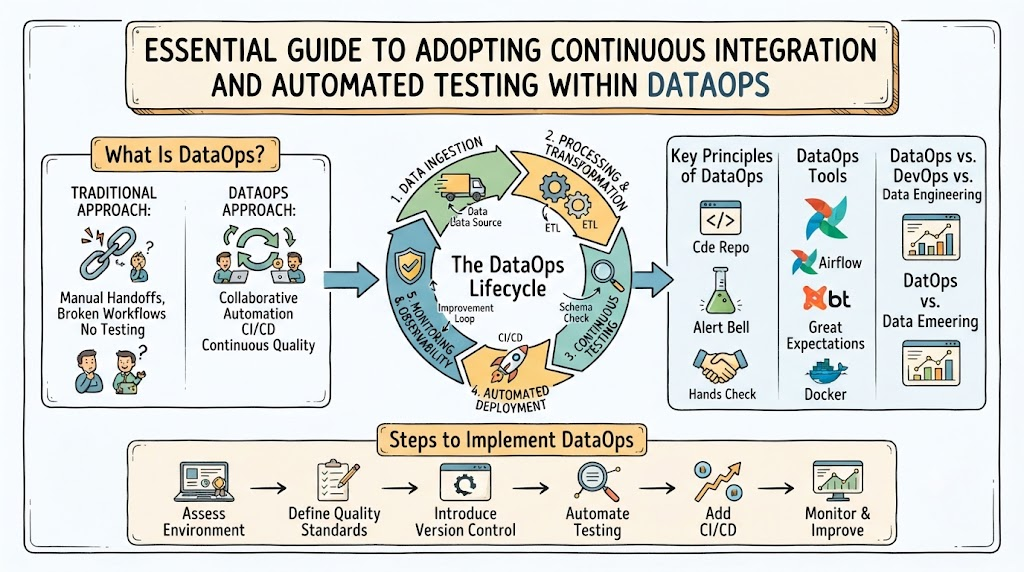
Introduction
Modern enterprises depend entirely on accurate data to guide critical decisions, yet legacy architectures frequently produce broken workflows and delayed reports. Establishing dependable pipelines requires moving past ad-hoc fixes and embracing sustainable automation throughout the entire operational lifecycle. This is where DataOps bridges engineering, quality, and platform infrastructure to accelerate production releases while ensuring strict operational reliability. Whether evaluating the exact scope behind “What is DataOps” or building high-throughput systems, mastering continuous delivery principles transforms struggling teams into dependable data providers. This technical guide explores lifecycle mechanics, core toolchains, and modern delivery strategies, highlighting structured training, certifications, and enterprise consulting available at DataOpsSchool.
What Is DataOps?
DataOps is an automated, process-oriented methodology used by data engineers, platform teams, and business analysts to improve the quality and reduce the cycle time of end-to-end data analytics. Unlike isolated data engineering that solely writes queries, DataOps infuses DevOps software engineering agility with the statistical process control of total quality management. For example, a legacy pipeline manually updates transformations directly inside production databases, risking widespread reporting outages whenever upstream APIs shift schema types unexpectedly. In contrast, a DataOps-driven architecture tests those schema updates within isolated pull requests, executes automated unit and regression checks, and releases the pipeline through automated deployment pipelines.
Why DataOps Matters for Modern Data Teams
Exponential increases in business data volume make manual maintenance an operational impossibility for modern data engineering teams operating across hybrid multi-cloud systems. Without automated governance and continuous integration, engineers spend more than half their working hours troubleshooting broken transformation jobs instead of delivering strategic analytical products. Adopting a comprehensive operational strategy eliminates upstream schema drift failures, guarantees data freshness across distributed dashboards, and automates regulatory compliance tracking like access auditing. Consequently, businesses secure reliable analytical insights for key stakeholders while software teams maintain predictable, low-stress operational routines without frequent emergency debugging incidents.
How Does DataOps Work?
Operational pipelines systematically move raw events from source systems through automated ingestion, staging, business transformation, automated validation, continuous integration, production deployment, and continuous observability. Transformation logic changes are committed into distributed version control systems, triggering automated continuous integration runners that evaluate code validity and execute strict schema regression checks against sandboxed data assets. Once changes merge successfully, workflow orchestration engines schedule containerized tasks while anomaly-detection algorithms continuously analyze processing durations, table row counts, and structural integrity. Whenever metrics deviate past configured thresholds, notification systems alert on-call data engineers before corrupted figures land in executive dashboards or operational intelligence tools.
DataOps Lifecycle
The operational lifecycle functions as an iterative pipeline that systematically validates code, infrastructure, and tabular payloads across every stage of delivery.
| Stage | What Happens | Example |
| Data Ingestion | Data enters the platform | Real-time API, event stream, and database ingestion |
| Processing | Data is transformed | Automated modular dbt and Spark SQL transformation |
| Testing | Data and pipelines are tested | Pre-merge schema validation and data integrity checks |
| Deployment | Changes are released | Version-controlled CI/CD infrastructure releases |
| Monitoring | Pipeline health is tracked | Anomaly detection alerts and pipeline failure triage |
| Governance | Data access and policies are managed | Role-based access control and policy auditing |
| Feedback | Issues and improvements are identified | Run-time query tuning and pipeline optimization |
Recognizing that DataOps is not a single shrink-wrapped product, teams integrate these lifecycle stages using interconnected automation tools and established organizational practices.
Key Principles of DataOps
Succeeding with modern data workflows requires adhering to foundational principles that emphasize radical automation, proactive operational quality, continuous collaboration, and fully reproducible pipeline architectures. Code, transformation queries, orchestrator schedules, and underlying infrastructure must reside in version-controlled repositories to maintain historical lineage, track breaking modifications, and enable swift operational rollbacks. Furthermore, continuous automated testing must validate both transformation code logic and underlying dataset distributions, treating dirty records identically to application software bugs. Prioritizing automated system observability guarantees full operational transparency across the environment, turning ad-hoc firefighting into a continuous, quantifiable, and resilient platform engineering process.
DataOps Tools
Enterprise engineering teams leverage modular, best-of-breed open-source and cloud-native software utilities to construct robust, enterprise-grade delivery workflows.
| DataOps Function | Example Tools/Technologies | Purpose |
| Version Control | Git | Track pipeline code, queries, and infrastructure definitions |
| CI/CD | GitHub Actions, GitLab CI, Jenkins | Automate testing, dry-runs, and environment deployment |
| Orchestration | Apache Airflow, Dagster | Schedule, manage, and coordinate complex workflow dependencies |
| Transformation | dbt, Apache Spark | Execute modular transformations across warehouse data layers |
| Containers | Docker, Kubernetes | Standardize and isolate pipeline execution environments |
| Data Quality | Great Expectations, Soda Core | Validate data schema, null constraints, and value distributions |
| Observability | Monte Carlo, Datadog | Monitor runtime data freshness, volume changes, and lineage |
| Cloud Data | AWS, Azure, Google Cloud | Supply scalable storage and elastic analytical compute resources |
| Monitoring | Prometheus, Grafana | Track pipeline execution latency and underlying resource health |
| Databases | PostgreSQL, Snowflake, BigQuery | Store structured datasets, raw landings, and reporting marts |
Engineering organizations choose individual tool components based entirely on internal architectural patterns, compliance boundaries, total data scale, and team skill profiles.
DataOps vs DevOps vs Data Engineering
Understanding modern data platform maturity requires recognizing how these three distinct engineering disciplines overlap, interface, and support each other across projects.
| Area | DataOps | DevOps | Data Engineering |
| Main Focus | Reliable, automated data operations | Reliable application software delivery | Constructing data infrastructure and models |
| Automation | End-to-end data workflows and pipelines | Software testing and cloud provisioning | Extraction, load, and data transformation |
| Testing | Transformation logic plus dataset quality | Application unit, load, and security tests | Data warehouse transformations and syntax |
| Monitoring | Data freshness, schema, and pipelines | Application uptime, latency, and system health | Job execution success and database metrics |
| CI/CD | Pipeline releases and migration tests | Automated application binary deployments | Pipeline deployments and job updates |
These disciplines converge seamlessly when data engineers write modular pipeline code, DevOps specialists supply secure containerized infrastructure, and operational engineers automate delivery.
Benefits of Implementing DataOps
Adopting disciplined operational data practices yields measurable workflow efficiencies for engineering organizations while dramatically increasing the business value derived from analytics. Software releases transition from high-risk manual migrations to predictable, automated deployments, minimizing catastrophic production outages and accelerating the rollout of new metrics. Data analysts and business intelligence teams gain dependable trust in reporting models because automated validation checks prevent corrupted, incomplete, or out-of-date records from landing in presentation tables. As a direct result, platform engineers eliminate endless operational firefighting, engineering collaboration improves across isolated teams, and the entire organization scales its analytical capabilities securely.
Real-Life DataOps Scenarios and Industry Experience
In a large fintech enterprise processing millions of payment transactions daily, unannounced schema updates by third-party payment gateways regularly caused downstream revenue dashboards to fail silently. By implementing automated schema validation with pull-request CI/CD checks, any structural change that broke downstream pipelines was caught and isolated in staging before deployment. Another real-world scenario involved an e-commerce platform where marketing teams relied on hourly customer conversion tracking that frequently stalled due to hidden warehouse resource deadlocks. Deploying modern observability and automated alerts enabled the infrastructure team to isolate failing queries instantly, reducing incident resolution time from twelve hours to twenty minutes.
How to Implement DataOps in an Organization
Step: Assess the Current Data Environment
The initial phase involves documenting every data source, pipeline dependency, manual deployment step, and frequent failure mode currently hurting engineering productivity. Auditing the data ecosystem reveals undocumented ad-hoc queries, manual warehouse edits, and operational bottlenecks that expose the organization to silent data errors and delivery delays.
Step: Define Data Quality Standards
Engineering leadership must define clear, programmatic criteria for data completeness, uniqueness, timeliness, schema validity, and business logic accuracy across all production layers. Setting measurable service level indicators allows teams to quantify acceptable operational performance, catch anomalous records immediately, and prevent flawed analytics from damaging downstream business operations.
Step: Introduce Version Control
Every single database transformation script, orchestration DAG, pipeline configuration, and infrastructure definition file must be consolidated inside a centralized, branch-protected Git repository. Versioning assets eliminates untracked production modifications, establishes an auditable change history for enterprise governance, and enables rapid operational rollback if unexpected pipeline regressions slip past review.
Step: Automate Testing
Teams must configure test suites that automatically evaluate code syntax, transformation logic, and dataset distributions before merging changes into main production environments. Incorporating rigorous unit, integration, and data validation tests ensures that both software functionality and incoming records meet strict operational criteria before reaching consumers.
Step: Introduce CI/CD
Automated continuous integration and delivery runners should execute regression tests, run pipeline dry-runs in sandboxed staging environments, and push verified code directly to production. Transitioning to CI/CD pipelines eliminates error-prone manual console deployments, enforces code review standards consistently, and significantly increases deployment frequency across the engineering organization.
Step: Add Monitoring and Observability
Data platforms require real-time telemetry tracking pipeline execution times, system resource utilization, data freshness, row count deviations, and breaking schema changes. Comprehensive observability provides instant context during operational anomalies, allowing engineers to isolate pipeline failures, investigate root causes, and repair broken ingestion jobs before users report errors.
Step: Improve Governance
Sustainable operations require enforcing role-based access permissions, programmatic data masking, detailed metadata lineage tracking, and complete audit trails for every pipeline modification. Establishing robust governance directly within automated pipelines guarantees security compliance, satisfies enterprise regulatory requirements, and builds organizational trust in the underlying data asset platform.
Step: Continuously Improve
Implementing operational data methodologies is an evolving cultural process that requires regular performance reviews, failure post-mortems, and iterative platform refactoring. Teams must continuously measure pipeline reliability, optimize computational query bottlenecks, gather stakeholder feedback, and modernize infrastructure components to support growing organizational data demands without operational degradation.
DataOps Training and DataOps Course
Engineers aiming to master modern workflows often face fragmented documentation that fails to explain how orchestration, automated testing, and CI/CD interact within production systems. Enrolling in structured DataOps training bridges this conceptual gap by combining deep theoretical engineering principles with hands-on labs simulating enterprise delivery scenarios. A complete DataOps course teaches professionals how to build resilient pipelines, configure automated validation frameworks, and manage scalable cloud platforms under real-world operational constraints. To acquire these competitive operational skills, engineers can explore technical courses and tutorials at DataOpsSchool to accelerate their career development and operational mastery.
DataOps Certification
Pursuing a formal DataOps certification provides validation of an engineer’s technical ability to design, deploy, and manage production-grade automated data workflows. These industry programs evaluate an engineer’s practical understanding of continuous delivery, automated quality frameworks, workflow orchestration, pipeline observability, and enterprise governance standards. Preparing for examinations requires candidates to master end-to-end operational automation rather than merely memorizing individual database syntaxes or basic transformation scripts. While certification signals technical competence to prospective technology employers, true professional authority comes from applying these validated operational best practices to resolve real enterprise data reliability problems.
Certified DataOps Engineer
A Certified DataOps Engineer focuses primarily on building, automating, and maintaining dependable data pipelines using modern CI/CD systems, containerized runtimes, and quality frameworks. Professionals in this role write automated integration tests, configure orchestration schedules, monitor pipeline performance metrics, and debug broken transformation logic before downstream consumers are impacted. Data engineers, DevOps practitioners, and backend developers seeking deeper operational specialties thrive on this career path because it directly resolves widespread pipeline failure challenges. Practitioners preparing for this credential utilize targeted study frameworks and specialized hands-on project tutorials at DataOpsSchool to master everyday operational delivery.
Certified DataOps Architect
A Certified DataOps Architect operates at the enterprise systems level, designing scalable platform infrastructure, multi-cloud data integration patterns, and organization-wide automation strategies. Unlike engineers who write pipeline logic, architects focus on governance guardrails, disaster recovery protocols, zero-trust security postures, and toolchain interoperability across teams. They balance compliance mandates with developer velocity, establishing modular platform patterns that empower decentralized business teams to build pipelines safely without compromising security. Achieving architect-level certification demonstrates an ability to guide enterprise technology modernization initiatives, eliminate structural technical debt, and build resilient data platform ecosystems.
DataOps Tutorial: Where Should Beginners Start?
Beginning practitioners should start by mastering basic software engineering practices, such as Git branch workflows, Linux system administration, containerization, and basic SQL query development. Once foundational engineering concepts are comfortable, learners should advance to orchestrating transformation jobs, writing automated data tests, and setting up simple CI/CD delivery pipelines. Building an end-to-end portfolio project that extracts API data, runs automated quality checks, and deploys reports highlights operational comprehension far better than memorizing theoretical definitions. By focusing on why automated testing and observability matter rather than chasing individual tool brands, beginners rapidly establish meaningful, career-accelerating operational competencies.
DataOps Consulting and DataOps Services
Enterprises struggling with chronic pipeline outages, regulatory compliance gaps, or painful cloud migrations frequently engage external DataOps consulting partners to accelerate platform transformation. Professional DataOps services assist organizations by auditing broken architectures, implementing robust CI/CD frameworks, automating complex data quality checks, and modernizing legacy infrastructures without disrupting ongoing business operations. These engagements eliminate technical debt, improve release cadences, and train internal data teams to maintain modern, automated delivery practices independently. Organizations seeking hands-on architectural modernization or strategic delivery advisory can leverage the specialized consulting and service capabilities provided by DataOpsSchool.
Common Mistakes to Avoid in DataOps
- Treating DataOps exclusively as a software tooling purchase rather than an organizational cultural shift that requires cross-functional engineering collaboration and disciplined delivery processes.
- Skipping automated testing on data values and assuming that simply verifying SQL transformation syntax protects production environments from silent upstream data corruption.
- Implementing heavy, manual approval gates for every minor pipeline modification instead of writing automated CI/CD validation tests that verify code safely.
- Neglecting end-to-end data lineage and observability, leaving platform engineers completely blind to where broken records originated during downstream dashboard outages.
- Managing production pipeline configurations and database schemas through manual console adjustments rather than storing infrastructure definitions under strict version-controlled repositories.
- Attempting to automate every single legacy pipeline simultaneously instead of adopting an incremental, high-value phased roadmap to demonstrate immediate operational ROI.
- Failing to define clear data ownership guidelines between ingestion teams, analytics engineers, and downstream business consumers, causing chaotic incident remediation loops.
- Ignoring cloud infrastructure compute costs and execution durations when orchestrating automated transformation pipelines, leading to massive, unexpected monthly cloud platform expenditures.
How to Choose the Right DataOps Approach
Selecting an appropriate operational data strategy requires evaluating team engineering capabilities, underlying business compliance requirements, existing cloud architectures, and overall data processing throughput. Small startups handling modest batch datasets often find lightweight orchestrators combined with basic Git-driven continuous integration perfectly sufficient for their everyday operational needs. Conversely, multinational enterprises subject to strict regulatory scrutiny require sophisticated observability platforms, automated row-level security masking, and distributed orchestrators capable of managing petabyte-scale transformations. Technology leaders must avoid adopting over-engineered frameworks simply because hyperscalers use them, selecting instead practical tools that solve tangible operational pain points.
Who Should Learn DataOps?
- Data Engineers: Professionals who want to stop manual pipeline debugging and master automated testing, CI/CD delivery patterns, and resilient cloud-native data architectures.
- DevOps Engineers & SREs: Infrastructure specialists looking to apply their continuous delivery, containerization, and system observability expertise directly to complex enterprise data pipelines.
- Analytics Engineers & Data Scientists: Modelers who need to ensure the datasets driving statistical predictions and executive dashboards remain accurate, versioned, and continuously validated.
- Cloud & Platform Architects: System designers tasked with creating scalable, highly secure multi-cloud environments that maintain high availability while handling modern distributed analytical workloads.
- Engineering Managers & Tech Leads: Leaders seeking to improve developer productivity, reduce production incident escalations, and establish predictable, high-quality data software release cycles.
Why DataOpsSchool Can Be a Useful Resource
DataOpsSchool provides a dedicated learning and advisory platform designed specifically to advance modern data operations, pipeline reliability, and scalable platform automation methodologies. The platform features curriculum paths covering foundational fundamentals, advanced architecture blueprints, and specialized courses for professionals pursuing Certified DataOps Engineer or Certified DataOps Architect credentials. Beyond comprehensive tutorials and practitioner education, the organization delivers practical consulting and enterprise services to help businesses automate broken pipelines, implement robust governance, and modernize architectures. Whether you are an engineer expanding your operational skill set or an enterprise team seeking greater platform reliability, DataOpsSchool supplies practical, real-world operational guidance.
Frequently Asked Questions
1. Is DataOps simply DevOps applied to data platforms?
While DataOps incorporates continuous integration and deployment principles from DevOps, it explicitly tackles challenges unique to data, such as schema evolution, data quality, and distribution shifts. Application code is generally deterministic, whereas data pipelines must constantly adapt to unpredictable, externally generated inputs without failing or corrupting downstream historical analytics.
2. Do I need to learn advanced coding to master DataOps?
A practical understanding of Python and SQL is essential, alongside familiarity with shell scripting and Git version control workflows. You do not need to be an expert software developer, but writing automated tests, interacting with APIs, and debugging containerized orchestration systems requires solid technical problem-solving skills.
3. How does DataOps prevent broken dashboards?
DataOps enforces automated schema and value validation checks during ingestion and transformation stages, catching dirty, null, or out-of-bounds records before they reach analytics marts. If incoming records violate business rules, automated alerts notify engineers and stop the pipeline, preventing bad reports from ever reaching decision-makers.
4. What is the difference between data testing and data observability?
Data testing executes static validation checks at specific points in a pipeline to confirm whether data meets predefined conditions like uniqueness or schema structure. Data observability provides continuous, dynamic platform monitoring across runtime duration, data freshness, anomalous volume changes, and upstream-to-downstream lineage tracking without hardcoded rules.
5. Can small startups benefit from implementing DataOps methodologies?
Yes, adopting basic practices early—such as storing code in Git, automating transformation tests, and scheduling jobs with basic orchestrators—saves startups hundreds of hours of debugging. Building resilient habits early prevents technical debt from accumulating, allowing growing engineering teams to scale pipeline architectures smoothly without constant outages.
6. Which orchestration tool is considered the industry standard for DataOps?
Apache Airflow remains widely utilized across global enterprises for managing complex directed acyclic graphs, though modern orchestrators like Dagster and Prefect are gaining significant adoption. The optimal tool choice depends on your team’s programming preferences, state-management requirements, and whether your pipelines are heavily data-aware or task-driven.
7. How long does it take to prepare for a DataOps certification?
Experienced data or DevOps engineers can typically prepare for a professional-level certification exam within two to three months of focused study and practical lab implementation. Beginners without prior infrastructure, CI/CD, or orchestration experience may need four to six months to build the foundational knowledge necessary to succeed.
8. Does implementing DataOps require rebuilding our entire data stack?
No, DataOps is an operational methodology rather than a rigid, all-or-nothing software suite that requires abandoning functional, existing data warehouse investments. Organizations regularly implement practices iteratively by first adding version control, introducing automated data tests to vulnerable pipelines, and progressively building continuous integration checks around priority models.
9. What are the key metrics for tracking DataOps success?
Teams measure success through deployment frequency, pipeline change failure rates, mean time to detection, mean time to recovery, and overall data freshness latency. Tracking these operational indicators demonstrates tangible improvements in delivery velocity, platform availability, and developer productivity while proving the business value of platform automation investments.
10. How does DataOps handle strict data security and compliance requirements?
DataOps integrates automated security checks, programmatic role-based access control, and dynamic data masking directly into automated CI/CD deployment pipelines. By embedding regulatory validation tests directly within code repositories, engineering teams guarantee that sensitive financial or health information is continuously protected without relying on manual audits.
11. What is the role of containers like Docker in DataOps?
Containers package pipeline dependencies, execution runtimes, database drivers, and transformation logic into immutable, isolated environments that run consistently across development, staging, and production platforms. Standardizing runtimes eliminates configuration drift, speeds up local developer testing, and simplifies executing automated jobs reliably across distributed Kubernetes clusters.
12. How does DataOps improve collaboration between data engineers and business analysts?
By establishing reliable, tested data models with transparent documentation and clear data lineage, analysts can discover and query trustworthy production datasets self-sufficiently. Furthermore, version-controlled transformations allow analysts to propose metric modifications safely via pull requests, while automated tests ensure those changes never accidentally break downstream enterprise reports.
Conclusion
DataOps delivers a structured, automated framework that transforms unpredictable pipelines into dependable analytical delivery engines by integrating testing, orchestration, and continuous observability across the entire data lifecycle. As modern enterprises handle increasingly complex multi-cloud workloads, establishing reliable, automated data operations is no longer optional—it is the operational foundation for secure, scalable, and audit-compliant analytics. Organizations successfully navigate this transition by auditing current architectural bottlenecks, establishing strict data quality standards, and iteratively deploying version-controlled CI/CD validation. For technology professionals, mastering these methodologies through structured coursework, hands-on lab experimentation, and industry certifications unlocks exceptional career growth across the data engineering landscape. DataOpsSchool serves as a valuable resource along this journey, offering practical training, professional certifications, and enterprise consulting to help teams and individuals achieve operational excellence. Sustainable success ultimately depends on cultivating disciplined engineering habits, prioritizing data quality, and continually refining platform reliability rather than simply collecting software tools or credentials.