Introduction
Artificial intelligence is undergoing a massive shift, moving far beyond basic conversational chatbots into systems that independently execute complex workflows. Modern organizations need intelligent tools that can analyze situations, break down high-level objectives, utilize external software APIs, and adapt when faced with unexpected operational roadblocks.
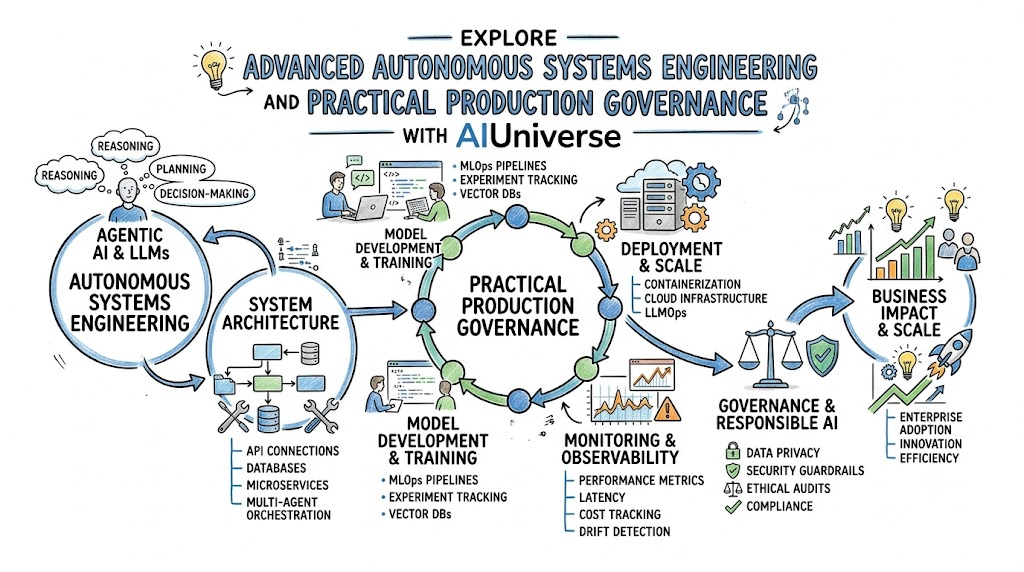
Mastering these autonomous technologies requires a strong grasp of system architecture, security controls, and operational workflows. A structured, hands-on educational pathway helps engineers and technical leaders bridge the gap between simple prompt engineering and enterprise-ready deployments. Through this detailed blueprint, you will explore core system design, tool integration, multi-agent coordination, deployment pipelines, and practical governance strategies required to build resilient, reliable software solutions across diverse industry environments. To begin your learning journey and explore professional learning pathways, visit AIUniverse.
What Is Agentic AI?
Agentic AI refers to software systems that use large language models as core reasoning engines to complete goals with minimal step-by-step human intervention. Unlike standard conversational interfaces that simply generate text responses based on immediate prompts, these systems feature continuous loops of reasoning, planning, memory retrieval, and external tool execution to solve multi-step operational problems.
Consider a corporate travel agent tool tasked with booking a business trip. Instead of asking you to search flights, check schedules, and submit expense forms manually, the agent parses your request, queries internal policy databases using RAG, checks calendar availability, calls airline APIs to find matching flights, submits the reservation, and drafts an expense line item for manager approval automatically.
How Agentic AI Differs from Traditional AI and Generative AI
Traditional AI relies on predefined, deterministic logic where every single rule, condition, and branch must be explicitly programmed by developers ahead of time. Generative AI introduces impressive context processing and content creation capabilities, but standard implementations remain fundamentally passive, waiting for direct human prompts to produce static text, code, or media assets.
Agentic AI combines the natural language processing of generative models with dynamic goal creation, tool integration, and state tracking. By evaluating feedback from its environment and adjusting its actions dynamically, an autonomous agent transitions from a simple content generator into an active workflow executor that independently navigates complex software environments.
| Technology Type | Main Capability | Level of Autonomy | Common Example |
| Traditional AI | Deterministic logic and rule enforcement | Zero dynamic autonomy | Spam filters and rule-based decision trees |
| Generative AI | Content creation and text summarization | Low (requires explicit human prompts) | Draft-generating chatbots and image generators |
| Conversational AI | Natural language dialog processing | Medium (follows scripted context paths) | Standard customer support chat widgets |
| Agentic AI | Goal completion, planning, and tool use | High (operates independently within limits) | Automated software debugging and triage agents |
Why Agentic AI Skills Matter for Working Professionals
As software automation evolves, technical roles across software engineering, IT management, data science, and operational analysis are rapidly shifting toward autonomous workflow orchestration. Engineers and technical professionals who understand how to design, evaluate, and govern agentic architectures can streamline operational overhead, eliminate repetitive software integration tasks, and build scalable systems that act on complex enterprise data safely.
Developing expertise in autonomous workflows allows professionals across sales, cybersecurity, finance, and cloud operations to build intelligent tools tailored to their domain needs. Instead of writing endless glue code or manually processing support tickets, teams can deploy resilient agents that handle routine triage, system monitoring, and administrative workflows, freeing up valuable human capital for strategic high-level decision-making.
What Is an Agentic AI Certification Course?
An Agentic AI certification course provides a structured learning curriculum designed to teach engineers how to architect, test, deploy, and govern production-ready autonomous systems. Rather than focusing purely on theoretical concepts or surface-level API calls, comprehensive training programs guide learners through real-world software architecture, vector database integration, state management, and enterprise security controls.
Earning a formal certification validates your ability to construct robust technical architectures, but practical application remains the true measure of mastery. High-quality learning programs emphasize hands-on coding labs, security evaluation frameworks, and capstone projects that demonstrate your ability to handle real-world challenges like hallucination mitigation, rate limits, and permission boundaries.
Who Should Take an Agentic AI Certification Course?
Working Professionals
Working professionals can leverage autonomous system skills to transform their existing domain workflows, automate repetitive data handling tasks, and drive operational efficiency within their current teams without changing their underlying career track.
AI Beginners
Beginners can build a strong foundation in modern artificial intelligence concepts by progressing systematically through structured learning modules, basic programming foundations, API integrations, and practical system design exercises.
Developers and Engineers
Software developers and system engineers can master advanced techniques for integrating language models with external APIs, managing system memory state, writing custom tool definitions, and building scalable multi-agent software pipelines.
Managers and Business Leaders
Business leaders and product managers can gain the technical insight required to identify viable enterprise use cases, evaluate infrastructure costs, mitigate operational risks, and oversee responsible AI deployment across organizational boundaries.
Enterprise Teams
Enterprise technical teams can align on standardized development practices, shared governance frameworks, secure data handling protocols, and scalable MLOps infrastructure tailored specifically to internal business requirements and compliance mandates.
Skills Covered in an Agentic AI Certification Program
Artificial Intelligence Fundamentals
A solid educational baseline begins with foundational machine learning principles, neural network concepts, decision-making algorithms, and evaluation metrics required to understand how modern intelligence models process complex contextual inputs.
Python Programming
Developing functional autonomous systems requires fluent Python skills, focusing heavily on asynchronous programming, structured error handling, clean object-oriented design, REST API consumption, data manipulation, and modular package management.
Large Language Model Fundamentals
Learners build a deep technical understanding of transformer architectures, tokenization mechanics, context window constraints, embedding generation, structured output parsing, and key strategies for reducing non-deterministic hallucinations in production.
Prompt Engineering
Mastering prompt engineering involves writing precise instructions, defining clear system constraints, establishing role contexts, providing structural input-output examples, and utilizing techniques like chain-of-thought reasoning to guide model decision-making reliably.
Prompt Management
To maintain system consistency across software iterations, engineering teams must leverage the best prompt management tools to centralize prompt repositories, manage version control, run automated performance regression tests, monitor API costs, and facilitate seamless cross-functional team collaboration across different application environments.
API and Tool Integration
Building practical agents requires linking model reasoning outputs to functional code execution through REST APIs, webhooks, database connections, cloud infrastructure interfaces, enterprise ticketing platforms, and third-party software systems safely.
Retrieval-Augmented Generation
Retrieval-Augmented Generation (RAG) connects language models to external enterprise knowledge sources by converting documentation into vector embeddings, storing them in specialized databases, and executing semantic searches to ground model responses in reliable data.
Agent Memory
Designing practical agents involves implementing short-term working memory for active conversation state, long-term semantic memory stored in vector databases, task tracking registers, and user preference state to maintain continuity across complex multi-step sessions.
Planning and Reasoning
Agents require formal reasoning structures like ReAct, Plan-and-Solve, or Tree of Thoughts to break broad operational goals down into manageable sub-tasks, prioritize actions logically, evaluate intermediate tool outputs, and recover gracefully when sub-tasks fail.
Agent Evaluation
Comprehensive evaluation frameworks measure system performance beyond simple text accuracy by benchmarking task completion rates, tool selection accuracy, execution latency, API call costs, output consistency, and human intervention frequency.
Security and Governance
Deploying enterprise agents demands strict security safeguards, including granular API permission boundaries, role-based access controls, comprehensive audit logging, human-in-the-loop validation checkpoints, and robust defenses against prompt injection attacks.
Agentic AI Learning Roadmap for Beginners
| Learning Stage | Main Topics | Practical Outcome |
| AI Fundamentals | Basic machine learning, neural networks, linear algebra | Solid foundation in core AI concepts |
| Python & APIs | Asynchronous Python, JSON parsing, REST interfaces | Functional ability to integrate web services |
| Generative AI | Transformer models, tokenization, contextual limits | Understanding model behavior and capabilities |
| Prompt Engineering | System context, zero/few-shot prompting, constraints | High-precision instruction design skills |
| RAG Implementation | Vector databases, chunking strategies, embeddings | Custom factual document retrieval system |
| Agent Design | Memory persistence, ReAct logic loops, tool usage | Fully functional single-agent assistant |
| Multi-Agent Systems | Communication protocols, task orchestration | Coordinated multi-agent workflow solution |
| MLOps & Governance | System monitoring, rate limiting, security audits | Production-ready, safe deployment pipeline |
Single-Agent and Multi-Agent Systems
Single-Agent Systems
Single-agent architectures rely on a single central intelligence loop that manages reasoning, tool selection, context tracking, and task execution independently. While single-agent setups are significantly easier to design, debug, test, and deploy, they often encounter operational bottlenecks, context window saturation, and degraded reasoning accuracy when forced to manage complex, multi-domain business workflows containing dozens of individual tools.
Multi-Agent Systems
Multi-agent architectures address complex enterprise workflows by dividing large business objectives among specialized agents operating with dedicated context boundaries, distinct system instructions, and specific toolsets. These specialized agents communicate, exchange data, and coordinate through centralized orchestrator frameworks to execute multi-stage operations efficient and reliably.
For instance, in a multi-agent software delivery workflow, an initial Architecture Agent converts product specs into system designs, a Coding Agent writes modular code, a QA Agent executes unit tests, and a Security Agent scans for vulnerabilities before requesting final deployment approval from a human engineer. Beginners should always start by building stable, single-agent systems before attempting to manage the communication complexity, state synchronization, and execution costs inherent to multi-agent architectures.
Connection Between Agentic AI and MLOps
Autonomous software agents rely heavily on production-grade operational infrastructure to maintain uptime, consistency, and execution speed. Completing a targeted MLOps certification course equips engineers with the deployment principles needed to manage underlying language model versions, maintain vector database infrastructure, automate deployment pipelines, track system performance metrics, and execute seamless system rollbacks when operational issues emerge in production environments.
Selecting the best MLOps tools requires evaluating an organization’s cloud architecture, security posture, team size, budget constraints, and current tooling ecosystem. Rather than adopting tools blindly, teams should choose frameworks that provide robust experiment tracking, automated prompt versioning, continuous latency monitoring, granular cost tracking, and seamless integration with existing continuous delivery software pipelines.
Connection Between Agentic AI and AIOps
Modern enterprise IT management relies increasingly on advanced operational automation frameworks. Enrolling in an AIOps certification course helps infrastructure professionals learn how artificial intelligence continuously processes system telemetries, correlates log signals, detects performance anomalies, triages critical infrastructure alerts, identifies root causes, and automates remediation actions across distributed cloud software deployments.
For example, when a high-traffic database experiences anomalous latency spikes, an AIOps agent can independently gather container logs, correlate infrastructure metrics, identify a failing cloud instance, and draft a corrective traffic rerouting plan. To prevent catastrophic failure, high-impact operational actions must always require human approval, restricted API permissions, automated rollback procedures, and immutable audit logging.
Role of Federated Learning Platforms
Federated learning enables organizations to train and refine machine learning models across decentralized edge devices or isolated data centers without centralizing raw, sensitive data. Utilizing specialized federated learning platforms allows enterprises in strictly regulated sectors like healthcare, banking, telecommunications, and defense to collaborate on shared models while guaranteeing that raw patient records or confidential financial transactions never leave local infrastructure boundaries.
While federated architecture offers massive privacy benefits, technical teams must overcome significant engineering challenges, including high network communication latency, non-identical data distributions across devices, hardware heterogeneity, and potential security risks like model-poisoning attacks. Implementing robust governance policies and secure aggregation algorithms ensures that decentralized learning systems remain secure, accurate, and fully compliant with privacy laws.
Practical Agentic AI Use Cases Across Industries
Customer Service
Autonomous support agents handle multi-step ticket resolution by retrieving customer account history, diagnosing order issues, issuing refunds within predefined financial limits, and updating CRM records automatically. Human escalation triggers ensure complex disputes or sensitive account inquiries transition smoothly to human support representatives.
Software Development
Engineering agents streamline software delivery by parsing issue tickets, generating modular code snippets, running automated test suites, analyzing build failures, and opening pull requests. Human code reviews remain mandatory to prevent code security flaws or architectural debt from reaching production branches.
IT Operations
Operational agents monitor cloud infrastructure, parse system logs during active incidents, correlate network alerts, and execute initial diagnostic routines automatically. Security boundaries prevent autonomous agents from making unverified production infrastructure changes without explicit, logged approvals from on-call systems engineers.
Sales and Marketing
Sales agents research inbound leads, scrape public company metrics, enrich CRM records, draft personalized outreach emails, and schedule discovery meetings automatically. Human oversight prevents spamming risks, maintains brand alignment, and guarantees that sensitive client communications remain professional and accurate.
Finance and Accounting
Financial agents analyze vendor invoices against purchase orders, flag price discrepancies, detect duplicate billing attempts, and prepare draft journal entries for ERP systems. Human approval gates ensure that funds are never disbursed without direct authorized sign-off from human finance managers.
Human Resources
HR onboarding agents guide new hires through documentation signing, software credential provisioning, training scheduling, and policy questions seamlessly. Guardrails ensure sensitive personal identification data is masked and that policy explanations reference verified internal handbooks accurately.
Cybersecurity
Security agents process threat intelligence feeds, analyze system logs during security events, isolate compromised cloud instances, and draft incident response reports. Human security analysts must validate all isolation actions to prevent accidental disruption of critical business services.
Healthcare
Clinical administrative agents transcribe patient encounters, pull historical lab metrics, check prescription interactions, and draft insurance prior-authorization forms. Human physicians must carefully review and sign off on all drafted documentation, as inaccurate clinical decisions directly impact patient safety.
Manufacturing
Supply chain agents track inventory levels, monitor telemetry from factory equipment, predict component maintenance schedules, and draft purchase orders for replacement parts. Facility managers must review scheduled downtime windows and confirm high-value equipment purchases prior to vendor dispatch.
Business Analytics
Analytics agents process raw transactional data, construct SQL queries, run statistical correlations, and generate executive reporting dashboards on demand. Analysts validate query logic regularly to ensure data summaries accurately reflect underlying financial and operational performance metrics.
Best AI Tools for Business Evaluation Guide
Selecting the best AI tools for business requires evaluating software platforms based on operational needs, existing technical architecture, regulatory compliance, and total cost of ownership. Organizations should avoid buying software based on marketing hype, choosing tools that provide clear API access, flexible integration paths, precise control over data retention, and proven security standards.
| Evaluation Area | Questions Businesses Should Ask |
| Business Fit | Does this tool solve a specific, high-priority operational bottleneck? |
| Data Privacy | Is enterprise data excluded from public model re-training datasets? |
| Security | Does the platform support SOC2, encryption, and granular access controls? |
| Integration | Can the software connect easily with existing databases and internal APIs? |
| Accuracy | How does the tool handle edge cases, hallucinations, and error recovery? |
| Scalability | Can the infrastructure handle peak transactional loads without unexpected failure? |
| Governance | Does the platform provide comprehensive audit logs and decision tracking? |
| Cost | What are the total operational costs, including compute, licensing, and API fees? |
| Customization | Can system prompts, guardrails, and tools be tailored to custom workflows? |
| Technical Support | Does the vendor provide dedicated technical account management and SLAs? |
| Exit Strategy | How easily can data and workflows be migrated if vendor pricing changes? |
Organizations should always validate vendor claims by running controlled pilot projects using real business data and measurable key performance indicators before committing to enterprise-wide software contracts.
Practical Agentic AI Project Ideas
Beginner Projects
- Document Question-Answering Agent: A RAG system that parses local PDF manuals to answer operational questions accurately.
- Meeting Summary Agent: An automated script that transcribes audio recordings, extracts key action items, and posts summaries to team messaging channels.
- Personal Task-Planning Agent: A simple assistant that breaks daily goals down into structured sub-tasks and adds them to a calendar app.
- FAQ Assistant: A customer support bot grounded strictly in public web documentation to address routine user inquiries.
- Product Information Assistant: A retail bot that queries local inventory spreadsheets to help users find matching product SKUs.
Intermediate Projects
- Customer Support Ticket Agent: An integrated workflow that triages incoming support tickets, queries database records, drafts responses, and updates CRM status.
- Sales Lead Qualification Agent: A tool that analyzes incoming contact forms, scrapes company metadata, scores lead viability, and alerts sales reps.
- Employee Onboarding Assistant: An interactive agent that guides new hires through documentation steps, verifies task completion, and issues IT software credentials.
- IT Incident Analysis Agent: An operational agent that aggregates cloud logs during outage alerts and summarizes potential failure causes for on-call engineers.
- Testing Assistant: A development tool that reads code files, drafts corresponding unit tests, and verifies test execution results locally.
Advanced Projects
- Multi-Agent Software Delivery System: A multi-agent framework where dedicated planning, coding, security scanning, and testing agents build and verify software modules autonomously.
- Cloud Operations Agent: An AIOps pipeline that monitors infrastructure metrics, detects system degradation, scales resources, and logs diagnostic reports.
- Enterprise Knowledge Agent: A cross-departmental RAG system connecting vector search across databases, documents, and messaging history with strict role-based access limits.
- Security Investigation Agent: An automated SOC tool that gathers threat telemetry, analyzes attack vectors, isolates affected endpoints, and drafts incident timelines.
- Supply-Chain Decision-Support System: An operational framework that evaluates real-time inventory signals, forecasts demand variations, and generates purchase orders for manager approval.
For every project, developers should thoroughly document the initial problem statement, system architecture, integration points, testing procedures, monitoring logs, security guardrails, and known operational limits.
Common Challenges in Agentic AI Development
Hallucinated Information
Language models frequently generate plausible-sounding but completely incorrect information when context is missing. Implement strict RAG grounding, force structured output schemas, and configure validation layers to reject unverified claims automatically.
Incorrect Tool Usage
Agents often pass malformed parameters or choose wrong API tools when instructions are ambiguous. Provide detailed parameter documentation, include concrete usage examples, and implement rigorous input validation before executing tool calls.
Prompt Injection
Malicious users can bypass system boundaries by embedding adversarial instructions within user input or retrieved context files. Sanitize all incoming external data, isolate system prompts, and run input filtering to detect injection attempts.
Data Leakage
Agents may accidentally reveal sensitive context data across user sessions if memory state is managed improperly. Implement multi-tenant data isolation, strictly segregate session memory, and scrub sensitive personal identifiers from outgoing logs.
Unlimited Action Loops
Agents can get stuck repeating failing tool calls infinitely when error recovery fails. Establish strict maximum execution limits, enforce maximum API cost thresholds, and implement loop detection mechanisms to terminate runaway processes automatically.
High API Costs
Processing large context windows repeatedly across autonomous execution loops can inflate cloud operational costs rapidly. Cache recurring prompt contexts, optimize vector retrieval sizes, use smaller specialized models where appropriate, and set hard daily usage caps.
Slow Response Time
Sequential tool calls and deep multi-step reasoning loops often introduce significant execution latency. Parallelize independent tool requests, stream intermediate thoughts to user interfaces, and optimize vector database query speeds.
Difficult Evaluation
Testing non-deterministic software systems across varied user inputs requires comprehensive evaluation approaches beyond traditional assertions. Combine automated benchmark runs, unit-tested tool parameters, LLM-as-a-judge scoring, and continuous human sampling.
Weak Monitoring
Failing to track production tool calls, memory state transitions, and API response metrics makes troubleshooting systemic failures impossible. Implement structured telemetry logging, capture complete execution traces, and alert on elevated error rates.
Lack of Human Control
Allowing autonomous agents to execute irreversible business operations without oversight can result in severe financial or operational damage. Enforce explicit human approval workflows for high-impact actions like payment processing or infrastructure deletion.
Integration Problems
Connecting agents with legacy enterprise software often fails due to brittle APIs, rate limits, and poor documentation. Build robust API retry logic, implement exponential backoff strategies, and maintain clear schema adapters for underlying backend tools.
Regulatory and Compliance Issues
Uncontrolled AI deployments can violate data privacy regulations like GDPR or HIPAA if data processing is unmonitored. Maintain detailed decision logs, uphold data residency commitments, and enforce transparent system usage policies across all environments.
Responsible Agentic AI Practices
- Enforce Minimum Permissions: Grant agents only the specific API privileges required to complete their designated tasks.
- Mandate Human-in-the-Loop Approvals: Require direct human approval before executing non-reversible operational actions.
- Secure Data Handling: Encrypt all context data in transit and at rest using enterprise security standards.
- Isolate Environments: Maintain strict isolation between development, staging, and production agent deployment environments.
- Implement Comprehensive Logging: Capture immutable audit logs for every user input, reasoning step, tool call, and output.
- Test for Adversarial Vulnerabilities: Continuously scan system prompts and retrieval pipelines for prompt injection weaknesses.
- Establish Action Limits: Set hard limits on the total number of sequential tool executions an agent can perform per request.
- Set Financial Budget Caps: Configure hard spending limits across LLM API endpoints to prevent unexpected compute charges.
- Ground System Context: Ensure agents retrieve factual context from verified, version-controlled enterprise knowledge bases.
- Validate Model Outputs: Run structural and schema checks on generated responses before passing data downstream.
- Design Fail-Safe Rollbacks: Build automated fallback mechanisms that return system state to a secure baseline when execution fails.
- Audit Memory Persistences: Review long-term vector memory stores periodically to purge obsolete or incorrect context data.
- Assign Clear System Ownership: Designate named engineering owners responsible for monitoring and maintaining deployed agents.
- Track System Performance Metrics: Continuously monitor response latency, tool call error rates, and user satisfaction metrics.
- Document Operational Boundaries: Clearly communicate system capabilities and known technical limitations to all end users.
Career Opportunities After Agentic AI Certification
Mastering autonomous systems, model deployment, and cloud infrastructure operations opens diverse career pathways across the technology industry. Organizations are rapidly recruiting skilled technical professionals capable of designing, managing, and securing intelligent enterprise workflows across complex software ecosystems.
- Agentic AI Developer: Focuses on writing custom tool integrations, managing agent memory, and building reasoning workflows.
- Generative AI Engineer: Specializes in fine-tuning models, optimizing RAG architecture, and building context pipelines.
- AI Application Developer: Integrates intelligent model capabilities directly into customer-facing web and mobile software.
- MLOps Engineer: Manages model deployment infrastructure, deployment pipelines, vector databases, and system scaling.
- LLMOps Engineer: Specializes in tracking, benchmarking, monitoring, and optimizing large language model performance.
- AIOps Engineer: Implements machine learning models to monitor cloud infrastructure, parse logs, and automate incident responses.
- AI Automation Specialist: Redesigns internal business workflows by automating manual software tasks using intelligent agents.
- AI Solutions Architect: Designs high-level enterprise system architectures, data flows, security boundaries, and tool integrations.
- Prompt Engineer: Crafts complex system instruction sets, evaluates model outputs, and refines operational guardrails.
- AI Consultant: Advises external clients on technology selection, use-case prioritization, security compliance, and deployment strategy.
- AI Product Manager: Defines product roadmaps, user requirements, evaluation benchmarks, and feature goals for intelligent tools.
- AI Governance Analyst: Oversees organizational compliance, data privacy standards, security audits, and risk mitigation strategies.
How to Build a Strong Agentic AI Portfolio
A standout professional portfolio demonstrates practical software engineering skills, architectural discipline, and real-world problem-solving capabilities rather than trivial, surface-level code tutorials. To catch the attention of technical recruiters and engineering managers, showcase fully deployed end-to-end applications that solve distinct operational business problems reliably.
Ensure every portfolio project includes well-documented source code, architectural system diagrams, comprehensive API usage details, RAG retrieval evaluation metrics, security boundary designs, complete logging infrastructure, cost breakdown analyses, and an honest discussion of known edge cases and technical limitations. Focus on building two or three exceptionally polished, fully production-ready applications rather than collecting dozens of incomplete code repositories.
How to Choose AI Certification Courses Online
Selecting high-quality AI certification courses online requires evaluating curricula carefully to ensure programs deliver rigorous hands-on technical skills rather than superficial theoretical summaries. Look for structured programs that prioritize practical coding labs, real-world architecture design, comprehensive MLOps pipelines, security guardrails, evaluation frameworks, and direct mentor support.
Be cautious of training programs that advertise unrealistic career transformation timelines, guarantee specific job placements, focus exclusively on surface-level prompt tools without teaching underlying coding fundamentals, or rely on outdated training materials that ignore modern agentic frameworks, multi-agent communication, vector databases, and enterprise security standards.
Weekly Learning Plan for Working Professionals
Week 1: Core Python Async Concepts & REST API Architecture
│
├── Days 1-2: Master Python async loops, context managers, and type hinting (2 hrs/day)
├── Days 3-4: Build robust REST API integrations with retry logic and JSON parsing (2 hrs/day)
└── Days 5-7: Build an automated script querying live web APIs; log traces & document (4 hrs total)

Week 2: Language Model Fundamentals & Advanced Prompt Design
│
├── Days 1-2: Study tokenization, context windows, and structural output formatting (2 hrs/day)
├── Days 3-4: Practice few-shot prompting, system roles, and chain-of-thought logic (2 hrs/day)
└── Days 5-7: Construct a validated prompt testing pipeline using structured evaluation (4 hrs total)

Week 3: Vector Databases & RAG Implementation
│
├── Days 1-2: Learn semantic embeddings, vector indexing, and document chunking strategies (2 hrs/day)
├── Days 3-4: Implement local vector database instances and write custom search queries (2 hrs/day)
└── Days 5-7: Deploy a fully functional document QA bot grounded in custom context files (4 hrs total)

Week 4: Agent Logic Loops & External Tool Execution
│
├── Days 1-2: Master ReAct loop architecture, state persistence, and tool definitions (2 hrs/day)
├── Days 3-4: Build custom agent tools linking model outputs to external backend APIs (2 hrs/day)
└── Days 5-7: Assemble a single-agent task assistant with memory and error recovery (4 hrs total)

Week 5: Multi-Agent Orchestration & MLOps Pipelines
│
├── Days 1-2: Study multi-agent communication protocols, task distribution, and state limits (2 hrs/day)
├── Days 3-4: Implement observability tracking, rate limiting, and cost monitoring (2 hrs/day)
└── Days 5-7: Finalize, test, document, and deploy your multi-agent capstone project (6 hrs total)
Beginner Roadmap for Starting Agentic AI
- Learn Basic Python: Master core programming fundamentals, data structures, object-oriented concepts, and package management.
- Understand APIs and JSON: Learn how to query web endpoints, parse complex JSON schemas, handle authentication headers, and manage rate limits.
- Study AI Fundamentals: Grasp underlying machine learning concepts, natural language processing basics, and neural network principles.
- Learn Large Language Model Basics: Understand context constraints, token mechanics, temperature controls, and structural output parsing.
- Practice Prompt Engineering: Design precise system instructions, role definitions, constraints, and structured output formatting rules.
- Build a Chatbot: Develop a simple conversational interface that tracks state memory across basic user interactions.
- Add Document Retrieval: Connect your application to vector databases using semantic embeddings to build a custom RAG pipeline.
- Connect an External Tool: Extend model capabilities by allowing it to trigger external API calls and parse real-world data responses.
- Add Memory and Planning: Implement continuous reasoning loops, persistent session memory, and step-by-step task decomposition logic.
- Test the Agent: Benchmark system accuracy, measure response latency, audit tool parameters, and check error recovery behavior.
- Deploy a Basic Project: Host your code on cloud infrastructure, implement rate limits, secure API credentials, and monitor usage costs.
- Learn Monitoring and Governance: Implement structured telemetry logging, establish human approval gates, and continuously audit system security.
Corporate AI Training for Enterprise Teams
Organizations scaling artificial intelligence capabilities across enterprise operations require structured, highly customized training frameworks tailored specifically to internal technology stacks, compliance mandates, and business goals. Generic video tutorials rarely address the complex integration security, data privacy, and architectural challenges faced by enterprise engineering teams.
Executive AI Training
Focuses on evaluating business ROI, selecting viable high-impact use cases, understanding organizational security risks, setting governance policies, and managing change across technical departments.
Developer and Engineering Training
Delivers deep hands-on instruction in agent system design, vector database configuration, tool API integration, structured error handling, evaluation framework setup, and security guardrail implementation.
Operations and MLOps Training
Equips cloud, DevOps, and IT engineers with skills to manage deployment infrastructure, establish continuous delivery pipelines, track API metrics, monitor operational costs, and handle system alerts.
Business User Training
Teaches non-technical business teams how to utilize internal AI tools safely, construct clear operational inputs, evaluate tool responses critically, and report anomalous system behaviors.
AI Governance Training
Guides legal, compliance, and security personnel through risk management frameworks, data residency laws, audit logging standards, prompt injection mitigation, and responsible AI usage enforcement.
How AI Consulting Services Support Implementation
Organizations attempting to deploy autonomous systems often face technical complexities, security concerns, and infrastructure choices that can delay project delivery. Engaging specialized consulting services helps businesses evaluate technical readiness, prioritize viable use cases, establish architectural standards, and implement resilient systems without making costly infrastructure missteps.
Experienced consultants guide enterprise technical leadership through technology evaluation, data preparation, vector database selection, RAG pipeline optimization, MLOps setup, and security framework configuration. By prioritizing well-defined business problems and clear operational metrics over technology trends, organizations can build pilot projects that deliver measurable value before expanding AI across broader enterprise operations.
How AIUniverse Supports Agentic AI Learning and Implementation
Navigating the rapidly shifting landscape of artificial intelligence requires access to structured educational resources, hands-on technical guidance, and reliable tool evaluations. AIUniverse offers a comprehensive educational ecosystem tailored to working professionals, AI beginners, software developers, technology architects, and enterprise organizations seeking to build, deploy, and manage production-grade AI solutions.
Through specialized training programs—including an intensive Agentic AI certification course, a production-focused MLOps certification course, and an operational AIOps certification course—learners gain deep, practical experience building real-world software applications. AIUniverse also offers flexible AI certification courses online and customized corporate AI training solutions designed to upskill technical teams on secure deployment practices, RAG architectures, and model governance frameworks.
Beyond structured learning programs, AIUniverse provides strategic technical insights through specialized AI consulting services. Teams can explore detailed software evaluation buyer guides comparing the best prompt management tools, privacy-focused federated learning platforms, industry-standard best MLOps tools, and practical guides highlighting the best AI tools for business applications. By emphasizing production readiness, security boundaries, and real-world project portfolios, AIUniverse empowers technical professionals and enterprises to deploy intelligent systems safely and effectively.
Expert Tips for Agentic AI Learners
- Start with One Clear Problem: Focus on automating a single, well-defined business workflow before attempting to build broad multi-domain assistants.
- Build One Reliable Agent First: Master single-agent state loops and tool execution stability before moving into complex multi-agent architectures.
- Limit Agent Permissions: Always enforce strict role-based access limits on the tools and backend databases connected to your agents.
- Use Structured Outputs: Force models to return standardized JSON parameters to ensure downstream software tools can process responses reliably.
- Test Every Tool Separately: Verify that backend APIs, database search scripts, and web utilities execute correctly independent of model reasoning loops.
- Include Human Approvals: Design explicit human-in-the-loop validation checkpoints for high-impact operational actions like financial transactions or data deletion.
- Monitor Cost per Task: Track token usage and compute expenses continuously to identify operational cost inefficiencies across execution steps.
- Maintain Granular Logs: Capture full execution traces, tool parameters, prompt versions, and model outputs for debugging and security audits.
- Use Trusted Data Sources: Ground RAG retrieval pipelines in version-controlled, verified enterprise documentation repositories to prevent hallucinations.
- Test Unusual Inputs: Benchmark system performance against adversarial, malformed, or out-of-bounds user prompts to test security guardrails.
- Learn MLOps and LLMOps: Develop a strong understanding of deployment pipelines, vector infrastructure, and monitoring systems alongside basic agent design.
- Document Known Limitations: Communicate system operational boundaries, failure modes, and tool constraints clearly to technical teams and end users.
- Connect Projects with Professional Background: Build portfolio tools tailored to your specific industry domain to showcase practical software execution skills.
- Focus on Practical Skills: Prioritize writing clean, resilient, and well-tested application code over collecting surface-level framework certificates.
- Continuously Improve Deployed Systems: Utilize real-world execution logs and user feedback to refine prompt instructions, tools, and retrieval accuracy over time.
Frequently Asked Questions
What is the difference between Generative AI and Agentic AI?
Generative AI focuses primarily on producing content, text, code, or media based on static user prompts. Agentic AI uses generative language models as reasoning engines to break down high-level goals, plan multi-step actions, query vector databases, execute external software tools through APIs, evaluate intermediate outputs, and adapt dynamically to accomplish tasks with minimal human intervention.
Do I need advanced coding skills to learn Agentic AI?
While beginners can start learning basic concepts and prompt engineering techniques without deep coding experience, building production-grade autonomous agents, custom tool integrations, RAG pipelines, and secure enterprise deployments requires solid foundational skills in Python programming, asynchronous execution, REST API handling, JSON parsing, and general cloud software architecture.
How long does it take to complete an Agentic AI learning pathway?
A motivated learner spending 8–10 hours per week can master foundational concepts, basic prompt engineering, vector databases, RAG systems, single-agent design, and tool integration in approximately 6 to 12 weeks. Mastering advanced multi-agent orchestration, MLOps deployment pipelines, continuous evaluation frameworks, and enterprise governance typically requires additional hands-on project practice over several months.
Are certifications enough to land an Agentic AI job?
A certification validates structured learning and baseline knowledge, but hiring teams prioritize practical, hands-on technical execution skills. To secure competitive roles, professionals must support certifications with a strong portfolio containing production-ready open-source code repositories, detailed architecture diagrams, working tool integrations, continuous evaluation tests, and clear documentation explaining real-world business outcomes.
What are the primary security risks associated with autonomous AI agents?
Key security risks include prompt injection attacks, unauthorized tool execution, sensitive data leakage across multi-tenant sessions, infinite execution loop resource drain, unexpected API compute costs, and model hallucinations leading to inaccurate downstream backend updates. Implementing least-privilege API keys, input sanitization, human approval gates, and comprehensive audit logging mitigates these vulnerabilities significantly.
How do multi-agent systems communicate with each other?
Multi-agent systems communicate through structured software protocols managed by central orchestrator frameworks. Agents exchange message payloads, task tokens, intermediate tool outputs, and state updates via defined JSON schemas. The orchestrator routes tasks to specific specialized agents based on domain expertise, manages task dependencies, resolves execution conflicts, and compiles final outputs seamlessly.
Why is MLOps important for Agentic AI applications?
MLOps provides essential deployment infrastructure, experiment tracking, prompt version control, model performance monitoring, latency tracking, vector database management, and automated continuous integration pipelines. Without robust MLOps practices, autonomous agent applications in production suffer from brittle deployments, unmonitored execution costs, unmanaged prompt regressions, difficult troubleshooting, and frequent system downtime.
How does Retrieval-Augmented Generation improve agent accuracy?
Retrieval-Augmented Generation (RAG) grounds language model reasoning in external, factual knowledge bases. By converting enterprise documentation into vector embeddings and retrieving contextually relevant text chunks during request processing, RAG drastically reduces non-deterministic model hallucinations, ensures responses reference current business data accurately, and maintains verifiable source attribution for every output generated.
Can agentic workflows be implemented in legacy enterprise systems?
Yes, agentic workflows can integrate with legacy enterprise software provided those systems expose functional REST APIs, database connectors, webhooks, or command-line interfaces. Agents connect to legacy environments using specialized API tool wrappers that sanitize parameter inputs, handle rate limits, manage access authentication, and parse output responses into structured JSON formats safely.
What is the role of human-in-the-loop controls in autonomous systems?
Human-in-the-loop controls establish mandatory human approval checkpoints before an autonomous agent executes high-impact, non-reversible, or sensitive operational tasks—such as executing financial payments, sending external customer communications, modifying production cloud infrastructure, or changing security permissions. This practice prevents catastrophic system errors while maintaining operational transparency.
How do organizations control the operational costs of AI agents?
Organizations control costs by establishing hard usage limits across language model API accounts, implementing context window optimization techniques, caching recurring prompt contexts, utilizing smaller domain-specific models for simple classification sub-tasks, parallelizing tool calls efficiently, and setting strict maximum execution loop limits for every incoming user request.
What is the best way for a business to start adopting Agentic AI?
Businesses should begin by identifying a specific, high-frequency, non-critical operational bottleneck that involves repetitive software tasks and clear inputs. Implementing a tightly controlled pilot project using a single agent with strict permission boundaries allows teams to measure performance accuracy, evaluate API costs, refine security controls, and demonstrate clear business value before attempting enterprise-wide expansion.
Conclusion
The shift from simple conversational text interfaces to autonomous agentic architectures represents a major leap in enterprise software capabilities. Building systems that reason logically, break complex objectives into structured sub-tasks, query semantic vector databases, execute external backend APIs, and learn continuously from operational feedback requires combining software engineering discipline, robust MLOps deployment pipelines, detailed evaluation frameworks, and strict security governance. Professional certifications validate structured technical knowledge, but long-term career success relies on building practical, production-ready portfolio projects that address real-world business problems safely and reliably. Platforms like AIUniverse provide technical learners, engineering teams, and enterprise leaders with the comprehensive educational pathways, detailed software comparisons, and strategic consulting guidance required to navigate this technical landscape. By emphasizing hands-on practice, least-privilege security controls, human-in-the-loop validation checkpoints, and continuous performance monitoring, organizations and engineers can design, deploy, and scale autonomous artificial intelligence solutions with complete confidence.