Introduction
When most travelers think of an immersive Indian getaway, their minds often drift to the crowded forts of Rajasthan or the heavily commercialized spice markets of Old Delhi. But if you want to experience a destination that trades artificial tourist traps for raw, generational authenticity, you look toward Kolkata. The cultural capital of India does not put on a show for outsiders; it invites you to witness its living, breathing history. Nowhere is this deep-rooted cultural heritage more tangible than in the art of the Bengali saree. For centuries, the rhythmic clacking of handlooms has woven the very social fabric of this region. Stepping into Kolkata’s historical saree markets is not a mere retail transaction—it is an evocative journey through time, textures, and ancestral craftsmanship.
Why Kolkata is a must visit city
Kolkata occupies a monumental chapter in global travel, serving as a geographical and cultural bridge between deep antiquity and spirited modernity. As the former capital of the British Raj, the city boasts a magnificent architectural sprawl wrapped along the banks of the Hooghly River. For the global explorer, it is a remarkably accessible megalopolis. It is comprehensively connected by the Netaji Subhash Chandra Bose International Airport, multiple historic railway termini like Howrah and Sealdah, and an extensive network of national highways. Whether you are a backpacker navigating via the iconic, century-old tramways or a luxury seeker checking into heritage boutique properties, Kolkata adapts seamlessly to your travel archetype.
The city’s legendary textile circuit serves as a vibrant, geographic mirror of its diverse neighborhoods. In the north, the labyrinthine lanes of Burrabazar and College Street echo with centuries of wholesale trade secrets. Meanwhile, the sprawling avenues of Gariahat in South Kolkata present an open-air carnival of color, where heritage emporiums stand side-by-side with animated street hawkers. To understand Kolkata is to understand its drapes—from the diaphanous, breathable weaves of Tant to the exquisite, storytelling motifs of Baluchari and Kantha.
| Core Attribute | Regional Detail |
| Primary Textile Hubs | Gariahat, College Street, Burrabazar, New Market, Dhakuria |
| Signature Saree Varieties | Tant (cotton), Garad (silk), Baluchari, Jamdani, Kantha embroidery |
| Best Transit Access | Kolkata Metro Blue Line, Yellow Taxis, Uber/Ola, Historic Trams |
| Peak Shopping Season | August to October (Pre-Durga Puja festival window) |
| Average Ideal Stay | 3 to 4 Days for a comprehensive cultural and shopping circuit |
Best Places or Experiences
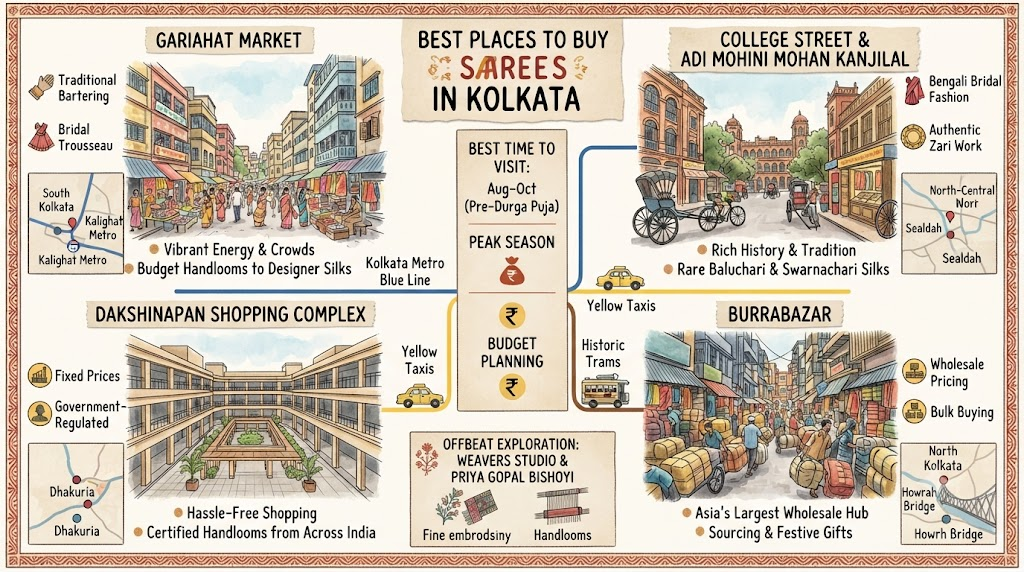
1. Gariahat Market
Gariahat Market is the undisputed beating heart of South Kolkata’s retail culture. This sprawling, multi-lane shopping universe seamlessly blends massive, multi-level heritage stores with miles of colorful pavement stalls. The air here is perpetually thick with the scents of fresh street food, printing inks, and starched cotton fabrics. For decades, it has served as the ultimate rite of passage for every local bride and textile connoisseur looking for the perfect drape.
The real magic of Gariahat lies in its sheer spatial density and sensory energy. As you navigate the crowded footpaths, you will find mountains of handloom cottons stacked directly beneath the gleaming glass facades of legendary institutions. It is a living marketplace where traditional bartering thrives just steps away from air-conditioned luxury showrooms.
- Location: South Kolkata, approximately 10 km from Howrah Railway Station and easily accessible via Kalighat Metro Station.
- Why it is worth visiting: It offers the most comprehensive, democratic spectrum of sarees in India, ranging from budget daily-wear cottons to high-end designer silks.
- Best things to do: Hunt for authentic Begumpuri and Dhakai Jamdani sarees at the street kiosks, explore the massive legacy collections inside Trader’s Assembly, and enjoy a classic clay-pot Bharer Cha (milk tea) while observing the master bargainers.
- Best time to visit: Late afternoon (4:00 PM to 8:00 PM) when the street lights kick in, creating a vibrant, high-energy night market atmosphere.
- Ideal for whom: Street shoppers, families planning bridal trousseaus, and budget travelers seeking high-quality handlooms.
- Travel tip: Guard your wallet carefully against pickpockets in the dense crowds, and always quote exactly half the initial price when buying from pavement vendors.
2. College Street & Adi Mohini Mohan Kanjilal
College Street, globally renowned as the Boi Para (Book Town), holds a parallel legendary status as the cradle of traditional North Kolkata saree trading. Nestled amidst historic universities and old-world publishing houses stands Adi Mohini Mohan Kanjilal, a monumental multi-story textile empire that has defined Bengali bridal fashion for well over a century. The surrounding neighborhood retains an unmistakable 19th-century charm, characterized by crumbling old mansions, open balconies, and hand-pulled rickshaws.
Visiting this zone provides a stark contrast to the modern, sanitized malls of the city. The showrooms here treat saree shopping as a celebratory, sit-down family ritual where salesmen patiently unfold hundreds of yards of pure silk while sharing local folklore.
- Location: North-Central Kolkata, right at the College Street Crossing, roughly 3.5 km from Sealdah Railway Station.
- Why it is worth visiting: It is the ultimate historical destination for genuine Swarnachari and Baluchari silks that feature intricate mythological scenes woven into their borders with pure gold and silver zari threads.
- Best things to do: Take a traditional white floor-cushion seat inside the legacy stores to view heavy bridal silks, admire the antique wooden architectural motifs of the older buildings, and walk to the iconic Indian Coffee House nearby for a historic mutton cutlet.
- Best time to visit: Late morning around 11:30 AM, right after opening hours, to secure undivided attention from the master salesmen before the afternoon rush.
- Ideal for whom: History buffs, cultural purists, and brides seeking authentic, regal Bengali bridal drapes.
- Travel tip: Traffic around the College Street crossing can become heavily gridlocked; arriving via the MG Road Metro Station will save you significant time.
3. Dakshinapan Shopping Complex
For travelers who prefer a calm, structured, and completely hassle-free shopping experience, Dakshinapan is a breath of fresh air. Built as an open-air, multi-tiered concrete cultural complex, this iconic destination houses official government-run handloom emporiums from almost every single state across India. It completely eliminates the stress of aggressive sales pitches and unpredictable price bartering.
The complex features wide, breezy corridors surrounding an open central courtyard. It functions as a serene cultural sanctuary where you can leisurely compare the distinct weaves of different Indian states at officially certified, government-regulated prices.
- Location: Dhakuria in South Kolkata, situated right next to the Madhusudan Mancha cultural auditorium.
- Why it is worth visiting: It is the premier hub for guaranteed, certified authentic handloom products, specifically Tantuja (West Bengal), Tantusree, and various rare tribal weaves.
- Best things to do: Browse genuine silk-mark Tussar sarees at the West Bengal stall, pick up rare northeastern tribal weaves from the Assam and Nagaland emporiums, and relax by the courtyard with a glass of infused iced tea from the famous Dolly’s Tea Shop.
- Best time to visit: 2:00 PM to 6:00 PM on weekdays for an incredibly quiet, unhurried, and deeply therapeutic browsing experience.
- Ideal for whom: Solo travelers, foreigners, corporate shoppers, and anyone looking for authentic certified textiles at fixed prices.
- Travel tip: Please note that the entire Dakshinapan complex remains strictly closed on Sundays, so plan your weekend itinerary accordingly.
4. Burrabazar (Bara Bazar)
Burrabazar is one of the largest, oldest, and most astonishingly dense wholesale trade markets in all of Asia. Operating continuously since the 18th century, this historic merchant district behaves like a giant, roaring human ant-heap where billions of rupees change hands daily. It is an intense, high-energy labyrinth of specialized trading yards, known locally as Katras, where generations of families have sold textiles in massive bulk.
Shopping here is a raw, unedited adventure that requires spatial stamina. If you are willing to brave the narrow, bustling alleyways shared with coolies carrying enormous cloth bales, you will unlock access to direct-from-the-loom trade prices that you simply cannot find anywhere else in the country.
- Location: North Kolkata, spreading outwards from the Mahatma Gandhi Road Metro Station down toward the Hooghly riverbanks.
- Why it is worth visiting: It offers an unbeatable wholesale pricing advantage on bulk purchases, making it the premier location for sourcing festive gift sarees and heavy banarasis directly from primary trade distributors.
- Best things to do: Navigate the historic Bayan Bhavan and Sarda Market buildings, explore ancient lanes dedicated entirely to specific textile accessories, and treat yourself to iconic, ghee-soaked local street foods like Kachoris and Rabri.
- Best time to visit: Early morning between 10:00 AM and 12:30 PM, before the overwhelming mid-day rush of heavy commercial trade transport blocks the paths.
- Ideal for whom: Wholesale buyers, large families shopping for multi-day wedding events, and thrill-seeking travelers.
- Travel tip: Wear sturdy, closed-toe walking shoes, keep your personal belongings securely zipped up, and completely avoid taking local cabs inside these narrow lanes—rely strictly on foot or metro travel.
Offbeat Exploration: Hidden Gems Tourists Miss
Weavers Studio (Ballygunge Place)
Tucked away within a quiet, leafy residential alley of South Kolkata, this upscale artisan studio functions more like a living textile museum than a retail store. Founded to preserve dying ancestral art forms, Weavers Studio specializes in exquisite, museum-grade Kantha embroidery, natural vegetable dyes, and intricate shibori techniques. It is a quiet sanctuary where global textile researchers and high-end collectors mingle, far away from the chaotic shouting of the commercial markets.
Priya Gopal Bishoyi (Utpalendu Bishoyi)
While mainstream tourists crowd the heavily advertised modern mega-stores, local textile purists quietly make their way to the historic, unpretentious brick-and-mortar outlets of Priya Gopal Bishoyi. Located away from the primary tourist thoroughfares, this heritage brand maintains deep, direct structural ties with master weavers across rural Bengal. It is widely considered the ultimate insider secret for sourcing incredibly soft, authentic Phulia Tant and heavy Phulia Jacquard cotton drapes that beautifully retain their starch and texture for decades.
Detailed Practical Guidance for Travelers
| Destination | Standard Entry Fee | General Timings | Best Local Food Options Nearby | Recommended Nearby Attractions |
| Gariahat Market | Free Access | 11:00 AM – 9:00 PM (Sundays partial) | Bhojohori Manna (Authentic Bengali), Bedouin Roll | Lake Kalibari, Rabindra Sarobar Lake |
| College Street | Free Access | 10:30 AM – 8:30 PM (Closed Sundays) | Indian Coffee House, Paramount Sherbets | Presidency University, Vidyasagar House |
| Dakshinapan | Free Access | 11:00 AM – 8:00 PM (Closed Sundays) | Dolly’s Tea Shop, Bijoli Grill | Jadavpur University Campus, Dhakuria Lakes |
| Burrabazar | Free Access | 10:30 AM – 7:30 PM (Closed Sundays) | Tewari Brothers (Sweets), local street stalls | Howrah Bridge, Armenian Holy Church |
Logistics & On-Ground Navigation
Local Transport Options
- Metro Railway: The fast, reliable backbone of city travel. The Blue Line connects North and South Kolkata seamlessly, making stations like Kalighat (for Gariahat) and MG Road (for Burrabazar) your most reliable transit assets.
- Yellow Taxis & App Cabs: The vintage Ambassador Yellow Taxis offer flat, metered rates, while Uber and Ola provide transparent, app-based pricing ideal for long, air-conditioned return trips with heavy shopping bags.
- Auto-Rickshaws: Operating on fixed, highly economical shared routes, these are perfect for zipping through short distances between metro stations and primary market entries.
Budget Planning
- Budget / Backpacking Tier: ₹1,500 – ₹2,500 per day. This covers commuting via the metro and shared autos, dining at legendary street stalls or historic cabins, and purchasing basic, beautiful everyday-wear Tant cotton sarees (ranging between ₹600 and ₹1,200 per piece).
- Mid-Range / Comfort Tier: ₹5,000 – ₹12,000 per day. This accommodates comfortable travel in air-conditioned app cabs, sit-down meals at classic heritage Bengali restaurants, and purchasing fine handloom silks like authentic Jamdanis or Tussars (ranging between ₹3,500 and ₹9,000 per piece).
Safety and Inclusivity Tips
- For Families: Stick to the structured, air-conditioned legacy showrooms during peak afternoon heat to ensure elderly family members have access to comfortable seating and clean restrooms.
- For Couples: Take romantic shopping breaks at historic cafes like Paramount or the Indian Coffee House to soak in the vintage charm without feeling rushed.
- General Safety: Kolkata is widely celebrated as one of India’s safest metros for solo travelers. However, the sheer density of crowds in wholesale markets requires a basic level of situational awareness regarding your personal bags and pockets.
Strategic Travel Planning Guardrails
Travel Planning Tips for Kolkata
- Cash is King on the Pavement: While large multi-story showrooms accept all major credit cards and digital UPI apps, small street hawkers deal strictly in hard cash. Always carry a healthy stash of smaller denominations (₹100 and ₹200 notes).
- The Seasonal Sweet Spot: Schedule your trip during the shoulder months of November to February to enjoy gorgeous, breezy walking weather, or visit in September if you want to experience the electric, high-stakes shopping energy directly preceding the grand Durga Puja festival.
- Dress for Utility: Wear lightweight, breathable cotton clothing and comfortable flat slip-on shoes, as you will be frequently stepping on and off carpeted display platforms inside traditional shops.
Common Mistakes to Avoid
- Trusting Unsolicited Street Guides: Never allow local hotel touts or unknown auto drivers to steer you toward “exclusive discount weaver warehouses”—these are commission-driven traps.
- Forgetting the Sunday Shutdown: Do not schedule your major shopping runs for Sundays; a vast majority of Kolkata’s traditional wholesale zones and government emporiums remain completely closed.
- Underestimating the Hydration Factor: Do not forget to carry a reusable water bottle; the humid coastal air of Bengal can drain your physical stamina faster than you realize during long walking tours.
Suggested Itinerary Blueprints
1. 1-Day Quick Dash (The Express South Loop)
- Target Audience: Time-sensitive business travelers or weekend shoppers.
- Routing Layout: Start at 11:00 AM at the Dakshinapan Complex to secure high-quality, fixed-price regional handlooms in a quiet environment. By 3:30 PM, move to Gariahat Crossing to experience the legendary street market energy and explore the massive legacy showrooms. Wrap up your evening with a classic fish fry at Mitra Cafe.
2. 2-Day Deep-Dive (The Heritage & Fusion Route)
- Day 1 (The Vintage North): Spend your morning exploring the wholesale treasures of Burrabazar. In the afternoon, walk through the historic book lanes of College Street, culminating in a relaxed bridal-silk browsing session at Adi Mohini Mohan Kanjilal.
- Day 2 (The Modern South): Dedicate your morning to the elite, custom-curated designs at Weavers Studio. Spend your afternoon hunting for trendy, contemporary cotton drapes along the vibrant footpaths of Gariahat.
3. Complete Weekend Travel Plan (The Ultimate Textile Loop)
- Friday Evening: Arrive and ease into the city’s unique cultural rhythm with a refreshing iced tea at Dolly’s Tea Shop in Dakshinapan.
- Saturday Morning & Afternoon: Brave the high-energy lanes of Burrabazar early, followed by a late-afternoon exploration of the heritage stores around New Market in central Kolkata.
- Sunday: Focus on the modern, artistic boutique lifestyle spaces of South Kolkata, paired with a relaxed, fine-dining Bengali feast at 6 Ballygunge Place.
Common Tourist Mistakes to Avoid
- Geographic Blunders: Attempting to explore Burrabazar (extreme North) and Gariahat (deep South) on the exact same afternoon will leave you exhausted and hopelessly stuck in city traffic for hours. Divide your shopping days strictly by geographic zones.
- Commercial Traps: Spending your precious travel days inside modern, generic glass shopping malls like Quest or South City. You can find those exact same international brands anywhere; Kolkata’s true soul lives in its atmospheric, centuries-old street markets.
- Neglecting Modern expansions: Forgetting to explore the quieter, artistic, and cafe-centric neighborhood boutiques tucked away in residential zones like Hindustan Park, which offer stunning contemporary revivals of traditional weaves.
- Transport Overpayment: Boarding non-metered taxis outside major railway stations without cross-referencing prices on ride-sharing apps like Uber or Ola first.
- Luxury Dining Bias: Restricting your meals strictly to high-end hotel buffets. Missing out on the city’s legendary street food—like the iconic Mughlai parathas, kathi rolls, and phuchkas—deprives you of the very flavors that fuel the local artisans.
Frequently Asked Questions
1. What is the average price range for an authentic handloom Tant saree in Kolkata?
A basic, authentic everyday-wear Tant cotton saree sourced directly from street markets like Gariahat or Burrabazar ranges between ₹600 and ₹1,500. Premium varieties featuring intricate jacquard work or fine zari borders can go up to ₹3,500 to ₹6,000.
2. How can a traveler distinguish between a real silk Baluchari and a cheap synthetic replica?
A genuine silk Baluchari saree will always carry the official government-certified Silk Mark tag. Additionally, look closely at the reverse side of the pallu (the decorative end drape); hand-woven silks show slight, natural thread variations and neat knotting, whereas synthetic replicas feel slick, perfectly uniform, and stiff.
3. Are the prices at the pavement stalls in Gariahat completely fixed or open to bargaining?
The prices at the pavement stalls are highly flexible and heavily open to bargaining. As a rule of thumb, politely counter-offer about 50% to 60% of the seller’s initial quoted price and gradually negotiate your way to a mutually agreeable middle ground.
4. Which saree variety is considered the traditional choice for a typical Bengali bride?
The classic choice for a traditional Bengali bride is the Lal-Paar Garad Saree (a pristine white or off-white raw silk saree framed by a rich, deep red border) for morning rituals, followed by a heavy, ornately woven Crimson Red Banarasi Silk Saree for the main evening wedding ceremony.
5. Is the historic Burrabazar market comfortable for elderly travelers or small children?
No, Burrabazar is a high-density, intense wholesale zone characterized by extremely narrow lanes, massive crowds, and heavy manual labor transport. It is not recommended for elderly travelers or young children; families should choose the comfortable, air-conditioned legacy showrooms of South Kolkata instead.
6. What exactly is a Jamdani saree, and why is it so highly valued?
Jamdani is a legendary, highly labor-intensive Parsi-origin weaving technique where intricate geometric or floral motifs are hand-woven directly into translucent cotton or silk fabrics using an extra weft needle. It creates the beautiful illusion that the patterns are floating elegantly on a sheer, weightless background.
7. Can I request international or domestic shipping services directly from the large legacy saree showrooms?
Yes, almost all the major, multi-story legacy institutions like Adi Mohini Mohan Kanjilal or Sree Leathers provide reliable domestic insured shipping services across India, and several major houses can arrange international courier shipping for large bridal orders.
8. Do I need to book an appointment in advance to visit elite design spaces like Weavers Studio?
While walk-ins are welcome during regular business hours, booking an appointment in advance via phone or email is highly recommended if you wish to access their private archival collections or request a specialized, guided tour of their artisan textile processes.
9. What are the standard operating days and times for the government emporiums at Dakshinapan?
The government-run emporiums at Dakshinapan generally operate from 11:00 AM to 8:00 PM. It is critical to remember that the entire Dakshinapan complex remains strictly closed on Sundays.
10. How can I ensure that the Kantha embroidery saree I am purchasing is genuinely hand-done?
Examine the reverse side of the embroidery work. True hand-done Kantha features subtle, uneven stitch lengths, tiny hand-tied thread knots, and slight structural irregularities that reflect real human craftsmanship, unlike the flawless, perfectly identical patterns stamped out by automated embroidery machines.
11. Is it safe to carry large amounts of cash while shopping in the dense street markets?
While Kolkata boasts exceptionally low violent crime rates, crowded shopping lanes are always prime targets for nimble pickpockets. Avoid carrying large wads of exposed cash; instead, divide your currency across secure, inner zippered pockets or rely heavily on digital UPI apps wherever possible.
12. What is the cultural significance behind the traditional Tussar silk sarees of Bengal?
Tussar silk, derived from wild silkworms, possesses a naturally rich, deep golden-beige texture and a beautiful matte luster. It holds immense cultural value in Bengal as a symbol of natural purity, making it the preferred traditional attire for sacred religious rituals, festivals, and elegant literary gatherings.
Conclusion
Choosing to explore the historic saree trails of Kolkata is far more than a simple shopping excursion; it is a profound journey into the very soul of Indian craft heritage. Long after your trip concludes, the true reward of this journey reveals itself not just in the beautiful drapes resting in your wardrobe, but in the vivid memories of the people you met along the way. It lives in the memory of the humble artisan who spent months hand-weaving a single masterpiece, the friendly banter of a local street vendor, and the warmth of a city that values its rich history far above fleeting modern trends. Kolkata offers a transformative travel experience that honors the slow, deliberate beauty of human hands—a timeless treasure that no ordinary commercial holiday can ever replicate.