Introduction
When most travelers plan an Indian culinary escape, they instinctively seek out the heavily commercialized street food alleys of Mumbai or the rich, cream-laden Mughal curries of Old Delhi. Yet, tucked away in the atmospheric, monsoon-washed lanes of North Kolkata lies a vastly different kind of gastronomic devotion—one that is quiet, deeply intellectual, and inextricably tied to the soul of Bengal. This is the world of the Sandesh, a legendary sweet made from pristine, hand-kneaded chhena (fresh curd cheese) that represents the absolute pinnacle of Bengali confectionery art.
Unlike flashy, mass-produced desserts found in global tourist hubs, authentic Sandesh is a fleeting, artisanal masterpiece that demands a slow, deliberate exploration of Kolkata’s historic neighborhoods. Walking into an operational 200-year-old sweetshop (locally known as a mishti dokan) offers an intimate cultural connection that modern commercial spaces simply cannot replicate. The gentle scraping of massive iron woks, the scent of fresh cardamom, and the sight of generational artisans pressing delicate curds into antique wooden molds reveal the true heartbeat of the Cultural Capital of India.
Why Kolkata is a Must Visit City
Kolkata acts as an essential, living chapter in global travel history, standing proudly as the former gateway of the British East India Company and the birthplace of the 19th-century Bengali Renaissance. Geographically positioned along the banks of the majestic Hooghly River, the city’s unique maritime climate and fertile delta planes historically fueled a rich agricultural trade, creating a society that fiercely values culinary refinement. For travelers of all archetypes—whether you are a backpacker navigating by the historic tram lines, a family traveling via the highly efficient Kolkata Metro, or a luxury seeker relying on private car rentals—the city offers an seamlessly accessible urban grid lined with unparalleled hospitality.
The culinary travel circuit here is beautifully concentrated, primarily tethered to the heritage zones of North and Central Kolkata, where century-old sweet shops stand as preserved monuments. Tasting your way through this historic sweet track provides a visceral understanding of how European cheese-making techniques collided with traditional Vedic dairy practices to create the iconic chhena base we love today.
| Metric | Quick City Guide Reference |
|---|---|
| Primary Airport Hub | Netaji Subhash Chandra Bose International Airport (CCU) |
| Major Railway Stations | Howrah Junction (HWH) & Sealdah (SDAH) |
| Key Culinary Neighborhoods | Hatibagan, Shimla Street, Bowbazar, Chitpur, Chitranjan Avenue |
| Signature Culinary Heritage | Chhena-based sweet preparation using seasonal ingredients |
| Best Transport for Foodies | Kolkata Underground Metro and traditional yellow Ambassador cabs |
Best Places to Eat Sandesh in Kolkata
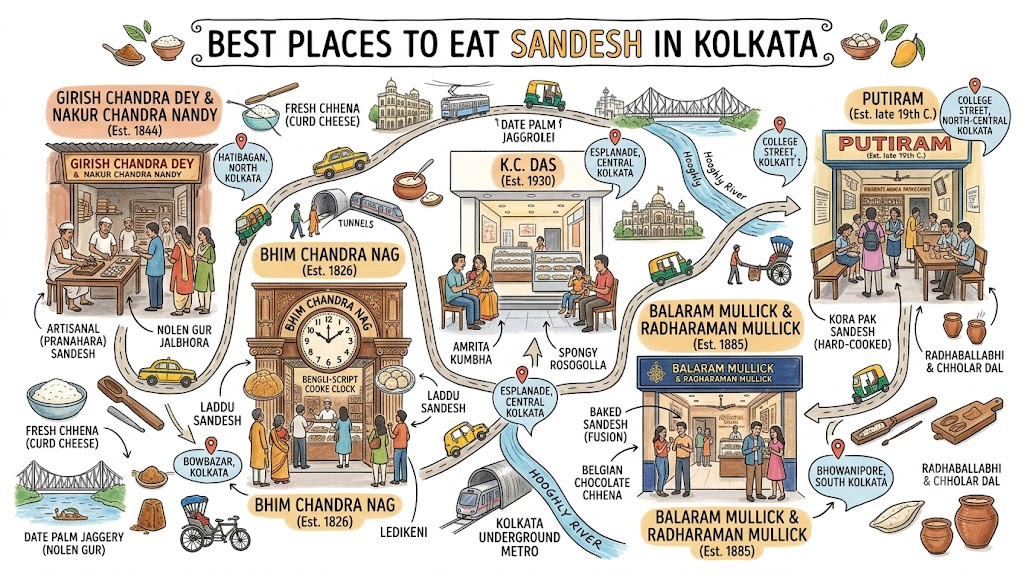
Girish Chandra Dey & Nakur Chandra Nandy
Stepping into this legendary establishment in North Kolkata feels exactly like taking a vibrant step back into the mid-19th century. Founded in 1844, this unassuming, no-frills shop has stubbornly resisted modernization, preserving the intense manual craftsmanship required to create the world’s finest Kachagolla and dry Sandesh varieties. The walls are steeped in history, having served iconic Bengali historical figures, artists, and freedom fighters who once debated politics over plates of exquisite sweets.
The artisans here are true masters of controlling moisture and heat, utilizing family heirloom wooden molds to stamp out intricate, edible works of art. Their creations boast a impossibly velvety texture that crumbles gently on the tongue, instantly releasing the natural sweetness of premium dairy without being weighed down by excessive sugar.
Artisanal Sandesh creations at Nakur Nandy.
- Location: Hatibagan, North Kolkata; approximately 5.5 km from Howrah Railway Station.
- Why it is worth visiting: It is universally recognized by locals as the gold standard for traditional, artisanal soft-cooked (Pranahara) and dry Sandesh varieties.
- Best things to do: Try the legendary seasonal Nolen Gur Jalbhora (sweet filled with liquid date palm jaggery), sample the delicate Parijat, and watch the craftsmen deftly shape the sweets behind the counter.
- Best time to visit: Arrive between 11:00 AM and 1:00 PM for the freshest daytime batches, or visit during the winter months (November to February) for the true jaggery specialties.
- Ideal for whom: Culinary historians, solo travelers, and dedicated sweet purists.
- Travel tip: The shop does not offer seating space and gets incredibly crowded; be prepared to stand on the pavement while savoring your sweets, and always bring small cash bills.
Bhim Chandra Nag
Located deep within the bustling wholesale trading heart of Bowbazar, Bhim Chandra Nag has been an undisputed titan of the Bengali sweet landscape since its inception in 1826. This historic shop is famous for introducing pioneering structural innovations to Bengali sweets, including the creation of the Laddu Sandesh and the iconic Ledikeni (crafted in honor of Lady Canning during the British Raj). The centerpiece of the shop is a magnificent, massive antique English clock with numbers painted in the Bengali script—a gift from the clockmaker Thomas Cooke himself in the 19th century.
The culinary philosophy here focuses heavily on balance, ensuring that the inherent flavor of the fresh chhena remains the hero of every bite. Their sweets feature a slightly denser, more robust texture compared to their northern counterparts, allowing the delicate infusions of saffron, pistachio, and rosewater to bloom beautifully as you chew.
The historic entrance of Bhim Chandra Nag.
- Location: Bowbazar, Central Kolkata; roughly 3.5 km from Sealdah Railway Station.
- Why it is worth visiting: To experience a continuous 200-year-old culinary legacy and view the historic, operational Bengali-script Cooke clock.
- Best things to do: Indulge in the velvety Manohara Sandesh, purchase a box of their uniquely shaped Abar Khabo, and photograph the legendary antique interior decorations.
- Best time to visit: Late mornings (around 10:30 AM) when the daily stock is fully replenished and the heavy marketplace traffic is still manageable.
- Ideal for whom: Architecture enthusiasts, heritage travelers, and families looking for classic sweet boxes.
- Travel tip: Navigating the Bowbazar lanes can be visually overwhelming; take the Metro to Central Station and walk a short distance rather than attempting to take a car directly to the storefront.
K.C. Das
While K.C. Das is globally celebrated for popularizing the spongy, syrup-filled Rosogolla, serious food lovers flock to this iconic Central Kolkata location for its brilliant contributions to modern Sandesh evolution. Established formally in 1930 by the descendants of Nobin Chandra Das, this shop successfully institutionalized the sweet-making process, making high-quality delicacies highly accessible while strictly maintaining ancestral flavor profiles. The spacious, clean, brightly lit shop provides a stark but comforting contrast to the cramped heritage holes-in-the-wall of the north.
Their Sandesh varieties are highly praised for their incredibly consistent moisture content and pristine presentation. K.C. Das masterfully bridges the gap between old-world luxury and modern culinary preferences, making it an excellent starting point for travelers who are new to the distinct textures of fresh paneer desserts.
- Location: Esplanade, Central Kolkata; directly adjacent to the Esplanade Metro Station.
- Why it is worth visiting: It offers an incredibly clean, easily accessible environment to sample benchmark versions of both syrup sweets and classic Sandesh under one roof.
- Best things to do: Order the unique, creamy Amrita Kumbha Sandesh, sample their rich Dilkhush, and enjoy a cold glass of sweet Rasomalai milk.
- Best time to visit: 3:00 PM to 5:00 PM for a relaxed evening dessert break right after the afternoon lunch rush.
- Ideal for whom: First-time international tourists, large family groups, and travelers who prefer structured seating spaces.
- Travel tip: Because of its prime location near major shopping hubs, the queues for takeaway boxes can lengthen significantly during festival days; look for the separate token counter for immediate in-shop dining.
Balaram Mullick & Radharaman Mullick
Originating from Bhowanipore in 1885, Balaram Mullick & Radharaman Mullick represents the absolute pinnacle of contemporary sweet innovation in Kolkata. While they treat ancient recipes with immense respect, this generational powerhouse has captured the hearts of younger foodies by infusing global flavors into the classic chhena base. The polished, modern boutique-style stores showcase rows of meticulously labeled sweets behind gleaming glass cases, indicating an evolution into the high-end luxury market.
Their signature style is defined by a luxurious, silky smooth texture that melts away effortlessly. They are universally famous for pioneering fusion concepts, seamlessly blending traditional baking methods and local winter date palm jaggery with unexpected ingredients like dark Belgian chocolate and Alphonso mango pulp.
- Location: Bhowanipore, South Kolkata; approximately 2 km from the iconic Kalighat Temple.
- Why it is worth visiting: To experience how traditional Bengali confectionery successfully adapts to modern global palates through cutting-edge fusion recipes.
- Best things to do: Devour the warm, gooey Baked Mihidana Sandesh, sample the highly innovative Baked Rosogolla, and explore their seasonal fruit-infused Chhena creations.
- Best time to visit: 6:00 PM to 8:00 PM when the shop is brightly lit, buzzing with local families, and offering hot, freshly baked items.
- Ideal for whom: Experimental foodies, younger crowds, couples, and premium souvenir shoppers.
- Travel tip: They use highly specialized food-grade structural packaging, making this the best place to buy large quantities of sweets intended for long-distance air travel.
Putiram
Tucked neatly into the historic, book-lined avenues of College Street, Putiram is an old-school institution that has fueled generations of intense student debates from the neighboring Presidency University and Calcutta University. Operating for well over a century, this humble establishment retains a timeless, deeply nostalgic intellectual charm. The wooden benches, stone floors, and fast-moving servers dressed in traditional dhotis tell a vivid story of an era when food was simple, affordable, and incredibly nourishing.
Putiram specializes heavily in the rustic, deeply comforting hard-cooked (Kora Pak) Sandesh variants that prioritize a rich, long-lasting caramelized dairy profile. Their sweets are noticeably less sweet than modern commercial varieties, allowing the clean, nutty, deeply satisfying flavors of roasted milk solids to take center stage.
- Location: College Street (Boipara), North-Central Kolkata; roughly 1.5 km from Mahatma Gandhi Road Metro Station.
- Why it is worth visiting: To soak in the classic, vibrant student-intellectual atmosphere of Kolkata while enjoying incredibly cheap, authentic heritage recipes.
- Best things to do: Pair a dense Kora Pak Sandesh with their famous deep-fried, saffron-colored Radhaballabhi (lentil-stuffed flatbread), and sip hot tea from a clay cup.
- Best time to visit: Early morning (7:30 AM to 9:00 AM) to experience a classic Kolkata breakfast alongside professors and students.
- Ideal for whom: Budget backpackers, solo travelers, and culture enthusiasts who love old book markets.
- Travel tip: Seating is shared and tight; be prepared to quickly share a table with friendly locals, and note that digital payment options can occasionally experience cellular network delays here.
Offbeat Exploration: Hidden Gems Tourists Miss
Makhan Lal Das & Sons
Hidden deep within the winding, narrow residential alleyways of Chitpur in North Kolkata, this ancient gem has been quietly operating since 1821. They are the absolute masters of the rare Nikhuti and specialized dry-textured Kora Pak Sandesh, which can easily be stored for days without any refrigeration. Tourists almost completely miss this location due to its dense, non-commercial setting, making it a highly rewarding reward for intrepid travelers.
Nalin Chandra Das & Sons
Located near the historic residential quarters of Jorasanko, this venerable shop has been quietly perfecting the art of stuffing Sandesh since 1841. They are famous for their unmatched mastery over the Jalbhora shape, utilizing a highly guarded family technique to ensure the liquid jaggery or scented syrup remains perfectly suspended inside the soft chhena shell without leaking out prematurely.
Detailed Practical Guidance for Travelers
| Destination | Standard Entry Fee | General Timings | Best Local Food Options Nearby | Recommended Nearby Attractions |
|---|---|---|---|---|
| Girish Chandra Dey & Nakur Chandra Nandy | Free Access | 7:00 AM – 10:00 PM | Spicy Street Phuchka & Mutton Cutlets | Swami Vivekananda’s Ancestral House |
| Bhim Chandra Nag | Free Access | 8:00 AM – 9:30 PM | Traditional Kachori & Savory Radhaballabhi | Indian Coffee House (College Street) |
| K.C. Das (Esplanade) | Free Access | 8:00 AM – 10:00 PM | Mughlai Parathas & Street-style Chow Mein | Indian Museum & Victoria Memorial |
| Balaram Mullick (Bhowanipore) | Free Access | 7:00 AM – 11:00 PM | Classic Fish Fry & Saffron Mutton Biryani | Netaji Bhawan & Kalighat Temple |
| Putiram (College Street) | Free Access | 7:00 AM – 9:00 PM | Spicy Chholar Dal & Sweet Mishti Doi | Historic College Street Book Market |
Logistics & On-Ground Navigation
Local Transport Options
- The Underground Metro: This is by far the fastest, cleanest, and most predictable way to travel between North and South Kolkata, completely bypassing the dense surface traffic jams.
- Traditional Yellow Ambassadors: These iconic vintage cabs run reliably on app-based booking services (like Yatri Sathi) or upfront negotiated flat rates, providing a deeply nostalgic and comfortable transit experience.
- Hand-Pulled & Auto Rickshaws: Ideal for navigating the narrow, historic alleyways of Bowbazar and Chitpur where larger cars simply cannot fit.
- Suburban Railway Network: Highly useful if you are planning to travel outward from major terminals like Howrah or Sealdah to peripheral heritage zones.
Budget Planning
- Budget / Backpacking Tier: Expect to spend roughly ₹800 to ₹1,200 per day. This easily covers your daily travel via the Metro/trams, eating at historic street corners, and sampling 4-5 single pieces of heritage Sandesh.
- Mid-Range / Comfort Tier: Expect to spend roughly ₹2,500 to ₹4,500 per day. This easily covers app-based AC cab rides, sit-down meals at established heritage dining rooms, and buying premium, travel-safe sweet boxes.
Safety and Inclusivity Tips
- For Families: Stick to spacious, modern locations like Balaram Mullick or K.C. Das during peak afternoon hours to ensure comfortable seating and clean restroom access for children.
- For Couples: Take a slow, romantic evening stroll along the Princep Ghat promenade by the river after enjoying a sweet tasting session in Central Kolkata.
- General Safety: Kolkata is widely celebrated as one of India’s safest major metropolitan cities for solo travelers; however, remain alert to your personal belongings in heavily crowded marketplace zones like Burrabazar.
Strategic Travel Planning Guardrails
Travel Planning Tips for Kolkata
- Prioritize the Winter Season: Plan your trip between November and February to experience the magical arrival of Nolen Gur (fresh date palm jaggery), which transforms the entire sweet industry.
- Keep Liquid Cash Handy: While digital UPI payments are common, small heritage sweet shops in North Kolkata strongly prefer cash for low-value sweet transactions under ₹100.
- Dress Light and Breatheable: Wear loose cotton clothing and highly comfortable walking shoes to comfortably navigate the humid climate and old paved streets.
- Understand the Shelf Life: Soft-cooked Pranahara and liquid-filled Jalbhora sweets must be eaten within 24 hours; always ask for Kora Pak (hard-cooked) varieties if you intend to fly home with them.
- Respect Shop Customs: Avoid touching the glass display cases with your hands, and always throw your disposable leaf plates (sal pattas) into the designated bins outside.
Common Mistakes to Avoid
- Over-packing Your Daily Routes: Do not try to combine deep North Kolkata sweet trails with South Kolkata sightseeing on the exact same afternoon; the city’s traffic density will exhaust you.
- Assuming All Sweets Are Alike: Avoid ordering generic Rasogollas at a shop that specializes explicitly in artisanal, dry-molded Chhena Sandesh.
- Arriving During the Afternoon Break: Many old-school shops in the north close or have limited stock between 2:00 PM and 4:00 PM; time your visits for the morning or late evening.
- Skipping the Savory Side: Do not gorge exclusively on sugar; balance your palate by pairing sweet treats with the savory, peppery Radhaballabhi or Singara offered at the same counters.
- Paying Inflated Fixed cab Rates: Never board a yellow cab without cross-checking the pricing on the local Yatri Sathi app first to ensure you are paying standard local rates.
Suggested Itinerary Blueprints
Day Quick Dash (The Heritage Core Route)
Designed for time-restricted travelers. Start at 9:00 AM at Putiram for a classic breakfast of Kachoris and traditional hard-cooked Sandesh. Take a quick auto-rickshaw down to Bhim Chandra Nag in Bowbazar to view the historic Cooke clock and savor their iconic Abar Khabo. Conclude your fast-paced afternoon at the centrally located K.C. Das in Esplanade before catching an evening flight out.
Day Deep-Dive (North to South Evolution)
- Day 1 (The Ancient North): Dedicate your entire morning to exploring the narrow lanes of Chitpur and Hatibagan. Spend a long time enjoying the artisanal Jalbhora varieties at Girish Chandra Dey & Nakur Chandra Nandy, and then explore the nearby ancestral birthplace of Rabindranath Tagore at Jorasanko.
- Day 2 (The Modern South): Move south toward the leafy neighborhoods of Bhowanipore. Spend your afternoon enjoying the baked fusion delicacies and chocolate-infused creations at Balaram Mullick & Radharaman Mullick, followed by a relaxing cultural evening walk around the beautiful Victoria Memorial lawns.
Complete Weekend Travel Plan (The Ultimate Sweet Loop)
- Friday: Arrive and check into a central heritage hotel. Spend a relaxed evening exploring the bustling colonial architecture around Esplanade, making your first sweet stop at K.C. Das.
- Saturday: Dive deep into the vintage heart of North Kolkata. Visit Putiram for an early breakfast, browse the massive College Street book stalls, and walk over to Bhim Chandra Nag and Nakur Nandy for a glorious afternoon sweet tasting session.
- Sunday: Start with a peaceful morning boat ride on the Hooghly River from Princep Ghat. Head south to Balaram Mullick for an indulgent lunch of savory cutlets and premium baked sweets, finishing your weekend by purchasing travel-safe sweet boxes for your journey home.
Common Tourist Mistakes to Avoid
- Geographic Blunders: Attempting to visit Nakur Nandy (Deep North) and Balaram Mullick (Deep South) within a single two-hour window, which wastes valuable vacation time sitting in heavy city traffic.
- Commercial Traps: Wasting your evenings inside the generic, air-conditioned shopping malls of Park Circus or Salt Lake rather than soaking in the living history of Kolkata’s old lanes.
- Neglecting Modern/Alternative Zones: Forgetting to explore the gorgeous, artistic neighborhood cafes and independent bookshops hidden in the leafy, quiet residential bylanes of Southern Avenue and Hindustan Park.
- Transport Overpayment: Agreeing to unmetered, arbitrary pricing demands from airport taxi drivers without utilizing the official prepaid taxi booths or ride-sharing smartphone applications.
- Luxury Dining Bias: Eating dessert exclusively at expensive five-star hotel buffets, which completely deprives you of the incredible textures and fresh daily small-batch quality found only at street-level sweetshops.
Frequently Asked Questions
1. What exactly is Sandesh made of?
Sandesh is crafted primarily from chhena, which is fresh, moist curd cheese obtained by curdling milk with an organic acid like lemon juice or whey. The resulting curd is washed carefully, hung to drain all excess moisture, and then kneaded by hand with sugar or jaggery over low heat until it achieves a smooth texture.
2. How is Sandesh different from other popular Indian sweets like Peda or Barfi?
While Peda and Barfi rely on khoya (milk that has been boiled down and dried for hours into a solid state), Sandesh is made exclusively from fresh, soft chhena. This results in a much lighter, moister, and more delicate texture that carries a distinctly clean, fresh dairy flavor.
3. Can I carry Sandesh on an international flight back home?
Yes, you can easily carry Sandesh on long flights, but you must choose the right variety. Request Kora Pak (hard-cooked, low-moisture versions) from shops like Balaram Mullick or Bhim Chandra Nag, and ask them to pack the sweets in airtight, vacuum-sealed travel containers.
4. What is Nolen Gur and why is it so special in Sandesh making?
Nolen Gur is a liquid jaggery extracted from the sap of date palm trees exclusively during the cool winter months in Bengal. It possesses a deeply complex, smoky, caramel-like flavor profile that transforms regular Sandesh into a highly sought-after seasonal luxury.
5. Which is the single oldest operating sweet shop to taste Sandesh in Kolkata?
While several shops date back to the early 19th century, Bhim Chandra Nag (established in 1826) and Makhan Lal Das & Sons (established in 1821) stand as the oldest continuously operating institutions specializing in heritage Sandesh.
6. Are there any sugar-free or diabetic-friendly Sandesh options available?
Yes, most modern establishments, especially Balaram Mullick & Radharaman Mullick, offer specialized low-calorie and sugar-free Sandesh varieties created using natural sugar substitutes like stevia to accommodate health-conscious travelers.
7. How long does a standard box of fresh soft-cooked Sandesh stay fresh?
Delicate, soft-cooked (Pranahara or Sana pak) Sandesh has a very short shelf life and should ideally be eaten within 24 hours of purchase, or stored in a refrigerator for a maximum of 2 to 3 days.
8. What is the average price for a single piece of premium heritage Sandesh?
The price for a single piece of classic Sandesh is incredibly affordable, typically ranging from ₹15 to ₹50 depending on the complexity of the shape, fillings, and ingredients like saffron or pistachios.
9. Is Kolkata’s traditional Sandesh completely gluten-free?
In its purest form, traditional Sandesh made simply from fresh milk curd and sugar is entirely gluten-free; however, travelers with severe celiac disease should always confirm that the specific shop doesn’t use trace amounts of semolina or wheat flour for binding texturizers.
10. Why do some Sandesh sweets have a unique liquid center?
This is a brilliant engineering feat known as the Jalbhora style, where the artisan molds the soft chhena shell around a chilled pocket of liquid date palm jaggery or rose syrup, which liquefies beautifully when the sweet warms to room temperature.
11. Is it safe to eat street food sweets from small shops in North Kolkata?
Yes, eating from established heritage sweet shops in North Kolkata is remarkably safe because these businesses rely on huge local daily turnarounds, meaning their chhena stock is replenished fresh every single morning.
12. What is the best savory item to pair with a sweet Sandesh tasting?
The ultimate local pairing is a hot, savory Radhaballabhi (lentil-stuffed fried bread) served with a spicy potato curry (Aloor Dom), which perfectly balances your palate between all the sweet samplings.
Conclusion
Choosing to explore Kolkata’s historic sweet trails over a generic, predictable beach vacation rewards you with an incredibly rich cultural experience. As you savor a delicate piece of Sandesh under the slow-whirring fans of a 200-year-old shop, you aren’t just eating a dessert—you are participating in a living, centuries-old ritual of culinary devotion. The true reward of this journey lies in discovering the warmth of the local people, the beauty of preserved architecture, and the realization that the best travel memories are often found hidden in the quiet, atmospheric corners of the world.